An SPM manufacturer can have strong engineering capabilities, experienced technicians, successful installations, and a proven portfolio yet still struggle to generate a steady flow of enquiries. The reason is often not the product—it is visibility. Buyers looking for automation solutions may search Google for a specific machine, application, production problem, or manufacturer before they ever contact a supplier. If your company does not appear at that stage, the enquiry can go to a competitor.
SEO for SPM manufacturers helps businesses capture these searches, but SEO alone should not be viewed as the entire lead-generation strategy. A stronger approach connects organic search, Google Ads, LinkedIn outreach, technical content, conversion-focused websites, and AI-based lead qualification. The objective is simple: attract prospects with genuine machinery requirements and turn that interest into qualified sales opportunities.
Where Are SPM Manufacturers Losing Potential Leads?
Many Special Purpose Machine manufacturers depend heavily on referrals, repeat customers, exhibitions, distributors, and existing industry relationships. These channels remain valuable, but they can create an unpredictable pipeline when they are the primary sources of new business.
There are several points where potential online leads can disappear.
When buyers search but do not find your company
A procurement manager or engineering head may search for a specific automation solution rather than your brand name.
For example, they may search for:
- Custom SPM machine manufacturer
- Automated assembly machine manufacturer
- Special purpose machine manufacturer
- SPM machine supplier in India
- Industrial automation solutions
- Automatic testing machine manufacturer
If competitors appear while your company is absent, the buyer may never discover your capabilities.
When the website does not clearly explain your capabilities
An SPM website should quickly answer:
- What type of machines do you manufacture?
- Which industries do you serve?
- Which operations can you automate?
- Can you develop customized machines?
- What production challenges can you solve?
- What projects have you completed?
- How can a prospective customer request a quotation?
A website that simply says “We provide customized automation solutions” does not give an engineering or procurement professional enough information to take the next step.
When product pages attract visitors but fail to generate enquiries
Getting visitors to a website is only part of the process.
A product page can rank in search results and still produce very few enquiries if it lacks:
- Clear specifications
- Application information
- Project images
- Videos
- Case studies
- Technical details
- Strong calls to action
- Quote request options
The goal should be to move the visitor from research to conversation.
When enquiries reach sales without enough information
An enquiry saying “Need SPM machine” gives a sales team very little to work with.
A better lead form can collect information such as:
- Application
- Component or product
- Required operation
- Production volume
- Existing process
- Desired automation level
- Expected timeline
- Technical drawings
This allows the sales team to prioritize and respond more effectively.
When follow-up happens too late
B2B machinery buyers may contact several manufacturers while evaluating their options. If one supplier responds quickly with relevant questions while another takes several days to respond, the first supplier may gain an advantage.
Lead generation therefore cannot stop at the website form.
What Does a High-Intent SPM Search Actually Look Like?
Not every search has the same commercial value.
Someone searching “what is an SPM machine” may still be researching. Someone searching “SPM machine manufacturer in India” is much closer to evaluating suppliers.
Understanding these differences helps manufacturers allocate their marketing resources more effectively.
| Search stage | Example search | Potential intent |
| Awareness | Production automation solutions | Medium |
| Problem | How to automate assembly process | Medium–High |
| Solution | Custom SPM machine | High |
| Supplier | SPM machine manufacturer | Very High |
| Location | SPM manufacturers in India | High |
| Commercial | SPM machine quotation | Very High |
| Agency | SEO services for SPM manufacturers | Business intent |
This means a manufacturer should not build its entire search strategy around one keyword such as “SPM machine manufacturer.”
There can be hundreds of variations around products, applications, industries, locations, problems, processes, and commercial requirements.
Build a Search Demand Map Before Spending More on Marketing
A useful digital strategy starts by understanding what potential customers are searching for.
For an SPM manufacturer, search demand can be mapped across several layers.
Industry → Application → Machine → Problem → Location → Commercial intent
For example:
Automotive → Component assembly → Automated assembly SPM → Reduce manual operations → India → Request quotation
Another example could be:
Engineering → Drilling operation → Drilling SPM → Improve production consistency → Bangalore → SPM manufacturer
This approach gives the marketing team a much broader understanding of potential demand.
Search categories SPM manufacturers should investigate
Product searches
- SPM machine
- Special purpose machine
- Custom SPM machine
- Assembly SPM
- Testing SPM
Application searches
- Automated assembly machine
- Component testing machine
- Production automation machine
- Industrial assembly automation
Problem-based searches
- Automate manual assembly
- Reduce production cycle time
- Improve assembly accuracy
- Automate repetitive manufacturing processes
Commercial searches
- SPM machine manufacturer
- SPM machine supplier
- Custom automation manufacturer
- SPM machine quotation
Location searches
- SPM manufacturer in India
- SPM machine manufacturer in Bangalore
- Special purpose machine manufacturer near me
The exact opportunity will vary by the manufacturer’s products, industries, geography, and capabilities, so keyword research should be based on the company’s actual sales offering rather than generic manufacturing terms.
The Website Should Work Like a Sales Engineer, Not a Digital Brochure
A potential customer visiting an SPM manufacturer’s website should be able to understand the company’s capabilities without having to call the sales team for basic information.
This is where website structure becomes part of lead generation.
Replace generic service pages with application-led pages
Instead of having one broad page titled “Automation Solutions,” manufacturers can create focused pages around important applications.
For example:
- Automated assembly solutions
- Inspection automation
- Testing automation
- Component handling
- Drilling and tapping automation
- Customized SPM solutions
- Robotic integration
Each page can explain the problem, solution, machine capabilities, applications, industries served, and enquiry process.
Turn machine capabilities into searchable content
If a company specializes in a particular process, that capability should be clearly represented on the website.
Search engines need context, and buyers need clarity.
A page should explain what the machine does, who it is designed for, what processes it supports, and why the solution is useful.
Use project experience as commercial proof
Completed projects are valuable marketing assets.
A strong project page can include:
- Customer industry
- Manufacturing challenge
- Existing process
- Proposed automation
- Machine configuration
- Production objective
- Implementation details
- Photographs
- Results where information can be disclosed
This helps prospects see evidence of actual engineering experience rather than reading only promotional claims.
Give technical buyers enough information to take the next step
An SPM buyer does not necessarily expect every technical detail online.
But the website should provide enough information to answer initial questions and make requesting a discussion or quotation easy.
SEO for SPM Manufacturers Should Capture Problems, Not Just Product Names
Traditional SEO often starts with product keywords.
For SPM manufacturers, that is only one part of the opportunity.
A potential customer may not initially search for an “SPM.” They may search for a way to solve a manufacturing problem.
For example:
“How can we automate repetitive assembly?”
That person may eventually require an SPM solution.
Another buyer may search:
“Automatic component testing machine”
The search may lead to a manufacturer capable of designing a customized testing SPM.
This is why SEO for SPM manufacturers should cover both product-led and problem-led searches.
Build content around manufacturing challenges
Potential topics include:
- How to automate repetitive assembly operations
- When should manufacturers consider custom automation?
- How automation can reduce manual production steps
- Factors to consider before automating a production process
- How to evaluate a custom machine manufacturer
- How to prepare requirements for an automation project
These topics can introduce a manufacturer to prospects earlier in their buying journey.
Create Content That Moves an Engineering Buyer Toward an Enquiry
Not every visitor is ready to request a quotation.
Content should therefore support different stages of the buying journey.
Discovery content
This content addresses manufacturing problems.
Examples:
- How to automate repetitive production operations
- Signs that a production process needs automation
- Ways to improve manual assembly efficiency
Evaluation content
This helps prospects compare solutions.
Examples:
- Custom automation vs standard machinery
- Factors affecting SPM design
- What to consider when selecting an automation partner
Decision content
This targets prospects evaluating manufacturers.
Examples:
- How to choose an SPM machine manufacturer
- What to ask before selecting an automation company
- What should be included in an SPM quotation?
Conversion content
This is designed for prospects with immediate requirements.
Examples:
- Request an SPM quotation
- Discuss your automation requirement
- Submit your component drawing
- Talk to an SPM engineering team
This creates a content ecosystem instead of publishing disconnected blog posts.
SEO Services for SPM Manufacturers: What Should Actually Be Delivered?
Effective SEO services for SPM manufacturers should be connected to commercial objectives rather than focusing only on rankings.
A useful campaign should include several components.
Search-demand research
Identify the terms potential customers use when looking for:
- Machines
- Applications
- Automation solutions
- Manufacturers
- Suppliers
- Industry-specific solutions
Product and application keyword mapping
Each important service or machine capability should have a clear search strategy.
This prevents multiple website pages from competing for the same keywords.
Technical SEO
The website should be easy for search engines to crawl, understand, and index.
Technical work may include:
- Page structure
- Mobile usability
- Site speed
- Indexation
- Metadata
- Structured content
- Broken-page management
Commercial landing pages
High-value searches should lead to pages designed around the visitor’s requirement rather than generic homepage content.
Industry-specific content
Content should demonstrate knowledge of manufacturing processes, automation requirements, applications, and engineering considerations.
Conversion optimization
SEO traffic should be measured against enquiries, quotation requests, calls, and other commercial actions.
Lead attribution
Marketing teams should understand which search terms, pages, campaigns, and channels are producing actual business opportunities.
That is more valuable than reporting traffic growth alone.
Don’t Wait for SEO: Use Paid Search to Capture High-Intent Demand
SEO can take time to build visibility. Google Ads can provide another route to high-intent searches.
For example, campaigns can target searches related to:
- SPM machine manufacturers
- Custom SPM machines
- Special purpose machine manufacturers
- Automation machine manufacturers
- SPM suppliers
- Custom automation solutions
The important point is relevance.
A search for a specific automation solution should ideally take the visitor to a relevant landing page rather than the homepage.
SEO and Google Ads can work together
SEO can build long-term organic visibility while paid search captures valuable searches immediately.
Search data from paid campaigns can also reveal which terms generate enquiries, which can inform future organic content.
LinkedIn Can Put SPM Manufacturers in Front of Machinery Decision-Makers
SPM sales are B2B, and many important decision-makers can be identified through professional networks.
Potential audiences include:
- Plant Managers
- Production Managers
- Engineering Heads
- Automation Managers
- Procurement Managers
- Operations Heads
- Manufacturing Heads
A generic sales message is unlikely to be the strongest approach.
Instead, outreach can be based on a relevant production problem or application.
For example:
Target account → Identify decision-maker → Understand likely production challenge → Share relevant project/content → Start conversation → Qualify requirement
This makes LinkedIn more useful as an account-based prospecting channel.
Turn Completed SPM Projects Into a Lead-Generation Asset
Manufacturers often have years of valuable project information but use only a small portion of it for marketing.
A completed SPM project can become several marketing assets.
For example:
One project
↓
Case study
↓
Website application page
↓
Search-focused article
↓
LinkedIn content
↓
Machine demonstration video
↓
Sales presentation
↓
Remarketing content
This approach gives marketing teams original material based on actual engineering work.
It also gives potential buyers evidence of capability.
Where customer confidentiality permits, project content can explain the manufacturing challenge, solution, machine configuration, implementation and measurable outcome.
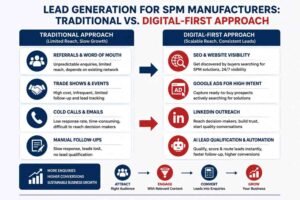
More Website Traffic Won’t Matter If Your Enquiry Process Is Weak
A manufacturer can increase website traffic without increasing qualified leads.
The conversion process needs attention too.
Make quotation requests easy
Instead of hiding the enquiry option at the bottom of the website, important pages should provide clear next steps.
Examples:
- Request a Quote
- Discuss Your Requirement
- Submit Your Application
- Request a Machine Concept
- Talk to an Automation Expert
Allow technical document uploads
For many SPM enquiries, drawings and specifications can provide valuable context.
A form can allow prospects to upload relevant technical documents where appropriate.
Use application-specific forms
A visitor enquiring about an assembly SPM may need to provide different information from someone enquiring about an inspection system.
Relevant forms can improve lead quality.
Track every meaningful conversion
Manufacturers should track more than website sessions.
Useful conversion data includes:
- Phone enquiries
- Quote requests
- Contact forms
- WhatsApp enquiries
- Document submissions
- Email enquiries
- Qualified opportunities
This makes it easier to understand which marketing activities contribute to sales.
Use AI to Qualify SPM Enquiries Before They Reach Sales
Lead volume is not the only challenge.
Sales teams also need to distinguish between serious opportunities and low-intent enquiries.
AI-based lead qualification can help collect preliminary information and categorize incoming leads.
A potential workflow could look like this:
New enquiry
↓
AI collects basic requirements
↓
Application and project details identified
↓
Lead scored
↓
High-priority enquiry sent to sales
↓
Follow-up begins
For SPM businesses, an AI qualification system could ask about:
- Industry
- Product/component
- Required operation
- Current production process
- Production volume
- Desired automation
- Expected timeline
- Technical drawings
- Project location
The objective is not to replace technical sales teams.
It is to help sales teams spend more time on enquiries that have genuine commercial potential.
Digital Marketing for SPM Manufacturers Works Best as One Connected System
A successful digital marketing for SPM manufacturers strategy should not treat every channel as an isolated activity.
Each channel can perform a different job.
| Channel | Primary role | Example outcome |
| SEO | Capture organic demand | Search visibility and inbound leads |
| Google Ads | Capture immediate demand | High-intent enquiries |
| Content | Educate and build authority | Better-informed prospects |
| Website | Convert visitors | Quote requests |
| Create outbound opportunities | Decision-maker conversations | |
| Social media | Demonstrate capabilities | Brand trust |
| AI qualification | Prioritize enquiries | Better sales efficiency |
| Follow-up automation | Reduce delays | Faster response |
The strongest system connects these activities.
A prospect might first discover an SPM manufacturer through Google, read a technical article, visit a project page, see a LinkedIn post, return through a paid advertisement, and finally submit a quotation request.
Marketing should be designed to support that journey.
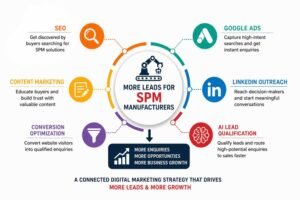
7 Practical Strategies to Generate More Leads for SPM Manufacturers
1. Build pages around high-intent searches
Identify the products, applications, industries, and commercial searches most closely connected to revenue.
Build useful pages around those opportunities instead of relying entirely on one general SPM page.
2. Create application-specific landing pages
If your company serves multiple applications, give each important application enough content to attract the right audience.
A visitor looking for automated assembly should not have to search through a generic website to discover whether you provide that solution.
3. Publish technical buyer-focused content
Answer the questions engineers and procurement teams ask before contacting a manufacturer.
Focus on real problems rather than publishing articles simply to increase word count.
4. Use Google Ads for immediate commercial opportunities
Target high-intent searches and send visitors to relevant landing pages.
Measure enquiries and qualified leads instead of optimizing campaigns only around clicks.
5. Use LinkedIn to reach decision-makers
Build targeted lists of companies and relevant decision-makers.
Use useful project examples, technical insights, and application-specific messages to begin conversations.
6. Turn every successful project into multiple marketing assets
A single project can provide enough original material for a case study, webpage, article, video, LinkedIn campaign, and sales asset.
7. Add AI-based lead qualification and follow-up
Use AI to collect initial information, classify leads, and trigger faster follow-up.
This can help prevent valuable enquiries from being overlooked.
Yes. That section feels too much like a generic agency roadmap. I’d replace it with something more SPM-specific and lead-focused, so it adds new information rather than repeating the earlier strategy sections.
Replace it with:
Turn One SPM Project Into Multiple Lead Opportunities
An SPM manufacturer does not need to create every marketing asset from scratch. Existing engineering projects can become a continuous source of content, search visibility, and sales opportunities.
A single completed project can reveal the exact type of problem, application, industry, and machine requirement that other potential customers may also have.
Start With the Customer’s Production Challenge
Instead of presenting only the machine specifications, document the problem the project solved.
For example:
- What production process needed improvement?
- Which operation was being performed manually?
- Was cycle time a concern?
- Was consistency or quality an issue?
- Was the customer handling high production volumes?
- Why was a customized machine required?
These details can become the foundation for search-focused content.
Create a Dedicated Project or Case Study Page
Turn the project into a detailed page covering:
- Customer industry
- Production challenge
- Automation requirement
- SPM solution
- Key machine functions
- Integration details
- Production improvements
- Images or videos where permitted
This gives potential buyers something more useful than a general statement about manufacturing capabilities.
Repurpose the Project Across Marketing Channels
One project can support multiple lead-generation activities.
For example:
Completed SPM project
→ Detailed case study
→ Application-focused website page
→ SEO article
→ LinkedIn post
→ Machine demonstration video
→ Sales presentation
→ Google Ads landing-page asset
This approach creates consistency across marketing channels while reducing the need to constantly produce completely new topics.
Build More Content Around Successful Applications
If a manufacturer repeatedly receives projects for a particular application, that is a strong signal for future marketing.
For example, several successful assembly automation projects could lead to dedicated content around:
- Automated assembly solutions
- Assembly SPM applications
- Custom assembly automation
- Production automation for component assembly
- How automated assembly improves production efficiency
The objective is to make proven engineering expertise easier for potential buyers to discover.
Use Sales Data to Decide What to Promote
Marketing should also learn from the sales team.
If certain applications consistently produce:
- More enquiries
- Larger projects
- Faster conversions
- Better margins
- Repeat business
Those areas deserve greater visibility through SEO, paid campaigns, case studies, and targeted outreach.
This creates a continuous cycle:
Successful project → Marketing content → Search visibility → New enquiry → Sales data → Better targeting → More relevant opportunities
For SPM manufacturers, this can be more valuable than following a fixed content calendar that is disconnected from actual business opportunities.
How to Measure Whether Digital Marketing Is Actually Generating SPM Leads
Rankings and traffic can be useful indicators, but they should not be the final measures of success.
For a machinery manufacturer, commercial metrics matter more.
| Metric | Why it matters |
| Qualified enquiries | Shows lead quality |
| Quote requests | Indicates strong commercial intent |
| Organic leads | Measures SEO contribution |
| Cost per qualified lead | Measures paid marketing efficiency |
| Landing-page conversion rate | Measures website performance |
| Lead-to-opportunity rate | Connects marketing with sales |
| Search visibility | Shows demand capture |
| Sales response time | Influences opportunity handling |
A marketing campaign that produces 1,000 visitors but no serious enquiries is less valuable than a campaign that produces a smaller number of highly relevant prospects.
FAQ’s :
How can SEO help SPM manufacturers generate more leads?
SEO can help an SPM manufacturer appear when potential customers search for relevant machines, automation solutions, applications, suppliers, and manufacturing capabilities. The strategy becomes more effective when high-intent search traffic is directed to pages designed to generate enquiries.
Which keywords should SPM manufacturers target for SEO?
Manufacturers should consider product, application, problem-based, location, supplier, and commercial keywords. Instead of focusing only on “SPM machine manufacturer,” the strategy should identify searches connected to the company’s actual machines, applications, industries, and services.
Is SEO better than Google Ads for SPM manufacturers?
Neither channel is universally better. SEO can build organic visibility over time, while Google Ads can provide immediate visibility for selected high-intent searches. Using both can allow manufacturers to capture current demand while developing long-term organic traffic.
How long does SEO take to generate leads for an SPM manufacturer?
There is no fixed timeline because results depend on competition, website authority, technical condition, content quality, target geography, and search demand. A new SEO campaign should be evaluated through visibility, relevant traffic, enquiries, and qualified opportunities rather than expecting an immediate ranking change.
How can an SPM manufacturer get more enquiries from its website?
Improve the relevance and clarity of landing pages, show actual machine capabilities, add project evidence, provide useful technical information, use clear enquiry CTAs, simplify forms, enable document submissions where appropriate, and track every meaningful conversion.
How much should an SPM manufacturer spend on digital marketing?
There is no universal budget. The appropriate investment depends on the target market, geographic coverage, competition, average project value, sales cycle, existing website performance, and selected channels. The budget should be connected to realistic lead and sales objectives.
Should SPM manufacturers use LinkedIn for lead generation?
Yes, LinkedIn can be useful for reaching manufacturing and engineering decision-makers. Its strongest role is often targeted B2B prospecting rather than broad consumer-style promotion. Campaigns should focus on relevant industries, companies, roles, applications, and production challenges.
What should an SPM manufacturer look for in a digital marketing agency?
A suitable agency should understand B2B lead generation, industrial search behaviour, technical products, long sales cycles, conversion tracking, paid search, SEO, content strategy, and lead qualification. The focus should be on generating qualified business opportunities rather than reporting website traffic alone.
Choosing the Right Digital Marketing Agency for SPM Manufacturers
Choosing a marketing partner requires more than checking whether an agency offers SEO, PPC, social media, or content marketing.
An SPM manufacturer should look for a team capable of understanding the connection between marketing and its sales process.
A suitable strategy should consider:
- How buyers search for automation solutions
- Which applications create the most revenue
- Which industries are the priority
- Which geographic markets should be targeted
- Which searches indicate immediate purchase intent
- How website visitors become enquiries
- How leads are qualified
- How marketing data reaches the sales team
A specialized digital marketing agency for SPM manufacturers should therefore focus on the complete path from search visibility to qualified opportunity.
The goal is not simply to make an SPM company more visible online.
The goal is to make it visible to the right industrial buyers at the right stage of their decision-making process.
Turn Search Visibility Into SPM Enquiries
Special Purpose Machine manufacturers already possess the technical expertise needed to solve complex production challenges. The marketing challenge is making those capabilities visible to companies actively looking for solutions.
SEO for SPM manufacturers can capture organic demand around machines, applications, production problems, and commercial searches. Paid search can capture immediate high-intent opportunities, while LinkedIn can help manufacturers reach decision-makers directly. Strong technical content and project case studies can build trust, and a conversion-focused website can turn interest into quotation requests.
The next step is connecting those enquiries with effective qualification and follow-up.
A well-planned approach to SEO services for SPM manufacturers, Digital marketing for SPM manufacturers, and Lead generation for SPM manufacturers can create a more predictable path from online discovery to sales opportunity.
For manufacturers looking to build that system with the right strategy, technology, and lead-generation approach, Visit Us and explore how Adsthrive can support your digital growth.