Industrial automation companies rarely sell through a quick online purchase. A potential customer may need a PLC system, SCADA integration, robotic automation, control panel, machine vision solution, or a complete production-line automation project. Before contacting a supplier, the buyer may compare technologies, review capabilities, check applications, discuss requirements internally, and then approach a shortlist of companies.
That makes lead generation for industrial automation companies different from lead generation for consumer businesses.
The challenge is not simply getting more website visitors. It is getting the right engineers, plant managers, operations teams, procurement professionals, OEMs, and industrial decision-makers to discover the company, understand its capabilities, and take the next step.
A stronger B2B lead-generation system combines search visibility, technical content, paid advertising, LinkedIn outreach, account targeting, lead nurturing, and AI-assisted qualification. The goal is to create more relevant enquiries without depending entirely on referrals, exhibitions, or existing industry contacts.
For industrial automation companies, Adsthrive can bring these channels together into a focused digital marketing and lead-generation strategy built around the company’s products, applications, industries, and target buyers.
Why Does Lead Generation Matter for Industrial Automation Companies?
Industrial automation businesses often have strong technical expertise but struggle to communicate that expertise online.
A website may list PLCs, HMIs, VFDs, robotics, SCADA systems, control panels, sensors, or automation services. But simply listing products does not necessarily answer the questions a prospective buyer has.
A buyer may want to know:
- Can you handle automation projects for my industry?
- Do you work with the equipment already installed at my facility?
- Can you integrate different systems?
- Do you provide installation and commissioning?
- Can you support the system after implementation?
- Have you worked on similar applications?
- Can you meet our technical and commercial requirements?
- How can I request a quotation or discuss my project?
If the website does not answer these questions, the visitor has little reason to enquire.
This is where digital marketing for industrial automation companies becomes more than visibility. The website, content, search campaigns, LinkedIn activity, and follow-up process should work together to move a potential buyer from discovery → evaluation → enquiry → sales conversation.
What Makes B2B Lead Generation Difficult in Industrial Automation?
Long and technical buying cycles
Automation projects can involve technical evaluation, budgeting, multiple approvals, site requirements, integration planning, and procurement. A visitor who discovers a company today may not be ready to submit an enquiry immediately.
Marketing therefore needs to support buyers at different stages instead of expecting every visitor to convert on the first visit.
Multiple decision-makers
The person researching an automation solution may not be the person approving the purchase.
A typical buying group can include:
- Plant managers
- Production managers
- Engineering managers
- Maintenance teams
- Automation engineers
- Operations heads
- Procurement teams
- Project managers
- OEMs
- Systems integrators
Each person may look for different information.
Technical products need technical communication
An automation buyer does not necessarily want a broad marketing language. They need clear information about applications, compatibility, specifications, processes, integration, industries served, and project capabilities.
That means generic content is unlikely to be enough.
Different industries have different requirements
An automation company may serve automotive, pharmaceuticals, food processing, packaging, chemicals, textiles, electronics, or other manufacturing sectors.
The same automation solution can solve very different problems across these industries.
Marketing should therefore connect the company’s capabilities with the specific industries and applications it serves.
B2B Lead Generation Strategies for Industrial Automation Companies
1. Build Search Visibility Around Industrial Buying Intent
SEO for industrial automation companies should begin with what potential customers actually search for.
Instead of creating one broad page around “industrial automation,” build search visibility around products, services, applications, industries, problems, and commercial requirements.
For example, an automation company could create relevant pages around:
- PLC automation services
- SCADA system integration
- industrial robotics solutions
- control panel automation
- machine vision systems
- factory automation solutions
- conveyor automation
- industrial IoT solutions
- automation solutions for packaging
- automation solutions for pharmaceutical manufacturing
The exact topics should come from the company’s actual services and target markets.
Why this matters
A buyer searching for a specific automation solution is giving Google a much clearer indication of their requirement than someone searching for a broad industry term.
The objective is not to attract every possible visitor. It is to become visible when a relevant buyer searches for something the company can actually deliver.
What an SEO strategy should include
A focused SEO program can cover:
- Product and service pages
- Application pages
- Industry-specific pages
- Technical blogs
- Comparison and educational content
- Location pages where relevant
- Technical SEO
- Internal site structure
- Conversion-focused landing pages
Good SEO services for industrial automation companies should connect keyword research with the actual sales process rather than treating rankings as the final objective.
2. Turn Technical Expertise Into Lead-Generating Content
Industrial automation companies already have a valuable content source: their technical knowledge.
Engineers and sales teams answer questions every day. Those questions can become useful content.
Consider topics such as:
- How does a PLC-based automation system work?
- What should manufacturers consider before upgrading a control system?
- When should a factory consider robotic automation?
- What is the difference between PLC and DCS control?
- How does SCADA help production monitoring?
- What factors affect automation project costs?
- How can legacy machinery be integrated with newer control systems?
- What should a company evaluate before selecting an automation integrator?
The purpose is not to publish articles simply to increase the number of pages on the website.
The purpose is to answer questions that potential buyers are already asking.
Why it matters
Technical content can help a company appear during the research stage, before the buyer has selected a supplier.
It also gives sales teams useful material to share during conversations.
For example, if a prospect asks about integrating an existing machine with a new automation system, a useful technical article can provide context before the sales discussion.
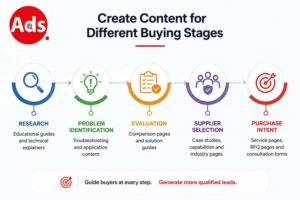
Create content for different buying stages
| Buyer stage | Useful content |
| Research | Educational guides and technical explainers |
| Problem identification | Troubleshooting and application content |
| Evaluation | Comparison pages and solution guides |
| Supplier selection | Case studies, capabilities and industry pages |
| Purchase intent | Service pages, RFQ pages and consultation forms |
This approach makes content part of the lead-generation process rather than a separate blogging activity.
3. Use Google Ads to Capture High-Intent Searches
SEO can take time to build visibility. Paid search can provide another route to buyers who are already searching for an automation product or service.
Google Ads can be particularly useful when the campaign is built around specific commercial intent.
Instead of sending every visitor to the homepage, create campaigns around individual product groups, services, industries, or applications.
For example:
Campaign: PLC Automation Services
Landing page: PLC Automation Services
CTA: Discuss Your Automation Requirement
Another campaign might focus on:
Campaign: SCADA Integration
Landing page: SCADA Integration Services
CTA: Request a Project Consultation
Why landing pages matter
A paid advertisement may generate the click, but the landing page has to answer the buyer’s next questions.
A strong industrial landing page should make it easy to understand:
- What the company provides
- Which industries it serves
- What applications it handles
- What technical capabilities it has
- What makes its solution relevant
- What action the visitor should take
Paid campaigns also provide useful data
Search advertising can reveal which products, applications, locations, and search themes attract commercial interest.
That information can then influence SEO and content planning.
For digital marketing for industrial automation companies, paid search and SEO should not operate as completely separate activities. Search data from one channel can help improve the other.
4. Reach Industrial Decision-Makers Through LinkedIn
Industrial buyers are not only searching on Google. They also use professional networks to research companies, technologies, suppliers, and industry developments.
LinkedIn can help automation companies reach specific professional audiences instead of waiting for them to discover the company.
A LinkedIn strategy can focus on:
- Plant managers
- Engineering heads
- Operations managers
- Procurement professionals
- Manufacturing directors
- Automation engineers
- OEM decision-makers
- Project managers
What should an automation company post?
Avoid turning the company page into a product catalogue.
Useful topics include:
- Automation project insights
- Before-and-after process improvements
- Technical demonstrations
- Common automation problems
- Industry applications
- New technologies
- Project lessons
- Engineering explanations
- Short videos of equipment or processes
- Customer questions answered by technical experts
LinkedIn outreach should be targeted
Sending the same sales message to hundreds of unrelated people is unlikely to create meaningful conversations.
Instead, identify accounts and roles that match the company’s ideal customer profile.
A relevant outreach message can begin with an industry problem or business requirement rather than immediately pushing a product.
This makes LinkedIn a useful part of a wider lead generation for industrial automation companies strategy.
5. Focus on the Accounts That Matter Most
Not every industrial company is an equally valuable prospect.
An automation provider may have specific industries, company sizes, locations, production processes, or project types where its solutions are strongest.
This creates an opportunity for account-based marketing.
How ABM can work for automation companies
First, identify a group of target accounts.
Then research:
- Their industry
- Manufacturing processes
- Locations
- Existing technologies
- Expansion activity
- Relevant decision-makers
- Potential automation requirements
Marketing can then create content, advertising, LinkedIn activity, and outreach around those accounts.
Why this approach works
Instead of asking, “How can we get more leads?”
The question becomes:
“Which companies do we actually want as customers, and how can we get in front of the people responsible for those projects?”
This can make marketing more focused and improve coordination between sales and marketing.
For high-value automation projects, a smaller number of relevant accounts can be more useful than a large database of poorly matched contacts.
6. Build a Follow-Up System for Buyers Who Are Not Ready Yet
A lead does not become useless simply because they did not request a quotation immediately.
Industrial buying decisions can take time.
Someone may download a technical document, contact the company about a project, attend a webinar, interact with LinkedIn content, or visit several product pages without being ready to speak with sales.
This is where lead nurturing becomes important.
A simple nurturing process
A potential buyer could move through:
First interaction → Technical information → Relevant solution content → Case study/application → Sales conversation
The communication should match the buyer’s interest.
For example, someone interested in robotic automation should receive information related to robotic applications rather than unrelated automation products.
Marketing automation can help
Automation tools can organize contacts based on:
- Source
- Industry
- Product interest
- Location
- Enquiry type
- Engagement
- Sales status
This gives the sales team better context when following up.
The goal is not to send more emails.
The goal is to make follow-up more relevant.
7. Use AI to Qualify and Prioritize Leads
Generating enquiries is only one part of the problem.
Industrial automation companies can also receive enquiries that are incomplete, outside their service area, too small, unrelated to their capabilities, or still at an early research stage.
AI-assisted lead qualification can help organize these enquiries before sales teams spend significant time on them.
What AI can help identify
Depending on the available data and workflow, an AI system can help categorize leads based on:
- Company and industry
- Product or service requested
- Project requirement
- Location
- Estimated project stage
- Enquiry type
- Buyer role
- Urgency
- Previous interactions
A lead can then be routed according to priority.
For example:
High priority: Clear project requirement + relevant industry + decision-maker + immediate requirement
Medium priority: Relevant company + identified requirement + project still under evaluation
Low priority: General enquiry + unclear requirement + no immediate project
AI does not replace the sales team. It helps the team spend more time on enquiries that deserve human attention.
This is one area where digital marketing for industrial automation companies can move beyond traffic generation and become part of the sales workflow.
What Search Opportunities Are Industrial Automation Companies Missing?
Many companies focus only on their main product keywords.
That can leave a large range of relevant searches uncovered.
A keyword strategy should look at different types of buyer searches.
| Search type | Example search | Opportunity |
| Service | industrial automation services | Core service visibility |
| Product | PLC automation system | Product demand |
| Application | factory conveyor automation | Application-based leads |
| Industry | automation for pharmaceutical manufacturing | Industry-specific demand |
| Problem | machine automation upgrade | Problem-led searches |
| Commercial | industrial automation company | Supplier discovery |
| Location | industrial automation company in India | Geographic demand |
| Agency | SEO for industrial automation companies | Marketing-service demand |
For Adsthrive’s commercial positioning, the website can also target searches such as:
- SEO for industrial automation companies
- SEO services for industrial automation companies
- Digital marketing for industrial automation companies
- Lead generation for industrial automation companies
- Digital marketing agency for industrial automation companies
The important point is to build separate content around genuine search intent rather than placing every keyword on one page.
How Can Industrial Automation Companies Turn Website Traffic Into Enquiries?
Getting visitors to a website is not enough.
The website should make the next step obvious.
A prospective buyer should quickly understand:
- What the company does
- What products or services it provides
- Which industries it serves
- What applications it handles
- What technical capabilities it has
- Why the visitor should consider the company
- How to contact the team
Use clear conversion paths
Depending on the business, useful calls to action can include:
- Request a Quote
- Discuss Your Project
- Request Technical Consultation
- Send Your Requirement
- Talk to an Automation Expert
- Request Product Information
The form should also collect useful information without becoming unnecessarily long.
For an automation business, relevant fields could include:
- Company name
- Industry
- Requirement
- Product/service interest
- Location
- Project details
- Contact information
This gives the sales team more context before making contact.
How Should SEO, Paid Ads, LinkedIn and AI Work Together?
The strongest approach is not to treat every marketing channel as an independent campaign.
Each channel can perform a different job.
SEO captures ongoing search demand.
Google Ads provides faster visibility for selected high-intent searches.
LinkedIn helps identify and reach specific decision-makers.
Technical content answers questions and supports evaluation.
Lead nurturing keeps relevant prospects engaged during longer buying cycles.
AI qualification helps organize and prioritize incoming opportunities.
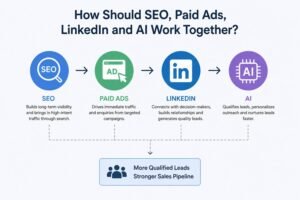
The overall process can look like this:
Search / LinkedIn / Ads → Website → Technical Content → Enquiry → Lead Qualification → Sales Follow-Up → Opportunity
Adsthrive can help industrial automation companies design this system around their actual products, target industries, locations, and commercial goals rather than applying the same marketing plan used for consumer businesses.
How Should Industrial Automation Companies Measure Lead Generation?
Traffic and keyword rankings are useful, but they should not be the only measurements.
A B2B automation company should connect marketing activity to actual enquiries and sales opportunities.
Important metrics include:
Search visibility
- Relevant keyword rankings
- Search impressions
- Organic clicks
- Organic landing pages
Lead generation
- Number of enquiries
- Qualified enquiries
- RFQs
- Consultation requests
- Lead source
Sales performance
- Leads converted into opportunities
- Opportunities converted into customers
- Sales pipeline generated
- Average deal value
- Lead-to-opportunity rate
Paid advertising
- Cost per lead
- Cost per qualified lead
- Conversion rate
- Search terms generating enquiries
- Relevant decision-maker engagement
- Target-account interactions
- Qualified conversations
- Meetings generated
The most useful question is not:
“How much traffic did marketing generate?”
It is:
“How many relevant business opportunities did marketing create?”
Key Takeaways
- Industrial automation lead generation requires a strategy built around technical B2B buying behaviour.
- SEO should target products, services, applications, industries, problems, and commercial searches.
- Technical content can help companies reach buyers during the research stage.
- Google Ads can capture high-intent searches while SEO builds longer-term visibility.
- LinkedIn can help companies reach specific industrial decision-makers and target accounts.
- Account-based marketing can focus resources on companies that fit the ideal customer profile.
- Lead nurturing is important because automation purchases often require multiple conversations and approvals.
- AI can help organize, qualify, and prioritize incoming enquiries.
- Website conversion paths should make it easy for qualified visitors to request information or discuss a project.
- Marketing performance should ultimately be measured through qualified leads, opportunities, and pipeline – not traffic alone.
Frequently Asked Questions
What is the best way to generate B2B leads for industrial automation companies?
There is no single channel that works for every automation company. A combination of SEO, technical content, Google Ads, LinkedIn, targeted account marketing, lead nurturing, and AI-assisted qualification can create a stronger and more consistent lead-generation system.
How does SEO help industrial automation companies generate leads?
SEO helps an automation company appear when potential customers search for relevant products, services, applications, industries, and technical solutions. The strategy should focus on high-relevance searches rather than simply maximizing website traffic.
Should industrial automation companies invest in Google Ads?
Google Ads can be useful when the company has identifiable high-intent searches and suitable landing pages. Campaigns should be structured around specific products, services, applications, and target markets rather than sending all paid traffic to the homepage.
How can LinkedIn generate leads for industrial automation companies?
LinkedIn can help companies identify and communicate with professionals such as plant managers, engineering heads, operations managers, procurement teams, and other decision-makers. The strongest approach combines targeted prospecting with useful technical and industry content.
What type of content should industrial automation companies publish?
Useful content can include technical explainers, application guides, troubleshooting articles, product comparisons, industry-specific solutions, project insights, case studies, and answers to questions commonly asked by engineers and procurement teams.
How does AI help with industrial automation lead generation?
AI can assist with lead classification, prospect research, enquiry prioritization, data organization, and follow-up workflows. It can help sales teams identify which enquiries require immediate attention while allowing lower-priority prospects to enter appropriate nurturing processes.
How long does it take to generate leads through SEO?
The timeframe depends on the website’s existing authority, technical condition, competition, target market, content quality, and search intent. SEO should be treated as a continuing acquisition channel rather than a short campaign with a guaranteed lead volume.
Why should an industrial automation company work with a specialized digital marketing agency?
Industrial automation requires marketing that understands technical products, long buying cycles, multiple decision-makers, and industry-specific search behaviour. A digital marketing agency for industrial automation companies should be able to connect technical SEO, content, paid campaigns, LinkedIn outreach, conversion optimization, and lead qualification instead of treating each activity separately.
Build a More Consistent B2B Lead Pipeline With Adsthrive
Industrial automation companies already have the technical expertise needed to solve complex manufacturing problems. The marketing challenge is making that expertise visible to the right buyers and creating a clear path from discovery to enquiry.
That requires more than publishing a few blogs or running occasional advertisements.
A structured strategy can connect SEO, technical content, Google Ads, LinkedIn outreach, account targeting, lead nurturing, and AI-assisted qualification into one B2B acquisition system.
Adsthrive can help industrial automation companies build that system around their specific products, target industries, buyer profiles, and growth objectives.
The objective is straightforward: put the company in front of relevant industrial buyers, give them the information they need to evaluate the solution, and create a measurable path toward a qualified business conversation.
Turn your industrial expertise into a stronger lead pipeline with Adsthrive. From SEO and Google Ads to LinkedIn outreach and AI-powered lead qualification, we help industrial automation companies attract and convert the right B2B buyers.
Ready to generate more qualified leads? Talk to Adsthrive today.