Industrial component manufacturers often have the capabilities buyers are actively looking for—CNC machining, forging, casting, fabrication, precision components, surface finishing, heat treatment or complete assemblies—but those capabilities are not always easy to discover online.
An engineer may search for a CNC machined component supplier, a procurement manager may look for a custom industrial component manufacturer, while an OEM may search by material, tolerance, application, standard or production process. If your website does not have a page that directly answers that requirement, the enquiry can go to another supplier.
This is where SEO for industrial component manufacturers becomes commercially important. The objective is not simply to increase website traffic. It is to make your products, manufacturing capabilities and technical expertise visible when engineers, procurement teams, OEMs and distributors are actively evaluating suppliers.
A strong strategy combines SEO with technical content, Google Ads, LinkedIn outreach, lead-generation campaigns and AI-powered lead qualification so that visibility can turn into relevant RFQs and sales opportunities.
Why Industrial Component Manufacturers Lose Enquiries Online
Many industrial manufacturing websites still function more like digital brochures than sales channels.
They may have:
- A homepage
- An About Us page
- One general Products page
- A list of manufacturing processes
- A PDF catalogue
- A generic Contact Us form
That may be enough when an existing customer already knows the company.
But a new buyer rarely starts with a company name.
They start with a requirement.
An engineer might search:
“precision CNC components manufacturer”
A procurement team might search:
“custom stainless steel components supplier India”
An OEM sourcing team might search:
“automotive forged component manufacturer”
Another buyer may search by a standard, material, tolerance, component type or application.
If your website has only one broad Products page, it becomes difficult for search engines—and buyers—to understand exactly what you manufacture.
Three common problems create lost opportunities
- Technical information is hidden inside PDFs
Your catalogue may contain excellent information, but buyers still need to download and open a document before understanding your capabilities.
- Too many products are placed on one page
A single page called “Industrial Components” cannot effectively target every product, material, manufacturing process and application.
- The next step is unclear
Even when a buyer finds the right page, they may not know whether they can upload a drawing, request a quotation, ask about MOQ or speak directly with an engineer.
The solution is not simply “more content.”
It is a website structure designed around how industrial buyers actually search.
What Is SEO for Industrial Component Manufacturers?
SEO for industrial component manufacturers is the process of structuring a manufacturing website so buyers can discover specific products, capabilities, materials, standards and applications through search engines and AI-powered search experiences.
It differs considerably from traditional SEO.
| Area | General SEO | Industrial Component SEO |
| Search terms | Broad keywords | Product, material, standard, process and application terms |
| Audience | General consumers | Engineers, OEMs, procurement teams and distributors |
| Content | Blogs and general information | Product, capability, industry and technical pages |
| Conversion | Purchase/contact | RFQ, drawing upload, sample request |
| Trust | Reviews and popularity | Certifications, testing, capacity and technical expertise |
| Search intent | Information or purchase | Supplier evaluation and sourcing |
A search such as “industrial component manufacturer” is useful for visibility, but a search such as “precision turned steel components manufacturer” can reveal a much stronger commercial requirement.
That is why SEO services for industrial component manufacturers should be built around commercial search intent rather than simply chasing high-volume keywords.
What Are Industrial Buyers Actually Searching For?
One of the biggest opportunities is understanding the different ways buyers describe the same requirement.
A manufacturer may call something a “precision-machined component.”
The buyer may search:
- CNC machined parts supplier
- precision turned components manufacturer
- custom metal components
- OEM component supplier
- stainless steel machined parts
- small-batch precision components
- automotive component manufacturer
The manufacturing company and the buyer may be talking about the same capability using completely different terminology.
Search opportunities industrial component manufacturers may be missing
| Search Type | Example Search | Buyer Intent | Useful Website Asset |
| Product | Precision machined components manufacturer | Supplier search | Product-family page |
| Material | Stainless steel components supplier | Material requirement | Material page |
| Process | CNC turned components manufacturer | Capability search | Process page |
| Application | Components for automotive applications | Industry sourcing | Industry page |
| Standard | ISO standard components manufacturer | Technical sourcing | Standards/specification page |
| Custom | Custom industrial components manufacturer | Needs a manufacturer | Custom manufacturing page |
| Tolerance | High precision components manufacturer | Technical requirement | Precision capability page |
| Volume | High-volume component manufacturing | Production requirement | Capacity page |
| Geography | Industrial component manufacturer in India | Regional sourcing | Location/export page |
| Combination | CNC machined aluminium automotive components | Strong commercial intent | Focused landing page |
These are not necessarily high-volume searches.
But they can be valuable because the person searching already has a manufacturing requirement.
Build the Website Around Products and Capabilities
The first step in digital marketing for industrial component manufacturers is creating a website structure that reflects what the company actually manufactures.
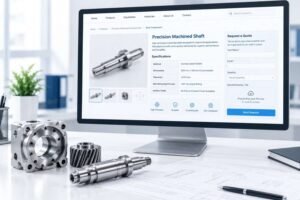
Instead of putting everything under:
Products → Industrial Components
break the catalogue into logical product families.
For example:
Product categories
- Precision machined components
- CNC turned components
- CNC milled components
- Forged components
- Cast components
- Sheet metal components
- Fabricated components
- Industrial fasteners
- Shafts and pins
- Bushes and sleeves
- Gears and precision parts
- Custom assemblies
Then create dedicated capability pages for:
- CNC machining
- CNC turning
- CNC milling
- Forging
- Casting
- Heat treatment
- Surface finishing
- Grinding
- Assembly
- Inspection and testing
Each page should answer the buyer’s most important questions.
What should a capability page contain?
- What process you offer
- Materials supported
- Component sizes
- Tolerance capability
- Machine capacity
- Production volume
- Inspection facilities
- Applicable industries
- Certifications
- Typical components
- Images
- Technical documentation
- RFQ option
This gives search engines a clearer understanding of your manufacturing expertise while giving buyers enough information to decide whether to contact you.
Turn Your Factory Knowledge Into Searchable Content
Industrial manufacturers already possess an enormous amount of content.
It is sitting inside:
- Engineering drawings
- Product catalogues
- Quality manuals
- Machine specifications
- Inspection reports
- Material specifications
- Certifications
- Production documentation
- Customer questions
- Sales conversations
- RFQs
- Technical presentations
The problem is that much of this information never becomes searchable website content.
For example, your sales team may regularly answer:
Can you manufacture this component in EN8?
What tolerance can you achieve?
Can you handle 50,000 pieces per month?
Do you provide heat treatment?
Can you manufacture according to customer drawings?
Can you support PPAP?
These are not just sales questions.
They can become SEO content opportunities.
A technical FAQ, capability page or application article can answer the question before the buyer ever contacts sales.
Put Technical Specifications in HTML
PDF catalogues are still useful.
But important information should not exist only inside PDFs.
A product page should provide the core information directly in HTML.
For example:
| Specification | Example |
| Manufacturing process | CNC turning |
| Materials | Carbon steel, stainless steel, aluminium |
| Component diameter | Up to specified machine capacity |
| Tolerance | According to drawing requirement |
| Surface finish | As required |
| Heat treatment | Available |
| Inspection | Dimensional and material inspection |
| Production volume | Prototype to mass production |
| Industries | Automotive, engineering, industrial equipment |
Then provide the detailed catalogue or technical datasheet as a downloadable PDF.
This creates a better experience for both search engines and buyers.
Target Product + Material + Application Searches
One of the biggest mistakes manufacturers make is targeting only broad phrases such as:
Industrial Component Manufacturer
That keyword describes the company, but it does not necessarily describe what a buyer needs.
A better keyword strategy combines different attributes.
Product
- CNC machined components
- precision turned parts
- forged components
- industrial shafts
- custom metal components
Material
- stainless steel components
- aluminium components
- alloy steel components
- brass components
- carbon steel components
Application
- automotive components
- construction equipment components
- industrial machinery components
- hydraulic components
- agricultural machinery components
Buyer qualifier
- manufacturer
- supplier
- OEM supplier
- custom manufacturer
- bulk supplier
- exporter
You can then combine them naturally:
Precision stainless steel components manufacturer
Custom CNC components for automotive applications
Industrial machinery component supplier
This is where lead generation for industrial component manufacturers becomes closely connected to SEO.
The objective is to identify searches where the buyer is close to evaluating a supplier.
Create Industry-Specific Pages
Different industries have different component requirements.
An automotive buyer may care about:
- Repeatability
- PPAP
- Traceability
- High-volume production
- Tight tolerances
- Quality systems
An industrial machinery buyer may care more about:
- Component durability
- Material selection
- Machining capability
- Customisation
- Production capacity
An energy-sector buyer may have different requirements around:
- Material certification
- Testing
- Traceability
- Standards
- Reliability
Instead of creating one generic page saying:
“We serve multiple industries.”
Create focused pages such as:
Industrial Components for Automotive Manufacturers
Explain:
- Components supplied
- Manufacturing processes
- Materials
- Quality systems
- Production capacity
- Inspection
- Relevant certifications
- Applications
The same approach can be used for:
- Industrial machinery
- Construction equipment
- Agriculture
- Energy
- Railways
- Defence
- Aerospace, where applicable
- Pumps and valves
- Hydraulics
- Electrical equipment
This creates additional opportunities for SEO services for industrial component manufacturers to target industry-specific search intent.
Make the RFQ Process Easy
Getting a buyer to your website is only half the job.
The next question is:
Can they easily contact you?
A strong industrial component page should have a clear RFQ path.
Include:
- Request a Quote button
- Drawing upload
- CAD file upload where appropriate
- BOM upload
- Quantity field
- Material requirement
- Target delivery location
- Company name
- Phone number
- Message/specification field
Don’t force a procurement manager to fill out a 15-field form just to ask whether you manufacture a component.
A simple first step can collect the basic requirement and allow your sales team to obtain the remaining technical information later.
The buyer should immediately understand:
Can you manufacture it?
Can you meet the specification?
Can you produce the required quantity?
Can you supply their location?
How do they request a quotation?
Show Proof of Manufacturing Capability
Industrial buyers are not simply buying a product.
They are taking a supplier risk.
That makes proof extremely important.
Your website should clearly communicate:
Certifications
- ISO certifications
- IATF, where applicable
- Industry-specific certifications
- Customer approvals
- Product approvals
Quality
- Inspection equipment
- CMM capability
- Testing facilities
- Material testing
- First article inspection
- PPAP support, where applicable
Manufacturing
- Machine count
- Production capacity
- Facility size
- Process capabilities
- Automation
- In-house operations
Experience
- Industries served
- Component types
- Export markets
- Case studies
- Customer applications
A manufacturer claiming “high-quality components” provides little useful information.
A manufacturer explaining its inspection equipment, tolerances, materials, processes and certifications provides evidence.
That evidence also gives search engines and AI systems more concrete information about the company.
Use Technical Content to Capture Earlier Searches
Not every buyer searches for a supplier immediately.
Some start with a technical question.
For example:
What material is best for high-strength industrial shafts?
What is the difference between CNC turning and CNC milling?
How does heat treatment affect component hardness?
What tolerance can precision CNC machining achieve?
How should manufacturers specify a custom machined component?
These searches create an earlier opportunity to introduce your expertise.
A technical content strategy can include:
- Manufacturing explainers
- Material guides
- Process comparisons
- Tolerance guides
- Industry application articles
- Standards explanations
- Component selection guides
- Manufacturing FAQs
The important part is that the content should lead naturally toward a relevant capability.
A guide about CNC machining, for example, can link to the manufacturer’s CNC machining capability page rather than ending with generic information.
Google Ads Can Capture Buyers Before SEO Builds Momentum
SEO is a long-term acquisition channel.
A new product page may take time to gain organic visibility.
Google Ads can provide immediate visibility for high-intent searches.
For example:
- Custom industrial component manufacturer
- CNC component supplier India
- Precision machined component manufacturer
- Forged industrial components supplier
- OEM component manufacturer
- Custom metal component supplier
But broad keywords should not automatically receive the highest budget.
The campaign should be evaluated based on:
Search → Landing Page → Enquiry → Qualified RFQ
not simply:
Click → Website visit
Google Ads can also help SEO
Suppose you test 20 commercial searches through Google Ads.
Three search groups generate qualified RFQs consistently.
Those searches become strong candidates for:
- Dedicated SEO pages
- Technical content
- Industry pages
- New landing pages
This allows paid search data to inform the organic strategy.
LinkedIn Can Reach Buyers Before They Search
Not every opportunity begins on Google.
Industrial component manufacturers can also identify companies that are likely to need their capabilities.
For example, you may target:
- OEMs
- Procurement managers
- Strategic sourcing managers
- Engineering managers
- Plant managers
- Product development teams
- Manufacturing engineers
- Distributors
The approach should not simply be:
“We are a manufacturer. Please contact us.”
A better outreach message can relate to a specific capability.
For example:
“We manufacture precision CNC components for industrial equipment manufacturers and support custom drawing-based production. Would it be useful to share our capability profile?”
The buyer can then be directed to a focused capability page rather than a generic homepage.
This is where digital marketing for industrial component manufacturers becomes more effective when channels work together.
Use Lead Generation Campaigns for Specific Offers
Not every prospect is ready to send an RFQ immediately.
A lead-generation campaign can offer something useful that starts the conversation.
Examples:
- Manufacturing capability brochure
- Product catalogue
- Material capability list
- Component sample programme
- Supplier qualification discussion
- Engineering consultation
- Custom manufacturing assessment
For example:
Need a New Industrial Component Supplier?
Share your drawing, material requirement and expected volume to check manufacturing feasibility.
The campaign can then direct prospects to a dedicated landing page.
This is much more specific than sending every advertisement to the homepage.
Social Media Should Show the Manufacturing Reality
Social media is not necessarily where an industrial buyer completes the purchase.
But it can reinforce trust.
Instead of posting generic graphics such as:
“Quality is our priority.”
Show the actual manufacturing environment.
Content can include:
- CNC machining operations
- Forging processes
- Casting
- Inspection
- CMM measurement
- Finished components
- Packaging
- Quality checks
- New machinery
- Factory expansion
- Engineering teams
- Production milestones
A procurement manager who discovers your company through Google or LinkedIn may check your social profiles before contacting you.
Real manufacturing content helps confirm that the company actually has the capabilities described on the website.
AI Lead Qualification Helps Sales Focus on Better Enquiries
SEO, Google Ads, LinkedIn and lead-generation campaigns can increase enquiries.
But more enquiries do not automatically mean more sales.
A manufacturing company may receive:
- Genuine RFQs
- Small quantities
- Out-of-range components
- Students
- Distributors
- Price enquiries
- Wrong geographies
- Requests for products you don’t manufacture
An AI qualification system can ask initial questions around:
- Product requirement
- Quantity
- Material
- Application
- Drawing availability
- Location
- Timeline
The system can then categorise the enquiry before sending it to the appropriate sales team.
For example:
High fit:
Required component + correct material + target quantity + supported region
Needs review:
Potentially suitable but missing technical information
Low fit:
Outside manufacturing capability
This allows sales teams to spend more time on enquiries that match their actual business.
Structure Your Website for AI Search
Search is no longer limited to traditional blue Google results.
Buyers increasingly use AI-powered search experiences to ask questions such as:
“Which companies manufacture custom CNC components in India?”
“Who supplies precision components for industrial machinery?”
“What manufacturers can produce small-volume custom metal components?”
For your company to be understood correctly, the website needs clear factual information.
Use:
- Descriptive headings
- Direct answers
- Product tables
- Technical specifications
- Manufacturing capabilities
- Industry pages
- Certifications
- FAQs
- Structured data
- Consistent company information
This is an important part of modern SEO for industrial component manufacturers because the goal is not only to rank a page—it is to make your company and its capabilities understandable to search systems.
What Should a Complete Digital Marketing Program Cover?
A complete strategy should not treat SEO, advertising, social media and lead generation as separate activities.
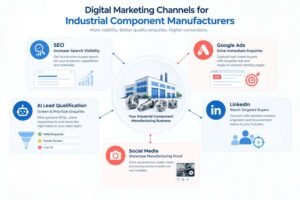
Each channel should support the same commercial objective.
| Marketing Area | Role |
| SEO | Capture ongoing product and capability searches |
| Technical Content | Answer engineering and procurement questions |
| Google Ads | Capture high-intent searches immediately |
| Reach specific companies and decision-makers | |
| Lead Generation | Create focused offers and campaigns |
| Social Media | Demonstrate manufacturing capability |
| AISEO | Improve visibility across search and AI experiences |
| AI Lead Qualification | Screen and organise incoming enquiries |
| Follow-up Automation | Keep potential opportunities moving |
| Analytics | Measure RFQs and qualified opportunities |
The important point is that these channels should lead to the same product, capability or industry pages rather than sending buyers to unrelated destinations.
What Should You Look for in SEO Services for Industrial Component Manufacturers?
Not every SEO agency understands industrial manufacturing.
Before hiring an agency, ask whether it understands:
Manufacturing terminology
Can the team discuss:
- Materials
- Standards
- Processes
- Tolerances
- Certifications
- OEM requirements
- RFQs
- Production volumes
Product architecture
Can it convert a large product catalogue into a logical SEO structure?
Search intent
Can it distinguish between:
“What is CNC machining?”
and:
“CNC machined components manufacturer India”
These searches have very different commercial intent.
Lead measurement
Does the agency report:
- Rankings?
- Traffic?
- Enquiries?
- RFQs?
- Qualified leads?
- Cost per qualified lead?
A digital marketing agency for industrial component manufacturers should connect marketing activity to actual commercial opportunities rather than stopping at traffic reports.
How Adsthrive Helps Industrial Component Manufacturers Generate Leads
Adsthrive approaches SEO for industrial component manufacturers as part of a larger lead-generation system.
Instead of treating SEO, Google Ads, LinkedIn outreach, lead generation, AI qualification and follow-ups as disconnected campaigns, the objective is to connect them around the manufacturer’s actual products, capabilities and target industries.
What this can include
| Requirement | Adsthrive Approach |
| Improve organic visibility | Product, capability and industry-focused SEO |
| Target technical searches | Keyword mapping around products, materials, standards and applications |
| Generate immediate enquiries | Google Ads for high-intent searches |
| Reach named buyers | LinkedIn outreach targeting relevant companies and decision-makers |
| Create new opportunities | Focused lead-generation campaigns |
| Improve AI visibility | AISEO and structured technical content |
| Respond faster | AI chatbot and AI calling |
| Qualify enquiries | AI-powered lead qualification |
| Improve follow-up | Automated communication and CRM workflows |
| Measure performance | RFQ and qualified-lead reporting |
The goal is simple: make the manufacturer’s capabilities easier to discover, make the website easier to evaluate, and make the enquiry process easier to manage.
How Long Does SEO Take to Generate Leads for Industrial Manufacturers?
SEO timelines vary depending on competition, website quality, domain authority, product coverage and the number of pages being developed.
A manufacturer with 20 well-structured product and capability pages has a different opportunity from a manufacturer with a single generic Products page.
Rather than measuring success only by rankings, track:
- Organic enquiries
- RFQs
- Drawing uploads
- Product-page conversions
- Qualified leads
- Enquiries by industry
- Enquiries by product
- Cost per qualified lead
This gives management a clearer picture of whether marketing is contributing to the sales pipeline.
Conclusion
Industrial component manufacturers already have the technical expertise buyers need. The challenge is making that expertise discoverable at the right moment.
A strong strategy starts with product and capability pages, technical specifications, industry-focused content and search terms based on how engineers and procurement teams actually search.
From there, digital marketing for industrial component manufacturers can combine SEO, Google Ads, LinkedIn outreach, lead-generation campaigns, social proof and AI-powered qualification to turn visibility into a more organised enquiry pipeline.
The objective is not to generate traffic for the sake of traffic.
It is to help the right buyer discover the right capability, understand whether you can meet the requirement, submit an RFQ and move into a genuine sales conversation.
That is where SEO for industrial component manufacturers becomes a lead-generation system rather than just a ranking exercise.
FAQs
What keywords should industrial component manufacturers target?
Focus on combinations of product type, manufacturing process, material, application, industry and buyer intent. Terms containing words such as manufacturer, supplier, OEM, custom, bulk and exporter can indicate commercial intent.
Does every industrial component need a separate webpage?
No. Create dedicated pages for meaningful product families, manufacturing capabilities, materials and applications. Avoid creating hundreds of thin pages that provide little additional information.
Should technical specifications be placed only in PDFs?
No. Put important specifications in crawlable HTML and provide the detailed PDF as an additional resource.
Is Google Ads useful for industrial component manufacturers?
It can be useful for high-intent searches, particularly when testing new products, markets or keyword groups. The important metric is qualified enquiries rather than clicks alone.
Can LinkedIn replace SEO?
No. LinkedIn and SEO serve different purposes. LinkedIn can help you reach specific companies and decision-makers, while SEO can capture buyers actively searching for products and suppliers.
How can manufacturers generate better-quality leads?
Start by targeting specific products, applications and industries, then qualify enquiries based on product fit, quantity, geography, technical requirements and timeline.
What is AISEO for industrial manufacturers?
AISEO focuses on making technical company information clear, structured and understandable across modern search and AI-powered discovery systems.
What should an industrial component manufacturer measure?
Measure RFQs, qualified enquiries, drawing uploads, product-page conversions, cost per qualified lead and opportunities generated—not just website traffic.
Ready to Generate More Industrial Component Leads?
Turn your manufacturing capabilities into a stronger digital sales channel with SEO, Google Ads, LinkedIn and AI-powered lead generation.
Get found by the right buyers. Generate qualified enquiries. Contact Adsthrive today.