A precast concrete manufacturer can have strong production capabilities, an extensive product range and years of project experience, yet still struggle with inconsistent enquiries.
The problem may not be a lack of demand. It may be that potential customers cannot find the right products online, the website does not convert visitors effectively, or enquiries reach sales without enough information to determine whether they are worth pursuing.
A contractor may search for a specific precast product. An engineer may look for technical specifications. A procurement team may compare manufacturers. A project manager may need a supplier in a particular location.
If your business is not visible for these searches—or makes it difficult to enquire—the opportunity can move to another manufacturer.
That is why digital marketing for precast concrete manufacturers should go beyond rankings, social media posts and website traffic. It should create a connected path from search → website → enquiry → qualification → follow-up → sales opportunity.
The Real Digital Marketing Problem for Precast Manufacturers
Precast concrete is not one product. Manufacturers can serve structural, architectural, infrastructure, transportation, utility, drainage and other applications.
This creates a wider search opportunity than simply targeting “precast concrete manufacturer.”
Potential customers may search by:
- Product
- Application
- Technical requirement
- Manufacturing capability
- Supplier
- Location
- Project type
- Custom requirement
Yet many manufacturing websites put most of this information into a homepage, product catalogue or PDF.
That creates a visibility gap.
A company may manufacture exactly what a prospect needs but fail to appear when that prospect searches for it.
There is also a lead-quality problem.
A form submission containing only a name, phone number and message gives sales very little context.
A better enquiry could contain:
“Product → Quantity → Project location → Application → Specification → Timeline”
This is where a modern digital marketing strategy becomes a sales system rather than simply a traffic-generation exercise.
The Precast Digital Lead Funnel
The traditional model is simple:
Google → Website → Contact Form → Sales
A stronger system looks like:
Search
↓
SEO / Local SEO / Google Ads
↓
Product or Application Page
↓
Mobile Website
↓
Call / Form / WhatsApp / AI Chatbot
↓
AI Lead Qualification
↓
Lead Scoring
↓
Sales Notification
↓
AI Follow-Up
↓
Qualified Sales Opportunity
Each stage has a specific purpose.
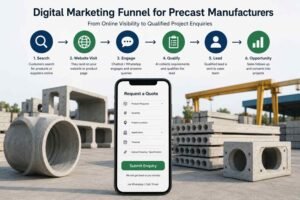
SEO helps the manufacturer get discovered. The website explains the product. Mobile optimisation removes friction. AI captures requirements. Qualification improves lead quality. Follow-up prevents interested prospects from disappearing.
SEO for Precast Concrete Manufacturers Should Follow the Product Catalogue
What should manufacturers actually rank for?
SEO for precast concrete manufacturers should be built around the company’s actual products, applications and capabilities.
Instead of focusing on one broad keyword, create search visibility across several areas.
Product searches
Depending on the manufacturer’s catalogue:
- Precast concrete pipes
- Precast manholes
- Precast culverts
- Precast wall panels
- Precast barriers
- Precast retaining walls
- Precast utility products
- Structural precast products
- Architectural precast
- Custom precast products
Manufacturing searches
These can include:
- Custom precast concrete manufacturing
- Structural precast manufacturer
- Architectural precast manufacturer
- Reinforced precast concrete manufacturer
- Custom precast components
Technical searches
Technical content can address:
- Precast concrete specifications
- Precast concrete dimensions
- Precast concrete load capacity
- Precast concrete installation
- Precast concrete design requirements
- Precast concrete tolerances
Application searches
Manufacturers can also target applications such as:
- Precast concrete for drainage
- Precast concrete for wastewater
- Precast concrete for infrastructure
- Precast concrete for transportation
- Precast concrete for commercial construction
- Precast concrete for industrial projects
The key is to build pages around real products and real applications, rather than creating generic articles simply to insert keywords.
Find the Search Gaps Hidden Inside the Industry
What searches could your precast business be missing?
A manufacturer can have strong visibility for its company name while remaining almost invisible for searches related to its products.
| Search Area | Example Search | Page Opportunity |
| Manufacturer | Precast concrete manufacturer | Manufacturer page |
| Product | Precast concrete manholes | Product page |
| Application | Precast drainage solutions | Application page |
| Technical | Precast manhole specifications | Technical resource |
| Custom | Custom precast components | Capability page |
| Location | Precast manufacturer in [city] | Location page |
| Commercial | Precast concrete supplier | Landing page |
| Project | Precast concrete for infrastructure | Application page |
This is the search gap.
The manufacturer knows its terminology.
The customer may use different words to find the same solution.
A strong SEO strategy connects the two.
Build Product Pages That Can Generate Enquiries
A product page should do more than display a product photograph.
It should help a potential customer determine whether the manufacturer can meet the requirement.
A strong product page can include:
- Product overview
- Applications
- Dimensions and specifications
- Available options
- Manufacturing capabilities
- Quality information
- Project examples
- Technical documentation
- Service areas
- FAQs
- Request-a-quote CTA
For technical buyers, useful information can make the difference between staying on the website and leaving for another supplier.
The goal is simple:
“Give the prospect enough useful information to move from product research to commercial conversation.”
Local SEO Should Reflect Where You Can Actually Supply
Why does Local SEO matter for precast manufacturers?
Precast products are physical products. Manufacturing location, transportation and project geography can influence supplier selection.
That makes Local SEO particularly useful.
A manufacturer can build visibility around:
Product + Location
Manufacturer + Location
Supplier + Location
Application + Location
For example:
- Precast concrete manufacturer in [location]
- Precast concrete supplier in [location]
- Precast manhole manufacturer in [location]
- Precast concrete products in [location]
Local SEO should include an optimised Google Business Profile, relevant local information and useful location pages.
However, location pages should not simply repeat the same content with different city names.
A useful location page can explain:
- Areas served
- Products supplied
- Manufacturing facility
- Delivery coverage
- Relevant projects
- Local industries served
The objective is to demonstrate genuine geographic relevance.
Mobile Optimisation Can Decide Whether a Search Becomes an Enquiry
Is your website easy to use from a construction site?
A potential customer may discover your business while:
- Visiting a project
- Travelling between sites
- Comparing suppliers
- Speaking with a procurement team
- Looking for a product urgently
They may be using a phone rather than a desktop.
The mobile experience should make important actions immediately visible:
Call | WhatsApp | Request Quote | Send Requirement | Download Specification | Talk to Sales
A visitor should not have to navigate through multiple pages simply to find a phone number.
A Better Mobile Enquiry Journey
Keep the journey simple:
Product Page → Request Quote → Short Form / WhatsApp → AI Qualification → Sales
Every unnecessary step creates another opportunity for the prospect to leave.
Turn the Website From a Brochure Into an Enquiry Engine
A typical manufacturing website may follow:
About → Products → Projects → Contact
This provides information but does not necessarily guide visitors toward conversion.
A lead-focused product journey should be more direct:
Google Search → Specific Product Page → Specifications & Applications → Project Examples → Request Quote → WhatsApp / AI Chat → Qualification → Sales
For example, someone searching for precast manholes should ideally land on a page specifically about that product—not simply the manufacturer’s homepage.
The more relevant the page, the shorter the journey from search to enquiry.
Google Ads Can Capture High-Intent Demand
SEO builds long-term visibility. Google Ads can help capture relevant searches immediately.
But paid search should also follow the product structure.
For example:
Search: “precast manhole supplier”
Ad: “Precast Manholes – Request a Quote”
Landing Page: Precast Manhole Product Page
Action: Quote / WhatsApp
Next Step: AI Qualification
Sending every paid visitor to the homepage makes it harder to connect the search intent with the conversion.
The important metrics should therefore include:
- Qualified leads
- Cost per qualified lead
- Quote requests
- Calls
- Conversion rate
—not just clicks.
LinkedIn Can Reach B2B Prospects Before They Search
SEO captures existing demand.
LinkedIn can help manufacturers reach relevant companies and decision-makers before a search happens.
Potential audiences include:
- Contractors
- Developers
- Infrastructure companies
- Engineering firms
- Procurement managers
- Project managers
- Construction companies
- Utility companies
Instead of generic social posts, content can focus on:
- Completed projects
- Manufacturing capabilities
- Product applications
- Technical knowledge
- Engineering considerations
- New capabilities
- Project challenges
LinkedIn outreach can then be used to start conversations with relevant accounts.
The roles are different:
SEO = capture existing demand
Google Ads = capture immediate search intent
LinkedIn = create targeted B2B conversations
Lead Generation for Precast Concrete Manufacturers Should Focus on Quality
Consider two enquiries.
Lead A
“Hi, I need precast products. Please call me.”
Lead B
Product: Precast manholes
Quantity: 80
Project: Infrastructure
Location: Hyderabad
Specifications: Available
Timeline: 30 days
Lead B gives the sales team much more useful information.
This is why lead generation for precast concrete manufacturers should focus on collecting the information required to determine whether an enquiry is commercially relevant.
The objective is not simply:
More forms.
It is:
More useful conversations.
AI Lead Qualification Can Improve the Quality of Enquiries
This is where automation can change the funnel.
Instead of immediately sending every enquiry to sales, an AI system can collect initial information.
It can ask:
- What product are you looking for?
- What quantity do you require?
- Where is the project located?
- What type of project is this?
- Is the requirement standard or custom?
- Do you have drawings or specifications?
- When is the product required?
- What is the preferred contact method?
Based on predefined rules, enquiries can then be categorised as:
High Priority
Potential
Low Intent
Incomplete
The sales team can receive the conversation together with the captured requirements.
AI is not replacing technical sales.
It is reducing the repetitive qualification work before the human conversation begins.
AI WhatsApp Can Turn Conversations Into Structured Leads
WhatsApp can reduce the friction of traditional forms.
Instead of asking a prospect to complete a long enquiry form, an AI WhatsApp agent can guide the conversation.
Example
Prospect:
I need precast manholes.
AI:
Sure. What quantity do you require?
Prospect:
Around 80.
AI:
Where is the project located?
Prospect:
Hyderabad.
AI:
Do you have the required dimensions or specifications?
Prospect:
Yes.
AI:
Great. Please share them here and I’ll pass the requirement to the sales team.
The result is not just a WhatsApp number.
It is a structured sales enquiry.
AI Chatbots Can Engage Website Visitors
A potential customer may have questions before they are ready to contact sales.
An AI chatbot can help with:
- Product discovery
- Basic product questions
- Applications
- Specifications
- Manufacturing capabilities
- Service areas
- Quote requests
- Contact information
The flow can be:
Visitor
↓
Question
↓
AI Response
↓
Commercial Intent Identified
↓
Qualification
↓
Lead Capture
↓
Human Handoff
The chatbot should be connected to the manufacturer’s actual product and company information.
Its role is not to replace technical experts.
Its role is to engage, guide and qualify before handing the conversation to the appropriate person.
AI Follow-Up Can Reduce Lead Leakage
What happens when a prospect stops responding?
A prospect may submit an enquiry but not respond immediately.
They may be waiting for:
- Project approval
- Drawings
- Specifications
- Procurement approval
- Internal discussions
- Budget confirmation
That does not always mean the opportunity is gone.
An AI follow-up system can keep appropriate conversations active.
Example
Initial enquiry
“Thanks for sharing your requirement for precast manholes. We’ve received your details.”
↓
Follow-up
“Do you have the final quantity or specifications available?”
↓
Later
“Would you like our team to assist with the quotation?”
The objective isn’t to repeatedly message prospects.
It is to prevent genuine opportunities from being forgotten simply because follow-up was delayed.
The Complete AI-Powered Precast Lead Funnel
All the components now connect.
From Search to Sales
Google Search
↓
SEO / Local SEO
↓
Product or Application Page
↓
Mobile Visitor
↓
Call / Form / WhatsApp / Chatbot
↓
AI Conversation
↓
Requirement Collection
↓
AI Lead Qualification
↓
Lead Scoring
↓
Sales Notification
↓
AI Follow-Up
↓
Human Sales
↓
Quotation
↓
Project Opportunity
This is the difference between simply running digital campaigns and building a digital lead-generation system.
What Should SEO Services for Precast Concrete Manufacturers Include?
SEO services for precast concrete manufacturers should be connected to both search visibility and commercial intent.
Technical SEO
- Website structure
- Indexation
- Page speed
- Mobile performance
- Structured data
- Internal linking
Product SEO
- Product keyword research
- Product page optimisation
- Product category structure
- Application pages
- Technical resources
Local SEO
- Google Business Profile
- Location pages
- Local relevance
- Geographic content
Content SEO
- Technical guides
- Product comparisons
- Application content
- FAQs
- Project content
The goal is to make the website useful for both search engines and potential customers.
What Should a Digital Marketing Agency for Precast Concrete Manufacturers Actually Do?
A manufacturer choosing a digital marketing agency for precast concrete manufacturers should look beyond rankings.
Ask whether the agency can:
- Understand the product catalogue
- Identify industry-specific searches
- Build product and application SEO
- Improve Local SEO
- Optimise mobile conversion
- Run high-intent Google Ads
- Generate B2B opportunities through LinkedIn
- Build landing pages
- Implement AI chatbots
- Automate WhatsApp conversations
- Qualify leads
- Automate follow-ups
- Track qualified opportunities
The agency should be able to connect these functions rather than treating them as unrelated services.
How Adsthrive Can Help Precast Manufacturers Fix the Low-Lead Problem
Adsthrive approaches the low-lead problem as a connected visibility, conversion and lead-generation system rather than relying on a single marketing channel. The focus is on getting the right prospects to the website, making it easier for them to enquire, and helping sales receive better-qualified opportunities.
1. Find the Right Search Opportunities
The first step is understanding what potential customers are actually searching for. This includes:
- Product and application searches
- Technical and specification-related searches
- Location-based searches
- Commercial-intent searches
- Competitor visibility
- Content and keyword gaps
2. Build Strong Search Visibility
Once the opportunities are identified, Adsthrive can optimize the website around the searches that matter to the business. This can include:
- Product and application pages
- Location pages
- Technical resources
- Search-focused content
- Internal linking
- On-page and technical SEO
3. Capture Immediate Demand
SEO takes time to build. Google Ads can help manufacturers capture high-intent searches immediately, particularly for products and locations where prospects are actively looking for suppliers.
4. Turn Website Visits Into Enquiries
Getting visitors is only part of the process. Adsthrive can improve the conversion journey through:
- Better landing pages
- Mobile optimisation
- Clearer CTAs
- Shorter quote forms
- WhatsApp access
- Improved enquiry journeys
The goal is to make it easier for a potential buyer to move from product interest to actual enquiry.
5. Add AI to the Lead-Handling Process
Once an enquiry comes in, AI can help businesses respond and qualify prospects faster. Depending on the sales process, this can include:
- AI Chatbot for website conversations
- AI WhatsApp Agent for enquiries and conversations
- AI Lead Qualification to identify sales-ready prospects
- AI Calling for automated conversations and qualification
- AI Follow-Up to keep potential opportunities engaged
6. Give Sales Better Lead Information
Instead of sending the sales team a contact with only a name and phone number, the system can capture useful information such as the product required, quantity, location, project type, specifications and expected timeline.
This gives the sales team more context before they make contact.
7. Measure the Pipeline, Not Just Traffic
The focus should move beyond website visits and clicks. Adsthrive can help businesses track the journey from:
Search → Visitor → Enquiry → Qualified Lead → Opportunity
The objective is not simply to generate more traffic. It is to create a stronger pipeline of relevant project opportunities.
Traditional Lead Handling vs AI-Assisted Lead Handling
| Traditional Approach | AI-Assisted Approach |
| Basic contact form | Form + WhatsApp + chatbot |
| Limited lead information | Structured requirement collection |
| Manual qualification | AI-assisted qualification |
| Follow-up depends on sales | Automated follow-up |
| Every lead treated equally | Leads can be prioritised |
| Website provides information | Website captures conversations |
| Traffic is the main metric | Qualified leads are measured |
AI does not eliminate the need for sales teams.
It allows salespeople to spend more time on technical discussions, quotations and genuine opportunities instead of repeatedly collecting basic information.

Measure Qualified Leads, Not Just Traffic
A manufacturer should monitor more than website visits.
Visibility
- Organic impressions
- Commercial keyword rankings
- Product visibility
- Local visibility
Engagement
- Product-page visits
- Specification downloads
- Quote-page visits
- WhatsApp conversations
- Chatbot conversations
Lead generation
- Form enquiries
- Calls
- Quote requests
- WhatsApp leads
- Chatbot leads
Lead quality
- Qualified leads
- High-priority enquiries
- Relevant project enquiries
- Leads within service areas
- Leads with complete requirements
Sales
- Opportunities
- Quotations
- Conversion rate
- Revenue influenced by marketing
The important shift is from:
“How much traffic did we generate?”
to:
“How many useful sales opportunities did marketing create?”
Frequently Asked Questions
How can precast concrete manufacturers generate more leads online?
Manufacturers can combine product-focused SEO, Local SEO, Google Ads, LinkedIn outreach, conversion-focused landing pages and AI-powered enquiry systems. The strongest results come from connecting these channels into one lead journey.
What is SEO for precast concrete manufacturers?
It is the process of improving a manufacturer’s visibility for relevant product, application, technical, supplier and location searches. The strategy should reflect the actual products and markets served by the manufacturer.
Are Google Ads effective for precast manufacturers?
Google Ads can help capture high-intent searches quickly, particularly when campaigns are organised around specific products, locations and commercial searches. Relevant landing pages and lead-quality tracking are important.
How can AI qualify precast concrete leads?
AI can ask about product requirements, quantity, project location, application, specifications and timeline. The collected information can then be used to prioritise or route enquiries according to predefined criteria.
Can WhatsApp generate better manufacturing enquiries?
WhatsApp can reduce the friction of traditional forms. An AI WhatsApp workflow can guide prospects through relevant questions and collect project information before sending the enquiry to sales.
What can an AI chatbot do for a precast manufacturer?
It can answer common questions, guide visitors toward relevant products, capture enquiries, collect initial requirements and transfer conversations to human sales or technical teams when necessary.
Why should manufacturers automate lead follow-up?
B2B manufacturing purchases can involve multiple approvals and longer decision cycles. Automated follow-up can help keep relevant prospects engaged while reducing the risk of enquiries being forgotten.
How do I choose a digital marketing agency for a precast manufacturer?
Look for an agency that understands product-led SEO, Local SEO, paid search, conversion optimisation, B2B lead generation and AI automation. The agency should focus on qualified enquiries and sales opportunities rather than rankings and traffic alone.
Turn Online Visibility Into Better Precast Enquiries
A precast manufacturer does not need more digital activity simply for the sake of being visible online.
It needs a system that connects visibility with sales.
- SEO helps potential customers discover products and capabilities.
- Local SEO captures relevant geographic demand.
- Google Ads captures high-intent searches.
- LinkedIn creates targeted B2B conversations.
- Mobile optimisation removes barriers to enquiry.
- AI Chatbots engage website visitors.
- AI WhatsApp makes it easier to start a conversation.
- AI Lead Qualification collects useful project information.
- AI Follow-Up Agents help prevent genuine opportunities from going cold.
And the sales team receives better-contextualised enquiries.
That is the real opportunity behind digital marketing for precast concrete manufacturers: not simply more clicks or more forms, but a connected system that can help turn online demand into qualified project opportunities.
If your current marketing produces inconsistent enquiries, poor-quality leads or too much manual follow-up, Adsthrive can help build a digital growth system around your products, locations, target market and sales process.
Ready to Turn More Searches Into Qualified Enquiries?
Your precast products may already have demand online – but if the right customers cannot find you, convert easily, or get timely follow-up, valuable opportunities can be lost.
Adsthrive helps precast concrete manufacturers build a complete digital lead system—from SEO and Local SEO to Google Ads, AI Chatbots, WhatsApp automation, lead qualification and follow-ups.
Get found. Capture enquiries. Qualify better leads. Grow project opportunities.
Talk to Adsthrive about your digital marketing strategy today.