A procurement manager looking for a precision engineering supplier may never see your factory before deciding whether to contact you.
The first interaction could happen on Google.
They might search for a supplier, compare manufacturing capabilities, check certifications, review technical information and shortlist companies for an RFQ.
If your company isn’t visible during that search, another supplier gets the opportunity.
Your business may have advanced machinery, experienced engineers and strong quality systems. But those capabilities only help generate business when potential buyers can find, evaluate and contact you.
The goal of online marketing isn’t simply to bring more visitors to your website.
It is to appear when the right B2B buyer is searching, demonstrate that you can handle their requirement and make it easy to request a quotation.
For precision engineering companies, that means connecting:
Search → Discovery → Evaluation → Trust → Enquiry → Qualification → Sales Opportunity
Where Could Your Next B2B Enquiry Be Coming From?
Before asking, “How do we improve SEO?”, ask:
“What would a potential customer search for if they needed a supplier like us?”
They might search for:
- Precision engineering company
- Precision engineering manufacturer
- CNC machining supplier
- CNC turning services
- Precision components manufacturer
- Custom machined components
- Precision engineering company in Bangalore
- CNC machining supplier in India
- Precision machining services
But these searches don’t all have the same commercial value.
Someone searching “what is CNC machining?” is probably researching.
Someone searching “CNC machining supplier in Bangalore” may already be comparing suppliers.
That distinction matters.
You don’t need to rank for every engineering-related search. You need to become visible for searches that can realistically lead to a commercial conversation.
This is the foundation of SEO for precision engineering companies.
Think Like a Procurement Manager
A buyer evaluating a precision engineering supplier is likely to ask practical questions before sending an enquiry.
They want to know:
- What can you manufacture?
- Which machining processes do you provide?
- What materials can you work with?
- What tolerances can you achieve?
- What machinery do you operate?
- Which industries do you serve?
- Can you handle prototypes or production volumes?
- What quality systems and certifications do you have?
- Can you manufacture according to drawings?
- Where do you supply?
- How can I request a quotation?
These aren’t simply website questions.
They’re buying questions.
Your digital presence should answer them before the buyer has to contact your sales team.

Build Your Website Around What Buyers Want to Buy
A common manufacturing website has a homepage, an About page and one broad Services page.
That may work for existing customers who already know the company.
It can be less effective for a buyer discovering the company for the first time.
Instead, create clear entry points around actual commercial requirements.
| Buyer requirement | Useful website page |
| CNC turning | Dedicated CNC turning page |
| CNC milling | Dedicated CNC milling page |
| Precision components | Capability/product page |
| Automotive manufacturing | Industry page |
| Supplier in a specific location | Relevant location page |
| Technical evaluation | Capability and quality information |
| Requesting a quotation | RFQ/Request a Quote page |
For example, someone searching for CNC turning shouldn’t have to visit your homepage and navigate through several pages to find out whether you provide the service.
They should immediately see:
Yes, this company provides the capability I need.
This is whereSEO services for precision engineering companies should connect search strategy with website structure.
Focus on Commercial Searches, Not Just Traffic
A website can attract thousands of visitors without generating meaningful business.
Consider these searches:
| Search | Likely intent |
| What is precision engineering? | Informational |
| Precision machining process | Informational |
| CNC machining explained | Informational |
| Precision machining services | Commercial |
| CNC machining supplier | High commercial intent |
| Precision components manufacturer | High commercial intent |
| CNC machining company in Bangalore | Local commercial intent |
| CNC machining quotation | Very high commercial intent |
The objective isn’t necessarily to get the highest possible traffic.
It is to attract the right traffic.
For a manufacturer, 30 visitors actively evaluating suppliers can be more valuable than 1,000 visitors who are only looking for general information.
A strong digital marketing for precision engineering companies strategy should therefore prioritise:
Search intent → Relevance → Enquiry potential
Turn Engineering Expertise Into Searchable Content
Your engineering team already has valuable content.
It is often hidden inside conversations with customers, sales teams and engineers.
Think about questions your team answers repeatedly.
For example:
“Can you manufacture tight-tolerance components?”
Could become:
How to Choose a Precision Machining Supplier for Tight-Tolerance Components
A customer asks:
“What should we consider when selecting materials?”
Could become:
What Should You Consider When Selecting Materials for Precision Machined Components?
A procurement manager asks:
“What information should I provide for a quotation?”
Could become:
What Should You Include in an RFQ for Precision Machining?
This creates a useful journey:
Buyer question → Useful content → Relevant capability → Proof → RFQ
The content isn’t being created simply because Google needs another blog.
It is being created because potential customers already have these questions.
Show Buyers Your Technical Capabilities
Technical information can be one of your strongest marketing assets.
A potential buyer should be able to understand:
Manufacturing capabilities
- CNC machining
- CNC turning
- CNC milling
- VMC machining
- Multi-axis machining
- Prototype manufacturing
- Production machining
Technical capabilities
- Materials
- Tolerances
- Surface finishes
- Component sizes
- Inspection processes
- Production capacity
Quality
- Certifications
- Inspection equipment
- Quality procedures
- Traceability
- Relevant standards
Industries
Where genuinely applicable:
- Automotive
- Aerospace
- Medical
- Electronics
- Industrial equipment
- Defence
The purpose isn’t to fill pages with technical jargon.
It’s to help the buyer answer one critical question:
Can this supplier actually handle my requirement?
Make Your RFQ Process Part of Your Marketing
You can rank highly and still lose enquiries if contacting your company is difficult.
Imagine a procurement manager finds your website and wants a quotation.
Don’t make them search for an email address and explain everything from scratch.
Give them clear actions:
- Request a Quote
- Send Your Drawing
- Discuss Your Requirement
- Speak to an Engineer
- Request a Callback
Where appropriate, an RFQ form can collect:
- Company name
- Industry
- Required service
- Material
- Quantity
- Timeline
- Drawing availability
- Location
- Contact details
This gives your sales team useful information before the first conversation.
The principle is simple:
Don’t make the buyer work harder than necessary to become an enquiry.
Use Google Ads Alongside SEO
SEO is valuable for long-term visibility, but companies may also need immediate lead-generation opportunities.
Google Ads can help capture high-intent searches such as:
- CNC machining supplier
- Precision machining services
- Precision components manufacturer
- CNC turning services
- Precision engineering company
However, sending every click to the homepage wastes some of that intent.
The landing page should match the search.
CNC turning search → CNC turning page
Precision components search → Precision components page
Industry-specific search → Relevant industry page
This gives the buyer an immediate answer to:
“Have I found the right supplier?”
Paid search and SEO can therefore work together:
Google Ads → Immediate demand capture
SEO → Long-term organic visibility
Use LinkedIn to Reach Procurement Decision-Makers
Google captures existing demand.
LinkedIn can help you reach potential buyers before they actively search.
Relevant audiences may include:
- Procurement managers
- Purchase managers
- Sourcing managers
- Engineering managers
- Manufacturing managers
- Operations managers
- Supply-chain professionals
- OEM decision-makers
But simply posting company announcements isn’t enough.
Create content that demonstrates useful expertise.
For example:
5 Things Procurement Teams Should Check Before Choosing a Precision Engineering Supplier
or
What Should an OEM Include in a CNC Machining RFQ?
or
3 Reasons a Machining Quotation Gets Delayed
For companies with defined target accounts, LinkedIn outreach can then be used to start relevant conversations with decision-makers.
The goal shouldn’t be mass messaging.
It should be relevant conversations with companies that fit your capabilities.
More Leads Don’t Always Mean Better Leads
Suppose your company receives 50 enquiries in a month.
If 40 aren’t relevant to your capabilities, your sales team has gained more work rather than more opportunities.
Lead generation should therefore consider quality as well as quantity.
Your enquiry form can capture:
- Company
- Industry
- Required service
- Component requirement
- Quantity
- Material
- Timeline
- Drawing availability
- Location
The sales team can then prioritise enquiries that better match the company’s capabilities.
This is the real objective of lead generation for precision engineering companies:
More relevant enquiries → Better qualification → Better sales conversations
Where AI Can Support Lead Qualification
AI can also support the process once enquiries start coming in.
For example, an AI-assisted system can help categorise enquiries based on:
- Industry
- Requirement
- Capability fit
- Urgency
- Company information
- Project details
Leads could then be prioritised as:
High Priority — Strong capability and commercial fit
Medium Priority — Potential fit but more information required
Low Priority — Limited relevance or poor capability match
AI shouldn’t replace engineering or sales conversation.
It can simply help the team spend more time on enquiries that deserve attention.
How AdsThrive Can Help Precision Engineering Companies?
A digital marketing agency for precision engineering companies should not begin with a generic promise to “increase traffic.”
It should begin by understanding:
What do you manufacture?
Who buys it?
What do they search?
Where are competitors visible?
What happens after someone reaches your website?
AdsThrive can connect those answers to the appropriate digital marketing services.
| Business challenge | AdsThrive approach |
| Buyers can’t find you | SEO and AI SEO |
| Important services aren’t ranking | SEO + commercial content |
| Need immediate visibility | Google Ads/PPC |
| Website gets traffic but few enquiries | Conversion optimisation |
| Lead flow is inconsistent | Performance marketing + lead generation |
| Sales receives unqualified enquiries | AI lead qualification |
| Prospects need faster answers | AI chatbot/automation |
| Need professional buyer awareness | LinkedIn/content marketing |
The services should work together rather than operate as isolated campaigns.
Content builds understanding.
The website builds confidence.
CRO creates the enquiry.
Lead qualification identifies the opportunity.
Sales takes over.
That is a much more useful approach than treating SEO as simply a ranking exercise.
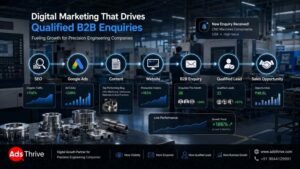
A Practical Digital Lead Generation Framework
A precision engineering company’s strategy can be built around six stages.
1. Identify Commercial Search Opportunities
Research searches around:
- Services
- Components
- Industries
- Applications
- Locations
- Supplier requirements
2. Build the Right Pages
Map important searches to relevant service, industry and capability pages.
3. Create Supporting Content
Turn genuine engineering knowledge into useful content that answers buyer questions.
4. Capture Existing Demand
Use SEO and Google Ads to reach buyers already searching for relevant suppliers.
5. Convert Visitors Into Enquiries
Improve RFQ forms, CTAs, landing pages and contact options.
6. Measure Lead Quality
Track:
Search visibility → Relevant visitors → Enquiries → Qualified enquiries → RFQs → Sales opportunities
This creates a system where every marketing activity has a connection to the sales process.
What Should a 90-Day Strategy Look Like?
Month 1 — Identify the Opportunity
Focus on:
- Competitor research
- Commercial keyword research
- Website audit
- Technical SEO audit
- Conversion audit
- Service/capability mapping
- Tracking setup
Goal: Identify where potential enquiries are being lost.
Month 2 — Build Visibility
Focus on:
- Priority service pages
- Industry pages
- On-page SEO
- Technical improvements
- Commercial content
- Local SEO where relevant
- Google Ads testing
Goal: Put the company in front of more relevant buyers.
Month 3 — Improve Enquiry Generation
Focus on:
- Landing-page optimisation
- RFQ improvements
- CTA testing
- Retargeting
- Keyword refinement
- LinkedIn activity
- Lead qualification
- Lead-quality analysis
Goal: Improve both enquiry volume and enquiry quality.
How Do You Know Whether Your Digital Marketing Is Working?
Don’t stop at:
“Our rankings improved.”
And don’t stop at:
“Our traffic increased.”
Track what happens after the visitor arrives.
| Stage | What to measure |
| Visibility | Relevant search rankings |
| Discovery | Organic/paid visits |
| Engagement | Important page interactions |
| Conversion | Enquiries |
| Qualification | Relevant enquiries |
| Commercial intent | RFQs |
| Sales | Qualified opportunities |
| Revenue | Won business |
A 40% increase in traffic sounds positive.
But:
Relevant traffic ↑ → Enquiries ↑ → RFQs ↑ → Qualified opportunities ↑
is the result that matters to a B2B manufacturer.
When Should You Work With a Digital Marketing Agency?
Specialist support can be useful when:
- Competitors rank above you for important searches.
- Your website receives little relevant traffic.
- Your services aren’t ranking individually.
- You rely heavily on referrals.
- Your website gets traffic but few enquiries.
- Your technical capabilities aren’t clearly presented online.
- Google Ads generates clicks but poor-quality leads.
- Your content is too generic for technical buyers.
- You don’t have a predictable digital lead source.
- You want to enter new industries or markets.
- Your engineering team has expertise but no time to turn it into content.
The question shouldn’t simply be:
“Do we need SEO?”
A better question is:
“Can our digital presence consistently help potential buyers discover, evaluate and contact us?”
Frequently Asked Questions
What is SEO for precision engineering companies?
It focuses on improving visibility for searches related to manufacturing services, components, capabilities, industries, locations and supplier requirements.
Can SEO generate B2B enquiries for precision engineering companies?
Yes. By targeting commercially relevant searches and connecting them to strong service pages, SEO can attract buyers who are actively evaluating suppliers.
What keywords should precision engineering companies target?
Focus on keywords related to actual services, capabilities, components, industries, locations and purchasing requirements.
Is Google Ads useful for precision engineering companies?
Yes. Google Ads can capture high-intent searches while organic SEO visibility is developing.
How can LinkedIn generate leads for precision engineering companies?
LinkedIn can help reach procurement, sourcing, engineering and operations professionals through targeted content and relevant outreach.
Why does my manufacturing website receive traffic but few enquiries?
Possible reasons include poor search intent targeting, unclear capabilities, weak trust signals, generic landing pages or a difficult enquiry process.
Can AI help qualify B2B enquiries?
Yes. AI can assist with categorising enquiries, collecting information and prioritising potential opportunities for sales follow-up.
Generate B2B Enquiries, Not Just Website Traffic
Precision engineering companies don’t need digital marketing simply to have an online presence.
They need it because their next customer could already be searching for a supplier.
The opportunity is to make sure that buyer finds your company, understands what you can manufacture and has a clear reason to contact you.
The journey should be:
Right search
↓
Right page
↓
Technical confidence
↓
Trust
↓
Easy RFQ
↓
Qualified enquiry
↓
Sales opportunity
That is the real purpose of digital marketing for precision engineering companies.
AdsThrive can help connect SEO, AI SEO, Google Ads, performance marketing, content, conversion optimisation, lead generation and AI-assisted lead qualification around your actual business goals.
Ready to Generate More B2B Enquiries?
Your manufacturing capabilities may already be strong. The challenge is getting the right buyers to discover your company, understand your capabilities and take the next step.
AdsThrive helps businesses build digital marketing strategies around SEO, AI SEO, Google Ads, performance marketing, content, conversion optimisation and lead generation.
Instead of focusing only on rankings or traffic, the strategy is built around one goal:
Reach the right buyers → Build trust → Generate enquiries → Create sales opportunities.
Talk to AdsThrive About Your Digital Growth
If you’re looking to improve your online visibility and generate more relevant B2B enquiries for your precision engineering business, get in touch with AdsThrive to discuss your requirements.
Your capabilities are already there. Let’s make sure the right buyers can find them.
This is also better for the article because it doesn’t make an offer that your sales team can’t actually fulfil, while still giving the reader a clear next step.