A forging manufacturer can have modern presses, skilled engineers, heat-treatment facilities, CNC machining and strict inspection processes, yet still miss B2B opportunities because buyers cannot find those capabilities online. A procurement manager may search for an alloy steel forging manufacturer, closed die forging supplier, automotive forging manufacturer, or a forging company that can also provide machining. This is where SEO for forging manufacturers becomes commercially important. The objective is not simply to increase website traffic, but to make the right manufacturing capabilities visible to engineers, procurement teams and sourcing managers at the point when they are evaluating suppliers.
Why Forging Manufacturers Need a Different Digital Marketing Approach
Forging is a highly technical manufacturing process. A buyer evaluating a supplier may need to know far more than whether the company “offers forging services.”
They may need information about:
- Forging process
- Open-die or closed-die capability
- Press or hammer capacity
- Material grades
- Component weight and dimensions
- Tool and die development
- Heat treatment
- CNC machining
- Dimensional tolerances
- Testing and inspection
- Production volume
- Industries served
- Quality certifications
- Export capabilities
- RFQ and drawing submission process
BIS documentation on steel drop, upset and press forgings covers requirements relating to areas such as material, testing and tolerances, showing why technical details are important when communicating forging capabilities.
This creates an important opportunity for manufacturers.
Instead of building a website around broad statements such as “We are a leading forging manufacturer,” the digital presence should explain what the manufacturer can forge, for whom, using which processes and with what supporting capabilities.
That is the foundation of effective digital marketing for forging manufacturers.
The Forging Buyer Usually Starts With a Requirement
A potential customer rarely begins by searching for a particular company’s name.
The search may start with a component, material, application or manufacturing process.
For example, an automotive procurement team may search for:
- Automotive forging manufacturer
- Forged automotive components
- Steering component forging supplier
- Alloy steel forging manufacturer
- Closed die forging manufacturer
An industrial machinery company might search for:
- Industrial forging manufacturer
- Heavy forged components
- Open die forging supplier
- Forging manufacturer with CNC machining
Another buyer may already know the material but not the supplier:
- Carbon steel forging manufacturer
- Alloy steel forgings supplier
- Stainless steel forging manufacturer
This means a manufacturer doesn’t have to depend on one broad keyword such as “forging manufacturer.”
It can become discoverable across the different ways its potential customers describe their requirements.
What Should a Forging Manufacturer Actually Be Found For?
A useful digital marketing strategy begins with the company’s real manufacturing capabilities.
Think about the website through five areas.
1. Forging process
Depending on actual capabilities:
- Open die forging
- Closed die forging
- Drop forging
- Press forging
- Ring forging
- Upset forging
2. Materials
Potential areas include:
- Carbon steel
- Alloy steel
- Stainless steel
- Aluminium
- Special alloys
3. Components
Examples could include:
- Shafts
- Gears
- Flanges
- Automotive components
- Industrial machine components
- Structural components
- Heavy-duty components
4. Supporting processes
These can include:
- Heat treatment
- CNC machining
- Surface finishing
- Inspection
- Testing
- Tool and die manufacturing
5. Industries
Potential sectors include:
- Automotive
- Industrial machinery
- Construction
- Mining
- Power
- Railways
- Oil and gas
- General engineering
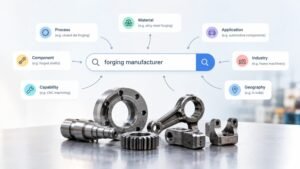
Not every manufacturer should create all of these pages. The website should reflect actual capabilities and commercially relevant target markets.
Build the Website Around Manufacturing Capabilities
One of the biggest opportunities for SEO services for forging manufacturers is restructuring the website around specific search intent.
A single page titled “Forging Services” may mention every process, material and industry in a few paragraphs.
That makes it difficult for both buyers and search engines to understand the depth of each capability.
A stronger structure could include dedicated pages such as:
Process pages
- Open Die Forging
- Closed Die Forging
- Drop Forging
- Press Forging
- Ring Forging
Material pages
- Carbon Steel Forgings
- Alloy Steel Forgings
- Stainless Steel Forgings
- Aluminium Forgings
Supporting capability pages
- Heat Treatment
- CNC Machining
- Tool & Die Development
- Testing & Inspection
Industry pages
- Automotive Forging
- Industrial Forging
- Power Industry Forgings
- Construction & Mining Forgings
- Railway Forging Components
The pages should not simply repeat the same company description.
Each should explain the relevant process, materials, component types, applications, production capabilities and enquiry options.
Your Factory Already Has the Content Buyers Need
Many forging manufacturers don’t have a lack of expertise.
They have a content translation problem.
Important information is often sitting inside:
- Machine lists
- Product catalogues
- Engineering documents
- Sales presentations
- Quality manuals
- Factory brochures
- Inspection reports
- Production photographs
- Customer discussions
For example, a sales brochure might say:
“Our facility has advanced forging machinery and modern quality systems.”
That doesn’t tell a procurement manager much.
A stronger website statement could explain:
“The facility supports closed-die forging for alloy-steel components, with heat treatment, CNC machining and inspection capabilities for industrial and automotive applications.”
The second version gives the buyer useful context.
The same principle can be applied to machine capabilities.
Instead of:
“High-capacity forging presses.”
Explain relevant information such as:
- Press capacity
- Maximum component weight
- Component dimensions
- Material range
- Production volume
- Tooling capability
- Machining capability
Only include specifications that are accurate and approved by the manufacturer.
Find the Searches Your Forging Business May Be Missing
A keyword strategy should go beyond variations of “forging manufacturer.”
Potential search opportunities can be grouped by buyer intent.
| Search intent | Example search | Suitable website asset |
| Supplier | Forging manufacturer in India | Main capability page |
| Process | Closed die forging manufacturer | Process page |
| Material | Alloy steel forging manufacturer | Material page |
| Industry | Automotive forging manufacturer | Industry page |
| Component | Forged shaft manufacturer | Product/application page |
| Capability | Forging with CNC machining | Supporting service page |
| Technical | Forging design considerations | Technical article |
| Quality | Forging inspection and testing | Quality page |
| Procurement | Forging RFQ | RFQ landing page |
| Comparison | Forging vs casting | Technical article |
These aren’t necessarily separate pages in every case.
The purpose of the exercise is to identify how potential buyers describe their requirements, then make sure the website provides useful information for those searches.
That is much more useful than repeatedly placing the same keyword throughout the homepage.
Answer an Engineer’s Questions Before They Contact Sales
A manufacturing website should reduce the amount of basic information a buyer needs to request from sales.
An engineer evaluating a forging supplier may ask:
What forging processes do you offer?
Clearly explain whether the manufacturer handles open-die, closed-die, drop, press, ring or other processes.
What materials can you forge?
List the actual materials and grades supported.
What is your forging capacity?
Provide relevant press, hammer or production information where appropriate.
What component sizes can you handle?
Explain actual size and weight ranges instead of using vague claims.
Do you manufacture dies?
Explain the tooling and die-development capability.
Do you provide heat treatment?
If yes, explain the processes offered and relevant capabilities.
Can you provide CNC machining?
If machining is part of the offering, show how it supports the forged component.
How are components tested?
Explain relevant inspection and testing capabilities.
Which industries do you serve?
Show actual sectors and applications.
Can I submit a drawing for quotation?
This should be easy to find.
BIS provides a searchable Know Your Standard resource where users can search Indian Standards by IS number or keyword and access related standard information, amendments and other resources.
For manufacturers discussing standards on their websites, linking to relevant authoritative resources can also give technical content more context.
However, a manufacturer should only claim compliance with a particular standard or certification where that claim genuinely applies.
Turn Technical Knowledge Into Searchable Content
Forging companies have a natural advantage when it comes to technical content because their engineers already understand questions that buyers ask.
The opportunity is to turn that knowledge into useful resources.
For example:
Process questions
- What is closed die forging?
- What is open die forging?
- How does press forging work?
- What is drop forging?
Material questions
- Carbon steel vs alloy steel forgings
- How material grade affects forged components
- What factors influence material selection?
Design questions
- Forging design considerations
- How draft angles affect forging
- How machining allowance affects forged components
- What tolerances are possible in forged parts?
Quality questions
- Common forging defects
- Why heat treatment matters
- Forging inspection methods
- Mechanical testing for forged components
Procurement questions
- How to select a forging manufacturer
- What should a forging RFQ include?
- What information does a forging supplier need before quotation?
This content should not exist simply to increase the number of pages.
Each article should answer a question that occurs somewhere in the buyer’s evaluation process.
Create Industry-Specific Forging Content
A manufacturer serving several industries should not necessarily communicate with all buyers in exactly the same way.
Consider automotive.
An automotive buyer may be interested in:
- Component consistency
- Production volume
- Material specifications
- Dimensional requirements
- Heat treatment
- Machining
- Quality systems
- Delivery capability
An industrial machinery buyer may have a different priority:
- Component size
- Strength
- Material
- Machining
- Low-volume or custom production
- Inspection
- Engineering support
The website can therefore create industry-specific content where there is genuine business relevance.
Automotive Forging
Explain relevant component types, production capabilities and quality requirements.
Industrial Machinery Forging
Discuss suitable component types, materials, machining and production capabilities.
Power Industry Forging
Focus on relevant components, material requirements, testing and manufacturing capabilities.
Construction and Mining
Discuss heavy-duty applications and relevant production capabilities.
This is one of the strongest ways digital marketing for forging manufacturers can move from generic visibility toward commercially relevant visibility.
Make the Journey From Search to RFQ Simple
Ranking is only part of the job.
A visitor who arrives through Google still needs to understand what to do next.
Imagine someone searching for:
“Alloy steel forging manufacturer.”
They click a result and reach a dedicated alloy-steel forging page.
Within that page, they should be able to understand:
- Materials
- Component types
- Manufacturing process
- Capacity
- Heat treatment
- Machining
- Testing
- Industries served
- Relevant experience
- How to request a quotation
The conversion point could be:
Request a Forging Quote
or
Submit Your Component Drawing
rather than a generic “Learn More.”
For technical B2B manufacturing, a drawing or CAD upload can be particularly useful because it allows the buyer to communicate the requirement more accurately.
Use Google Ads When Buyers Have High Commercial Intent
Organic SEO can build long-term visibility, but paid search can help manufacturers capture selected searches immediately.
For example:
Campaign: Closed Die Forging
Target searches related to closed-die forging manufacturers and suppliers.
Landing page: Closed Die Forging capability
Campaign: Alloy Steel Forging
Target searches related to alloy-steel forging suppliers.
Landing page: Alloy Steel Forging capability
Campaign: Automotive Forging
Target searches from automotive sourcing and manufacturing requirements.
Landing page: Automotive Forging capability
The landing page should match the search.
Sending every paid visitor to the homepage creates unnecessary friction.
A person searching for “automotive forging manufacturer” should immediately see information relevant to automotive applications rather than having to navigate through several unrelated services.
This is where SEO services for forging manufacturers and paid search can complement each other rather than operate as separate marketing activities.
LinkedIn Can Reach Buyers Before They Search
Google captures existing demand.
LinkedIn can help manufacturers reach professionals who may become future customers even when they are not actively searching for a supplier.
Potential audiences include:
- Procurement Managers
- Purchase Heads
- Strategic Sourcing Managers
- Supplier Development Engineers
- Manufacturing Engineers
- Product Development Engineers
- Plant Heads
- OEM sourcing professionals
The content should demonstrate manufacturing knowledge.
For example:
Content idea 1
What should an OEM check before selecting a forging supplier?
Discuss:
- Material capability
- Capacity
- Heat treatment
- Machining
- Testing
- Quality systems
Content idea 2
Why does heat treatment matter in forged components?
Explain the relationship between heat treatment and required mechanical properties without making unsupported performance claims.
Content idea 3
What information should be included in a forging RFQ?
Explain why material, drawing, quantity, application and required processes are useful when requesting a quotation.
Content idea 4
Open-die vs closed-die forging: what is the difference?
Explain the processes in straightforward engineering language.
This type of content can help a manufacturer demonstrate expertise before a buyer begins a formal supplier evaluation.
Build Lead Generation Around the Industries You Actually Want
Lead generation becomes more useful when the target customer is clearly defined.
A forging manufacturer might prioritize:
- Automotive OEMs
- Automotive Tier-1 suppliers
- Industrial machinery manufacturers
- Power equipment companies
- Construction equipment manufacturers
- Mining equipment manufacturers
- Railway equipment companies
- General engineering companies
But the appropriate targets depend on the manufacturer’s actual capabilities and market.
For example, if a company specializes in high-volume automotive components, its campaigns should not spend the same effort attracting buyers looking for one-off heavy forgings.
Likewise, a manufacturer specializing in large open-die components should communicate differently from a company focused on smaller closed-die production.
Effective lead generation for forging manufacturers therefore starts with defining:
- Target industry
- Component type
- Material
- Manufacturing process
- Production volume
- Geographic market
- Buyer role
Marketing can then be built around those parameters.
Social Media Should Show the Manufacturing Reality
Social media for a forging company does not have to be filled with generic motivational posts.
The factory itself can provide useful content.
Examples include:
Factory content
- Forging press operation
- Die preparation
- Billet heating
- Forging stages
- Trimming
- Heat treatment
- Machining
- Inspection
Product content
- Finished components
- Before-and-after machining
- Component close-ups
- Technical drawings where permitted
- Application examples
Knowledge content
- Forging terminology
- Process explanations
- Material information
- Quality inspection
- Common manufacturing questions
This content can also support LinkedIn outreach and website content, allowing one technical subject to be repurposed across multiple channels without simply duplicating the same post.
AISEO Can Help Make Technical Expertise Easier to Discover
AISEO should not mean generating hundreds of generic articles.
For a forging manufacturer, it should help make the company’s expertise clear across traditional search and newer AI-driven discovery environments.
The website should make it easy to understand:
What does the company manufacture?
Which forging processes does it use?
Which materials does it handle?
What component range does it support?
Which industries does it serve?
What supporting processes are available?
What quality and testing capabilities exist?
This information should appear consistently across relevant pages.
For example, a technical article titled:
“Closed Die Forging vs Open Die Forging for Industrial Components”
could explain the difference between the processes and then naturally direct readers to the manufacturer’s relevant forging capability.
Likewise:
“How to Select an Alloy Steel Forging Manufacturer”
could discuss the information procurement and engineering teams should evaluate before sending an RFQ.
The goal is to make useful technical knowledge accessible rather than producing content purely for keyword volume.
What Happens After a Forging Enquiry Arrives?
Marketing does not end when the contact form is submitted.
Consider an enquiry containing:
- Component drawing
- Alloy steel requirement
- Annual quantity
- Automotive application
- Heat-treatment requirement
- Machining requirement
The sales team may need to determine:
- Does the requirement match our capability?
- Is the material supported?
- Is the volume commercially relevant?
- Is the component within our size range?
- Is additional information required?
- Should engineering review the drawing?
AI lead qualification can help organize this information before the enquiry reaches the appropriate team.
It can assist with:
- Initial response
- Requirement collection
- Lead categorization
- Missing-information detection
- CRM updates
- Follow-up reminders
- Email follow-ups
- WhatsApp communication
- Appointment scheduling
The final technical decision remains with the relevant sales and engineering professionals.
The value of AI is in reducing repetitive administrative work and making sure useful enquiries don’t disappear into an unmanaged inbox.
Where Forging Websites Commonly Lose Potential Buyers
Even manufacturers with strong production capabilities can lose enquiries because their websites don’t communicate those capabilities clearly.
Generic positioning
The website says:
“We are a leading forging company.”
But doesn’t explain what the company actually manufactures.
Too many capabilities on one page
Open-die, closed-die, machining, heat treatment and several industries are mixed together without clear sections.
No material information
The buyer cannot determine whether the manufacturer handles the required grade.
No capacity information
There is no indication of component size, weight or production capability.
No technical evidence
The website contains marketing claims but few factory photographs, machine details or process information.
No application pages
The manufacturer serves automotive or industrial companies but has no dedicated content for those markets.
Difficult RFQ process
The buyer has no simple way to submit drawings or explain requirements.
Weak follow-up
A genuine enquiry may sit in a shared inbox without timely routing or response.
These issues can reduce the commercial value of existing traffic.
Quality and Standards Information Can Strengthen Technical Trust
For industrial buyers, technical credibility matters.
BIS’s resources include standards relevant to steel and forging. For example, BIS currently lists IS 1875:2025 for steel ingots, billets, blooms, slabs and bars for forging, while its standard resources also provide information on testing and related requirements.
BIS also explains that where a product is covered by a relevant compulsory certification requirement, manufacturers need the appropriate infrastructure, process controls, quality control and testing capabilities for the applicable standard.
For a forging manufacturer’s website, this means standards-related content should be handled carefully.
Instead of writing:
“Our products meet all Indian Standards.”
unless that statement is verified, the company can explain the specific standards, tests or quality processes that genuinely apply to its products.
Useful quality content can cover:
- Material testing
- Hardness testing
- Tensile testing
- Dimensional inspection
- Non-destructive testing
- Heat-treatment records
- Traceability
- Inspection documentation
This gives technical buyers more information to evaluate the supplier.
Measure Marketing by Qualified Enquiries
A manufacturing marketing campaign shouldn’t be judged only by website sessions.
The more useful metrics connect marketing activity with the sales pipeline.
| Metric | What it indicates |
| Organic impressions | Search visibility |
| Commercial keyword clicks | Buyer interest |
| Capability-page visits | Interest in specific services |
| RFQs | Direct commercial intent |
| Drawing uploads | Technical buying intent |
| Qualified enquiries | Lead relevance |
| Quote requests | Sales opportunities |
| Cost per qualified lead | Paid campaign efficiency |
| Quote-to-order rate | Commercial performance |
| Enquiry response time | Follow-up efficiency |
For example, a page generating 20 highly relevant RFQs can be more commercially useful than another page receiving thousands of visitors who have no forging requirement.
The important question is not simply:
“How much traffic did marketing generate?”
It is:
“Did marketing create relevant conversations with companies that can actually become customers?”
What a Complete Forging Marketing Program Should Cover
A strong digital marketing agency for industrial component manufacturers should look at the entire buyer journey rather than treating each marketing channel as an isolated activity.
SEO
Build visibility around processes, materials, components, industries and commercial searches.
Technical content
Answer engineering and procurement questions before the buyer contacts sales.
Google Ads
Capture selected high-intent searches and direct them to relevant landing pages.
Reach procurement, engineering and sourcing professionals through targeted content and outreach.
Social media
Show manufacturing expertise, factory capabilities, products and technical knowledge.
Lead generation
Target industries and accounts that match actual manufacturing capabilities.
AI lead qualification
Organize enquiries, collect missing information and route opportunities to the right team.
Follow-up automation
Support timely communication through email, WhatsApp, calling or other appropriate channels.
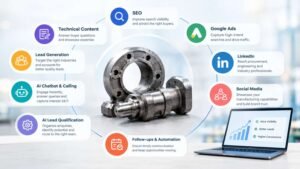
When these activities are connected, marketing becomes much closer to the actual sales process.
How Adsthrive Can Support Forging Manufacturers
The role of a digital marketing agency for industrial component manufacturers is not simply to increase website traffic. Industrial marketing needs to connect visibility with the technical requirements of the buyer and the manufacturer’s sales process.
Adsthrive can support this through SEO services, AI SEO services, lead generation, Google Ads, social media and LinkedIn-focused campaigns.
For enquiry management, Adsthrive also provides AI chatbot solutions and AI calling solutions, which can support lead qualification, communication and follow-up.
The larger approach is to customize the system around the manufacturer’s actual workflow instead of forcing the business to manage separate tools for every part of the process.
For example, a manufacturer could combine search visibility with a technical website, RFQ capture, AI-assisted qualification, WhatsApp or email follow-ups and CRM updates.
The exact setup should depend on the company’s target industries, sales process, enquiry volume, CRM and internal team.
Conclusion: Make Your Forging Capabilities Easier to Find
A forging manufacturer doesn’t need to rank for every possible manufacturing search.
It needs to become visible when the right buyer is looking for the capabilities it actually provides.
That means moving beyond a generic company website and building a useful digital presence around forging processes, materials, components, industries, machine capabilities, heat treatment, machining and quality.
SEO for forging manufacturers becomes more valuable when it is connected to the rest of the B2B buying process. Technical content can answer questions before the RFQ. Google Ads can capture selected high-intent searches. LinkedIn can reach procurement and engineering professionals. A better RFQ process can turn website visits into enquiries, while AI-assisted qualification and follow-up can help sales teams manage those opportunities more efficiently.
For a forging manufacturer, the goal of digital marketing should not simply be more traffic.
It should be more visibility among relevant buyers, more qualified enquiries and more opportunities that the sales team can actually pursue.
FAQs About Digital Marketing for Forging Manufacturers
1. How can forging manufacturers generate more B2B enquiries?
Forging manufacturers can improve B2B enquiries by creating capability-specific website pages, publishing useful technical content, targeting relevant search terms, running high-intent Google Ads, reaching procurement professionals through LinkedIn and simplifying the RFQ process.
2. What keywords should forging manufacturers target?
Keywords should reflect actual capabilities. Examples include forging manufacturer, closed die forging manufacturer, alloy steel forging manufacturer, automotive forging supplier, open die forging manufacturer and forging manufacturer with CNC machining.
3. Does SEO work for forging manufacturers?
SEO can help forging manufacturers become more visible when engineers, procurement teams and sourcing professionals search for suppliers, processes, materials and technical information. Results depend on competition, search demand, website quality, content and the manufacturer’s actual capabilities.
4. What should a forging manufacturer’s website include?
It should clearly explain forging processes, materials, component capabilities, industries served, machine capacity, heat treatment, machining, inspection, quality information, product examples and the process for requesting a quotation.
5. Can Google Ads generate forging enquiries?
Google Ads can capture selected high-intent searches while organic SEO develops. Campaigns should ideally direct users to relevant process, material or industry pages instead of sending every visitor to the homepage.
6. How can LinkedIn help forging manufacturers?
LinkedIn can help manufacturers reach procurement, engineering, sourcing and manufacturing professionals. Technical content, manufacturing insights, project examples and targeted outreach can help initiate conversations with potential B2B accounts.
7. What should a forging RFQ form collect?
Depending on the manufacturer’s sales process, useful information may include company name, industry, component/application, material, quantity, drawing or CAD file, machining requirements, heat treatment requirements and delivery expectations.
8. How can AI lead qualification help forging companies?
AI can organize information from incoming enquiries, identify missing details, categorize leads according to predefined criteria and route them to appropriate sales or engineering teams. Technical feasibility and commercial decisions should remain with qualified professionals.
Ready to Generate More Qualified Forging Enquiries?
Turn your forging capabilities into a stronger digital sales channel with SEO, Google Ads, LinkedIn outreach, technical content and AI-powered lead qualification.
Get found by the right buyers. Generate better leads. Grow with Adsthrive.