Industrial buyers rarely contact an Electrical Equipment manufacturer simply because they saw an advertisement. Before an enquiry reaches the sales team, a buyer may already have checked product categories, technical specifications, applicable standards, voltage or current ratings, applications, certifications, delivery capability and whether the manufacturer appears capable of handling the project.
That changes what digital marketing needs to accomplish.
For an Electrical Equipment company, the objective is not simply to bring more visitors to the website. The website and marketing channels need to help the right buyer find the right product, understand whether it fits the requirement, verify the manufacturer’s capability and take the next commercial step.
That is where SEO for electrical equipment companies becomes more valuable than simply publishing generic industry blogs. When SEO, paid advertising, product content, lead generation and automated follow-up are connected to the sales process, digital marketing can contribute to a much more useful outcome: qualified B2B enquiries rather than unfiltered website leads.
The Real Digital Problem Is Often Happening Before the Lead Form
Consider two manufacturers selling similar equipment.
Manufacturer A has a large product catalogue, but most pages contain a short product description, a few images and a “Contact Us” button.
Manufacturer B explains its equipment by product category, application, specifications and operating requirements. Buyers can find relevant technical information, understand available configurations, download documentation and submit an enquiry with useful project details.
Both companies may have capable engineering teams and similar production facilities.
But online, they are not presenting the same amount of evidence.
The second manufacturer gives a buyer more reasons to continue the evaluation.
This distinction matters because industrial purchasing is rarely an impulse decision. Electrical equipment can become part of a larger project involving consultants, contractors, engineers, procurement teams, plant managers, system integrators and end users.
A digital presence therefore has to answer a practical question:
“Why should a technical buyer continue talking to this company after finding it online?”
That question should influence the entire marketing strategy.
Start With What the Buyer Needs to Verify
Before discussing keywords or advertisements, look at the information a buyer needs to establish before making an enquiry.
For an electrical product, the requirements can vary considerably depending on the application. A buyer may need to understand:
- Equipment type
- Voltage or current range
- Capacity
- Configuration
- Environmental conditions
- Enclosure or protection requirements
- Application
- Installation conditions
- Available options
- Testing and documentation
- Applicable standards
- Manufacturing capability
- Delivery requirements
- Customisation possibilities
- Service or technical support
For example, a person searching for a low-voltage switchgear assembly may be interested in very different information from someone evaluating a transformer, motor control centre, control panel or power distribution solution.
BIS currently references standards covering several categories of electrical equipment, including low-voltage switchgear and controlgear. Its published material also references standards such as IS/IEC 60947 and IS/IEC 61439.

The marketing lesson is straightforward:
Your website should not make the buyer work unnecessarily hard to determine whether your product is relevant.
Product Discovery Should Come Before Lead Capture
One common mistake is trying to push every visitor towards the same contact form.
That approach treats a technical website like a generic service website.
A better structure begins with product discovery.
Suppose an Electrical Equipment manufacturer offers:
- Control panels
- Switchgear
- Distribution boards
- Motor control centres
- Transformers
- Busbar systems
- Power distribution equipment
- Industrial automation panels
Each category can attract different search behaviour.
A procurement manager may search by product.
An electrical consultant may search by technical specification.
An EPC company may search by application.
A plant engineer may search for a replacement or retrofit solution.
A distributor may search for a manufacturer or bulk supplier.
This means the website should create multiple entry points rather than forcing everyone through the homepage.
A useful product architecture
Equipment category
→ Product family
→ Specification or configuration
→ Application
→ Technical documentation
→ Enquiry
For example:
Switchgear
could lead to:
Low-voltage switchgear
then to:
Specific configuration / application
then to:
technical specifications, documentation and enquiry
This creates considerably more useful search real estate than having one generic “Electrical Equipment Manufacturer” page.
The Website Should Sell Capability Before It Asks for Contact Details
A buyer who arrives through Google is not necessarily ready to call.
They may be comparing three or four manufacturers.
They may have received a project specification from an EPC contractor.
They may be preparing a tender.
They may simply be checking whether a manufacturer can build a particular configuration.
That means the website needs to support evaluation.
A strong product page can include:
Product overview
Explain what the equipment is and where it is normally used.
Technical specifications
Present relevant technical parameters clearly instead of hiding everything inside a PDF.
Available configurations
Show standard and configurable options where applicable.
Applications
Explain the environments and industries where the equipment is used.
Standards and compliance
Reference applicable standards and certifications accurately.
Technical documentation
Provide datasheets, catalogues, drawings or other useful documents where appropriate.
Manufacturing capability
Explain what the company can manufacture, customise, test or support.
Enquiry option
Give the buyer a clear next step.
This is important for SEO as well.
If the only information available to search engines is a product name followed by three lines of marketing copy, the page has very little opportunity to demonstrate relevance for the technical searches surrounding that product.
Build SEO Around Commercial Questions, Not Just Product Names
This is where SEO for electrical equipment companies can become much more commercially useful.
A product name by itself is often too broad.
Instead, build keyword coverage around different types of buyer intent.
| Search intent | Example search | What the buyer may need |
| Product | industrial control panel manufacturer | Supplier discovery |
| Specification | low voltage switchgear assembly manufacturer | Technical suitability |
| Application | electrical panels for manufacturing plants | Application fit |
| Customisation | custom industrial control panel manufacturer | Engineering capability |
| Commercial | electrical equipment manufacturer India | Supplier comparison |
| Procurement | electrical equipment supplier for EPC projects | Project sourcing |
| Compliance | IEC 61439 electrical panel manufacturer | Standards-related evaluation |
| Service | electrical equipment installation support | Post-sale requirement |
The point is not to create a separate page for every imaginable keyword.
The point is to identify which searches represent real commercial opportunities and then make sure the website has genuinely useful content for those searches.
That is a much stronger basis for SEO services for electrical equipment companies than simply increasing the number of keywords appearing across a website.
A Small Search Opportunity Can Be More Valuable Than a Large Keyword
Industrial marketers sometimes reject long-tail keywords because the individual search volume appears small.
That can be misleading.
Consider the difference between:
“electrical equipment”
and:
“custom industrial control panel manufacturer”
The first could represent research, education, employment searches, consumer searches or general browsing.
The second communicates a much clearer commercial requirement.
The same principle applies to searches involving:
- manufacturer
- supplier
- custom
- industrial
- project
- specification
- quotation
- bulk
- OEM
- EPC
- application
- voltage
- capacity
- standard
These modifiers can make a relatively narrow search much more commercially relevant.
The missed-search problem
An Electrical Equipment company may already rank for its brand name and broad product terms while missing searches that happen immediately before a procurement enquiry.
That is where a search-intent audit becomes useful.
Look at:
What does the buyer search before they know our brand?
That question often reveals more opportunities than simply checking where the company ranks for its own product names.
Turn Technical Expertise Into Searchable Commercial Content
Many manufacturers already have valuable technical knowledge.
The problem is that much of it remains inside:
- sales presentations
- catalogues
- PDF files
- engineering discussions
- quotations
- email responses
- internal documentation
Some of that knowledge can become useful website content.
For example:
Instead of publishing a generic article titled:
“Benefits of Industrial Control Panels”
a manufacturer could answer a much more specific question:
“How to Select an Industrial Control Panel for a Manufacturing Plant”
That article could discuss:
- load requirements
- operating environment
- control requirements
- enclosure considerations
- protection
- available configurations
- documentation
- testing
- installation considerations
Now the content has a reason to exist.
It helps a potential customer understand the purchase.
It also gives search engines a much clearer relationship between the company’s expertise, product range and commercial subject area.
Create Content Around Applications
Product-based SEO is important, but application-based content can open another layer of demand.
An equipment manufacturer may sell the same product into several sectors.
For example:
Control panels
could be relevant to:
- Manufacturing plants
- Water treatment facilities
- Food processing
- Pharmaceutical facilities
- Infrastructure projects
- HVAC systems
- Material handling
- Process industries
Instead of creating thin location pages or repeating the same product description, build useful application pages.
A good application page should explain:
What problem does the equipment solve in this environment?
Then connect the application to the manufacturer’s relevant product capabilities.
This creates a much more natural bridge between search visibility and sales conversations.
Use Standards and Compliance Information Carefully
For technical products, standards are not decoration.
They can influence whether a product is considered during procurement.
BIS maintains product-specific information for electrical equipment and references standards including IS/IEC 60947 series requirements for low-voltage switchgear and controlgear. BIS also publishes information around IS/IEC 61439 for low-voltage switchgear and controlgear assemblies.
That creates an opportunity for manufacturers to make standards-related information easier to understand on their websites.
However, there is an important distinction:
Do not use standards simply as SEO keywords.
If a manufacturer references a standard, the page should make clear what the reference means for the product and the relevant scope.
For example:
- Applicable standard
- Product category covered
- Testing or verification information
- Certification status, where applicable
- Documentation available
- Relevant limitations or configuration details
Technical accuracy matters more than keyword density.
This is also an area where a specialised content team can work with the manufacturer’s engineering team rather than inventing technical claims.
Your Product Catalogue Can Become a Lead-Generation Asset
A catalogue should not exist only as a downloadable PDF.
If all important product information is buried inside a PDF, the website may lose opportunities to rank for the individual topics covered by that document.
Instead, consider turning important catalogue information into searchable HTML content.
For example:
Product page
Product overview
Technical section
Specifications and configurations
Application section
Industries and use cases
Documentation
Datasheet / catalogue / drawing
Commercial section
Request quotation
The PDF can still remain available.
But the web page becomes the searchable version of the information.
This is one of the practical areas where digital marketing for electrical equipment companies needs to work closely with the website rather than existing separately from it.
Paid Advertising Should Capture Demand That Already Exists
SEO is a long-term acquisition channel.
Paid search can capture active demand immediately.
But simply creating a Google Ads campaign around broad electrical keywords can produce the wrong traffic.
A commercial campaign should be built around searches that indicate an actual requirement.
For example:
- electrical equipment manufacturer
- industrial control panel manufacturer
- switchgear manufacturer
- custom control panel supplier
- industrial electrical equipment supplier
- transformer manufacturer
- power distribution equipment supplier
The exact keyword set should depend on the company’s actual product range and target market.
The next step is equally important:
Separate irrelevant intent.
Potential exclusions can include searches related to:
- residential repair
- DIY electrical work
- electrician jobs
- training courses
- consumer product repair
- wiring instructions
- household troubleshooting
The objective isn’t to get the largest possible number of clicks.
It is to spend budget where the search has a reasonable connection to the company’s commercial offering.
Give Every Important Ad Its Own Commercial Destination
Sending every Google Ads visitor to the homepage creates unnecessary friction.
Imagine someone searching:
custom industrial control panel manufacturer
and arriving on a homepage containing 40 different product categories.
They now have to find the relevant product themselves.
A dedicated landing page can instead immediately communicate:
- What is manufactured
- Typical applications
- Configuration options
- Technical capabilities
- Relevant documentation
- Industries served
- Project experience
- Enquiry route
The same principle can apply to other high-intent searches.
This is where lead generation for electrical equipment companies becomes more than form creation.
The landing page itself should help qualify the buyer.
Ask Better Questions in the Enquiry Process
A contact form asking:
Name | Email | Phone | Message
does not tell the sales team very much.
For an industrial enquiry, additional fields can make the conversation substantially more useful.
Depending on the product, consider asking for:
- Product required
- Application
- Quantity
- Voltage
- Current/capacity
- Project location
- Required delivery timeline
- Existing specification
- Drawing or document upload
- Company name
- Project stage
Not every form needs every field.
Too many mandatory questions can also reduce conversions.
The right approach is to identify the minimum information the sales engineer needs to decide what happens next.
That is the point where marketing starts behaving like part of the sales process.
Make the First Response Faster Without Making It Robotic
A website visitor who submits an enquiry should not necessarily have to wait until the next working day to receive a response.
This is where automation can become commercially useful.
For an Electrical Equipment business, an AI chat or WhatsApp assistant can collect basic project information before a salesperson gets involved.
For example, the assistant can ask:
Which equipment are you looking for?
Then:
What is the application?
Then:
Do you have a required capacity, voltage or specification?
Then:
Do you have a drawing or BOQ you can share?
The result is not intended to replace an engineer.
It is to make the first interaction more productive.
Instead of sales receiving:
“Need panel. Please contact.”
they may receive:
Control panel required for manufacturing plant; quantity 4; project location Bengaluru; specification document uploaded; requirement expected within 60 days.
That is a very different sales conversation.
Where AdsThrive’s AI Automation Becomes Useful
This is where AdsThrive can add a layer that traditional SEO alone cannot provide.
AdsThrive can connect the acquisition and enquiry-handling side of digital marketing through a customised combination of:
- SEO
- AI SEO
- Google Ads
- Lead generation
- AI Chat
- WhatsApp automation
- AI lead qualification
- AI calling
- Automated follow-ups
- CRM updates
- Booking and enquiry workflows
The important point is not to install every feature simply because it exists.
The workflow should be built around how the Electrical Equipment company actually receives and handles enquiries.
For example, an enquiry generated from an SEO product page can enter an AI chat or WhatsApp workflow, provide basic project information, be classified according to the company’s qualification rules and then be passed to the relevant sales person.
If the prospect does not respond, automated follow-up can continue according to the agreed process.
If a lead needs a conversation rather than a text response, AI calling can become another contact point.
The sales team therefore spends less time manually sorting basic enquiries and more time working on opportunities that require engineering or commercial attention.
Explore AdsThrive’s AI Calling solution
AI SEO Can Help When Buyers Ask More Complex Questions
Search behaviour is becoming less dependent on short product phrases.
A potential buyer may ask a much longer question such as:
“Which type of industrial control panel is suitable for a manufacturing plant operating in a high-dust environment?”
Or:
“What should I check before selecting a low-voltage switchgear manufacturer for an industrial project?”
This creates an opportunity for AI SEO to work alongside traditional SEO.
Instead of creating content simply because a keyword has been identified, the content can be structured around:
- Buyer questions
- Product relationships
- Applications
- Technical concepts
- Comparisons
- Standards
- Selection considerations
- Commercial intent
The objective remains the same: make the company easier to discover and understand.
Don’t Treat Every Lead as Equal
One of the biggest commercial problems with B2B lead generation is that the number of leads can look impressive while the sales team sees little value.
Imagine a campaign produces 100 enquiries.
But:
- 30 are students
- 20 are residential requirements
- 15 are outside the service area
- 10 are looking for products the company does not manufacture
- 15 have no immediate project
- 10 are genuine commercial opportunities
The campaign generated 100 leads.
The sales team received only 10 useful opportunities.
That is why reporting needs to move beyond:
Leads generated
and start measuring:
Qualified enquiries generated
and eventually:
Quotes generated
and:
Revenue generated from digital channels
This is one of the strongest reasons to connect lead-generation campaigns with CRM and sales data.
What Should Be Measured?
A practical reporting structure for an Electrical Equipment company could look at the complete commercial progression.
Search visibility
Track:
- Commercial keyword rankings
- Product-page visibility
- Application-page visibility
- Organic impressions
- Organic clicks
Website engagement
Track:
- Product page visits
- Datasheet downloads
- Catalogue downloads
- Technical document requests
- RFQ starts
- RFQ completions
Lead quality
Track:
- Qualified B2B enquiries
- Product-fit enquiries
- Specification-ready enquiries
- Drawing/document uploads
- Project-stage information
Sales progression
Track:
- Sales-qualified opportunities
- Quotations issued
- Quote value
- Opportunities won
- Revenue influenced by digital channels
This gives management a much better understanding of whether marketing is contributing to the commercial pipeline.
A Practical Keyword and Content Map
The following is a starting framework rather than a list that should be copied onto every website.
| Keyword/theme | Search intent | Recommended destination |
| SEO for electrical equipment companies | Commercial service | Dedicated service/article page |
| SEO services for electrical equipment companies | Commercial service | SEO service page |
| Digital marketing for electrical equipment companies | Commercial research | Digital marketing page |
| Lead generation for electrical equipment companies | Commercial | Lead-generation page |
| Digital marketing agency for electrical equipment companies | Agency evaluation | Agency/service page |
| Industrial control panel manufacturer | Supplier search | Product page |
| Industrial switchgear manufacturer | Supplier search | Product/category page |
| Custom electrical control panel manufacturer | Custom requirement | Capability page |
| Low-voltage switchgear manufacturer | Technical/commercial | Product page |
| Electrical equipment supplier for industrial projects | Procurement | Industry/application page |
| Electrical equipment manufacturer India | Supplier discovery | Location/company page |
| Electrical equipment for manufacturing plants | Application | Application page |
The five primary commercial keywords should be used naturally in the relevant sections rather than inserted repeatedly.
The primary keyword “SEO for electrical equipment companies” appears naturally in the article, while Electrical Equipment is used throughout in context. The supporting terms are positioned around different commercial intents rather than being treated as a keyword list.
What a Strong Electrical Equipment Website Should Contain
Before increasing advertising spend, review the website itself.
A commercially useful website should make it easy to discover:
Products
What does the company manufacture?
Specifications
What are the relevant technical parameters?
Applications
Where is the equipment used?
Capabilities
What can the manufacturer customize or engineer?
Standards
What standards or certifications are relevant?
Documentation
Can the buyer access technical information?
Evidence
Can the company demonstrate manufacturing capability?
Enquiry
Can a buyer request a quotation easily?
Response
What happens immediately after an enquiry?
If several of these are missing, increasing traffic may simply increase the number of people who leave without contacting the company.
Don’t Hide Manufacturing Capability Behind Generic Marketing Copy
Phrases such as:
“Best quality products”
“Advanced technology”
“Trusted manufacturer”
“High-quality solutions”
do very little for a technical buyer on their own.
Replace generic claims with evidence.
For example:
- Product range
- Manufacturing facilities
- Testing capabilities
- Engineering expertise
- Quality processes
- Certifications
- Industries served
- Customisation capabilities
- Project applications
- Technical documentation
This makes the website more credible without needing exaggerated claims.
It also gives SEO more useful material to understand.
Where LinkedIn Fits
LinkedIn can support the strategy, but it should not simply become a schedule of generic corporate posts.
Use it to distribute information that demonstrates capability.
Examples include:
New product capability
Explain what has been added and where it can be used.
Engineering insight
Share a practical technical consideration relevant to buyers.
Project application
Explain how a product is used in a particular industrial environment.
Manufacturing capability
Show the production or testing process.
Technical documentation
Promote a useful datasheet, guide or application article.
Industry perspective
Discuss a genuine change affecting equipment procurement or engineering.
The objective is to create familiarity with the company among people who may not be ready to enquire today but may become involved in a project later.
Digital Marketing Should Connect With the Sales Team
Marketing should not operate as a separate department that reports only traffic and leads.
Sales can provide valuable information about:
- Which enquiries are genuine
- Which products generate better opportunities
- Which regions produce stronger demand
- Which questions prospects repeatedly ask
- Which competitors appear in evaluations
- Which enquiries are disqualified
- Which quotations convert
- Why opportunities are lost
That information can then feed back into SEO, paid advertising and content.
If prospects repeatedly ask a particular technical question, create a useful page for it.
If one product category generates poor-quality traffic, review the keywords.
If a particular application produces high-value opportunities, build stronger content around that application.
This turns marketing into a feedback loop based on actual commercial conversations rather than assumptions.
How AdsThrive Can Build the Full Digital Pipeline
For companies that need more than isolated SEO or advertising services, AdsThrive can bring the different pieces together.
The approach can combine SEO and AI SEO for organic discovery, Google Ads for active search demand, lead generation for campaign acquisition, AI Chat and WhatsApp for immediate engagement, AI lead qualification for enquiry screening, AI calling for follow-up, and automation for CRM updates and sales workflows.
The important part is customisation.
A transformer manufacturer, control-panel manufacturer and switchgear company do not necessarily need the same campaigns, forms, qualification questions or follow-up sequence.
AdsThrive’s approach is to build the automation around the company’s actual products, buyer types and sales process rather than forcing the business to manage several disconnected tools.
See how AdsThrive approaches digital marketing and automation
For an Electrical Equipment company, that can mean starting with the search and product architecture, identifying commercially useful acquisition opportunities, improving the enquiry experience and then automating the repetitive parts of lead handling.
A Better Way to Think About B2B Lead Generation
The goal isn’t:
More website traffic.
It isn’t even simply:
More form submissions.
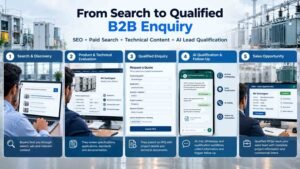
The more useful progression is:
Relevant search → useful product information → technical confidence → enquiry → qualification → sales conversation → quotation → opportunity
Every stage has a different job.
SEO helps the right buyer discover the company.
Product and technical content helps the buyer evaluate it.
Paid advertising captures active demand.
Landing pages make the commercial next step easier.
AI Chat and WhatsApp can respond immediately.
AI qualification can collect and organise initial information.
AI calling and automated follow-up can help prevent good enquiries from being forgotten.
CRM integration gives the sales team visibility.
And sales data can then improve the marketing strategy.
That is a much more useful definition of digital marketing for electrical equipment companies than simply publishing more content every month.
Final Takeaway
An Electrical Equipment manufacturer does not need to become a media company to generate more B2B leads online.
It needs to become easier for the right buyer to find, understand, verify and contact the company.
That starts with product and application visibility, continues through useful technical information and ends with a better enquiry and follow-up experience.
SEO for electrical equipment companies works best when it is connected to the commercial reality of the business. The same applies to paid advertising, content, lead generation and automation.
When these channels are connected to what the sales team actually considers a qualified opportunity, digital marketing stops being measured only by traffic and starts contributing to the pipeline.
Frequently Asked Questions
How does SEO help electrical equipment companies generate B2B leads?
SEO helps manufacturers become visible when engineers, procurement teams, EPC companies and other commercial buyers search for products, suppliers, applications and technical information. The strongest opportunities usually come from combining product, specification, application and commercial-intent searches rather than targeting broad keywords alone.
What should an electrical equipment manufacturer’s website include?
At minimum, the website should clearly present its product range, technical specifications, applications, manufacturing capabilities, relevant standards or certifications, technical documents and a straightforward enquiry process. More complex businesses can also benefit from product filters, document uploads and application-specific landing pages.
Is Google Ads useful for industrial electrical equipment?
Yes, when campaigns are built around relevant commercial search intent. Paid search can provide visibility for active procurement searches while organic SEO develops over time. Careful keyword selection and negative keywords are important to reduce irrelevant traffic.
Should manufacturers publish technical content?
Yes, provided the content addresses genuine buyer questions. Technical articles, selection guides, application pages, specification explanations and comparison content can help buyers during research while creating additional opportunities for organic search visibility.
How can AI improve B2B electrical equipment lead handling?
AI can help engage website visitors, collect basic project information, qualify enquiries, respond through chat or WhatsApp, trigger follow-ups, use AI calling where appropriate and update CRM workflows. The manufacturer’s sales or engineering team can then handle enquiries that require technical or commercial expertise.
What is the difference between SEO and AI SEO for electrical equipment companies?
Traditional SEO focuses on search visibility through areas such as technical optimisation, keywords, content and website architecture. AI SEO extends the approach toward more conversational, contextual and question-based discovery, helping content address the broader information needs surrounding a product or service.
How should an electrical equipment company measure digital marketing?
Look beyond impressions and traffic. Useful commercial measurements include qualified B2B enquiries, RFQ completion, technical document requests, drawing uploads, cost per qualified lead, quotations generated, pipeline value and revenue influenced by digital channels.
AdsThrive helps industrial and B2B companies connect SEO, AI SEO, paid advertising, lead generation and AI-powered enquiry automation into customized workflows.
If your goal is to attract more relevant industrial buyers, qualify enquiries faster and give your sales team better opportunities to work on, the next step is to build the digital process around your actual products and sales cycle.