A textile plant looking for an ETP, a pharmaceutical manufacturer needing purified water, a hotel evaluating an STP, and a food-processing unit trying to reuse processed water are not looking for the same thing. Yet many water treatment websites market all of them through one generic “water treatment solutions” page.
That creates a commercial problem: the company may have the right technology but fail to appear when an industry-specific requirement reaches Google.
For Water Treatment companies, Google can do more than generate website traffic. It can expose which industries are actively creating demand, bring those visitors to the right solution page, capture technical requirements and move serious enquiries into a sales process.
This guide takes a different approach to SEO for water treatment companies. Instead of starting with keywords or generic SEO tactics, it starts with the industries that actually use water and wastewater treatment systems, then builds the Google strategy around those commercial opportunities.
The opportunity is not “water treatment” — it is the industry problem behind it
A company rarely wakes up and searches Google because it wants “water treatment.”
The business problem usually comes first.
- A textile manufacturer may need to manage coloured effluent.
- A pharmaceutical plant may need high-purity process water.
- A food-processing facility may need wastewater treatment before discharge or reuse.
- A hotel may need sewage treatment.
- A chemical plant may require an ETP designed around a difficult effluent stream.
- A power plant may need demineralised or boiler-feed water.
- A commercial development may require an STP.
- A manufacturing facility may want to reduce freshwater consumption through recycling.
These are different commercial opportunities.
Indian water-treatment companies already market solutions such as STP, ETP, RO, UF, DM, ZLD and water-recycling systems across sectors including pharmaceuticals, chemicals, textiles, food and beverage, healthcare, power, hospitality and manufacturing.
That creates the central marketing idea for this article:
Don’t market the treatment plant first. Market the industrial situation that creates the need for the treatment plant.
Once that principle is applied, Google becomes much more useful.
Start with where the money comes from
Before changing titles, publishing blogs or running Google Ads, divide the business into its actual revenue opportunities.
For most industrial water-treatment companies, these can fall into several commercial groups.
| Revenue opportunity | Typical requirement | Example buyer industry |
| New treatment plants | ETP, STP, WTP | Manufacturing, pharma, food |
| Water purification | RO, UF, DM | Pharma, electronics, power |
| Wastewater reuse | Recycling systems | Textile, chemical, food |
| Zero Liquid Discharge | ZLD systems | Textile, pharma, chemical |
| Plant upgrades | Capacity or technology upgrade | Existing industrial plants |
| Replacement | Membranes, equipment, components | Existing installations |
| O&M | Operation and maintenance | Industrial facilities, hotels |
| Compliance-driven projects | Treatment and monitoring | Regulated industries |
| Water-efficiency projects | Recovery and reuse | Water-intensive industries |
This immediately changes the marketing conversation.
Instead of asking:
“How do we rank for water treatment?”
the better questions become:
“Which industries need ETP?”
“Which industries need ZLD?”
“Who needs industrial RO?”
“Where does STP demand come from?”
“Which existing facilities may need upgrades or O&M?”
That is a much more commercially useful starting point for Digital marketing for water treatment companies.
Turn industrial sectors into your Google growth map
The strongest websites in this market should make it obvious what they can do for a particular industry.
Consider the difference.
Generic page
Industrial Water Treatment Solutions
We provide advanced water treatment solutions for various industries.
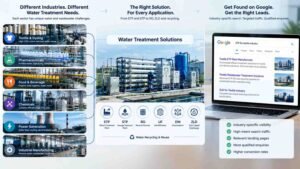
This tells Google and the visitor very little.
Industry-led page
Water Treatment Solutions for Pharmaceutical Manufacturing
Now the page can discuss:
- Process water
- Purified water
- Water for manufacturing
- Wastewater treatment
- API and formulation-related wastewater
- RO/DM systems
- ETP requirements
- ZLD where applicable
- Reuse opportunities
- Documentation
- Installation
- O&M
The same principle can be applied to other sectors.
High-value industry pages
- Textile and dyeing
- Pharmaceuticals
- Chemicals
- Food and beverage
- Dairy
- Power generation
- Hospitals
- Hotels and resorts
- Automobile manufacturing
- Electronics
- Engineering manufacturing
- Paper and pulp
- Sugar and distilleries
- Oil and gas
- Real estate and townships
- Marine and offshore
Industry application pages like these are already common across Indian water-treatment businesses because treatment requirements vary substantially by sector.
The SEO opportunity is to make those pages commercially stronger and more specific, rather than simply creating an industry list.
Give every major industry a reason to contact you
An industry page should not finish with:
“Contact us for more information.”
That is too weak for a high-value industrial enquiry.
A better page should lead the visitor toward a specific commercial action.
For example:
Textile industry page
Problem: High-colour, high-COD wastewater
Possible solutions: ETP, RO, ZLD, water recovery
Conversion: Request an ETP assessment
Pharmaceutical page
Problem: Process-water quality and complex wastewater
Possible solutions: RO, DM, ETP, purified-water systems
Conversion: Discuss your water-treatment requirement
Food-processing page
Problem: Organic wastewater and high BOD/COD
Possible solutions: ETP, biological treatment, water reuse
Conversion: Submit plant capacity and wastewater details
Hotel page
Problem: Sewage treatment and reuse
Possible solutions: STP, treated-water reuse, O&M
Conversion: Request an STP proposal
This is where lead generation for water treatment companies becomes connected to SEO.
The page does not merely attract visitors.
It gives the visitor a reason to become a lead.
Use Google to capture different stages of the same industry requirement
A major opportunity is to stop treating every search as a completely separate customer.
One industrial requirement can create multiple searches.
Imagine a textile company considering a new wastewater-treatment project.
Early research may involve:
textile wastewater treatment
Later:
textile ETP plant
Then:
textile ETP manufacturer
Then:
ZLD system for textile industry
Then:
ETP plant cost
Then:
ETP company in India
A manufacturer that has only one product page may appear for only part of this journey.
A manufacturer with a well-connected content architecture can address several stages.
Example content cluster
Main commercial page
Textile ETP Plant Manufacturer
↓
Supporting pages
Textile Wastewater Treatment
How Textile ETP Systems Work
ZLD for Textile Industry
Textile Water Recycling
ETP Upgrade and O&M
↓
Conversion
Request Technical Proposal
This is more valuable than publishing ten unrelated blogs.
The keyword opportunity is bigger than the obvious product term
The following table illustrates the types of searches an industrial water-treatment business can potentially capture.
These are search themes, not claimed search-volume figures. Exact volume and keyword difficulty should be validated in the company’s keyword research tool before assigning targets.
| Search category | Example search | Commercial intent |
| Core product | industrial water treatment plant | High |
| Industry | ETP for textile industry | Very High |
| Industry | pharmaceutical wastewater treatment | High |
| Application | industrial water recycling system | High |
| Technology | industrial RO plant | High |
| Technology | ZLD plant manufacturer | Very High |
| Project | ETP plant manufacturer in India | Very High |
| Replacement | ETP plant upgrade | High |
| Service | water treatment plant O&M | High |
| Problem | wastewater treatment for food industry | High |
| Location | ETP manufacturer in Hyderabad | High |
| Commercial | water treatment plant cost | High |
| Agency | SEO for water treatment companies | Commercial |
| Growth | lead generation for water treatment companies | Commercial |
The important point is that a website can capture demand before the visitor has decided exactly which technology to buy.
That is particularly valuable in engineered projects.
Build separate Google Ads campaigns around commercial situations
SEO takes time.
Google Ads can place a water-treatment company directly in front of people already searching for a solution.
But there is a major difference between running:
Industrial Water Treatment – Get Quote
and building campaigns around actual commercial requirements.
For example:
Campaign: Textile ETP
Keywords and landing page centred around textile wastewater treatment.
Campaign: Pharmaceutical Water Treatment
Focused on pharma water and wastewater applications.
Campaign: ZLD
Focused on zero-liquid-discharge requirements.
Campaign: Industrial RO
Focused on industrial purification and process-water requirements.
Campaign: STP
Focused on commercial, institutional and residential-scale sewage treatment where relevant.
Campaign: ETP Upgrade
Focused on existing plants that require capacity expansion, process changes or performance improvements.
Each campaign should lead to a matching landing page.
This improves the connection:
Google search → relevant solution → industry proof → enquiry
rather than:
Google search → homepage → visitor leaves
Google Ads should also have negative-keyword controls and lead-quality tracking so that budget does not get consumed by irrelevant residential, academic or DIY searches.
Make the website behave like a technical sales engineer
This is one of the biggest commercial opportunities.
A good water-treatment website should answer enough questions for a potential customer to determine:
“Is this company capable of handling my requirement?”
For an ETP page, that might mean showing:
- Typical industries served
- Treatment capacity
- Treatment technologies
- Effluent characteristics
- Process stages
- Installation capability
- Automation options
- Compliance considerations
- Water-reuse possibilities
- O&M support
- Project experience
- Technical documentation
- Enquiry requirements
For an RO page:
- Feed-water conditions
- Capacity
- Recovery considerations
- Pretreatment
- Membrane configuration
- Applications
- Water-quality targets
- Installation requirements
- O&M
The exact information depends on the product and company capability.
The point is simple:
technical information should reduce sales friction.
It should not exist only as a PDF nobody finds.
Turn compliance into a commercial advantage
Water treatment has a feature that many other industries do not:
regulatory requirements can directly create commercial demand.
CPCB publishes industry-specific effluent standards covering sectors including textiles, pharmaceuticals, chemicals and other industries. Its standards also include requirements and guidance around treated effluent and reuse/recycling in specific contexts.
That creates useful content opportunities.
Instead of writing:
“Our ETP is high quality.”
A stronger page could explain:
How textile effluent treatment requirements affect ETP design
Or:
What pharmaceutical manufacturers should evaluate before selecting an ETP
Or:
When wastewater reuse can reduce freshwater demand
This type of content can attract people who have a real project problem.
It also creates an opportunity for SEO services for water treatment companies to work with the engineering team rather than producing generic marketing articles.
Water reuse can be marketed as a business outcome
One of the strongest angles in this sector is that treatment is not always about disposal.
It can also be about reuse.
Government water resources material documents industrial reuse applications involving treated wastewater, including cooling and process applications. It also describes reuse and treatment approaches involving technologies such as UF and RO across sectors including textiles, food processing, distilleries and engineering industries.
That creates a completely different content angle.
Instead of:
Industrial Water Treatment Plant
you can build commercial content around:
Industrial Water Recycling Solutions
Water Reuse for Manufacturing
Process Water Recovery
RO-Based Water Recycling
Wastewater Recovery for Textile Plants
Water Recovery for Food Processing
This is valuable because the business case can move beyond compliance.
The conversation becomes:
freshwater consumption → wastewater → treatment → recovery → reuse
For a water-intensive industry, that can be a much stronger commercial story.
ZLD deserves its own commercial content path
Zero Liquid Discharge should not simply be listed under “our technologies.”
It can represent an entire commercial search category.
A ZLD buyer may need to understand:
- Why ZLD is required
- What wastewater characteristics matter
- Pretreatment
- RO
- Evaporation
- Crystallisation
- Reject management
- Water recovery
- Operating considerations
- Industry-specific applications
A dedicated ZLD content cluster can therefore include:
ZLD Plant Manufacturer
ZLD for Textile Industry
ZLD for Pharmaceutical Wastewater
Industrial ZLD Process
ZLD Plant Upgrade
ZLD O&M
This creates a much stronger Google footprint than one paragraph about ZLD on a generic water-treatment page.
Existing plants are a separate source of leads
New projects are not the only opportunity.
Thousands of treatment systems already operate across industrial and commercial facilities.
Those systems eventually require:
- O&M
- AMC
- Membrane replacement
- Filter replacement
- Pump replacement
- Automation upgrades
- Capacity expansion
- Process optimisation
- Plant refurbishment
- Performance improvement
That means a company can build a second Google strategy around existing installations.
For example:
ETP maintenance company
RO membrane replacement
STP plant maintenance
Industrial RO service
ETP upgrade
Water treatment plant AMC
These searches may not have the same project value as a new plant, but they can create recurring revenue and introduce the company to facilities that may later require larger upgrades.
This is an important distinction for digital marketing for water treatment companies: the website should support both new-project acquisition and installed-base revenue.
LinkedIn should target industries, not “everyone interested in water”
LinkedIn is particularly useful for the industrial side of Water Treatment because the people influencing projects can be identified by industry and role.
For example:
Pharmaceutical campaign
Target:
- Plant heads
- Engineering managers
- Utilities managers
- EHS professionals
- Project managers
Textile campaign
Target:
- Factory heads
- Utilities managers
- ETP managers
- Environmental professionals
- Engineering teams
Food-processing campaign
Target:
- Plant managers
- Engineering heads
- Maintenance managers
- Sustainability teams
The content should match the industry.
A pharmaceutical post about purified water will not necessarily resonate with a textile plant.
A textile ETP case study will be much more relevant to textile manufacturers.
LinkedIn can therefore support Google rather than compete with it.
Google captures existing demand.
LinkedIn can create awareness among companies that may not yet be actively searching.
Social media should show evidence, not generic company posts
A water-treatment company has plenty of material for useful industrial content.
Instead of posting:
“We provide complete water-treatment solutions for all industries.”
Show something specific.
Better content ideas
Before/after plant upgrade
Show the old configuration and what changed.
Industry problem
Explain why textile wastewater differs from food-processing wastewater.
Technology explanation
Show where RO fits into a treatment train.
Project documentation
Explain what information is required before preparing a technical proposal.
Water reuse
Show how treated water can be directed toward an appropriate reuse application.
Plant maintenance
Explain common causes of membrane or equipment performance problems.
This kind of content also gives the sales team material to send after a conversation.
Give Google visitors a better way to request a quotation
A generic contact form creates weak enquiries.
A better industrial form can adapt according to the selected requirement.
For an ETP project
Ask for:
- Industry
- Plant location
- Wastewater source
- Approximate flow
- Current treatment system
- Required capacity
- New plant or upgrade
- Reuse requirement
- Timeline
For an RO requirement
Ask for:
- Feed-water source
- Feed-water quality
- Required capacity
- Desired output quality
- Application
- Existing RO system
- Replacement or new installation
For O&M
Ask for:
- Existing plant type
- Capacity
- Current issue
- Location
- Current O&M arrangement
- Urgency
The form should not feel like an examination.
Ask only what the sales or technical team genuinely needs to make the next conversation useful.
For another practical perspective on generating qualified B2B enquiries in industrial markets, explore our “How Electrical Equipment Companies Can Generate More B2B Leads” for additional strategies and insights.
This is where AI Lead Qualification becomes valuable
Suppose a Google visitor submits:
“Need ETP for textile units. Please call.”
That is a lead, but it is not yet a useful sales opportunity.
AI can continue the conversation through website chat or WhatsApp:
What type of textile process does the facility operate?
Approximately how much wastewater is generated per day?
Is this a new ETP or an upgrade to an existing plant?
Do you require water reuse or ZLD?
Where is the facility located?
The system can then identify whether the enquiry appears to be:
- New project
- Existing plant upgrade
- O&M requirement
- Replacement
- Water-reuse project
- ZLD project
- Low-information enquiry
This helps the sales team prioritize.
Adsthrive’s AI Chatbot Agent can be integrated into this type of qualification workflow, including website conversations and enquiry handling.
WhatsApp can shorten the technical enquiry process
Industrial buyers often have documents already available.
They may have:
- Existing plant photographs
- Water-analysis reports
- Technical specifications
- Existing equipment details
- Flow information
- Laboratory reports
Instead of asking the visitor to manually type everything into a website form, WhatsApp can allow the conversation to continue naturally.
For example:
Visitor:
“We need to upgrade our ETP.”
AI:
“Is this for textile, pharmaceutical, food-processing or another industry?”
Visitor:
“Textile.”
AI:
“Please share your approximate daily effluent flow and, if available, your latest water-analysis report.”
That conversation can generate much more useful information than a standard form.
AI Calling can recover enquiries that would otherwise go cold
A serious industrial enquiry may arrive outside working hours.
It may also be submitted when the company’s sales team is busy.
If nobody responds quickly, the prospect can contact another supplier.
AI calling can support follow-up by:
- Confirming the requirement
- Checking urgency
- Collecting missing information
- Confirming location
- Scheduling a sales call
- Following up on quotations
- Reminding prospects about pending discussions
Adsthrive’s AI Calling Solution can form part of this automated follow-up layer.
The objective is not to replace technical salespeople.
It is to ensure that valuable enquiries do not disappear between the website and the sales team.
18. AI SEO should expand the commercial footprint without creating content spam
There is a temptation to create hundreds of pages:
ETP for Textile Industry
ETP for Textile Industry India
ETP for Textile Industry Manufacturer
ETP for Textile Industry Supplier
That is not a good content strategy.
Instead, each page should add something meaningful.
For example:
Industry page
Water Treatment for Textile Manufacturing
Explains the industry’s requirements.
Technology page
ETP Systems for Textile Wastewater
Explains the treatment approach.
Supporting guide
How Textile Wastewater Treatment Works
Explains the technical problem.
Commercial page
Textile ETP Plant Manufacturer
Targets project enquiries.
Case study
Textile Wastewater Treatment Project
Provides evidence.
This is where AI SEO services can help build contextual coverage without turning the site into a collection of nearly identical pages.
Measure Google by opportunities, not traffic
A water-treatment company should know which industries its marketing is actually producing.
A useful dashboard might look like this:
| Metric | Why it matters |
| Organic enquiries | Measures SEO’s commercial contribution |
| Google Ads enquiries | Measures paid demand capture |
| Industry-page enquiries | Shows which sectors respond |
| Technical proposal requests | Strong buying signal |
| Specification uploads | Indicates serious requirements |
| WhatsApp enquiries | Measures assisted conversion |
| AI-qualified leads | Shows lead quality |
| Site-assessment requests | Indicates project intent |
| Quotations generated | Connects marketing to sales |
| Qualified opportunities | Measures pipeline contribution |
| Orders | Final commercial outcome |
For example, if a company receives 100 enquiries but only 10 are relevant industrial projects, the marketing strategy needs work.
If another campaign produces 30 enquiries and 15 become technical proposals, it may be much more valuable.
That is why lead generation for water treatment companies should ultimately be measured by qualified opportunities and revenue—not just lead volume.
A practical seven-part Google growth strategy
The approach above can be condensed into seven actions.
1. Build the website around industries
Create strong pages for sectors where the company genuinely has technology, experience and commercial capability.
2. Separate new projects from existing-plant demand
Market new ETP/STP/RO/ZLD projects separately from O&M, replacement and upgrade opportunities.
3. Create application-led content
Connect each technology to the industrial problems it solves.
4. Build Google Ads around high-value requirements
Separate campaigns by application, industry and commercial intent.
5. Use LinkedIn to reach target industries
Build account lists and role-based outreach instead of generic industrial messaging.
6. Convert technical enquiries into structured leads
Use intelligent forms, AI Chat and WhatsApp to collect useful project information.
7. Automate follow-up
Use AI qualification, AI calling, WhatsApp and CRM workflows so qualified enquiries reach sales quickly.
Together, these create a commercial system rather than a collection of disconnected marketing activities.
What should a water treatment website make obvious within 30 seconds?
A potential customer should be able to answer five questions quickly:
What do you provide?
ETP, STP, RO, UF, DM, ZLD, recycling, O&M or other genuine capabilities.
Which industries do you serve?
Textile, pharma, food, chemical, power, healthcare, hospitality and others relevant to the company.
Can you handle my scale?
Capacity, project type, installation scope and technical capability.
Can you handle my specific problem?
Wastewater, water purification, reuse, discharge, ZLD, plant upgrade or maintenance.
What should I do next?
Request a technical proposal, share specifications, upload a report, book a discussion or contact the sales team.
If those five answers are unclear, more traffic will not solve the fundamental problem.
How Adsthrive can turn Google visibility into a lead-generation system
For a digital marketing agency for water treatment companies, the job should not stop at ranking pages.
The agency needs to connect the entire commercial path.
Adsthrive can combine:
- SEO services
- AI SEO
- Lead generation
- Google Ads
- LinkedIn outreach
- Landing-page optimisation
- AI Chat
- WhatsApp automation
- AI Lead Qualification
- AI Calling
- Automated follow-up
- CRM updates
- Booking and sales routing
The important part is that these features can be configured around the actual water-treatment business.
A company focused on textile, pharma and chemical industries should not have the same qualification workflow as a company focused on residential, commercial and municipal projects.
A company selling large ETP and ZLD projects needs different lead fields from a company selling RO systems and O&M services.
That is why a customized system is more useful than forcing a business into a standard marketing package.
The strongest commercial model: industry → problem → technology → enquiry
The entire strategy can ultimately be represented without turning the article into another generic marketing funnel:
| Stage | Example |
| Industry | Textile manufacturing |
| Business problem | High-volume wastewater |
| Treatment requirement | ETP / recycling / ZLD |
| Google visibility | Textile wastewater treatment |
| Landing page | Textile ETP solutions |
| Proof | Technology, projects, capabilities |
| Enquiry | Request technical proposal |
| Qualification | Flow, effluent, location, timeline |
| Follow-up | WhatsApp / AI calling / sales |
| Opportunity | Technical proposal and quotation |
Now repeat the same commercial logic for pharma, food, chemical, power, healthcare, hospitality and other relevant industries.
That is how a water-treatment company can build a much broader Google presence without producing duplicate articles.
Frequently Asked Questions
How can Water Treatment companies generate more leads through Google?
Build Google visibility around industries, applications and treatment problems rather than relying on one generic water-treatment page. Combine SEO with Google Ads, industry-specific landing pages, technical content, structured enquiry forms and AI-powered qualification.
Which industries use Water Treatment systems?
Industrial and commercial applications include pharmaceuticals, textiles, chemicals, food and beverage, dairy, power, healthcare, hospitality, automobile manufacturing, electronics, engineering, oil and gas and other water-intensive sectors. The exact industries should match the company’s actual capabilities.
Should an industrial water-treatment company create separate pages for every industry?
Not necessarily. Create separate pages where the treatment requirement, technology, regulations, applications or commercial proposition genuinely differs. Avoid creating thin pages that only change the industry name.
Is Google Ads useful for water-treatment companies?
Yes. Google Ads can capture high-intent searches for ETP, STP, RO, ZLD, water recycling, treatment-plant upgrades and other commercial requirements. Campaigns should lead to relevant landing pages and be measured by qualified enquiries rather than clicks alone.
What information should a water-treatment enquiry form collect?
Depending on the project, useful information may include industry, location, water or wastewater source, approximate flow, existing treatment system, required capacity, technology requirement, reuse requirement and project timeline.
How can AI qualify water-treatment leads?
AI can ask follow-up questions based on the selected application, collect technical information, identify project type and urgency, and route qualified enquiries to the appropriate sales team.
Can WhatsApp help generate industrial water-treatment leads?
Yes. WhatsApp can allow prospects to share specifications, reports, photographs and project information while AI handles initial qualification before the enquiry reaches sales.
Should Water Treatment companies invest in SEO and Google Ads together?
Usually, yes. SEO builds organic visibility over time, while Google Ads can capture immediate demand. They work best when both channels use the same industry-specific landing pages and conversion tracking.
Final takeaway
The biggest Google opportunity for a water treatment company is not simply ranking for “water treatment.”
It is owning the searches created by the industries that depend on water treatment.
A textile manufacturer has one problem.
A pharmaceutical manufacturer has another.
A food-processing plant has another.
A hotel needs something different from a chemical plant.
A power facility has different water-quality requirements.
An existing ETP creates another type of opportunity altogether.
That gives SEO for water treatment companies a much stronger commercial direction.
Build visibility around the industries.
Explain the problem.
Connect it to the appropriate technology.
Show technical capability.
Make the enquiry easy.
Use Google Ads to capture immediate demand.
Use LinkedIn to reach target accounts.
Use AI Chat and WhatsApp to collect missing information.
Use AI Lead Qualification to separate genuine opportunities from weak enquiries.
Use AI Calling and automated follow-up to prevent qualified leads from going cold.
And connect all of it through one customised system rather than treating SEO, advertising, lead generation and automation as unrelated activities.
Google should not simply send more visitors to a water-treatment website. It should help send the right industrial opportunities to the sales team.
Turn Google Searches into Qualified Water Treatment Opportunities
Getting found on Google is only the first step. Water treatment companies need the right industries to discover the right solutions, submit meaningful enquiries and move into sales conversations.
Adsthrive combines SEO, AI SEO, Google Ads, lead generation, LinkedIn outreach, AI Chat, WhatsApp automation, AI lead qualification and AI calling into a customized system built around your business and sales process.
Get found by the right industries. Generate better enquiries. Convert more opportunities.