Industrial batteries are not bought because a company simply “needs a battery.” They are bought because a telecom network needs backup, a data centre cannot tolerate downtime, a factory needs reliable power for critical systems, a solar project needs storage, a utility needs grid flexibility, or an industrial vehicle needs dependable motive power. That distinction matters for marketing. A battery manufacturer that only promotes battery chemistry, voltage, capacity and product ranges can miss the industries already creating demand for those products.
India’s energy-storage market is also becoming broader. Government and industry sources identify applications spanning telecom, UPS, solar, grid storage, railways, industrial backup and other commercial and industrial uses. At the same time, BIS maintains standards covering stationary lead-acid batteries, solar photovoltaic batteries and secondary lithium batteries for industrial applications.
For an industrial battery company, the opportunity is therefore bigger than ranking for “industrial battery.” The real opportunity is to become visible inside the industries where batteries solve an expensive operational problem.
This article takes that approach. Instead of building another generic SEO checklist, it looks at where industrial battery demand actually comes from, how each industry should be marketed, and how Adsthrive can connect SEO, Google Ads, LinkedIn, lead generation and AI-powered enquiry handling into a commercial growth system.
The real marketing problem: your battery is rarely the customer’s starting point
Consider two searches:
- “industrial lithium battery manufacturer”
- “battery backup for telecom tower”
Both may eventually lead to a battery manufacturer.
But the second search tells you much more about the commercial situation.
The person searching for telecom backup is already thinking about an operating environment. They may care about backup duration, temperature, cycle life, maintenance, installation conditions and total operating cost.
The same principle applies elsewhere.
A data-centre operator may care about UPS backup and reliability. A solar developer may be evaluating storage capacity and discharge requirements. A factory may be replacing ageing batteries in a backup system. A warehouse operator may be looking for batteries for material-handling equipment.
The battery is the product, but the application creates the demand.
That is where the digital marketing opportunity starts.
Where do Industrial Batteries actually get used?
A strong marketing strategy begins by mapping the industries and operating environments where the product creates value.
India’s official and industry-related sources already show how broad this market is. A NITI Aayog energy-storage roadmap identifies applications including telecom towers, UPS, data centres and industrial/commercial energy storage. Government material has also identified applications such as telecom, UPS, solar, railways, inverter backup, microgrids and grid integration.
A practical commercial map looks like this:
| Industry / Application | Battery Requirement | Potential Marketing Angle |
| Telecom | Reliable backup power | Telecom backup batteries, tower energy storage |
| Data centres | UPS and short-duration backup | Data-centre UPS batteries, critical backup |
| Manufacturing | Backup and critical equipment power | Industrial backup batteries, factory power continuity |
| Solar & renewable energy | Energy storage | Solar storage batteries, BESS solutions |
| Utilities & power | Grid support and storage | BESS, peak shifting, grid flexibility |
| Railways | Stationary and rolling-stock applications | Railway batteries, signalling and backup |
| Warehousing & logistics | Motive power | Forklift and material-handling batteries |
| Mining & heavy industry | Rugged power systems | Heavy-duty industrial battery solutions |
| Commercial facilities | UPS and backup | Commercial backup battery systems |
| Industrial automation | Reliable power for critical systems | Automation backup and DC power solutions |
This table should not simply become a list on the website.
It should become the commercial architecture of the website.
Build the website around industries, not only battery models
A common battery website structure looks like this:
Home → Batteries → Products → Specifications → Contact
That structure works for someone who already knows the manufacturer.

It is less effective for a company trying to generate new demand.
A better architecture can connect:
Industry → Application → Battery requirement → Product → Enquiry
For example:
Telecom
→ Telecom backup
→ Required backup duration
→ Suitable battery technology
→ Relevant product range
→ Request a quotation
Or:
Solar
→ Energy storage
→ Required capacity and discharge profile
→ Battery technology
→ Storage solution
→ Project enquiry
This creates more commercially useful landing pages without producing dozens of thin pages with slightly different keywords.
A useful industry page should answer:
- What problem does the battery solve?
- Where is it used?
- Which battery technologies are suitable?
- What operating conditions matter?
- What specifications need to be evaluated?
- What standards or testing requirements apply?
- What information should the buyer provide?
- Which products can meet the requirement?
- How can the buyer request a quotation?
That is much stronger than creating a page that simply repeats “industrial battery manufacturer” twenty times.
This is where SEO for industrial battery companies becomes commercially useful: SEO is not just about putting a manufacturer in front of more people. It is about creating visibility around the applications where the manufacturer can actually win business.
Turn the biggest industries into separate revenue opportunities
Not every industry should receive the same marketing treatment.
A battery company may have excellent products for telecom but limited traction in data centres. Another may have strong lead-acid manufacturing capabilities and an established replacement market. Another may be building lithium-ion or BESS capabilities.
The marketing strategy should therefore follow commercial strength + market opportunity, rather than creating pages simply because a keyword exists.
Telecom: sell reliability, not just capacity
Telecom is a particularly useful market because backup power is part of network reliability.
The marketing message should focus on:
- Backup requirements
- Battery life
- Operating conditions
- Maintenance
- Temperature tolerance
- Installation environment
- Replacement requirements
- Telecom infrastructure compatibility
The page should also make it easy for a visitor to identify the right product.
A telecom-specific landing page can generate enquiries from network operators, infrastructure companies, system integrators and maintenance providers without forcing all of them through a generic product page.
Data centres: the cost of failure changes the conversation
Data centres represent another commercially important segment.
The buyer is not simply looking for “a battery.”
They are concerned about keeping critical systems running during interruptions and ensuring the battery system works as part of a larger UPS infrastructure.
The International Energy Agency reported that battery-based UPS capacity additions, primarily in data centres, grew significantly in 2025.
That creates several potential content and advertising angles:
- Data-centre UPS batteries
- Battery backup for critical infrastructure
- UPS battery replacement
- High-reliability battery systems
- Battery maintenance and replacement
- Battery selection for critical loads
Instead of competing only for “industrial battery,” a manufacturer can create visibility around these more specific commercial situations.
Manufacturing: the opportunity is bigger than backup power
Manufacturing plants use batteries in several contexts.
They may require:
- UPS backup
- Control-system backup
- Emergency systems
- Industrial automation
- DC power systems
- Material-handling equipment
- Renewable-energy storage
- Critical instrumentation
This means “manufacturing” itself can become a useful industry category.
The page should explain the consequences of power interruption in a factory rather than simply describe the battery.
For example:
A battery system supporting a PLC, control system or critical automation equipment has a different commercial requirement from a battery used for motive power.
That distinction gives the website a reason to create separate content and helps visitors identify whether the manufacturer’s products actually fit their application.
Make replacement demand a separate lead-generation channel
There is another source of demand that many manufacturers under-market:
replacement.
Replacement searches can be highly valuable because the customer already has an installed battery system.
They may already know:
- Battery voltage
- Ah rating
- Existing technology
- Physical dimensions
- Terminal arrangement
- Application
- Quantity
- Installation environment
- Required replacement date
The marketing opportunity is to make that information easy to submit.
Instead of:
“Contact us for more information.”
Use a replacement-oriented enquiry process:
Existing battery → specification → application → quantity → replacement requirement → quotation
A website could allow the visitor to submit:
- Existing battery model
- Voltage
- Capacity
- Dimensions
- Application
- Quantity
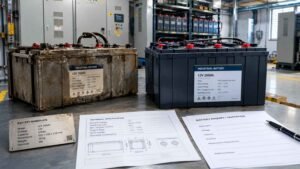
- Photograph of nameplate
- Replacement timeline
That creates a much better sales enquiry.
It also gives lead generation for industrial battery companies a practical conversion mechanism rather than treating lead generation as simply “getting contact-form submissions.”
Use battery specifications as sales tools, not walls of technical text
Battery manufacturers have a natural advantage that many B2B companies fail to use:
their products already contain commercially valuable technical information.
Capacity, voltage, cycle life, discharge characteristics, dimensions, operating temperature, charging requirements, terminal configuration and chemistry can all help a buyer evaluate suitability.
But publishing a PDF alone does not guarantee that it will generate leads.
The website should translate technical information into decision-making content.
For example:
Instead of:
Battery Model X
- 12V
- 150Ah
- 1500 cycles
- 45 kg
Create:
150Ah Industrial Battery for Backup Applications
Then explain:
- Suitable applications
- Expected operating environment
- Important selection considerations
- Available configurations
- Technical documentation
- Installation considerations
- Replacement compatibility
- Enquiry requirements
This gives search engines more context and gives buyers more reasons to continue.
BIS currently lists Indian standards covering several battery categories, including IS 16822:2019 for secondary lithium cells and batteries for industrial applications, IS 16805 for safety requirements for secondary lithium cells and batteries used in industrial applications, and IS 16270 for batteries used in solar photovoltaic applications.
That creates another content opportunity: standards and technical compliance can become part of the commercial website experience.
5. Don’t hide your strongest battery applications behind one “Industries Served” page
A common website mistake is creating one page called:
Industries We Serve
Then placing ten industries in a paragraph.
That page may tell visitors what the company does, but it does not create enough depth for search visibility.
Instead, use a hierarchy:
Industrial Batteries
Telecom
- Telecom backup batteries
- Tower backup applications
- Replacement requirements
Data Centres
- UPS batteries
- Critical backup
- Battery replacement
Manufacturing
- Industrial backup
- Automation
- Critical systems
Solar & Energy Storage
- Solar storage
- BESS
- Peak shifting
Railways
- Stationary batteries
- Signalling
- Railway applications
Material Handling
- Forklift batteries
- Warehouse equipment
- Motive power
This gives the website a much larger relevant search footprint while keeping every page commercially connected.
The important part is not to manufacture content for every possible keyword.
Create a page only when the manufacturer genuinely has something useful to say about that application.
Build a search portfolio instead of chasing one “industrial battery” keyword
The exact-match SERP for “SEO for industrial battery companies” is relatively sparse compared with broad SEO queries, which is actually useful.
There is little value in copying generic agency articles that say the same thing about keywords, backlinks and social media.
A better approach is to build topical depth around the actual industrial battery market.
The following is the type of search portfolio an industrial battery company can develop:
| Search type | Example search | Commercial value |
| Product | industrial battery manufacturer | High |
| Application | industrial battery for UPS | High |
| Industry | battery for telecom backup | High |
| Application | solar energy storage battery | High |
| Replacement | industrial UPS battery replacement | Very High |
| Product specification | 48V industrial battery | High |
| Technology | lithium battery for industrial backup | High |
| Project | battery energy storage system supplier | High |
| Equipment | forklift battery supplier | High |
| Service | industrial battery replacement | High |
| Problem | battery backup for manufacturing plant | High |
| Agency | SEO for industrial battery companies | Commercial |
| Growth | lead generation for industrial battery companies | Commercial |
These are search themes, not claims about search volume.
I would not publish fabricated daily search volumes or keyword-difficulty numbers without access to a verified keyword database. The commercial value here comes from matching the search with a real application and sales opportunity.
Paid search should follow the application map
Google Ads becomes more effective when it is separated by commercial intent.
A single campaign called:
Industrial Batteries
can attract an extremely mixed audience.
A better campaign structure could be:
Campaign 1 — Telecom Batteries
Landing page:
Industrial Batteries for Telecom Backup
Campaign 2 — UPS Batteries
Landing page:
Industrial UPS Battery Solutions
Campaign 3 — Solar & BESS
Landing page:
Battery Energy Storage Solutions
Campaign 4 — Replacement
Landing page:
Industrial Battery Replacement
Campaign 5 — Material Handling
Landing page:
Industrial Batteries for Forklifts and Warehouse Equipment
Each campaign can then use application-specific messaging.
This is where SEO services for industrial battery companies and paid search should support each other rather than operate as separate activities.
SEO builds long-term visibility.
Google Ads provides immediate visibility for commercially valuable searches.
The landing page handles the conversion.
And the lead-management system determines what happens next.
Social media should demonstrate capability, not just celebrate products
Battery manufacturers often post:
“Our latest battery model is now available.”
That is useful occasionally, but it is not enough to create demand.
A stronger industrial content mix would show the battery in context.
Example LinkedIn topics
Post 1:
Why backup battery selection differs between a telecom site and a manufacturing plant.
Post 2:
What information should a buyer provide when requesting an industrial battery replacement?
Post 3:
Lead-acid vs lithium-ion for specific industrial applications.
Post 4:
What battery specifications should an engineering team check before replacement?
Post 5:
Where battery storage fits into a solar-plus-storage project.
Post 6:
What happens when a UPS battery reaches the end of its useful operating life?
These topics do something important:
They give sales teams material that can be shared with prospects.
That makes social media part of the sales process rather than simply an engagement channel.
LinkedIn outreach works better when the target industry is specific
A battery manufacturer does not necessarily need to message thousands of people.
The better opportunity is to build small, relevant account groups.
For example:
Telecom campaign
Target:
- Telecom infrastructure companies
- Network infrastructure managers
- Power-system engineers
- Operations managers
- Maintenance teams
Data-centre campaign
Target:
- Data-centre operators
- Facility managers
- Critical-power engineers
- Infrastructure managers
- Electrical engineering teams
Manufacturing campaign
Target:
- Plant heads
- Maintenance managers
- Electrical engineers
- Automation managers
- Operations directors
The outreach message should then relate to the application.
Instead of:
“We are a leading industrial battery manufacturer. Please let us know if you have requirements.”
Try:
“We work with industrial backup applications where battery replacement and uptime are critical. If your facility is reviewing UPS or DC backup systems, we can help evaluate the existing battery specification and replacement requirement.”
That is a commercial conversation rather than a generic sales pitch.
A battery enquiry should tell the sales team something useful
This is where many industrial websites lose the value created by SEO and advertising.
Imagine spending money to bring 500 relevant visitors to a website and then asking all of them to fill:
Name | Email | Phone | Message
The sales team receives:
“Need battery. Please contact.”
The marketing campaign may have generated a lead, but the sales process still has to discover everything.
A better form could ask:
| Qualification field | Why it matters |
| Industry | Identifies application |
| Battery type | Establishes product requirement |
| Voltage | Narrows product range |
| Capacity | Helps technical qualification |
| Quantity | Indicates opportunity size |
| Existing battery | Useful for replacement |
| Application | Determines suitability |
| Location | Helps sales routing |
| Required timeline | Identifies urgency |
| Upload specification/nameplate | Adds technical context |
The form does not have to ask every question every time.
A smart form can progressively collect information based on the application selected.
This is where AI Lead Qualification becomes commercially useful
AI should not be added simply because “AI” is popular.
For an industrial battery company, AI has a specific job:
turn an incomplete enquiry into a sales-ready requirement.
Suppose someone sends this through WhatsApp:
“Need 48V battery for warehouse equipment. 6 units. Please quote.”
An AI qualification system can ask:
What equipment will the batteries be used with?
What is the required Ah capacity?
Are these replacing existing batteries?
What is the current battery model?
When do you need replacement?
The system can then classify the enquiry.
| Lead information | AI action |
| Clear application + specification + quantity | High-priority lead |
| Application known, specifications missing | Ask qualification questions |
| Product enquiry without urgency | Nurture |
| Replacement request with model number | Route to sales quickly |
| Large project / BESS enquiry | Escalate to specialist |
| Irrelevant enquiry | Filter or route separately |
This is much closer to the commercial reality of lead generation for industrial battery companies.
The objective is not to generate the largest number of forms.
It is to generate more useful sales conversations.
WhatsApp can become the fastest route from interest to qualification
Industrial buyers increasingly expect quick responses, particularly when the enquiry concerns replacement or an active project.
A battery company can use AI Chat and WhatsApp to handle common first-stage questions:
- Which battery is required?
- Do you supply lithium batteries?
- Do you supply lead-acid batteries?
- Can you replace an existing model?
- What information is required for a quotation?
- Do you supply batteries for telecom?
- Do you supply UPS batteries?
- Can you handle bulk quantities?
- Can I upload a specification sheet?
Instead of forcing every visitor to navigate five website pages, the system can collect the requirement and move it towards sales.
Adsthrive’s AI Chatbot Agent solution can be positioned around this type of enquiry-handling workflow rather than as a generic website chatbot.
AI Calling matters when the enquiry is worth chasing
Some battery requirements are time-sensitive.
A replacement requirement may need immediate attention.
A large BESS project may require several technical discussions.
A distributor may need pricing and availability.
A manufacturing company may need a replacement before planned maintenance.
If the sales team waits until the next working day, the opportunity may cool.
AI calling can support this stage by:
- Confirming enquiry details
- Checking whether the requirement is active
- Asking basic qualification questions
- Confirming preferred contact time
- Following up on unanswered enquiries
- Reminding prospects about pending quotations
- Updating the CRM with conversation information
Adsthrive’s AI Calling Solution can therefore be positioned as part of the follow-up layer rather than as a standalone calling product.
The commercial system should connect SEO, Ads and AI
This is where an industrial battery company can move beyond traditional digital marketing.
The system can work like this:
Industry demand
→ Telecom / Data Centre / Manufacturing / Solar / Utility / Railway / Warehouse
↓
Search visibility
→ SEO + AI SEO + application content
↓
Paid demand capture
→ Google Ads + industry-specific landing pages
↓
Enquiry
→ Website form / WhatsApp / AI Chat
↓
Qualification
→ AI Lead Qualification
↓
Follow-up
→ WhatsApp / Email / AI Calling
↓
Sales
→ Qualified requirement → quotation → opportunity
The important point is that the channels are not separate projects.
SEO creates discovery.
Ads capture immediate demand.
Content builds confidence.
AI captures missing information.
Calling and WhatsApp accelerate follow-up.
Sales receives better-contextualised opportunities.
That is a much stronger proposition than simply saying “we will increase website traffic.”
AI SEO can expand the application footprint
Traditional SEO often starts with a keyword list.
AI-assisted search changes how people discover information.
A buyer might ask:
“What type of battery is suitable for backup power at a telecom site in a high-temperature environment?”
Or:
“What should I check before replacing a 48V industrial battery system?”
Or:
“Is lithium-ion suitable for industrial UPS backup?”
The manufacturer that has useful, structured information around these questions has a better opportunity to appear across different discovery paths.
This is where Adsthrive’s AI SEO services can complement conventional SEO by building contextual coverage around applications, questions, product relationships and buyer problems.
The goal is not to publish hundreds of AI-generated pages.
That would create exactly the kind of repetitive content this article is designed to avoid.
Instead, each piece of content should have a commercial reason to exist.
What should an industrial battery company measure?
Traffic is useful, but it is not the final business metric.
A better measurement model follows the journey from visibility to revenue.
| Metric | What it tells you |
| Organic enquiries | Whether SEO is creating demand |
| Application-page enquiries | Which industries respond |
| Cost per qualified lead | Whether paid campaigns are efficient |
| Replacement enquiries | Strength of installed-base demand |
| Specification uploads | Quality of technical interest |
| WhatsApp conversations | Engagement after discovery |
| AI-qualified leads | Sales-readiness |
| Quotation requests | Commercial intent |
| Qualified opportunities | Pipeline contribution |
| Quotation-to-order rate | Sales quality |
| Repeat enquiries | Account potential |
For example, suppose a generic “industrial battery” campaign generates 100 enquiries while a telecom campaign generates only 25.
If 15 of the telecom enquiries become quotations and only 5 generic enquiries do, the telecom campaign may be considerably more valuable.
That is why marketing performance should be evaluated at the qualified opportunity level, not only at the click or lead level.
What a complete digital marketing system for an industrial battery company can look like
A manufacturer does not necessarily need ten disconnected marketing tools.
The better approach is to connect the functions around the actual sales process.
Adsthrive can bring together:
- SEO services
- AI SEO
- Lead generation
- Google Ads
- LinkedIn marketing and outreach
- AI Chat
- WhatsApp automation
- AI lead qualification
- AI Calling
- Automated follow-ups
- CRM updates
- Booking and sales routing
The advantage is not simply having all these features.
The advantage is designing them around the manufacturer’s workflow.
For example, a manufacturer targeting telecom, UPS and solar applications may need three different qualification paths.
A telecom enquiry may require:
Battery type → voltage → Ah → tower/site → quantity → replacement
A BESS enquiry may require:
Project capacity → application → duration → chemistry → installation → project timeline
A replacement enquiry may require:
Existing model → nameplate → dimensions → quantity → replacement date
The automation should reflect these differences.
That is what makes the system useful commercially.
Build content around the industries where you can actually sell
A useful content portfolio could look like this:
Core commercial pages
- Industrial Battery Manufacturer
- Industrial Battery Solutions
- Industrial Battery Replacement
- Industrial Battery Supplier
- Industrial Lithium Battery Solutions
Industry pages
- Batteries for Telecom
- Batteries for Data Centres
- Batteries for Manufacturing
- Batteries for Solar & Energy Storage
- Batteries for Railways
- Batteries for Material Handling
- Batteries for Utilities
Application content
- Industrial UPS Battery Selection
- Battery Backup for Manufacturing Plants
- Industrial Battery Replacement Guide
- Solar Battery Storage Requirements
- Battery Backup for Telecom Infrastructure
Technical content
- Lead-Acid vs Lithium for Industrial Applications
- How to Select Industrial Battery Capacity
- Battery Life and Replacement Planning
- Industrial Battery Safety and Testing
- Battery Storage and Operating Conditions
This approach gives the site depth without publishing the same article repeatedly with a different city or industry name.
India’s battery-storage expansion creates another commercial content opportunity
The energy-storage side of the market deserves separate attention.
The Ministry of New and Renewable Energy states that India’s energy-storage requirement is expected to increase substantially as renewable-energy integration expands. Its current ESS overview cites a projected storage requirement of 82.37 GWh for 2026–27 and 411.4 GWh for 2031–32, based on the National Electricity Plan.
The Central Electricity Authority is also publishing regular updates on the status of BESS projects in India.
This means manufacturers involved in relevant battery technologies can create content around:
- BESS
- Renewable integration
- Solar-plus-storage
- Energy shifting
- Peak demand management
- Grid support
- Commercial and industrial storage
- Storage project requirements
The IEA also reports that global battery-storage deployment accelerated strongly in 2025, with utility-scale systems accounting for around 80% of new battery capacity additions that year.
For Indian manufacturers, this is not a reason to publish generic “future of batteries” articles.
It is a reason to identify which storage applications the company can genuinely serve and build commercial pages around them.
Compliance and recycling can also support trust
Battery marketing cannot ignore lifecycle responsibilities.
India’s Battery Waste Management Rules place Extended Producer Responsibility obligations on producers, including registration and recycling/refurbishment responsibilities. The Ministry of Environment, Forest and Climate Change also lists subsequent amendments to the Battery Waste Management Rules through 2025.
This creates useful content opportunities around:
- Battery lifecycle
- Recycling
- Refurbishment
- End-of-life management
- Producer responsibilities
- Battery collection
- Sustainable battery practices
For a serious industrial buyer, this information can contribute to trust.
It also separates a manufacturer with a documented process from a company that only publishes product specifications.
The role of an agency is to connect these opportunities
A battery manufacturer may already have good products, engineering capability and distribution.
The missing piece may be how that capability is translated into digital demand.
That is where digital marketing for industrial battery companies should be different from generic digital marketing.
The agency should understand:
Which industries are commercially important?
Which applications are profitable?
Which products serve each application?
Which searches indicate buying intent?
Which landing pages should receive paid traffic?
Which enquiries need technical qualification?
Which leads need immediate follow-up?
Which opportunities should sales prioritise?
Adsthrive’s industrial lead-generation approach can be built around those questions.
The objective is not to force every battery company into the same marketing template.
It is to build the digital system around its products, industries, sales process and growth priorities.
The broader Adsthrive content ecosystem also provides useful supporting material for manufacturers evaluating different parts of the system: Digital marketing for industrial machinery manufacturers
7 practical strategies Industrial Battery Companies can act on
The complete approach can be reduced to seven commercial priorities:
1. Build industry-led landing pages
Create dedicated pages for the industries where your batteries have a genuine use case.
2. Turn replacement demand into a conversion path
Make it easy to submit existing battery specifications, model numbers and nameplate images.
3. Build application-led SEO
Target the problems and applications surrounding batteries instead of relying on one broad product keyword.
4. Separate Google Ads by commercial application
Run focused campaigns for telecom, UPS, solar, BESS, replacement and other priority segments.
5. Use LinkedIn for account-level demand generation
Target companies and job roles that influence industrial battery requirements.
6. Qualify enquiries automatically
Use AI Chat, WhatsApp and AI Lead Qualification to collect missing technical and commercial information.
7. Automate follow-up without removing sales from the process
Use AI calling, WhatsApp, email and CRM workflows to move serious enquiries towards sales faster.
This is the practical difference between generating leads and building a lead-generation system.
Frequently Asked Questions
How can industrial battery companies generate more leads?
Industrial battery companies can generate more leads by marketing around the industries and applications that use their products. SEO, Google Ads, LinkedIn outreach, application-specific landing pages, replacement campaigns and AI-powered enquiry qualification can work together to generate and process qualified enquiries.
Which industries use Industrial Batteries?
Industrial Batteries are used across telecom, data centres, manufacturing, UPS systems, solar and renewable-energy storage, utilities, railways, material handling, mining and other industrial and commercial applications. The exact opportunity depends on the battery technology and manufacturer’s product range. Indian government and industry sources document applications including telecom, UPS, solar, railways, inverter backup and energy storage.
Is SEO worth investing in for an industrial battery manufacturer?
Yes, particularly when SEO is built around applications rather than only generic product terms. Pages targeting telecom backup, industrial UPS, solar storage, battery replacement and other specific applications can attract visitors closer to an actual requirement.
Should battery manufacturers use Google Ads along with SEO?
Yes. SEO is useful for building long-term organic visibility, while Google Ads can provide immediate visibility for high-intent searches. The two work best when they lead to application-specific landing pages rather than a generic homepage.
How can AI help qualify battery enquiries?
AI can ask follow-up questions about application, voltage, capacity, quantity, existing battery model, location and timeline. It can then classify the enquiry and route qualified requirements to the appropriate sales team.
Can WhatsApp be used for industrial battery lead generation?
Yes. WhatsApp can be useful for collecting specifications, answering initial questions, receiving product or nameplate images and qualifying replacement or project enquiries before handing them to sales.
What should a battery manufacturer include in an enquiry form?
The form should collect only information relevant to qualification. Depending on the application, useful fields can include battery type, voltage, capacity, quantity, application, existing model, location, required timeline and an option to upload technical documents or a battery nameplate.
What is the difference between SEO and lead generation for industrial battery companies?
SEO focuses on increasing relevant organic visibility and attracting searches. Lead generation focuses on converting that attention into enquiries and sales opportunities. A strong system connects both: SEO brings the right visitor, while landing pages, forms, AI qualification and follow-up turn that visitor into a commercially useful lead.
Final perspective: market the problem your battery solves
The strongest opportunity for an industrial battery company is not to become another website competing for the same broad battery keywords.
It is to become visible wherever its batteries solve a real operational problem.
Telecom companies need dependable backup.
Data centres need critical-power continuity.
Manufacturers need reliable power for essential systems.
Solar projects need storage.
Utilities need flexibility and grid support.
Warehouses need dependable motive power.
Industrial buyers replacing ageing batteries need a fast and technically credible route to the right product.
Those are different commercial situations, even though they may all eventually require an industrial battery.
That is why SEO for industrial battery companies should be built around industries, applications, products and problems—not a long list of repeated keywords.
Adsthrive can connect that visibility with SEO, AI SEO, Google Ads, LinkedIn outreach, lead generation, AI Chat, WhatsApp automation, AI Lead Qualification, AI Calling and automated follow-up in one customized system.
The objective is simple:
Reach the industries that use your batteries. Generate better enquiries. Qualify them faster. Give sales more opportunities worth pursuing.
Talk to Adsthrive about your industrial battery lead-generation strategy