A precast wall panel manufacturer can have the production capacity, moulds, reinforcement systems and quality-control processes required for large projects, yet still miss enquiries because buyers cannot quickly establish whether the panels fit their construction requirements. A developer may need boundary walls, an industrial facility may require internal partitions, and an infrastructure contractor may be evaluating a prefabricated wall system. Each buyer has a different project brief, but many manufacturers present all these capabilities through one generic product page.
The commercial opportunity is to make the manufacturer’s capabilities easier to evaluate before a buyer contacts the sales team. SEO for precast wall panel manufacturers should therefore do more than improve rankings. It should connect product information, project applications, technical documentation, advertising and enquiry management to the decisions that lead to quotations and orders.
This article takes a project-opportunity approach: how to make a wall panel business easier to shortlist, how to attract buyers with active requirements, and how to convert their interest into commercially useful enquiries.
Why do precast wall panel manufacturers struggle to generate consistent enquiries?
Precast wall panels are not always purchased like standard building materials. The decision can involve developers, architects, structural consultants, contractors, project managers, procurement teams and specialist installation contractors.
A buyer may need to establish:
- Whether the manufacturer supplies the required wall panel system.
- Whether the panel is suitable for the intended application.
- Whether dimensions, thickness, reinforcement and connection details can meet the project specification.
- Whether the manufacturer can produce the required quantity within the project schedule.
- Whether transportation, unloading, lifting and installation can be coordinated.
- Whether the supplier can provide the drawings, technical information and quality documentation required by the project team.
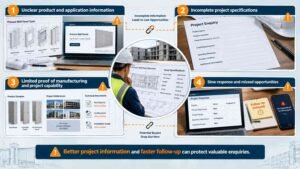
These questions create a marketing challenge. A company might rank for a broad term such as precast wall panels but still fail to attract the right project enquiries. It may receive enquiries from buyers looking for unrelated decorative panels, small retail quantities or products outside its manufacturing capability.
The opposite can also happen. A manufacturer may have the exact product required by a contractor but remains difficult to find because its website does not explain the product category, application or location it serves.
The solution is not simply to publish more blogs. It is to build a commercial system that connects the manufacturer’s actual capabilities with the requirements of projects that can become revenue.
The commercial opportunity starts with the project brief, not the product catalogue
A product catalogue tells buyers what a manufacturer produces. A project-focused marketing system helps them understand whether the manufacturer can contribute to their project.
Consider three potential enquiries:
A real estate developer is planning a residential development and wants a walling solution for a defined area. The buyer may be comparing construction methods, programme requirements and the feasibility of using prefabricated components.
An industrial contractor needs wall panels for a factory or warehouse project. The enquiry may depend on panel dimensions, openings, structural coordination, delivery access and installation arrangements.
An infrastructure contractor is evaluating precast components for a project with a specific construction schedule. The buyer may need manufacturing capacity, technical approvals, quality records and delivery coordination.
These are not identical leads. A website that presents only a general description of precast wall panels forces all three buyers to interpret the manufacturer’s suitability themselves.
A stronger approach gives each application a clear route to relevant information. It also helps the sales team identify which enquiries deserve immediate technical attention.
The Government of India’s Housing for All technology knowledge material describes precast construction as a process in which components such as walls, slabs, stairs, columns and beams are manufactured in a plant or casting yard before being transported and installed at the site. This is useful context for manufacturers explaining the relationship between factory production and site execution.
1. Turn manufacturing capabilities into project-specific reasons to contact you
A buyer does not need a long company introduction before understanding whether a supplier is relevant. The first task is to make the manufacturer’s capabilities visible in terms of actual project requirements.
Instead of describing the business only as a precast wall panel manufacturer, organise the website around the products, systems and applications the company can genuinely supply.
Which applications should the website explain?
Depending on the manufacturer’s actual portfolio, relevant application pages may include:
- Residential and multi-storey building projects.
- Commercial developments.
- Industrial buildings and warehouses.
- Institutional buildings.
- Boundary and compound wall applications.
- Infrastructure and other project-specific construction requirements.
These should not become automatically generated pages with identical descriptions. Each page should explain a distinct application, the type of wall system offered and the information a buyer needs to assess suitability.
For example, an industrial building application page could explain the manufacturer’s available panel configurations, design coordination process, openings and interface requirements, production capacity and delivery considerations. A boundary wall application page would need a different set of details.
Make the product information useful to a project team
A strong product page should answer practical questions such as:
| Information buyers need | What the manufacturer should explain |
| Product range | Available wall panel types and configurations |
| Dimensions | Standard sizes and customisation possibilities |
| Technical details | Relevant thicknesses, reinforcement and design information |
| Finish | Available surface finishes and appearance options |
| Project suitability | Applications the manufacturer serves |
| Production | Manufacturing capacity and quality-control process |
| Logistics | Loading, transportation and delivery coverage |
| Installation | Available technical coordination or installation support |
Only publish specifications that the manufacturer can verify. Structural performance, fire resistance, acoustic performance, thermal properties and load capacity should never be claimed without appropriate technical evidence.
A useful reference is BIS’s listing for IS 15916:2020 – Building Design and Erection Using Prefabricated Concrete – Code of Practice. Manufacturers can use relevant standards and technical references to guide their documentation, while ensuring that project-specific design and compliance claims are confirmed by qualified professionals.
Show evidence rather than relying on broad claims
A manufacturer can make its website more convincing with:
- Photographs of actual panel production.
- Images of moulds, reinforcement preparation and finished panels.
- Project references, where permission is available.
- Approved technical drawings and product information.
- Quality-control processes and relevant certifications.
- Details of manufacturing and delivery capabilities.
A project reference should explain the application, the manufacturer’s contribution and the scope of work without disclosing confidential client information.
This approach gives SEO and advertising campaigns stronger destinations. It also reduces the chance that a buyer submits an enquiry only to discover that the company does not supply the required system.
For support with organic search visibility, AdsThrive’s SEO services can be positioned around product pages, application pages, technical resources and commercial search intent rather than a collection of disconnected keywords.
2. Capture the searches that indicate a real project requirement
A precast wall panel buyer may not search using the manufacturer’s preferred product terminology. One person may search for a supplier, another for a specific wall system, and another for a project application.
The website needs to cover these different search situations without creating thin or repetitive pages.
What searches could precast wall panel companies be missing?
The following are keyword opportunities and examples, not verified daily search counts or measured search volumes.
| Search intent | Example search | Suitable website destination |
| Supplier selection | Precast wall panel manufacturer | Manufacturer page |
| Product selection | RCC precast wall panels | Product page |
| Project application | Precast wall panels for industrial buildings | Industrial application page |
| Residential application | Precast wall panels for housing projects | Residential application page |
| Custom requirement | Custom precast wall panel manufacturer | Custom capability page |
| Technical evaluation | Precast wall panel specifications | Technical resource |
| Location selection | Precast wall panel supplier in [city] | Relevant location page |
| Commercial enquiry | Precast wall panel quotation | Enquiry landing page |
The purpose is not to create a separate URL for every phrase. It is to identify the different questions buyers ask and decide which ones deserve a dedicated page, a section on an existing page or a supporting article.
“For more insights on improving lead generation and reaching the right industrial buyers, explore our guide on how recycling equipment companies can generate more leads.”
Build pages around search intent, not keyword variations
For example, a page targeting industrial wall panel applications should not simply repeat the phrase “precast wall panels for industrial buildings” throughout the content.
It should answer questions such as:
- What types of industrial projects does the company serve?
- What panel configurations are available?
- What project information is needed before a quotation?
- Can the manufacturer coordinate with the project design team?
- What delivery and site-access factors need to be considered?
This is where SEO services for precast wall panel manufacturers should be judged by their ability to attract relevant project searches, not by the number of keywords inserted into a page.
Use Search Console to identify missed opportunities
Google Search Console can show the queries that already generate impressions for a website. Manufacturers should review:
- Queries generating impressions but very few clicks.
- Product searches that lead to the homepage instead of a relevant product page.
- Application searches for which the website has no dedicated information.
- Location-based searches that are not supported by useful service-area content.
- Pages receiving traffic but producing few enquiries.
A query with impressions but no clicks may indicate a weak title or description, a mismatch between the page and the search, or competition from more useful results. A page with clicks but no enquiries may have a different problem: insufficient product detail, weak project evidence or an unclear contact process.
Do not treat every impression as a potential lead. The objective is to discover which searches bring buyers with requirements the manufacturer can fulfil.
For businesses looking to improve their visibility across traditional search and AI-assisted discovery, AdsThrive’s AI SEO services can be incorporated into a broader strategy focused on useful, well-structured product and application information.
3. Make technical evaluation easier before asking for an enquiry
A precast wall panel enquiry can require more than a name and phone number. A contractor may have drawings, preliminary quantities, site details and a project schedule. If the website offers no way to communicate these requirements, the sales team may spend several calls collecting basic information.
The enquiry process should make it easier for a serious buyer to provide the details needed for an initial assessment.
What should a project enquiry form collect?
A useful form can request:
- Name and organisation.
- Business email and contact number.
- Project location.
- Project type or application.
- Approximate panel quantity or area.
- Required panel dimensions, if known.
- Expected project or delivery timeline.
- Whether drawings or specifications are available.
- Any additional technical requirements.
Allow the buyer to submit an enquiry even if some technical information is not yet available. A developer at an early planning stage may not have final drawings, while a contractor seeking a quotation may have a detailed bill of quantities.
The form should therefore distinguish between essential contact details and optional project information.
Give buyers a clear next step
After submitting the form, explain what happens next. For example:
- The enquiry is received by the sales team.
- The requirement is reviewed.
- The team contacts the buyer for missing details.
- Technical information or drawings are reviewed where applicable.
- A quotation or further project discussion is arranged.
This is a commercial improvement, not merely a website design change. It sets expectations and gives the sales team a repeatable process.
A manufacturer can also provide a downloadable product catalogue or technical enquiry checklist. These resources help buyers understand what information to prepare before requesting a detailed quotation.
For businesses that receive enquiries through several channels, AdsThrive’s AI chatbot solution can help answer common questions, collect initial project details and direct prospects towards the appropriate sales contact. The chatbot should not make unverified structural or engineering recommendations; technical questions should be routed to the relevant professional.
4. Use Google Ads to reach buyers when project demand is active
SEO builds visibility over time. Paid search advertising can help a manufacturer appear for relevant searches while organic visibility is developing or when a specific product category needs more immediate exposure.
However, advertising a broad phrase without controlling search intent can waste the budget. A campaign for precast wall panels may attract searches from people looking for decorative interior wall panels, PVC wall cladding or unrelated retail products.
The campaign needs to distinguish industrial and construction requirements from unrelated demand.
Separate campaigns by product and application
A practical account structure could include:
Campaign A – Precast wall panel manufacturer
Target supplier and manufacturer searches. Direct users to a page that explains the company’s manufacturing capabilities, product range and enquiry process.
Campaign B – Industrial and commercial applications
Target relevant searches from industrial developers, warehouse contractors and commercial project teams. Send visitors to an application page with project-specific information.
Campaign C – Location-based demand
Target areas the company can realistically serve. Consider transportation costs, manufacturing location, delivery capacity and the practical service radius before expanding geographic targeting.
Campaign D – Custom project requirements
Target relevant custom manufacturing and project enquiry searches if the company accepts such work.
Use negative keywords to control irrelevant clicks
Depending on the company’s product range, negative keyword candidates may include terms related to:
- Decorative interior wall panels.
- Wallpaper and wall stickers.
- DIY installation.
- Jobs and careers.
- Second-hand products.
- Small retail quantities, if the company only accepts project orders.
These are examples, not a universal negative-keyword list. Review actual search-term reports before excluding phrases. A term that appears irrelevant to one manufacturer may be commercially valuable to another.
Match the advertisement to the landing page
An advertisement promising industrial precast wall panels should not send users to a generic homepage. The landing page should explain the relevant application, product information, project evidence and enquiry process.
Track more than clicks. Record calls, form submissions, qualified project enquiries, quotations and orders. If the campaign generates many enquiries but few suitable projects, review search terms, location targeting, ad copy and landing-page relevance.
AdsThrive’s lead generation services can support a campaign strategy that connects advertising with enquiry capture and follow-up rather than treating lead volume as the final outcome.
5. Use LinkedIn and project-based content to reach decision-makers before procurement
Not every precast wall panel requirement begins with a Google search. Some opportunities emerge when developers appoint consultants, contractors prepare tenders, architects evaluate construction systems or project teams compare suppliers.
LinkedIn can help manufacturers reach people involved in these decisions.
Identify the people who influence a wall panel purchase
Depending on the project and organisation, relevant audiences may include:
- Real estate developers.
- Construction company directors.
- Project managers.
- Civil and structural engineering consultants.
- Architects.
- Procurement managers.
- Infrastructure contractors.
- Industrial facility developers.
A manufacturer should not send the same sales message to every role. A structural consultant may care about technical coordination and design information, while a procurement manager may prioritise supply capacity, commercial terms and delivery.
Build outreach around a useful project conversation
Instead of sending a generic message asking whether someone needs precast wall panels, use a more relevant approach.
For example:
“Hello [Name], we manufacture precast wall panel systems for construction projects. I noticed your work in [relevant sector]. If your team is evaluating prefabricated walling for an upcoming project, I can share our product range and technical information for an initial review.”
The message should be personalised and based on a genuine business connection. Avoid bulk messaging, exaggerated claims or repeated follow-ups that do not add value.
Publish content that helps a project team evaluate the system
Useful LinkedIn content could include:
- A short factory walkthrough showing panel production.
- A technical explanation of how panels are manufactured and handled.
- A project case study with permission from the client.
- A comparison of project considerations for precast and conventional construction.
- A video showing loading, transportation and site installation.
- A post explaining what information is needed for a project quotation.
The goal is to give a potential buyer a reason to remember the manufacturer and start a relevant conversation.
A digital marketing agency should also connect these activities to the website. A LinkedIn post about a specific application should link to the corresponding product or project page, not always to the homepage.
6. Build confidence with project evidence, not unsupported performance claims
Precast wall panels are part of a construction system. Buyers need confidence in the product and in the manufacturer’s ability to supply components that fit the project.
A website can communicate this confidence through evidence that the company can genuinely provide.
What project evidence should manufacturers publish?
Consider developing a structured project portfolio containing:
Project overview: Describe the type of project, location where disclosure is permitted, and the application.
Product supplied: Explain the wall panel system or components supplied.
Scope of work: Clarify whether the manufacturer was responsible for production, design coordination, delivery, installation support or another defined part of the project.
Technical considerations: Explain relevant dimensions, interfaces, handling requirements or coordination challenges where these details can be shared.
Project photographs: Include genuine images of manufacturing, dispatch and completed work.
Outcome: State verifiable delivery or project outcomes. Do not invent construction-time savings, cost reductions or performance improvements.
The Ministry of Road Transport & Highways’ National Highway Pre-cast Concrete Policy provides an example of how precast manufacturing capability can intersect with public infrastructure requirements. The policy discusses factory-manufactured precast elements and specifies requirements for factories in the context of eligible highway projects. Manufacturers serving this market can use such official references to understand the importance of production infrastructure and project readiness.
Turn technical resources into sales-support material
A useful resource section may contain:
- Product catalogue.
- Technical data sheets.
- Available panel dimensions.
- Design coordination information.
- Installation and handling guidance.
- Quality-control documentation.
- Frequently asked project questions.
Only publish documents that are current and approved for external distribution. Where project design depends on structural calculations or site-specific conditions, make it clear that final suitability must be established by the responsible design professionals.
The National Building Code of India provides a broader regulatory and technical framework for building construction. Manufacturers can direct customers to relevant official information while avoiding claims that a particular product automatically complies with every project requirement.
7. Connect every enquiry to a sales process using CRM and AI automation
A manufacturer may receive leads from Google Ads, organic search, LinkedIn, website forms, telephone calls and WhatsApp. If each channel is managed separately, a serious project enquiry can remain unanswered or get lost between departments.
This is where lead management becomes a commercial advantage.
What should happen after a buyer makes contact?
A practical workflow can look like this:
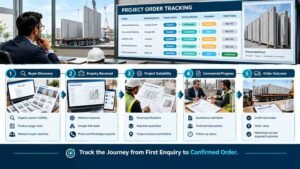
“New enquiry received → Source recorded → Project requirement captured → Lead assigned → Sales follow-up → Technical review → Quotation → Outcome recorded”
Each stage should have a clear owner. The sales team should know which enquiries are new, which require technical input and which are awaiting a quotation.
Qualify enquiries using project information
An initial lead qualification process can distinguish between:
- A buyer seeking a general product catalogue.
- A contractor evaluating panels for an identified project.
- A developer planning a future project.
- A consultant requesting technical documentation.
- A procurement team seeking a quotation.
- An enquiry that falls outside the manufacturer’s product or delivery capability.
A lead should not be marked as qualified simply because the person submitted a form. Qualification should depend on fit, project relevance and the information available.
Use AI calling and WhatsApp follow-up carefully
An AI calling system can help acknowledge new enquiries, collect basic information and arrange a callback. WhatsApp automation can share a catalogue, confirm receipt of a request or remind a prospect about a pending discussion.
For example, after a website enquiry, an automated workflow could:
- Record the lead in the CRM.
- Send an acknowledgement.
- Ask whether the buyer has drawings or a project specification.
- Notify the appropriate sales representative.
- Schedule a follow-up if the prospect requests one.
- Update the CRM when the sales team records the discussion.
AI should support the sales process, not replace engineering judgement. Questions involving structural suitability, design calculations, installation safety or compliance must be escalated to qualified personnel.
AdsThrive’s AI calling solution can form part of this connected follow-up system. The commercial value comes from reducing delays and improving enquiry handling, not from making automated calls without a defined purpose.
How AdsThrive can support precast wall panel manufacturers
For a manufacturer, the marketing challenge rarely sits inside one channel. A product page may need better search visibility, an advertising campaign may need a more relevant landing page, and a new enquiry may need to reach the right sales representative.
Digital marketing for precast wall panel manufacturers should connect these activities to a measurable commercial process.
AdsThrive brings together services that can support different parts of that process:
| Business requirement | AdsThrive capability | Commercial purpose |
| Improve product and application visibility | SEO and AI SEO | Reach relevant construction and project searches |
| Generate demand faster | Google Ads and paid campaigns | Reach active buyers and project-related searches |
| Reach professional audiences | Social media and LinkedIn campaigns | Build awareness among developers, consultants and contractors |
| Capture enquiries | Lead generation and landing pages | Turn relevant visits into project enquiries |
| Respond to prospects | AI chatbot and AI calling | Acknowledge enquiries and collect initial details |
| Manage follow-up | CRM and automation workflows | Route leads and maintain sales follow-up |
A digital marketing agency for precast wall panel manufacturers should understand that a click is not the same as a project opportunity. Campaigns need to be planned around the manufacturer’s product range, delivery geography, production capacity, target project types and sales process.
AdsThrive’s approach can bring SEO, paid advertising, lead generation, chatbot support, AI calling and follow-up automation into a connected workflow. The objective is to help the manufacturer attract relevant prospects, identify their requirements and give the sales team a better opportunity to convert them.
Explore AdsThrive to understand how its marketing and automation services can be aligned with a manufacturer’s commercial requirements.
How should a precast wall panel manufacturer measure marketing performance?
The number of leads received is only one part of performance. A campaign that produces 40 enquiries but no suitable projects may be less valuable than a campaign that produces fewer enquiries with clear requirements and realistic purchase potential.
The manufacturer should measure performance from the first interaction through to the commercial outcome.
| Measurement stage | What to track | What it helps identify |
| Visibility | Search impressions and relevant clicks | Whether buyers can discover the business |
| Engagement | Product-page visits and catalogue requests | Whether product information is useful |
| Enquiries | Calls, forms and WhatsApp conversations | Whether visitors are contacting the company |
| Qualification | Relevant projects and suitable requirements | Whether enquiries match the business |
| Sales activity | Meetings, technical reviews and quotations | Whether opportunities are progressing |
| Business outcome | Orders, revenue and acquisition cost | Whether marketing contributes commercially |
Review the data by product category, application, location and campaign. This can reveal that one product attracts many enquiries but few quotations, while another receives fewer enquiries but converts more consistently.
The sales team should also record why enquiries are lost. Common reasons may include unsuitable dimensions, delivery constraints, project postponement, price differences, unavailable production capacity or a mismatch between the buyer’s requirement and the company’s product range.
These reasons can inform future marketing decisions. If many prospects ask for a product the company does not manufacture, the business may need to refine targeting. If suitable prospects repeatedly request technical information that is missing from the website, the product pages may need improvement.
The right reporting system connects marketing activity to sales outcomes instead of treating website traffic as the final measure.
Frequently asked questions
1. How can precast wall panel manufacturers get more project enquiries?
Build dedicated product and application pages, publish accurate technical information, target relevant construction searches, run focused Google Ads campaigns and make project enquiries easy to submit. Follow up quickly and qualify enquiries based on actual project requirements.
2. Is SEO useful for precast wall panel manufacturers?
Yes. SEO can help manufacturers appear when developers, contractors, consultants and procurement teams search for wall panel suppliers, product specifications and application-specific solutions. Results depend on competition, website quality, relevance and the time invested.
3. What keywords should a precast wall panel manufacturer target?
Relevant opportunities may include precast wall panel manufacturer, precast concrete wall panels, RCC wall panels, precast wall panels for industrial buildings, custom precast wall panels and location-specific supplier searches. The final keyword list should reflect the company’s actual products and service areas.
4. Should manufacturers use Google Ads or SEO?
They serve different purposes. SEO can build long-term organic visibility, while Google Ads can provide paid visibility for selected searches. Many manufacturers use both, with separate landing pages and conversion tracking to understand which channels generate suitable project enquiries.
5. What information should a wall panel enquiry form collect?
It should generally collect the buyer’s contact information, company, project location, application, approximate quantity or area, required dimensions if known, project timeline and available drawings or specifications. Keep optional technical fields flexible so early-stage buyers can still contact the company.
6. Can LinkedIn generate leads for precast wall panel companies?
LinkedIn can help manufacturers reach developers, contractors, consultants, project managers and procurement professionals. Sharing project references, product information and useful technical content can support conversations with relevant decision-makers.
7. How can AI help manage precast wall panel enquiries?
AI chatbots and calling workflows can acknowledge enquiries, collect basic project information, share approved resources and route prospects to sales representatives. Technical questions about design, structural performance or compliance should be handled by qualified professionals.
8. How long does SEO take to generate enquiries?
There is no fixed timeline. Results depend on the website’s current condition, competition, content quality, technical SEO, location and search demand. Paid advertising can provide visibility sooner, while SEO generally requires consistent work and monitoring.
Turn product visibility into project opportunities
Precast wall panel manufacturers need more than a website that lists products. They need a commercial presence that helps the right buyers understand the available systems, assess project suitability and contact the company with useful information.
That requires product-focused SEO, application pages, technical resources, targeted advertising, professional outreach and a reliable enquiry-handling process. Each activity should support the next stage of the buyer’s decision.
For manufacturers looking to improve search visibility and generate more qualified project enquiries, SEO for precast wall panel manufacturers should be connected to lead generation, sales follow-up and measurable business outcomes. AdsThrive can help bring these activities together through SEO, AI SEO, paid campaigns, lead generation, AI chatbot support, AI calling and automation.
The commercial objective is straightforward: make the right projects easier to find, make the manufacturer’s capabilities easier to evaluate and make it easier for serious buyers to start a conversation.