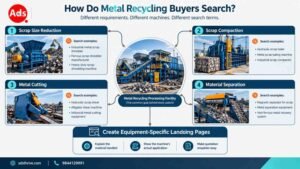
A steel scrap processing centre does not search for equipment in the same way as a plastic recycling plant. A vehicle scrapping facility may need shredding and dismantling machinery, while a municipal waste contractor may be evaluating a material recovery facility (MRF), conveyor system, trommel screen or baler. An e-waste recycler has a different requirement again, involving equipment for dismantling, size reduction and material separation.
For recycling equipment manufacturers, these differences matter commercially. Potential customers do not always search for “recycling equipment”. They may search for a metal scrap shredder, plastic washing line, PET bottle recycling plant, e-waste dismantling equipment, C&D waste crusher or MRF sorting system.
To generate more leads, recycling equipment companies need to reach the industries that use their machinery and optimize their websites around the language those industries use when planning, expanding or upgrading a facility. This means building visibility around real equipment applications, project requirements and investment decisions—not publishing another generic page about recycling machinery.
An effective strategy for SEO for recycling equipment companies should connect equipment-specific searches with relevant industry pages, technical content and conversion-focused landing pages. When supported by paid advertising, LinkedIn outreach and structured lead management, this approach can help manufacturers attract more relevant B2B enquiries and improve their sales opportunities.
This article examines the industries that create demand for recycling equipment, how their buyers search, how manufacturers can optimise their websites for those searches, and how SEO, paid advertising, LinkedIn outreach and AI-enabled lead management can turn that demand into commercial enquiries.
The real customers for recycling equipment may not call themselves recyclers
One of the biggest opportunities for a recycling equipment manufacturer is to look beyond businesses that identify themselves as recycling companies.
Consider a steel manufacturer handling production scrap, an automobile dismantling facility, a plastic product manufacturer recovering rejected material, and a municipal contractor setting up a waste-processing plant. All four may need recycling or material-processing equipment, but their buying requirements are very different.
A steel-related business may be interested in scrap shears, balers or metal shredders. A plastic manufacturer may need granulators to process production waste. A municipal contractor may be evaluating an entire material recovery facility. An e-waste company may require dismantling and separation machinery.
These organisations also approach equipment purchases differently. Some need a single machine to replace an existing unit. Others are planning a new facility and need several connected systems. A project developer may be gathering technical information before issuing a request for quotation (RFQ).
This creates an important commercial distinction: the company that buys recycling equipment is not always the company that sells recycled material.
Manufacturers should therefore identify the industries that use their machinery, the people involved in purchasing it and the operational problems that trigger an equipment search.
Steel scrap processors and metal recycling companies: Target the processing requirement
Metal recycling is an important market for industrial machinery suppliers. Scrap yards, metal recovery companies, steel-related businesses, foundries and authorised vehicle scrapping facilities may all require equipment to process different grades and forms of scrap.
The Ministry of Steel’s Steel Scrap Recycling Policy discusses organised collection, dismantling and processing of ferrous scrap, including the role of collection and dismantling centres and scrap processing centres. It provides useful context for manufacturers targeting this market.
What equipment do metal recycling businesses look for?
The requirement depends on the type of scrap, the incoming material condition and the processing operation.
A scrap yard handling bulky metal may evaluate a hydraulic shear or baler. A larger processing centre may need a shredder and material separation equipment. A vehicle scrapping facility may require dismantling equipment and systems for handling different vehicle components.
Typical equipment requirements include:
- Metal scrap shredders.
- Hydraulic scrap balers.
- Alligator and guillotine shears.
- Magnetic separators.
- Eddy current separators for suitable non-ferrous recovery applications.
- Scrap handling conveyors.
- Vehicle dismantling equipment.
- Material loading and feeding systems.
A manufacturer should not assume that every prospect needs a complete processing line. The website needs to address both individual machine buyers and businesses planning larger installations.
How do metal recycling buyers search?
The buyer’s search usually reflects the material being handled or the operation that needs to be improved.
A prospect may search for a metal scrap shredder manufacturer because the existing operation cannot process incoming material efficiently. Another may search for a hydraulic scrap baler because it wants to compact material for storage or transportation. A vehicle scrapping operator may use searches related to end-of-life vehicle (ELV) dismantling equipment.
These searches deserve different landing pages.
SEO opportunity: Create a dedicated metal scrap processing page, supported by individual pages for shredders, balers, shears and separation systems. Explain the material each machine is designed to handle, its role in the process and the technical information needed for a quotation.
If your company supplies equipment for vehicle scrapping facilities, build a separate application page. Do not expect a general metal shredder page to answer every question from an ELV facility operator.
Plastic recycling plants: Organise SEO around polymer and processing stage
Plastic recycling is not one uniform application. A facility processing PET bottles has different equipment requirements from a company handling HDPE containers, LDPE film, PP packaging or mixed plastic waste.
Depending on the plant design, the processing operation may involve sorting, washing, shredding, granulation, drying, extrusion and pelletising. Not every facility uses every stage. The configuration depends on the incoming material, contamination, required output and intended application.
Potential customers include:
- PET bottle recycling plants.
- Plastic washing and granulation facilities.
- Post-consumer plastic waste processors.
- Plastic packaging waste processors.
- Plastic manufacturers recovering production scrap.
- Film recycling companies.
- Businesses expanding pelletising operations.
A plastic product manufacturer may not describe itself as a recycler, but it may still invest in a granulator or recycling line to recover production waste. This is an audience that equipment manufacturers can miss when they target only registered recycling companies.
What does a plastic recycling buyer actually search for?
A buyer planning a PET bottle recycling line may search for PET bottle recycling plant machinery. A business processing plastic film may look for an LDPE film washing line. A manufacturer recovering rejected production material may search for an industrial plastic granulator.
The polymer and the processing stage help determine the search language.
PET bottle processing
A PET recycling page should explain the relevant sorting, label removal, washing and flake preparation stages where these are part of the manufacturer’s offering. Include the equipment supplied, material requirements and output considerations.
Plastic film processing
Film recycling can involve different feeding, washing and drying requirements from rigid plastic processing. A dedicated page should explain the film types the machinery supports and the process configuration available.
HDPE and PP recycling
The page should identify the intended material and explain the washing, size-reduction or granulation stages supported by the equipment.
Pelletising operations
A pelletising page should describe the equipment’s role in converting processed plastic into reusable pellets. Explain relevant input conditions and output specifications without making unsupported performance claims.
The Central Pollution Control Board’s Plastic Waste Management portal provides access to rules, amendments and plastic waste-related resources. It is a useful industry context for businesses operating in this sector.
The SEO opportunity for plastic recycling machinery
Do not create one page titled “Plastic Recycling Machines” and expect it to rank for every polymer and processing application.
Build separate pages for the actual solutions your company supplies, such as PET bottle recycling machinery, plastic film washing equipment, HDPE washing lines, granulators or pelletising systems.
Each page should explain the material, process stages, equipment configuration, technical specifications and information required for a project discussion.
The content must be genuinely different. Replacing PET with HDPE in an otherwise identical page creates little value for buyers or search engines.
E-waste recycling facilities: Attract businesses planning specialised processing capacity
Electronic waste processing is a specialised market. Equipment requirements differ according to the waste categories handled and the recovery processes used.
Potential buyers include authorised e-waste recyclers, electronic waste processing businesses, printed circuit board processors, large recyclers handling computers and consumer electronics, and companies evaluating lithium-ion battery recycling systems.
NITI Aayog’s report on advancing the circular economy of waste electrical and electronic equipment and lithium-ion batteries discusses India’s e-waste landscape, recycling capacity and the development of formal recycling systems.
What machinery may an e-waste facility require?
Depending on the material and process design, equipment may include:
- Manual or semi-automatic dismantling stations.
- Cable stripping machines.
- Shredders and granulators.
- Magnetic separation systems.
- Eddy current separation systems.
- Density or other material separation equipment.
- Dust collection systems.
- Conveyors and material handling equipment.
- Specialised battery-processing equipment designed for the relevant battery chemistry and safety requirements.
A manufacturer should be precise about which waste categories its machinery supports. Equipment suitable for one electronic waste stream should not automatically be presented as suitable for all electronic waste or battery processing.
What should an e-waste equipment page communicate?
A buyer planning a new facility may need to understand the equipment’s role before requesting a quotation. The page should therefore explain:
- The electronic waste categories the equipment is designed to process.
- The processing stage supported by the machine.
- The material handling and separation requirements.
- Available configurations and technical specifications.
- Safety and dust-control considerations relevant to the equipment.
- The information needed for a technical discussion.
Avoid broad claims about regulatory compliance or approvals unless the company can substantiate them. Purchasing machinery alone does not automatically make a facility compliant.
SEO opportunity: Build separate pages for e-waste recycling plant equipment, PCB processing machinery, cable processing equipment and other genuine product categories. If the company offers specialised battery recycling machinery, give that application its own technically accurate page.
A technical consultation CTA is often more appropriate here than a simple price request. A prospect planning an e-waste facility may need to discuss the intended process before the machinery scope can be finalised.
Municipal solid waste and material recovery facilities: Target project buyers
Municipal solid waste processing creates demand for equipment from a wider group of buyers. Potential customers include municipal corporations, urban local bodies, waste management contractors, infrastructure developers and companies executing public-private partnership projects.
A material recovery facility may use waste receiving and feeding systems, sorting conveyors, trommel screens, vibratory screens, magnetic separators, air classification systems and baling presses. The actual configuration depends on waste composition, facility capacity, segregation arrangements and project specifications.
The Ministry of Housing and Urban Affairs’ annual report provides context on solid waste infrastructure, waste-to-energy facilities and construction and demolition waste processing.
Why does this market need a different website approach?
A municipal contractor evaluating an MRF may not be searching for one individual machine. It may be looking for an equipment supplier capable of supporting a complete facility or a defined section of the processing line.
The buyer’s evaluation may involve several stages:
Project requirement: The contractor identifies the facility’s intended capacity, waste composition and processing objectives.
Equipment evaluation: The engineering or procurement team reviews available machinery and potential configurations.
Technical specification: The buyer checks equipment details, operating requirements, integration possibilities and documentation.
Supplier shortlisting: The project team evaluates manufacturers based on their actual capabilities and relevant experience.
Quotation and project discussion: The shortlisted suppliers discuss scope, technical requirements, delivery and commercial terms.
A manufacturer’s website should support these decisions. A page that only describes a trommel screen will not answer questions about an integrated MRF solution.
What should manufacturers publish?
If your company supplies complete MRF systems, create a dedicated solution page explaining the processing stages and equipment included in your offering.
If you supply only selected machines, make that scope clear. Explain which parts of the facility your equipment can support and whether it can integrate with other systems.
A genuine project capability page can also help. Include relevant installation experience, manufacturing capability, available technical documentation and after-sales support where these can be substantiated.
Do not publish confidential tender information or imply that your company is an approved supplier for a project unless that is verifiable.
Construction and demolition waste processors: Connect machinery to material recovery
Construction and demolition waste processing creates demand for machinery used to reduce, screen and recover reusable materials.
Potential customers include C&D waste processing contractors, urban local bodies and their project partners, infrastructure companies, demolition contractors and recycled aggregates producers.
Depending on the plant design, machinery may include crushers, screens, conveyors, magnetic separators, air separation systems and material handling equipment.
A manufacturer can make this application easier to understand by connecting the buyer’s operational requirement to the relevant equipment:
- Need to reduce material size? Explain the role of suitable C&D waste crushers and the material they are designed to handle.
- Need to separate material fractions? Describe screening systems and their place in the processing operation.
- Need to recover ferrous metal? Explain the role of magnetic separators.
- Need to move material between processing stages? Show the available conveyor and feeding solutions.
How should the C&D equipment page be optimised?
A page about a C&D waste crusher should explain its intended feed material, size-reduction role, capacity specifications and compatibility with screening and conveying equipment.
A screening equipment page should explain the separation stage and available configurations.
Avoid promising that every processed output can be reused as construction material. Output quality depends on feed composition, processing and applicable quality requirements.
The enquiry form should make it easy for a contractor or project developer to share the intended capacity, material composition, site location and project stage.
Cement plants and industrial users: Target waste-derived material processing
Cement manufacturers and other industrial facilities may invest in systems for handling and processing suitable waste-derived materials. In cement operations, alternative fuels and raw materials can involve equipment for feeding, size reduction, storage, conveying and dosing.
This is different from selling a conventional recycling plant. The buyer may be an engineering team, plant head, project department or procurement professional looking to integrate a waste-derived material handling system into an existing industrial process.
Potential equipment requirements may include industrial shredders for suitable waste-derived fuel preparation, conveyors, feeding systems, storage and material handling equipment, screening systems and dosing or metering equipment.
The exact machinery depends on the material, plant process, fuel specification and engineering requirements. A recycling equipment manufacturer should only target this market if its products are suitable for the intended application.
Why does search language matter here?
A cement plant may not search for “recycling equipment” at all. Its search may focus on RDF processing equipment, industrial RDF shredders, alternative fuel feeding systems or waste conveying systems.
This creates an opportunity to reach industrial buyers who would not necessarily find a general recycling equipment page.
SEO opportunity: Build application pages around the actual industrial systems supplied. Explain how the equipment fits the intended process, what material it handles and what technical details the buyer should share before requesting a quotation.
The keyword opportunities recycling equipment companies may be missing
The following examples show how different industries describe their machinery requirements. Use them as a starting point for keyword research and page mapping, then validate them by country, search volume, competition and actual search results.
| Industry | Example buyer searches | Commercial opportunity |
| Metal scrap processing | Metal scrap shredder manufacturer, ferrous scrap processing equipment | Machine purchase or processing centre setup |
| Plastic recycling | PET bottle recycling plant machinery, plastic film washing line | New line or capacity expansion |
| E-waste recycling | E-waste recycling plant equipment, PCB recycling machine | Facility setup or process upgrade |
| Municipal waste | MRF equipment supplier, MSW processing plant machinery | Project or plant procurement |
| C&D waste | C&D waste crusher, construction waste recycling plant | Contractor or infrastructure project |
| Cement and industrial | RDF shredder, alternative fuel handling system | Industrial integration project |
These are search examples, not claims about measured daily search volume. Some phrases may have low search volume but represent valuable project requirements. Others may attract visitors who are not machinery buyers.
The right keyword strategy is not simply to target the phrase with the highest estimated volume. It is to identify searches that match the company’s equipment, target market and ability to supply.
Industry-specific digital marketing opportunities
Identifying relevant keywords is only one part of the strategy. Manufacturers also need to select the right digital channels, landing pages and conversion actions for each target industry.
| Industry | Recommended digital marketing approach | Target landing page | Lead conversion opportunity |
| Metal scrap processing | SEO, Google Ads and technical demonstrations | Metal scrap processing equipment | Request a machine quotation |
| Plastic recycling | Application-specific SEO and search advertising | Plastic recycling plant machinery | Discuss a new recycling line |
| E-waste recycling | Technical content, SEO and LinkedIn outreach | E-waste recycling equipment | Request a technical consultation |
| Municipal solid waste | Project-focused content and B2B outreach | MRF equipment and systems | Discuss project requirements |
| C&D waste processing | Search campaigns and equipment case studies | C&D waste processing machinery | Request a project assessment |
| Cement and industrial users | Industrial keyword targeting and account-based outreach | RDF and alternative fuel processing systems | Discuss equipment integration |
This approach helps manufacturers connect each industry’s requirements with the most relevant marketing message. It also gives the sales team a clearer understanding of which equipment category and campaign generated an enquiry.
How to organise your website around industries and equipment
Once the target industries are identified, the website should make the relationship between the manufacturer, machinery and applications easy to understand.
A practical website structure could look like this:
Main equipment category
Recycling Equipment Manufacturer
↓
Industry application pages
- Metal Scrap Processing Equipment
- Plastic Recycling Plant Machinery
- E-waste Recycling Equipment
- Material Recovery Facility Equipment
- Construction and Demolition Waste Processing
- RDF and Alternative Fuel Processing Equipment
↓
Individual product pages
- Industrial Metal Shredder
- Hydraulic Scrap Baler
- PET Bottle Washing Line
- Plastic Granulator
- PCB Recycling Machine
- Trommel Screen
- Magnetic Separator
- Industrial Waste Conveyor
This is an example of website architecture, not a recommendation to create every page regardless of product availability. Publish only pages that represent equipment and applications your company genuinely supplies.
Connect product pages with their industrial applications
A metal shredder page should link to the metal scrap processing page. The application page should link to the relevant shredder, baler and separation equipment pages.
A PET recycling solution page can link to the washing line, granulator and pelletising equipment pages where applicable.
This creates useful navigation for buyers. Someone researching a plastic recycling plant can move from the application overview to the individual machinery required for that process.
Supporting content should answer equipment-selection questions
Blog content should help potential buyers evaluate machinery rather than repeat generic information about the importance of recycling.
Useful article topics include:
- What equipment is required for a PET bottle recycling plant?
- How do industrial metal shredders differ from scrap shears?
- What machinery is used in an e-waste recycling facility?
- What should a buyer check before selecting an industrial baler?
- Which processing stages are involved in a material recovery facility?
- What information is required to plan a C&D waste processing plant?
- How should a recycling plant estimate its machinery capacity?
Each article should link naturally to the relevant equipment or application page. It should answer a genuine buyer question and provide a clear next step for someone evaluating a purchase.
For further guidance on the wider industrial marketing approach, see Adsthrive’sDigital Marketing for Industrial Machinery Manufacturers.
How SEO services can help recycling equipment manufacturers attract qualified buyers
Effective SEO services for recycling equipment companies should combine technical website optimisation, keyword research, application-specific landing pages and content that answers genuine equipment-selection questions.
Rather than targeting every recycling-related keyword, manufacturers should prioritise searches that align with their product portfolio, target industries and geographical markets.
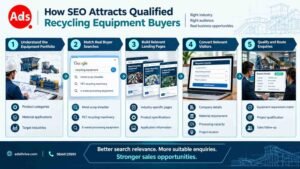
A practical SEO strategy includes:
- Keyword mapping: Match equipment and industry-specific search terms to the most relevant website pages.
- Technical SEO: Improve website crawlability, page performance, mobile usability and indexing.
- Product-page optimisation: Publish accurate equipment specifications, supported applications and relevant technical information.
- Industry content: Address questions about plant capacity, processing stages, equipment selection and facility planning.
- Internal linking: Connect application pages, product pages and technical articles to help buyers navigate the website.
- Conversion optimisation: Make quotation requests, technical consultations and equipment enquiries easy to complete.
Manufacturers can evaluate progress through relevant organic traffic, qualified enquiries, quotation requests and sales opportunities rather than relying on rankings alone.
Digital marketing strategies for recycling equipment manufacturers
Digital marketing for recycling equipment companies works best when search visibility, paid advertising, professional networking and enquiry follow-up support the same commercial objectives.
A manufacturer selling industrial shredders may need to reach scrap processing businesses, while a company supplying plastic washing lines may need to connect with plastic recyclers and manufacturers recovering production waste. The campaign strategy should reflect these differences.
A coordinated approach can include:
- Organic search: Attract buyers researching equipment specifications, applications and manufacturers.
- Google Ads: Reach prospects actively searching for machinery or complete processing systems.
- LinkedIn marketing: Connect with plant owners, procurement professionals, engineering teams and project developers.
- Technical content: Publish machine demonstrations, application guides and genuine installation case studies.
- Lead nurturing: Follow up with prospects who are evaluating equipment but are not yet ready to request a quotation.
Turning website visitors into sales opportunities
Lead generation for recycling equipment companies should focus on attracting prospects whose material requirements, processing capacity, project stage and technical needs match the manufacturer’s capabilities.
A dedicated landing page should explain the relevant machinery, outline its intended application and provide a clear next step. Depending on the buyer’s needs, that next step could be a quotation request, a technical consultation, a plant-layout discussion or a machinery demonstration.
Enquiry details should then be recorded in a CRM or another structured tracking system. This allows the sales team to prioritise relevant opportunities, follow up consistently and identify which marketing channels generate the strongest commercial results.
How Adsthrive can help recycling equipment manufacturers convert demand into enquiries
A manufacturer supplying metal shredders, plastic washing lines and MRF equipment should not run one broad campaign with the same message for every prospect.
The person searching for a PET bottle washing line should land on a page explaining that equipment. A contractor evaluating an MRF should see the company’s actual project capabilities. A scrap processor looking for a baler should be able to review the relevant specifications and request a quotation.
Choosing a digital marketing agency for recycling equipment companies involves more than evaluating website traffic or advertising reach. Manufacturers should look for a marketing partner that understands industrial buying journeys, can map search intent to specific equipment applications and can measure the quality of enquiries generated.
Adsthrive can help manufacturers coordinate SEO, paid search, LinkedIn outreach, landing-page optimisation and AI-enabled lead management around their actual product portfolio. The objective is to connect the right industrial buyers with the relevant machinery and help the sales team move suitable prospects towards technical discussions and quotations.
SEO and AI SEO for equipment-specific discovery
Adsthrive’s SEO services can support keyword mapping, technical optimisation, industry landing pages, product-page content and internal linking.
The work should begin with the manufacturer’s real product portfolio and target industries. This helps prevent the website from becoming a collection of generic pages targeting every possible recycling keyword.
Adsthrive’s AI SEO services can also form part of a broader search visibility programme. The content should still be grounded in the manufacturer’s specifications, actual applications and technical expertise.
Google Ads for buyers with immediate equipment requirements
Paid search campaigns can target specific equipment categories and industrial applications.
For example, a manufacturer could run separate campaigns for:
Metal processing: Target searches related to industrial metal shredders, scrap balers and scrap shears.
Plastic recycling: Target PET bottle recycling machinery, plastic washing lines and granulators.
E-waste processing: Target e-waste dismantling equipment and PCB processing machinery, where these products are supplied.
MRF and municipal projects: Target material recovery facility equipment and solid waste processing machinery.
Each campaign should lead to a relevant landing page. Search-term reviews and negative keywords can help reduce irrelevant traffic from job seekers, students, household recycling searches and people looking for small domestic machines.
The campaign should measure quotation requests, technical consultations and qualified project enquiries—not just clicks.
LinkedIn outreach for procurement and project contacts
LinkedIn can help manufacturers reach recycling plant owners, operations heads, procurement teams, project developers and infrastructure contractors.
The approach should be specific to the target industry.
For example, a metal shredder manufacturer could connect with scrap processing businesses and vehicle scrapping operators. An MRF equipment supplier could focus on waste management contractors, infrastructure developers and relevant project stakeholders.
A useful outreach message might offer a machine demonstration, explain an equipment application or introduce the manufacturer’s project capabilities. Sending the same generic catalogue to every contact is unlikely to communicate why the equipment is relevant to that prospect.
Lead generation that captures project details
Adsthrive’s lead generation services can support campaign planning, landing pages and enquiry capture.
The enquiry process should collect enough information to help the sales team understand what the prospect needs without making the form unnecessarily difficult to complete.
For example, a recycling plant enquiry form could ask for:
- Company name and contact details.
- Industry or recycling application.
- Material to be processed.
- Estimated processing capacity.
- Equipment or plant requirement.
- Facility location.
- Project stage and expected timeline.
A buyer who is still evaluating machinery may not know every technical specification. Allowing that prospect to submit an initial enquiry creates an opportunity for the sales team to clarify the requirement.
AI chatbot and calling for faster enquiry handling
A prospect enquiring about an e-waste recycling plant may need to share the facility location, waste category, estimated capacity and project stage. An AI chatbot can collect these initial details and route the enquiry to the appropriate team.
Adsthrive’s AI chatbot agent can support website conversations and initial information collection. Its AI calling solution can support follow-up conversations where appropriate.
Consider a sample enquiry:
Prospect: We are planning a plastic recycling plant and need machinery.
AI assistant: Which material are you planning to process—PET, HDPE, PP, LDPE film or mixed plastic?
Prospect: PET bottles.
AI assistant: Are you looking for an individual machine or a complete processing line?
Prospect: A complete line.
AI assistant: Do you have an estimated processing capacity and facility location?
The conversation gives the sales team a starting point. It does not replace engineering evaluation or automatically recommend a machine configuration.
Where suitable, enquiry details can be connected to CRM and follow-up workflows so the team can identify the industry, equipment category and campaign that generated the opportunity.
For manufacturers looking to connect these activities into a coordinated process, Adsthrive can help plan automation around the company’s actual sales workflow rather than relying on disconnected communication tools.
How should recycling equipment companies measure marketing performance?
Website traffic alone cannot show whether marketing is generating valuable machinery enquiries. A manufacturer needs to understand which industries are responding, which products are attracting interest and whether those enquiries progress into technical discussions and quotations.
The measurement process should connect marketing activity with commercial progress.
| Measurement stage | What to track | What it tells the business |
| Visibility | Organic search visibility, relevant visits, Google Ads clicks, LinkedIn reach | Which industries and equipment categories are attracting attention? |
| Enquiries | Forms, calls, WhatsApp conversations, quotation requests | Which channels are producing potential buyers? |
| Qualification | Material, capacity, location, project type, capability match | Are enquiries relevant to the manufacturer’s offering? |
| Sales progress | Technical discussions, site assessments, quotations, follow-ups | Are opportunities moving towards a purchase decision? |
| Commercial outcome | Orders, contract value, repeat business | Which marketing activities contribute to revenue? |
Review lead quality by equipment category
A campaign may generate many enquiries for plastic recycling machinery, but most could be from people looking for small domestic machines outside the manufacturer’s product range.
In that situation, the company should review its keyword targeting, advertisement copy and landing page. The problem may not be the number of enquiries; it may be that the campaign is attracting the wrong audience.
Similarly, a page for MRF equipment may generate fewer enquiries but produce several serious project discussions. That page could be commercially more valuable than a product page receiving significantly more visits.
Ask sales teams what happened after the enquiry
Marketing reports should not end when a form is submitted.
The sales team should record whether the prospect:
- Had a genuine equipment requirement.
- Matched the manufacturer’s technical capabilities.
- Shared sufficient project information.
- Requested a quotation or technical discussion.
- Progressed to a site assessment or demonstration.
- Placed an order or was lost to another supplier.
Reviewing lost enquiries is equally important. If prospects repeatedly request machinery the company does not manufacture, the website may be targeting too broadly. If buyers understand the product but do not submit forms, the next step may be unclear or the enquiry process may be difficult.
Marketing and sales teams should review these findings together. This helps the company identify which industries and equipment categories deserve more attention.
Frequently asked questions
1. Which industries buy recycling equipment?
Recycling equipment is used by metal scrap processors, steel-related businesses, plastic recyclers, e-waste facilities, municipal waste contractors, C&D waste processors, vehicle scrapping centres and some industrial facilities handling waste-derived materials. The machinery required depends on the material and processing application.
2. How can recycling equipment manufacturers generate more B2B leads?
They can identify the industries that use their machinery, create application-specific SEO pages, advertise individual equipment categories, publish genuine machine demonstrations and use LinkedIn to reach procurement and project contacts. Enquiry forms should collect information about the material, capacity, location and project requirement.
3. What SEO keywords should a recycling equipment manufacturer target?
Along with the primary keyword, SEO for recycling equipment companies should include machine-specific and application-specific phrases. Examples include metal scrap shredder manufacturer, PET bottle recycling plant machinery, e-waste recycling equipment, MRF equipment supplier and C&D waste crusher. The final list should be validated using keyword research and current search results.
4. Should recycling equipment companies create separate pages for different industries?
Yes, when their equipment genuinely serves different applications and each industry needs different technical information. A metal scrap processing page, PET recycling page and e-waste equipment page should explain their own materials, machinery and buyer requirements rather than repeat the same generic content.
5. Can Google Ads generate leads for recycling machinery?
Yes. Google Ads can capture active searches for specific machines and plant solutions. Separate campaigns and matching landing pages help connect advertisements with the buyer’s application. Search-term reviews and conversion tracking are important for reducing irrelevant traffic and evaluating lead quality.
6. How can LinkedIn help recycling equipment manufacturers?
LinkedIn can help manufacturers reach recycling plant owners, operations heads, procurement teams, project developers and infrastructure contractors. Technical content, machine demonstrations and targeted outreach can introduce the company’s equipment to relevant decision-makers.
7. What information should an equipment enquiry form collect?
It should collect the company name, contact details, industry, material to be processed, estimated capacity, required output, equipment of interest, facility location and project timeline. Prospects should be able to submit an initial enquiry even if they do not yet have every technical detail.
8. How can AI help recycling equipment companies handle leads?
AI can collect initial project information, classify enquiries by industry and equipment category, route prospects to the relevant sales team and support follow-up. Technical recommendations and equipment configurations should still be reviewed by qualified engineering personnel.
9. How long does SEO take to generate leads for recycling equipment manufacturers?
SEO results depend on website quality, competition, target keywords, existing search visibility and the quality of the content. Some improvements may produce early gains, while building consistent organic visibility for competitive industrial terms can take several months. Manufacturers should track qualified enquiries and sales opportunities alongside rankings and traffic.
10. Which digital marketing channels are best for industrial recycling equipment?
SEO and Google Ads can reach buyers actively researching machinery, while LinkedIn can help manufacturers connect with procurement teams, plant owners and project developers. Technical content, demonstrations and structured follow-up can support the buying process. The right combination depends on the product range, target market and sales cycle.
Generate leads from the industries that need your machinery
Recycling equipment companies do not sell to one uniform audience. A metal scrap processor, plastic recycler, e-waste facility and municipal waste contractor may all need recycling machinery, but they approach the purchase from different operational requirements.
That difference should be visible in the company’s digital marketing.
A metal recycling page should speak to scrap processing and material recovery. A plastic recycling page should explain polymer-specific processing stages. An e-waste page should demonstrate knowledge of electronic waste categories and facility requirements. An MRF page should address the needs of contractors and project developers.
SEO for recycling equipment companies should connect each industry’s search language with the exact machinery and processing applications the manufacturer can supply.
When supported by focused Google Ads, relevant LinkedIn outreach, machinery demonstrations and AI-enabled follow-up, digital marketing can help manufacturers attract better-matched enquiries and give sales teams more opportunities to discuss genuine equipment requirements.
With the right combination of SEO services for recycling equipment companies, application-specific campaigns and conversion tracking, manufacturers can build a more consistent digital marketing process. Adsthrive can help bring these activities together to support digital marketing for recycling equipment companies and measurable B2B lead generation.
For manufacturers looking to improve their online visibility, attract qualified industrial buyers and turn website visits into meaningful sales conversations, the next step is to assess the current website, identify the highest-potential equipment categories and build a marketing plan around the industries most likely to buy.