An automotive Tier-1 supplier needs a new production machine. A pharmaceutical manufacturer is looking for better packaging equipment. A food-processing company wants to increase production capacity, while a textile manufacturer is planning a machinery upgrade. Digital marketing for industrial machinery manufacturers can help these businesses discover the right machinery supplier at the moment they begin searching for a solution.
The requirement may already exist. The challenge is getting your company in front of that buyer — and giving them enough information and confidence to make an inquiry.
Because in industrial machinery, being visible is only the beginning. The real goal is a qualified B2B opportunity.
The Buyer Is Not Looking for a “Machinery Company”
They are looking for a solution to a business requirement.
Consider the different markets an industrial machinery manufacturer can serve:
Automotive
OEMs, Tier suppliers and auto-component manufacturers may be looking for production, machining, automation or assembly solutions.
Pharmaceutical
Manufacturers and packaging companies may require specialised equipment designed around production and packaging requirements.
Food & Beverage
Food processors and packaging businesses may need processing, filling, handling or packaging machinery.
Textiles
Spinning, weaving and textile manufacturers may be searching for machinery that can improve production capacity, consistency or automation.
Infrastructure
Construction and road companies can require heavy machinery and specialised equipment for projects.
Power & Energy
Generation and distribution companies often have highly specific equipment requirements.
Chemicals
Process-industry manufacturers may require machinery designed for demanding production and operating conditions.
FMCG & Packaging
Consumer-goods and packaging manufacturers may need automated machinery to improve speed, consistency and scalability.
The companies are different.
Their requirements are different.
And the people involved in the purchase can also differ.
A procurement manager may initiate supplier research. An engineering team may evaluate specifications. A plant head may assess operational suitability. A production manager may focus on capacity and efficiency. Senior management may ultimately approve the investment.
So your digital strategy needs to reach the account, the requirement and the people influencing the decision.
Start With the Search, Not the Advertisement
Before a buyer contacts a machinery manufacturer, there is usually a research stage.
And Google can become part of that process.
A buyer might search for a:
Product
industrial packaging machine manufacturer
Application
machinery for pharmaceutical packaging
Specification
high-speed automatic production machine
Problem
machine to increase production capacity
Supplier
industrial machinery supplier
Location
industrial machinery manufacturer in Bangalore
Notice something important.
The buyer isn’t necessarily searching for your brand.
They are searching for what they need.
That means manufacturers need to understand the language buyers use when looking for products, applications and solutions.
What Happens When the Buyer Finds You?
Getting a click is not the same as getting a lead.
Imagine a procurement professional lands on your website after searching for a specific machine.
Within a few minutes, they may be trying to answer:
- Do you manufacture the machine I need?
- Is it suitable for my industry?
- What production capacity does it support?
- What are its technical specifications?
- Can it be customized?
- What applications is it designed for?
- Have you supplied similar businesses?
- What certifications or standards are relevant?
- Do you provide installation and after-sales support?
- Where do you operate?
- How can I request a quotation?
If the website doesn’t answer these questions, the buyer has little reason to stay.
They can simply return to Google and evaluate the next manufacturer.
This is why search visibility and buyer confidence have to work together.
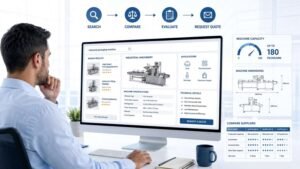
Your Product Catalogue Can Become Your Digital Sales Engine
For an industrial machinery manufacturer, every major product represents a potential entry point for a buyer.
Instead of treating your product catalogue as a list of machines, think of it as a network of search and conversion opportunities.
For each important machine, you can build around:
Product
→ Application
→ Industry
→ Technical information
→ Use cases
→ Proof
→ Enquiry
For example, a manufacturer producing automated packaging machinery could create supporting content around:
- Packaging machinery for pharmaceutical companies
- Packaging machinery for food manufacturers
- Automated packaging solutions
- High-speed packaging applications
- Packaging machine specifications
- How to select packaging machinery
- Automation and production efficiency
- Relevant project or application examples
Now one product isn’t represented by a single page.
It becomes the centre of a wider content ecosystem.
This can help search engines understand what you manufacture while giving potential buyers more useful information throughout their research process.
The Product Page Has to Do More Than Describe the Machine
A common mistake is creating product pages that sound impressive but don’t help a buyer make a decision.
For example:
“We manufacture high-quality, advanced industrial machinery using cutting-edge technology.”
That sounds positive.
But it doesn’t answer the buyer’s questions.
A stronger product page should make the buyer understand:
What is it?
Clearly explain the machine and its purpose.
Who uses it?
Show relevant industries and applications.
What can it handle?
Provide useful technical specifications and capacity information.
What makes it suitable?
Explain capabilities, automation, customisation or other relevant advantages.
Can I trust the manufacturer?
Show experience, certifications, projects, case studies and technical expertise where applicable.
What should I do next?
Give the buyer a clear way to request a quotation, discuss requirements or contact the sales team.
The journey should feel natural:
Understand → Evaluate → Trust → Enquire
This Is Where SEO Starts Bringing Commercial Value
This is the purpose of SEO for industrial machinery manufacturers.
Not simply to increase the number of keywords on Google.
Not simply to bring more visitors.
The objective is to make the right machinery visible to the right buyer.
A search strategy can connect different types of searches with different pages:
| Buyer intent | Useful website destination |
| Specific machine | Product page |
| Machinery for an industry | Industry/application page |
| Technical requirement | Product or technical content |
| Production problem | Solution-focused content |
| Manufacturer/supplier search | Commercial page |
| Location-based requirement | Location-focused page |
This creates a much more useful path:
Search
→ Relevant result
→ Relevant product/application page
→ Technical evaluation
→ Enquiry
That’s why effective SEO services for industrial machinery manufacturers should be closely connected to products, applications and commercial intent.
But SEO Is Not the Only Way to Capture Demand
Organic search is powerful when a buyer is actively researching.
But what about the company that needs machinery immediately?
Or a buyer who has never heard of your brand?
Or a manufacturer entering a new market?
This is where different digital channels can work together.
Google Ads
Capture high-intent searches when buyers are actively looking for machinery, manufacturers, suppliers or quotations.
Reach procurement, engineering, production, plant and operations professionals who may influence future purchases.
Content Marketing
Answer technical and application questions that buyers have before speaking with a supplier.
Remarketing
Stay visible to prospects who visited your website but weren’t ready to enquire during their first visit.
Instead of expecting one channel to do everything, the strategy becomes:
SEO captures existing search demand.
Google Ads captures immediate intent.
Content supports evaluation.
LinkedIn builds B2B visibility.
Remarketing brings interested prospects back.
The Next Question: What Happens After the Click?
This is where many campaigns lose their value.
- A buyer arrives.
- They browse.
- They have a question.
- They leave.
What if your website could start the conversation instead?
AI can help create an additional layer between website traffic and sales.
For example:
Visitor:
“We need an automated packaging machine.”
AI:
“What type of products are you packaging?”
Visitor:
“Pharmaceutical products.”
AI:
“What production capacity are you targeting?”
The system can help collect relevant information and guide the visitor towards an inquiry.
Depending on the business requirements, AI solutions can support:
- Initial visitor conversations
- Requirement collection
- Lead qualification
- Follow-ups
- Calling
- Appointment or enquiry handling
The important point is not to use AI simply because it is trending.
The question is:
Can AI help your sales team identify and respond to potential buyers faster?
If yes, it becomes part of the lead-generation system.
Not Every Lead Should Reach Your Sales Team
This is an overlooked part of B2B marketing.
Suppose a campaign generates 300 enquiries.
That sounds successful.
But what if only 20 are genuinely relevant?
Your sales team still has to spend time filtering the other 280.
A better system can look at information such as:
- Company
- Industry
- Product requirement
- Application
- Location
- Production requirement
- Project stage
- Timeline
- Contact details
This allows the business to distinguish between someone casually asking for a price and a company with a genuine machinery requirement.
That is the difference between lead volume and lead quality.
What Does a Quality Machinery Lead Actually Look Like?
Consider two enquiries.
Enquiry 1
“Need machine price.”
There is almost no useful context.
Enquiry 2
“We are an automotive component manufacturer expanding our production facility. We are evaluating automated machinery for a new production line and require approximately X capacity. Please share available specifications, lead time and quotation.”
The second enquiry gives the sales team something meaningful to work with.
They know:
Industry: Automotive
Company type: Component manufacturer
Requirement: Automated machinery
Project: Production expansion
Intent: Supplier evaluation
Next step: Technical discussion/quotation
This is what lead generation for industrial machinery manufacturers should ultimately aim to improve.
Not just the number of forms.
The relevance of the opportunities entering the pipeline.
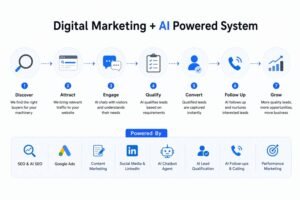
A Better Digital Strategy Connects Every Stage
The strongest results don’t come from running SEO, Google Ads or AI as completely separate activities.
They work better when connected.
Stage 1 — Identify the market
Automotive, pharmaceutical, food & beverage, textiles, infrastructure, power & energy, chemicals, FMCG and packaging.
Stage 2 — Understand demand
Find what those buyers search for around products, applications, problems and specifications.
Stage 3 — Build visibility
Use SEO, AI SEO and paid search to appear when relevant demand exists.
Stage 4 — Help buyers evaluate
Give them product information, technical specifications, applications, case studies and proof.
Stage 5 — Create the opportunity
Use strong enquiry paths, RFQs and conversion-focused website experiences.
Stage 6 — Engage
Use AI-powered conversations to answer initial questions and capture requirements.
Stage 7 — Qualify
Identify whether the enquiry matches your products, industry and sales criteria.
Stage 8 — Follow up
Use timely human or AI-assisted follow-up so potential opportunities don’t disappear.
Stage 9 — Sales
The sales team gets a more relevant opportunity instead of simply another contact form.
That’s when digital marketing starts looking less like marketing and more like a B2B acquisition system.
How AdsThrive Can Build This Lead-Generation System
This is where Digital marketing for industrial machinery manufacturers can be connected to the actual business objective.
AdsThrive can map different services to different stages of the buyer journey.
| Manufacturer’s challenge | AdsThrive approach |
| Buyers can’t find the company | SEO & AI SEO |
| Product pages have poor visibility | Product-focused SEO |
| High-intent buyers need immediate reach | Google Ads |
| Decision-makers aren’t familiar with the brand | LinkedIn & social media |
| Technical expertise isn’t visible online | Content marketing |
| Website traffic isn’t converting | Conversion optimisation |
| Need more relevant enquiries | Lead generation |
| Visitors need immediate answers | AI Chatbot Agent |
| Too many unqualified enquiries | AI Lead Qualification |
| Prospects aren’t followed up quickly | AI Follow-ups |
| Enquiries require faster handling | AI Calling Solution |
| Need to scale acquisition | Performance marketing |
The strategy doesn’t have to begin with every service.
It should begin with the gap in the buyer journey.
If your buyers can’t find your products, SEO is a priority.
If they’re searching but competitors are taking the clicks, Google Ads may help capture immediate demand.
If your website gets traffic but few enquiries, conversion optimization becomes important.
If your sales team receives too many irrelevant leads, qualification becomes the priority.
This is how a Digital marketing agency for industrial machinery manufacturers should think about growth — not as a fixed list of services, but as a system designed around where potential buyers are being lost.
What Should Manufacturers Measure?
If the ultimate objective is quality B2B leads, measuring only traffic can be misleading.
A better measurement chain is:
Search visibility
↓
Relevant visitors
↓
Product/application engagement
↓
RFQs and enquiries
↓
Qualified leads
↓
Sales opportunities
↓
Revenue
Useful metrics can include:
- High-intent keyword visibility
- Organic traffic to product pages
- Application-page engagement
- RFQs generated
- Qualified enquiry rate
- Cost per qualified lead
- Lead source
- Enquiry-to-opportunity rate
- Sales opportunities generated
The question shouldn’t simply be:
“How many people came to our website?”
Ask:
“How many companies that actually need our machinery entered our sales pipeline?”
That is a much more meaningful measure of digital performance.
Five Signs Your Machinery Marketing Needs a Different Approach
1. Your competitors appear for searches related to your products
If buyers are finding competitors before they find you, there is a visibility gap.
2. Your website has products but little search visibility
Having a product catalogue doesn’t automatically mean buyers can discover it.
3. Your website receives visitors but few enquiries
This can indicate a gap between traffic and conversion.
4. Paid campaigns generate too many irrelevant enquiries
The problem may be targeting, search intent, landing pages or lead qualification.
5. Your sales team spends too much time filtering leads
A stronger qualification process can help sales focus on opportunities with greater potential.
The Goal Is Not More Leads. It Is More Relevant Buyers.
An industrial machinery manufacturer doesn’t need to be visible to everyone.
It needs to be visible to the right companies.
The automotive OEM is searching for production machinery.
The pharmaceutical manufacturer evaluating packaging equipment.
The food processor is looking for increased capacity.
The textile company is planning a machinery upgrade.
The infrastructure business is looking for specialised equipment.
And when those buyers search, your company needs to be there with the right product, the right information and the right path to enquiry.
The journey should look like this:
Right Industry
→ Right Buyer
→ Right Search
→ Right Product
→ Right Information
→ Right Engagement
→ Right Qualification
→ Qualified B2B Enquiry
That is where digital marketing becomes commercially meaningful.
At AdsThrive, SEO, AI-powered marketing, Google Ads, performance marketing, content, lead generation and AI solutions can work together to help industrial businesses turn online demand into better sales opportunities.
Ready to Generate More Qualified B2B Enquiries?
Talk to AdsThrive about your digital growth goals.
FAQs
1. What is SEO for industrial machinery manufacturers?
It is a search strategy designed to improve a manufacturer’s visibility for relevant product, application, specification, supplier and industry-related searches so potential B2B buyers can discover the company.
2. How can digital marketing help industrial machinery manufacturers?
Digital marketing can help manufacturers reach potential customers through SEO, Google Ads, LinkedIn, content marketing and other channels while using website conversion and lead-qualification processes to turn interest into business enquiries.
3. What keywords should an industrial machinery manufacturer target?
Keyword selection depends on the manufacturer’s products and markets. Useful categories include machinery names, applications, industries, specifications, problems, manufacturers, suppliers and location-based commercial searches.
4. Can Google Ads generate B2B leads for machinery manufacturers?
Yes. Google Ads can capture buyers who are already searching for specific machinery, suppliers or manufacturers. Campaigns should be built around high-intent searches and send users to relevant product or application pages.
5. How can AI improve machinery lead generation?
AI can support website conversations, requirement collection, lead qualification and follow-up. It can help businesses respond to potential buyers faster and provide sales teams with more useful lead information.
6. How can manufacturers improve the quality of their leads?
Start by targeting the right industries and commercial search intent. Then create detailed product pages, clear enquiry paths and a qualification process that identifies whether a prospect genuinely matches the manufacturer’s products and sales criteria.
7. Why do industrial machinery websites get traffic but few enquiries?
Common reasons include poor product-page targeting, insufficient technical information, weak conversion paths, irrelevant traffic or a disconnect between what buyers search for and what the website communicates.
8. How long does SEO take for an industrial machinery manufacturer?
SEO is a long-term process and the timeline varies depending on the website, competition, target keywords, content quality, authority and existing online visibility. High-intent opportunities can be prioritised while the broader organic strategy develops.
Ready to Generate More Qualified B2B Enquiries?
Your next customer may already be searching for the machinery, equipment, or manufacturing capability you provide. The challenge is making sure they find you, understand your capabilities, and have a clear reason to enquire.
With the right combination of SEO, Google Ads, LinkedIn marketing, content, conversion optimisation and AI-powered lead qualification, your digital presence can become a consistent B2B lead-generation channel.
“AdsThrive helps industrial businesses build digital strategies focused on visibility, qualified enquiries and measurable growth — not just website traffic.”