Industrial cable buyers do not usually discover suppliers by browsing randomly. Electrical engineers, EPC contractors, procurement teams, automation companies and industrial buyers often begin with a specific requirement: a cable type, voltage rating, application, material, certification, quantity or project specification.
That creates a very different marketing challenge for an Industrial Cable Manufacturer.
A website can receive visitors without generating meaningful enquiries. A company can rank for broad cable-related searches while missing the searches that indicate genuine purchasing intent. Google Ads can generate clicks but waste the budget on consumer searches. LinkedIn can create visibility without reaching the people involved in actual projects.
For industrial cable companies, digital marketing needs to connect technical search visibility with commercial intent.
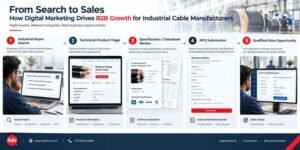
The objective is not simply to generate more traffic. It is to help the right buyer find the manufacturer, understand its capabilities, request technical information, submit an RFQ and move into a sales conversation.
This guide explains how industrial cable manufacturers can build that kind of digital lead-generation system using SEO, Google Ads, LinkedIn, conversion-focused website improvements, AI lead qualification and automated follow-up.
Why Industrial Cable Manufacturers Need a Different Digital Marketing Approach
Marketing industrial cables is fundamentally different from marketing consumer electrical products.
A consumer may search for a generic product and make a purchase quickly. An industrial buyer may need to compare construction, conductor material, voltage rating, insulation, shielding, temperature range, application requirements, testing standards and certifications before contacting a manufacturer.
The sales cycle can also involve several people.
An electrical engineer may identify the requirement. A project manager may approve the specification. Procurement may request quotations from several suppliers. A quality team may review certifications and testing documents. Finally, management may evaluate commercial terms.
That means your website needs to support more than one stage of the buying process.
A useful digital marketing strategy for industrial cable manufacturers should therefore answer five questions:
- Can the right buyer find you?
- Can they quickly determine whether you manufacture the required cable?
- Can they verify your technical capabilities?
- Can they submit an enquiry without unnecessary friction?
- Does the sales team receive enough information to respond effectively?
If the answer to any of these is no, marketing investment can leak away before the enquiry reaches your sales team.
Where Industrial Cable Companies Commonly Lose Potential Customers
The biggest problem is often not a lack of marketing activity. It is the gap between online discovery and commercial conversion.
1. The website attracts broad traffic instead of procurement traffic
A cable manufacturer may rank for searches containing words such as “cable,” “wire,” or “electrical cable.”
Those keywords can be useful for visibility, but they do not necessarily indicate that the searcher is looking for a manufacturing supplier.
An engineer searching for:
“medium voltage XLPE power cable manufacturer”
has a very different intent from someone searching:
“how to connect electrical cable.”
The first search can represent a commercial opportunity. The second may have no value to an industrial manufacturer.
This is why SEO for industrial cable manufacturers should focus heavily on search intent rather than simply increasing the number of keywords on a website.
2. Technical information is difficult to find
Industrial buyers want answers quickly.
If a product page only says:
High-quality industrial cables manufactured to international standards.
it does not give an engineer enough information to evaluate the supplier.
The page should provide relevant technical information such as:
- Cable construction
- Conductor material
- Voltage rating
- Insulation material
- Sheathing material
- Number of cores
- Temperature range
- Shielding options
- Application areas
- Applicable standards
- Testing information
- Available sizes
- Customisation capabilities
- Datasheets and technical documents
The exact information will depend on the product.
The goal is not to overload every page with specifications. It is to make the information a technical buyer is likely to need easy to locate.
3. Enquiry forms create unnecessary friction
A potential buyer may already have a detailed requirement but encounter a generic form asking only for:
Name → Email → Phone → Message
That can be insufficient for industrial enquiries.
A better enquiry experience can ask for relevant information such as:
- Cable type
- Required quantity
- Voltage
- Application
- Project location
- Delivery requirement
- Technical specification
- Drawing or BOM upload
Not every visitor needs to complete every field. The form should be designed around the manufacturer’s actual sales process.
4. Leads arrive without enough information
Imagine receiving an enquiry that says:
“I need cable. Please send a price.”
Your sales team now has to start the conversation from zero.
A better enquiry might say:
“Need 5 km of medium-voltage XLPE cable for a 33 kV substation project in Karnataka. Requirement expected within 60 days. Please advise available construction and quotation.”
The second enquiry is much more commercially useful because the sales team already understands the basic requirement.
This is where lead generation for industrial cable manufacturers should go beyond simply collecting contact details.
What Are Industrial Cable Buyers Actually Searching For?
One of the most important improvements a manufacturer can make is to stop treating “industrial cable” as a single keyword category.
Different buyers search according to their immediate requirement.
| Search intent | Example search | What it can indicate |
| Product search | Medium voltage XLPE power cable manufacturer | Product sourcing |
| Specification search | UL 1277 Type TC-ER cable supplier | Technical procurement |
| Custom manufacturing | Custom multi-conductor shielded cable manufacturer | OEM/custom requirement |
| Application search | Industrial control cable manufacturer | Application-specific sourcing |
| Industry search | Marine armored power cable manufacturer | Sector-specific requirement |
| Commercial search | Medium voltage power cable supplier | Supplier comparison |
| RFQ search | Industrial cable manufacturer quotation | Direct purchase intent |
| Service search | SEO for industrial cable manufacturers | Marketing requirement |
The original draft correctly identifies specification-led searches, custom manufacturing searches, sector-specific sourcing and direct commercial searches as important opportunities.
The important point is that each search type may require a different landing page, message and conversion path.
7 Practical Digital Marketing Strategies for Industrial Cable Manufacturers
1. Build SEO Around Products, Specifications and Applications
The foundation of SEO for industrial cable manufacturers should be a website architecture that reflects how industrial buyers actually search.
Instead of creating one generic “Industrial Cables” page and trying to rank it for everything, develop useful product and application sections.
For example:
Product-based pages
- Medium Voltage Cables
- XLPE Power Cables
- Armoured Cables
- Control Cables
- Flexible Cables
- Shielded Cables
- Tray Cables
- Specialised Industrial Cables
Application-based pages
- Power Distribution
- Industrial Automation
- Renewable Energy
- Manufacturing Plants
- Oil and Gas
- Marine Applications
- Infrastructure Projects
- OEM Applications
Capability-based pages
- Custom Cable Manufacturing
- Multi-Core Cable Manufacturing
- Shielded Cable Manufacturing
- High-Temperature Cable Manufacturing
- Special Cable Construction
This gives search engines a clearer understanding of the company’s product range while giving buyers dedicated pages relevant to their requirements.
2. Turn Technical Knowledge Into Searchable Content
Industrial manufacturers often possess an enormous amount of useful information that never reaches their website.
Engineers inside the company may know:
- Which insulation is appropriate for different applications
- How voltage ratings affect cable selection
- Differences between copper and aluminium conductors
- When shielding is required
- How environmental conditions influence cable construction
- What testing is performed
- Which standards apply to specific products
- How cable specifications change according to project requirements
That knowledge can become valuable search content.
Instead of publishing generic articles such as:
“Why Quality Cables Are Important”
create content around actual engineering questions.
Examples include:
- How to Select the Right Medium Voltage Power Cable
- XLPE vs EPR Insulation for Industrial Applications
- Copper vs Aluminium Conductors for Power Cables
- What Information Should Be Included in an Industrial Cable RFQ?
- How to Choose Shielded Cables for Industrial Automation
- What Cable Specifications Should EPC Contractors Check Before Ordering?
- Armoured vs Unarmoured Cable: Where Is Each Used?
- How Cable Voltage Rating Affects Product Selection
This approach makes the website useful before the buyer is ready to request a quotation.
3. Make Product Pages Commercially Useful
A product page should not behave like a digital brochure cover.
It should help the visitor decide whether your company is capable of supplying the required product.
A strong industrial cable product page can include:
Product overview
Briefly explain what the cable is designed for and where it is used.
Technical specifications
Present important specifications clearly rather than hiding them inside large paragraphs.
Applications
Explain the environments and industries where the product is suitable.
Standards and testing
Clearly display relevant certifications, testing capabilities and applicable standards where supported.
Manufacturing capabilities
Explain available sizes, construction options, customisation and production capabilities.
Technical documents
Provide datasheets, drawings and other useful documents where appropriate.
Enquiry CTA
Give the buyer a clear next step.
For example:
Request a Technical Quote
or
Send Your Cable Requirement
or
Upload Your Specification
This is an important part of SEO services for industrial cable manufacturers because search visibility has limited commercial value if the resulting page cannot convert an engineering visitor into an enquiry.
4. Use Google Ads for Immediate Commercial Demand
SEO takes time.
If a manufacturer is entering a new market, launching a product line or wants immediate visibility for high-intent searches, Google Ads can provide an additional acquisition channel.
But industrial manufacturers need to be careful with keyword selection.
A campaign targeting broad terms such as:
cable manufacturer
could potentially attract a wide variety of searches.
A more focused campaign could target phrases around:
- Medium voltage cable manufacturer
- Industrial cable supplier
- Custom industrial cable manufacturer
- XLPE cable manufacturer
- Armoured power cable manufacturer
- Control cable manufacturer
- Industrial cable supplier for OEMs
The exact keyword set should be based on the company’s actual products and target markets.
Negative keywords matter
Paid search can waste budget when consumer or informational searches enter the campaign.
Depending on the business, negative keywords may include searches related to:
- DIY
- Repair
- Home wiring
- Installation tutorials
- Wiring diagrams
- Jobs
- Courses
- Used products
- Retail requirements
The purpose is not to block traffic simply because it is inexpensive. The purpose is to protect the advertising budget for searches aligned with the manufacturer’s commercial market.
A combination of SEO and paid search can therefore provide both long-term organic visibility and immediate coverage for high-intent searches.
5. Use LinkedIn to Reach the People Behind Large Projects
Search captures active demand.
LinkedIn can help manufacturers reach potential buyers before they start searching.
This is particularly relevant when selling into:
- EPC companies
- Utilities
- Infrastructure companies
- Automation companies
- OEMs
- Renewable energy companies
- Industrial plants
- Engineering firms
- Construction companies
Instead of posting only product photographs, manufacturers can build content around technical and commercial problems.
For example:
Post:
“Three cable specifications EPC teams should confirm before requesting quotations.”
Another:
Post:
“Why do cable construction requirements change between indoor and outdoor industrial installations?”
Another:
Post:
“Questions procurement teams should ask before selecting an industrial cable supplier.”
This type of content can attract engineers and procurement professionals while demonstrating technical knowledge.
LinkedIn can also be used for targeted outreach to relevant job roles such as:
- Procurement Managers
- Electrical Engineers
- Project Managers
- Supply Chain Managers
- Engineering Heads
- Plant Managers
- EPC Procurement Teams
The objective should be relevant business conversations rather than sending mass promotional messages.
6. Improve the RFQ Experience
Getting a buyer to your website is only half the job.
The next question is:
How easy is it for them to request a quotation?
An industrial cable manufacturer can improve RFQ conversion by offering multiple enquiry routes.
Simple enquiry
For visitors who are still researching.
Name + company + requirement + contact details
Detailed RFQ
For procurement teams with a defined requirement.
Fields could include:
- Cable type
- Voltage
- Conductor
- Insulation
- Quantity
- Application
- Delivery location
- Required delivery date
Document upload
For buyers who already have technical documentation.
Allow them to upload:
- BOM
- Cable schedule
- Technical specification
- Project document
- Drawing
- Excel requirement sheet
This is particularly valuable for complex B2B enquiries because the sales or engineering team receives more useful context from the beginning.
7. Use AI to Qualify and Follow Up With Enquiries
This is where modern digital marketing for industrial cable manufacturers can move beyond traffic generation.
Imagine a visitor lands on a product page at 10:30 PM.
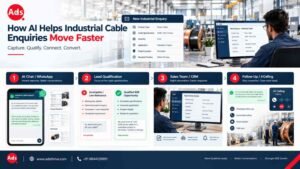
Instead of seeing only a static contact form, an AI chat assistant can ask:
What type of cable are you looking for?
The buyer responds.
The assistant can then ask relevant questions about:
- Voltage
- Quantity
- Application
- Project location
- Delivery timeline
- Required specification
The information can then be passed to the appropriate sales team.
This does not replace the sales engineer.
It helps the sales engineer start with useful information instead of an empty enquiry.
AI Lead Qualification Can Reduce Manual Enquiry Handling
Not every enquiry deserves the same sales priority.
A manufacturer might receive:
- A student asking for information
- A distributor asking about a product
- An engineer researching specifications
- An OEM looking for recurring supply
- An EPC company working on a large project
- A procurement manager requesting a quotation
These are different commercial situations.
AI-assisted qualification can collect the basic information and classify enquiries according to rules defined by the company.
For example:
Product: Medium-voltage cable
Quantity: 5 km
Application: Substation project
Location: Bengaluru
Timeline: 45 days
Status: Sales follow-up required
The sales team can then see the context before making contact.
AI Calling Can Add Another Layer of Follow-Up
Some enquiries require a conversation rather than another email.
An AI calling system can be used for appropriate follow-up workflows, such as confirming whether a customer still requires a quotation, collecting missing information or reminding a prospect about a requested callback.
For example, if a potential buyer submits an RFQ but does not provide the required quantity, an automated workflow can follow up and ask for the missing information.
Similarly, if a sales team wants to follow up with a prospect after a quotation is sent, automated calling can support the process.
The exact workflow should be designed around the manufacturer’s sales process rather than treating AI calling as a standalone feature.
WhatsApp Can Make Industrial Enquiries Easier to Continue
Many B2B buyers prefer quick communication after submitting an enquiry.
A WhatsApp workflow can be useful for:
- Enquiry confirmation
- Specification collection
- Document requests
- Sales follow-up
- Appointment or call scheduling
- Quotation follow-up
- Customer questions
For example:
“Thanks for your enquiry. To help our sales engineer prepare the right quotation, please share the cable type, required quantity and delivery location.”
The buyer can respond without returning to the website.
This is particularly useful when the company’s customers already use WhatsApp for business communication.
Where Adsthrive Fits Into the Growth Process
For an Industrial Cable Manufacturer, digital marketing should not be a collection of disconnected activities.
SEO brings organic search traffic.
Google Ads captures immediate commercial searches.
LinkedIn helps reach targeted B2B audiences.
The website provides technical information.
Lead generation turns visitors into enquiries.
AI chat can collect information.
WhatsApp can continue the conversation.
AI lead qualification can identify higher-value opportunities.
AI calling and automated follow-ups can help sales teams stay connected.
The real value comes from connecting these activities.
Adsthrive provides digital marketing and AI automation solutions that can be customized around a company’s workflow rather than requiring the business to manage several disconnected tools.
For an industrial manufacturer, this can include:
- SEO
- AI SEO
- Google Ads
- B2B lead generation
- AI Chat
- WhatsApp automation
- AI lead qualification
- AI calling
- Automated follow-ups
- CRM updates
- Booking and enquiry workflows
The objective is straightforward: bring more relevant prospects into the business and reduce the amount of manual work required to move an enquiry toward a sales conversation.
How to Measure Digital Marketing for an Industrial Cable Manufacturer
Traffic is useful, but it should not be the main measure of success.
For an industrial manufacturer, more meaningful metrics include:
Qualified RFQs
How many enquiries actually match the products and markets the company serves?
Cost per qualified enquiry
How much marketing expenditure is required to generate a relevant commercial enquiry?
RFQ-to-opportunity rate
How many enquiries become genuine sales opportunities?
Quote value
What is the estimated value of opportunities generated through digital channels?
Sales response time
How quickly does the sales team receive and act on a qualified enquiry?
Product-page conversion rate
Which product pages generate the most enquiries?
Technical document engagement
How many visitors download datasheets, specifications or other engineering resources?
Lead source
Are qualified opportunities coming from organic search, Google Ads, LinkedIn, WhatsApp or another channel?
This approach helps connect marketing performance to the sales pipeline rather than stopping at impressions and clicks.
A Practical Keyword and Search-Intent Plan
A successful SEO campaign should not simply collect hundreds of variations of “industrial cable.”
A more useful approach is to build keyword groups around commercial intent.
| Keyword group | Example | Recommended page |
| Product | Medium voltage cable manufacturer | Product page |
| Product + application | Industrial control cable manufacturer | Application/product page |
| Specification | XLPE power cable manufacturer | Technical product page |
| Custom | Custom industrial cable manufacturer | Custom manufacturing page |
| Industry | Cables for renewable energy projects | Industry page |
| Commercial | Industrial cable supplier | Commercial landing page |
| RFQ | Industrial cable quotation | RFQ page |
| Marketing | SEO for industrial cable manufacturers | Service page |
| Agency | Digital marketing agency for industrial cable manufacturers | Service page |
The exact keywords should be validated against the manufacturer’s target market, products and geography before implementation.
Content Ideas That Can Generate Better Industrial Enquiries
Once the basic product pages are established, manufacturers can build supporting content around questions their buyers actually ask.
Some useful topics include:
Technical content
- How to Choose the Right Industrial Cable for a Manufacturing Plant
- XLPE Cable vs EPR Cable: Key Differences
- What Is the Difference Between Armoured and Unarmoured Cable?
- How to Select Cable Voltage Rating for Industrial Applications
- Copper vs Aluminium Conductors: Which Is Suitable for Your Project?
Procurement content
- What Information Should You Include in an Industrial Cable RFQ?
- How to Compare Industrial Cable Manufacturers
- What Should EPC Companies Check Before Selecting a Cable Supplier?
- Questions to Ask an Industrial Cable Manufacturer Before Placing an Order
Application content
- Industrial Cables for Automation Systems
- Cable Selection for Renewable Energy Projects
- Industrial Cable Requirements for Manufacturing Plants
- Cable Considerations for Infrastructure Projects
Commercial content
- How Custom Cable Manufacturing Works
- What Affects Industrial Cable Pricing?
- What Determines Cable Manufacturing Lead Time?
- How Manufacturers Handle Large Cable Orders
These topics can attract visitors at different stages of the buying process and create opportunities to link readers naturally toward relevant product and RFQ pages.
What a Strong Industrial Cable Website Should Have
Before investing heavily in traffic generation, review the website itself.
A commercially prepared website should make the following information easy to find:
Products
Clear product categories and individual product pages.
Applications
Industries and use cases served.
Technical specifications
Relevant product details presented clearly.
Certifications and standards
Applicable compliance information.
Manufacturing capabilities
Production capacity, customisation and testing capabilities where appropriate.
Technical resources
Datasheets, catalogues, drawings and useful documentation.
Projects or case studies
Evidence of experience where customer information can be shared.
RFQ options
Simple and detailed enquiry options.
Contact information
Clear phone, email and location information.
Fast response mechanism
Chat, WhatsApp or other appropriate channels.
A manufacturer does not need to make every page complicated. It needs to make the information important to a buyer easy to access.
Why Technical Authority Matters in Industrial SEO
Industrial buyers are not only evaluating a product.
They are evaluating whether the supplier understands the application.
That is why technical authority can become an important part of organic search performance and conversion.
A company that publishes useful technical information can demonstrate knowledge before the first sales conversation.
For example, a manufacturer that explains cable construction, application requirements, testing and specification considerations can give an engineer a reason to continue exploring the website.
The content should still be accurate and reviewed by qualified technical personnel where necessary.
Marketing teams should not invent technical specifications simply to target keywords.
For industrial businesses, useful and accurate technical content is more valuable than large volumes of generic content.
The Role of AISEO in Industrial Manufacturing
Search behaviour is changing.
People increasingly use conversational searches and AI-assisted discovery to research suppliers and understand technical products.
That makes it important for manufacturers to structure content clearly.
Pages should answer questions directly, use descriptive headings, explain technical terminology and connect related product information.
This is where AISEO can complement traditional SEO.
Instead of focusing only on individual keywords, the content should establish clear relationships between:
Product → Specification → Application → Industry → Problem → Solution → Enquiry
For example, a page about medium-voltage XLPE cable can naturally connect the product with its applications, specifications, technical considerations and enquiry process.
That creates useful content for both traditional search and newer AI-driven discovery environments.
A 90-Day Starting Plan for Industrial Cable Manufacturers
A manufacturer does not need to change everything on day one.
First 30 days: Fix the commercial foundation
Review:
- Product architecture
- Product pages
- Technical information
- RFQ forms
- Contact pathways
- Mobile experience
- Conversion tracking
- Google Search Console data
- Existing keyword visibility
Identify the product categories with the strongest commercial potential.
Days 31–60: Build demand capture
Focus on:
- Priority product pages
- Technical SEO
- Commercial keywords
- Supporting technical content
- Google Ads for high-intent searches
- LinkedIn content
- RFQ improvements
At this stage, the objective is to create more opportunities for relevant buyers to discover and contact the manufacturer.
Days 61–90: Improve lead handling
Introduce or refine:
- AI chat
- WhatsApp workflows
- Lead qualification
- Automated follow-ups
- CRM routing
- Lead-source tracking
- Sales response alerts
Then evaluate which channels are producing genuine commercial opportunities.
The process should continue after 90 days. SEO authority, content depth and sales data improve over time.
Turn Online Searches Into Real Industrial Opportunities
For an Industrial Cable Manufacturer, digital marketing should not end when someone visits the website.
The real opportunity begins when the right engineer, procurement manager, EPC company or industrial buyer discovers the manufacturer and finds enough information to take the next step.
That means the website needs to be technically useful. SEO needs to target commercial intent. Google Ads needs to focus on relevant searches. LinkedIn needs to reach the right professional audiences. RFQ forms need to reduce friction. And once an enquiry arrives, AI-powered chat, WhatsApp, qualification, calling and follow-up can help the sales team respond more efficiently.
This is where digital marketing for industrial cable manufacturers becomes a business-development function rather than simply a traffic-generation exercise.
Adsthrive helps industrial businesses connect SEO, AISEO, paid advertising, lead generation and AI-powered enquiry handling into customised digital growth workflows.
Frequently Asked Questions
How can an industrial cable manufacturer generate more B2B leads online?
A manufacturer can combine technical SEO, Google Ads, LinkedIn, conversion-focused product pages, RFQ forms and automated lead qualification. The focus should be on reaching buyers with genuine product or project requirements rather than maximising general website traffic.
What keywords should industrial cable manufacturers target?
Keywords should reflect products, specifications, applications, industries and commercial intent. Examples include “medium voltage cable manufacturer,” “XLPE power cable manufacturer,” “custom industrial cable manufacturer” and other terms that accurately match the company’s capabilities.
Is SEO useful for industrial cable manufacturers?
Yes, when SEO is built around the searches used by engineers, procurement teams, EPC companies and other relevant buyers. Product pages, technical content, application pages and specification-led searches can all contribute to organic visibility.
Should industrial cable companies use Google Ads?
Google Ads can provide immediate visibility for relevant commercial searches while organic SEO develops. Campaigns should be tightly targeted and use appropriate negative keywords to reduce irrelevant traffic.
How can AI help generate industrial cable enquiries?
AI can assist with enquiry collection, qualification, routing and follow-up. A chatbot can collect basic project information, while automated workflows can send qualified enquiries to the appropriate sales representative.
Can WhatsApp be used for B2B industrial lead generation?
Yes. WhatsApp can be used for enquiry confirmation, specification collection, document requests and follow-up when it fits the company’s customers and sales process.
What should an industrial cable RFQ form include?
Depending on the product, useful information can include cable type, voltage, quantity, application, delivery location, required timeline and technical documents. The form should collect enough information to help sales or engineering teams respond without making the process unnecessarily difficult.
How should an industrial cable manufacturer measure digital marketing?
Instead of relying only on traffic and impressions, track qualified RFQs, cost per qualified enquiry, opportunity value, RFQ-to-opportunity conversion, sales response time, product-page enquiries and lead sources.
If your company wants to attract more relevant industrial buyers, capture better RFQs and reduce the gap between an online enquiry and a sales conversation, talk to Adsthrive about building a system around your actual sales process.