

A die casting manufacturer may have advanced high-pressure casting machines, aluminium and zinc casting capabilities, in-house tooling facilities and precision machining equipment. Yet, an international OEM searching for a reliable manufacturing partner may never come across the company online. The challenge is often not the quality of its manufacturing capabilities, but how effectively those capabilities are presented to potential buyers.
SEO for Die Casting Company strategies should go beyond improving website rankings. They should help manufacturers reach procurement managers, engineering teams, sourcing consultants and product developers who are actively looking for manufacturing partners.
Companies serving the automotive, electrical, aerospace, construction and industrial equipment sectors need a website that clearly communicates their technical expertise, production capabilities and ability to handle commercial requirements. They also need a reliable process for converting website visitors into drawing submissions, RFQs, meetings and long-term business relationships.
A well-planned digital marketing strategy brings these activities together. Through technical SEO, AI SEO, Google Ads, LinkedIn outreach, lead generation and automated follow-ups, manufacturers can improve their visibility and create more opportunities to connect with international buyers.
Your manufacturing capacity is not your marketing message
Consider two die casting manufacturers.
The first company’s website says:
“We are a leading manufacturer of quality aluminium and zinc die cast components.”
The second company provides more specific information:
- Aluminium high-pressure die casting for automotive and industrial components.
- Available machine tonnage and maximum component dimensions.
- Tool design, development and production capabilities.
- Secondary machining and surface finishing.
- Quality inspection and dimensional verification.
- Production volumes and industries served.
- Drawing submission and RFQ facilities.
Both manufacturers may have comparable production capabilities. However, the second website gives potential customers a much clearer picture of what the company can deliver.
International procurement teams do not shortlist suppliers simply because they claim to manufacture quality products. They want to know whether a company can produce their required components, work with the specified material, meet production requirements and maintain consistent quality.
This creates an important opportunity for manufacturers.
Instead of treating the website as an online company brochure, build it as a technical supplier evaluation platform.
A prospective buyer should be able to understand what you manufacture, which processes you support, what industries you serve and how to discuss a project with your team without having to contact you for every basic detail.
What should a die casting manufacturer’s website communicate?
| Information | What the prospective buyer wants to establish |
| Material capabilities | Whether the manufacturer works with the required alloy |
| Casting processes | Whether the company supports the specified production method |
| Machine capacity | Whether the equipment can accommodate the component |
| Tooling capabilities | Whether die design and development are supported |
| Quality systems | Whether inspection and documentation requirements can be met |
| Secondary operations | Whether machining, finishing and assembly are available |
| Production capacity | Whether the manufacturer can support the required volume |
| Export experience | Whether international supply requirements can be supported |
| RFQ process | How drawings, technical specifications and quantities can be submitted |
These details should form the starting point of your digital marketing strategy.
Find the commercial searches your competitors are capturing
Many manufacturers optimise their websites around broad terms such as die casting manufacturers, metal components and industrial manufacturing.
Although these keywords can attract visitors, they do not necessarily bring people who are ready to discuss a production requirement.
A better approach is to understand what potential buyers search for at different stages of the sourcing process.
An engineering professional might search for an aluminium die casting supplier. A procurement manager may be looking for a custom component manufacturer. A sourcing consultant may compare suppliers based on their country, material expertise, manufacturing process or machining facilities.
Each of these searches represents a different business opportunity.
The searches your website could be missing
The following are examples of relevant search queries, not claimed search-volume figures.
| Buyer search | Commercial opportunity | Recommended website destination |
| Aluminium die casting manufacturer | Production supplier enquiry | Aluminium capability page |
| Custom zinc die casting supplier | Specialised component requirement | Zinc casting page |
| High pressure die casting services | Process-specific enquiry | HPDC service page |
| Automotive die casting supplier | OEM and Tier-1 opportunities | Automotive industry page |
| Precision die casting components | Technical manufacturing requirement | Precision components page |
| Die casting manufacturer in India | International supplier discovery | Export-focused landing page |
| Magnesium die casting manufacturer | Material-specific requirement | Magnesium capability page |
| Custom die casting services | Drawing-based production enquiry | Custom manufacturing page |
| Die casting tooling manufacturer | Tooling and development enquiry | Tooling capability page |
| Aluminium die casting with CNC machining | Integrated manufacturing requirement | Machining and finishing page |
A website that targets only the broad term die casting manufacturer may miss many of these specific commercial searches.
How to turn search opportunities into an SEO plan
Start by grouping the keyword opportunities into three commercial categories.
Category A: Buyers searching for a manufacturing partner
Examples include die casting manufacturer, custom die casting supplier and die casting company in India.
These searches should lead visitors to company capability pages that explain manufacturing strengths, quality systems and enquiry options.
Category B: Buyers searching for a specific manufacturing requirement
Examples include aluminium die casting, zinc die casting, precision die casting and high-pressure die casting.
These searches deserve dedicated technical landing pages rather than a general services description.
Category C: Buyers comparing suppliers and production suitability
Examples include die casting supplier for automotive components, aluminium casting with machining and high-volume die casting manufacturer.
These searches require detailed information about relevant experience, manufacturing processes, equipment and production support.
A well-planned keyword strategy connects every important commercial search to a relevant website page and a clear enquiry option.
Build an SEO structure around what your factory can actually manufacture
For a manufacturing business, SEO should start with its actual production capabilities rather than a collection of keywords.
This becomes particularly important when a company works with multiple alloys, components and casting processes.
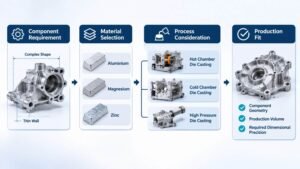
When all services are explained on one page, both search engines and potential customers may struggle to identify the specific manufacturing solutions the company offers.
SEO for Die Casting Services Company websites should therefore be organised around individual service categories, with each page providing relevant technical and commercial information.
SEO for Custom Die Casting Company
Custom manufacturing enquiries often start with an engineering drawing, CAD model or component specification.
In many cases, the buyer already knows the required material, approximate dimensions, application and expected production volume. The website should demonstrate that the manufacturer understands these requirements and has the facilities to assess them.
A dedicated custom manufacturing page should explain:
- Custom component development.
- Tool and die development.
- Prototype and production support, where available.
- Alloy selection assistance.
- Dimensional and quality inspection.
- Secondary machining and finishing.
- Volume production capabilities.
- Drawing-based quotation facilities.
Include a clear RFQ option that allows visitors to submit drawings, technical specifications and estimated quantities.
This makes it easier to attract buyers with actual production requirements rather than visitors who are only looking for general information about casting.
SEO for Custom Die Casting China Company and SEO for China Die Casting Manufacturers
Manufacturers in China targeting international buyers need to demonstrate more than their manufacturing location.
Their websites should explain the specific products and production capabilities they offer, supported by relevant technical information.
For example, a China-based supplier targeting European industrial buyers should communicate:
- Materials and casting processes supported.
- Production equipment and machine capacity.
- Quality management systems.
- Tooling and machining facilities.
- Inspection and documentation procedures.
- Export and logistics experience.
- Communication and quotation processes.
Country-specific landing pages should only be developed when the manufacturer genuinely serves those markets and can provide useful information for buyers in those locations.
Avoid publishing dozens of similar country pages by changing only the location name. Such pages offer little additional value to potential customers.
SEO for Aluminum Die Casting Company
Aluminium die casting manufacturers can target buyers from automotive, electrical, telecommunications, lighting, industrial equipment and other relevant sectors.
A dedicated aluminium page should explain the available alloys, component applications, machine capacity, tooling requirements and secondary operations.
Where the factory offers these facilities, include information about CNC machining, surface treatment, dimensional inspection and production scalability.
The page should also address common engineering questions related to component geometry, tolerances and design requirements.
SEO for Magnesium Die Casting Company
Magnesium casting involves specific material and engineering considerations. Manufacturers should explain the magnesium alloys they work with, relevant applications, production processes and quality controls.
The International Magnesium Association’s process resources provide useful background on magnesium processing and applications.
A technical landing page should explain where the manufacturer’s magnesium casting capabilities are relevant rather than making broad claims about performance.
SEO for Zinc Die Casting Company
Zinc die casting manufacturers can position their capabilities around components that require fine details, dimensional consistency and suitable surface finishing.
Depending on the manufacturer’s actual experience, relevant applications may include hardware, electrical components, automotive fittings and industrial products.
The page should explain available alloys, finishing options, tooling support and production volumes.
SEO for Hot Chamber Die Casting Company
Hot chamber casting is suitable for particular alloys and manufacturing applications. The landing page should explain the process, materials supported and equipment available at the facility.
Potential buyers should be able to understand which component types and production requirements are suitable for the company’s manufacturing setup.
SEO for Cold Chamber Die Casting Company
A cold chamber casting page should focus on the alloys and components the manufacturer processes using this method.
For example, an aluminium-focused manufacturer can explain its machine range, component dimensions, tooling capabilities and production facilities.
SEO for High Pressure Die Casting Company
High-pressure die casting is an important commercial search category for manufacturers serving automotive and industrial markets. A dedicated page should clearly communicate the technical scope of the company’s HPDC operations.
Useful information includes machine tonnage, casting dimensions, alloy capabilities, tooling support, production considerations and inspection facilities.
NADCA’s Product Specification Standards for Die Castings provide a useful industry reference covering tooling, alloy properties, tolerances, GD&T, design and quality assurance.
The objective is to make every service page useful to an engineering professional or procurement manager evaluating potential suppliers.
Make international buyers confident enough to shortlist your company
Getting your website to appear in another country’s search results is only one part of international marketing. You also need to give potential buyers enough information to consider your company as a reliable supplier.
An international buyer evaluating a new die casting partner may want answers to several questions before submitting an RFQ:
- Does the manufacturer have the right equipment?
- Can it produce the required component geometry?
- Does it have experience with the specified alloy?
- Can it meet the required inspection and quality documentation?
- Does it have sufficient production capacity?
- Can it support export requirements?
- Is there a reliable point of contact?
Your website should address these questions using genuine company information.
Build an international supplier profile
Create a dedicated company capability section covering the following areas:
Manufacturing information: Actual machine inventory, tonnage ranges, casting processes, tooling facilities and secondary operations.
Quality information: Applicable certifications, inspection equipment, testing processes and traceability practices.
Industry experience: Relevant component applications and sectors served, subject to customer confidentiality.
Commercial information: Minimum order requirements, quotation process, production planning and communication arrangements.
Export information: Markets served, shipping support and relevant export documentation.
For Indian manufacturers, the DGFT Foreign Trade Policy provides the regulatory framework for export activities. Its provisions cover matters such as the Importer Exporter Code and documentation requirements.
Make sure that all information published on your website accurately reflects your company’s export readiness. Avoid advertising certifications, customer approvals or export experience that the business does not actually possess.
Use proof instead of promotional statements
Compare these two approaches:
| Weak website statement | More useful commercial presentation |
| Best quality products | Describe inspection equipment and quality procedures |
| Advanced technology | Show actual machines and supported processes |
| International standard manufacturing | Identify applicable certifications and their scope |
| Fast delivery | Explain production planning and realistic lead times |
| Experienced manufacturer | Present relevant projects and years of manufacturing experience |
| Global supplier | Identify the markets actually served |
The second approach gives buyers something concrete to evaluate instead of asking them to rely on promotional claims.
Turn technical expertise into search visibility through on-page, off-page and AI SEO
A strong industrial SEO campaign requires more than regularly publishing articles.
It needs three connected areas of optimisation.
On-page SEO: Make each manufacturing capability discoverable
On-page SEO helps search engines understand the subject and purpose of individual website pages.
For a die casting website, this includes:
- Optimised title tags and meta descriptions.
- Clear H1, H2 and H3 heading structures.
- Service-specific page content.
- Relevant material and process terminology.
- Descriptive image names and alt text.
- Internal links between related services.
- Technical explanations and useful FAQs.
- Clear RFQ and contact information.
For example, an aluminium die casting page should not simply repeat the phrase aluminium die casting manufacturer throughout the content.
It should explain the actual manufacturing process, available alloys, component applications and supporting services.
Off-page SEO: Establish authority outside your website
International buyers may discover manufacturers through industry directories, supplier networks, trade associations, engineering publications and business platforms.
Off-page SEO should strengthen your company’s digital credibility through relevant and genuine references from other websites.
Useful activities include:
- Relevant industry directory listings.
- Genuine supplier and association profiles.
- Editorial mentions in engineering publications.
- Industry partnerships and business references.
- Original technical articles that attract relevant citations.
- Relevant backlinks from credible manufacturing websites.
A large number of unrelated backlinks will not necessarily improve your website’s industry relevance.
For manufacturers, a relevant reference from an engineering association or industrial publication can be more valuable than a collection of unrelated directory listings.
AI SEO: Prepare your manufacturing brand for AI-powered discovery
Search behaviour is gradually expanding beyond traditional search results.
Buyers may use conversational search platforms to ask questions such as:
- Which companies manufacture custom aluminium die cast components in India?
- What should I check before selecting a high-pressure die casting supplier?
- Which manufacturers offer zinc casting with secondary machining?
- How can I compare die casting suppliers for an automotive component?
AI SEO focuses on making your company’s expertise easier to understand and discover across these search experiences.
A practical AI SEO strategy should include:
Entity clarity: Clearly identify the company, its location, manufacturing processes, materials and industries served.
Structured content: Organise technical information using meaningful headings, tables, lists and relevant structured data.
Question-led content: Publish useful answers to genuine engineering and procurement questions.
Topical authority: Connect material pages, process pages, industry pages and technical resources through relevant internal links.
Consistent business information: Maintain accurate company details and consistent references across trusted platforms.
Evidence-based content: Use actual factory information, technical documents and relevant project experience to support claims.
AI SEO should complement conventional SEO rather than replace it. There is no guaranteed way to secure a recommendation or citation from an AI-generated search result.
For manufacturers, the objective is to make their business easier to understand, evaluate and reference.
“For a deeper understanding of how manufacturers can attract potential clients and generate qualified business leads, explore our guide on how die casting companies can generate more B2B enquiries .”
Reach procurement managers before they start comparing suppliers
Google is not the only channel through which international buyers discover manufacturers.
LinkedIn offers another way to connect with professionals involved in engineering, purchasing, sourcing and supplier development.
However, manufacturers should avoid treating LinkedIn as a platform for repeatedly posting factory photographs and promotional messages.
The content and outreach should be relevant to the people they want to reach.
Build a LinkedIn strategy around buyer roles
| Target audience | Relevant content |
| Procurement managers | Production capabilities, sourcing support and quotation processes |
| Engineering managers | DFM, alloy selection and manufacturing considerations |
| Supplier development teams | Quality systems, equipment and production readiness |
| OEM founders and directors | Manufacturing partnerships and scalability |
| Product designers | Component design and material considerations |
| Sourcing consultants | Manufacturing locations, processes and supplier capabilities |
A practical LinkedIn campaign can combine:
- Company capability posts.
- Factory and production videos.
- Technical manufacturing explanations.
- New equipment announcements.
- Industry-specific application posts.
- Relevant employee and leadership profiles.
- Targeted connection campaigns.
- Direct outreach to relevant decision-makers.
For example, instead of sending a generic message saying, “We are a leading die casting manufacturer, please contact us,” a manufacturer can introduce its aluminium HPDC capabilities to a procurement professional working with relevant industrial components.
The message should be personalised and based on a genuine business connection.
LinkedIn outreach should lead somewhere
Every outreach campaign should offer a useful next step.
This could be a technical capability document, an industry-specific landing page, a manufacturing consultation or an invitation to share a component drawing for an initial discussion.
This is where LinkedIn, website landing pages and lead management systems should work together.
Use Google Ads when waiting for organic rankings is not commercially practical
SEO takes time to build. A manufacturer entering a new export market may not want to wait for organic visibility before starting customer acquisition activities.
Google Ads can help manufacturers reach people who are already searching for specific suppliers and manufacturing services.
However, campaigns need to be planned around genuine buyer requirements.
What should die casting manufacturers advertise?
Instead of directing all paid traffic to the homepage, create campaigns around individual commercial requirements.
| Campaign | Target search intent | Landing page |
| Aluminium die casting | Buyers looking for aluminium suppliers | Aluminium service page |
| Custom die casting | Buyers with component requirements | Custom manufacturing page |
| HPDC manufacturing | Process-specific supplier searches | HPDC page |
| Zinc die casting | Zinc component sourcing | Zinc service page |
| Automotive components | Automotive supplier discovery | Automotive industry page |
| Export manufacturing | International supplier searches | Export capability page |
Negative keywords should also be reviewed regularly.
Searches related to jobs, training courses, academic projects, hobby casting and unrelated consumer products may generate clicks without producing relevant business opportunities.
Measure commercial outcomes, not just clicks
A paid advertising campaign should be evaluated based on the quality of enquiries it generates.
Track:
- Relevant landing page visits.
- RFQ form submissions.
- Drawing uploads.
- Calls and qualified conversations.
- Target-market enquiries.
- Cost per qualified lead.
- Quotation requests.
- Sales opportunities created.
Adsthrive’s Google Ads and PPC services can support paid acquisition campaigns through audience targeting, campaign optimisation and conversion-focused landing pages.
The important thing to remember is that more clicks do not automatically translate into more business. Campaigns should be optimised around relevant commercial enquiries.
Stop losing enquiries after buyers visit your website
A manufacturer can invest in SEO, paid advertising and LinkedIn outreach and still lose opportunities because its enquiry process is difficult to navigate.
Imagine an engineering buyer visiting your website from Germany.
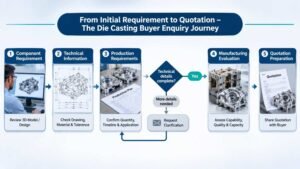
The visitor checks your aluminium casting capabilities, reviews your machining facilities and wants to know whether your company can manufacture a particular component.
But there is no clear RFQ option.
Alternatively, the visitor submits a form and waits several days for a response.
By that time, the buyer may have already contacted another supplier.
This is a conversion problem, not necessarily a traffic problem.
Design an RFQ experience for industrial buyers
A good enquiry process should make it straightforward for potential customers to communicate their manufacturing requirements.
Consider collecting:
| RFQ information | Why it matters |
| Company name | Identifies the potential buyer |
| Country | Helps identify the target market |
| Contact person | Establishes the business contact |
| Required material | Identifies alloy suitability |
| Casting process | Helps assess manufacturing compatibility |
| Component description | Clarifies the application |
| Drawing or CAD file | Supports technical evaluation |
| Estimated quantity | Helps assess production requirements |
| Annual volume | Provides demand context |
| Machining and finishing | Identifies secondary operations |
| Target delivery timeline | Helps assess commercial feasibility |
Avoid making the form unnecessarily complicated. Allow buyers to submit an initial enquiry even if they do not have every technical detail ready.
Provide a secure drawing submission facility and explain how confidential engineering information is handled.
Where Adsthrive’s AI automation becomes commercially useful
This is where digital marketing can extend beyond generating website traffic and enquiries.
Adsthrive offers an integrated set of AI and automation solutions that can support enquiry management.
AI ChatBot Agent
A website visitor can ask about available materials, manufacturing processes, machine capabilities or quotation procedures. The chatbot can help capture contact details and direct the visitor towards the appropriate enquiry process.
WhatsApp AI Agent
For manufacturers that use WhatsApp for sales communication, an AI agent can support initial conversations, collect basic requirements and guide potential customers towards the next step.
Explore the WhatsApp AI Agent.
AI Lead Qualification
Not every website enquiry will represent a suitable manufacturing opportunity.
A lead qualification system can help organise enquiries based on factors such as material, production process, estimated volume, application and buyer location.
This allows the sales team to prioritise enquiries that match its manufacturing capabilities.
Explore AI Lead Qualification.
AI Calling Solution
When a prospect requests a discussion, an AI calling solution can support initial outreach, follow-up conversations and meeting coordination.
This can be useful when enquiries arrive outside regular business hours or when sales teams are managing multiple markets.
Automated follow-ups and reminders
An RFQ may require additional drawings, specifications, quantity confirmation or technical discussions.
Automated reminders can help sales teams follow up on pending enquiries instead of allowing potential opportunities to get buried in their inboxes.
AI booking systems
When a buyer wants to discuss a manufacturing requirement, a booking system can make it easier to schedule a meeting without lengthy email exchanges.
The purpose is not to replace technical sales engineers. It is to reduce administrative delays and help qualified prospects reach the right people sooner.
Make social media support your credibility, not just your visibility
Social media marketing for a manufacturing company requires a different approach from consumer-focused brands.
The objective is to demonstrate operational credibility and keep the business visible to people who may influence a sourcing decision.
A practical content mix can include:
Factory and equipment content: Show actual machines, tooling operations, machining facilities and production processes.
Technical content: Explain differences between materials, casting processes and manufacturing considerations.
Quality content: Present inspection methods, measurement facilities and documented quality procedures.
Industry application content: Explain how the company’s components are used in relevant sectors, subject to customer confidentiality.
Company updates: Share new equipment, production capabilities, trade exhibitions and genuine business developments.
Every social media post should give a prospective customer a better understanding of the manufacturer’s capabilities.
Adsthrive’s social media marketing services can support content planning, brand communication and audience engagement.
Build a measurable lead-generation system instead of running disconnected campaigns
One common problem with industrial marketing is that each channel is managed separately.
SEO teams focus on rankings. Advertising teams focus on clicks. Social media teams track engagement. Sales teams handle enquiries through emails and spreadsheets.
As a result, the business may struggle to understand which marketing activities are actually generating commercial opportunities.
A better approach is to connect these channels.
Consider this example.
An OEM procurement manager searches for an aluminium die casting supplier and discovers a manufacturer’s service page through Google.
The visitor reviews its capabilities, reads a technical article and submits an RFQ.
The enquiry enters a central lead management process. AI qualification helps identify the material, application, expected quantity and country. The relevant sales representative receives the enquiry and follows up.
If the buyer needs additional information, automated reminders can support the next communication.
The enquiry can then be tracked through quotation, technical discussion and sales progression.
This creates a clearer connection between marketing activities and business development.
What should manufacturers measure every month?
| KPI | What it reveals |
| Organic commercial impressions | Visibility for buyer-related searches |
| Organic enquiries | Business opportunities from search |
| Paid qualified leads | Relevance of advertising campaigns |
| RFQ submissions | Strength of enquiry conversion |
| Drawing uploads | Technical buying interest |
| Qualified enquiry percentage | Lead quality |
| Response time | Efficiency of enquiry handling |
| Meeting bookings | Progress towards sales discussions |
| Quotation opportunities | Commercial pipeline development |
| Lead-to-customer conversion | Business contribution |
Do not measure campaign performance using website traffic alone.
A manufacturer may receive fewer visitors but generate more relevant business enquiries when its campaigns reach the right buyers.
How Adsthrive can help die casting companies reach more B2B buyers
Industrial manufacturers generally do not need ten disconnected marketing platforms that require separate management.
They need a coordinated approach that connects online visibility, enquiry generation and follow-up activities.
Adsthrive brings together digital marketing and AI automation capabilities to support different stages of this process.
A connected growth strategy for die casting manufacturers
Search visibility
Adsthrive’s SEO services cover on-page optimisation, off-page activities, technical SEO, content development and relevant keyword targeting.
The objective is to improve visibility for searches related to the manufacturer’s actual capabilities.
AI SEO and modern search visibility
AI SEO strategies help organise technical content, strengthen topical relevance and prepare company information for conversational and generative search experiences.
Paid acquisition
Google Ads and performance marketing can target selected manufacturing searches and direct potential buyers to relevant landing pages.
Lead generation
Campaigns can be planned around specific materials, processes, industries and export markets instead of relying on broad traffic acquisition.
Social media and LinkedIn marketing
Manufacturers can develop a stronger digital presence through capability-focused content and relevant professional outreach.
AI-powered enquiry management
Chatbots, WhatsApp agents, AI calling and lead qualification can help manage incoming enquiries and support timely communication.
Automated follow-ups
Follow-up workflows and CRM updates help sales teams keep track of pending opportunities and maintain communication with potential buyers.
The commercial value comes from connecting these activities rather than treating them as separate services.
A manufacturer can use SEO to develop long-term visibility, Google Ads to capture immediate search demand, LinkedIn to reach relevant professionals and automation to improve the enquiry management process.
For businesses looking for a coordinated digital marketing partner, Adsthrive’s digital marketing and AI automation solutions provide a starting point for building this system.
What should a die casting manufacturer prioritise in the first 90 days?
A manufacturer does not need to launch every marketing activity at once.
A phased approach makes it easier to organise the work, monitor progress and identify areas that need improvement.
| Period | Priority | Activities |
| Days 1–30 | Establish the foundation | Website audit, competitor analysis, keyword mapping, technical SEO and RFQ review |
| Days 31–60 | Build buyer visibility | Service landing pages, on-page SEO, technical content, Google Ads and LinkedIn planning |
| Days 61–90 | Improve conversion | Lead qualification, automation, remarketing, follow-up workflows and campaign analysis |
During the first month, identify the company’s strongest commercial capabilities and the markets it wants to reach.
In the second month, improve the website pages targeting those opportunities and begin suitable acquisition campaigns.
In the third month, review the enquiries received, identify conversion gaps and make the necessary campaign adjustments.
This is an implementation framework, not a guaranteed ranking timeline. Its purpose is to give manufacturers a structured starting point for building a measurable marketing system.
Frequently Asked Questions
1. How can die casting companies generate more B2B leads?
Die casting companies can generate B2B leads through industry-specific SEO, technical service pages, Google Ads, LinkedIn outreach, relevant industrial directories and targeted lead-generation campaigns. A straightforward RFQ process and timely follow-ups can help turn interested buyers into commercial opportunities.
2. Why is SEO important for die casting manufacturers?
SEO helps manufacturers appear when engineering professionals, procurement managers and sourcing teams search for specific materials, casting processes and component suppliers. It can attract relevant organic traffic and make individual manufacturing capabilities easier to discover.
3. How can an Indian die casting manufacturer attract international buyers?
An Indian manufacturer should create export-focused landing pages, communicate its actual production capabilities, display applicable certifications, explain its quality procedures and provide a simple international RFQ process. SEO, Google Ads and LinkedIn outreach can help the business reach relevant buyers in selected countries.
4. Should die casting companies invest in Google Ads or SEO?
Both channels serve different purposes. Google Ads can provide visibility for selected high-intent searches, while SEO helps build organic visibility over time. Using them together allows manufacturers to capture existing demand while developing a stronger long-term search presence.
5. What information should a die casting manufacturer’s website include?
The website should explain materials, casting processes, machine capabilities, tooling facilities, quality systems, secondary operations, industry applications, production capabilities and RFQ options. All technical information should accurately reflect the facilities and services available.
6. How does AI help manufacturers manage B2B enquiries?
AI automation can assist with initial enquiry handling, contact capture, lead qualification, WhatsApp communication, calling, appointment booking and follow-up reminders. Technical feasibility and commercial quotations should still be reviewed by the appropriate manufacturing and sales professionals.
7. How long does SEO take to generate enquiries for a die casting company?
The timeline depends on website authority, keyword competition, technical condition, content quality and the target market. Some improvements may produce early visibility, but competitive organic rankings and consistent enquiry generation generally require sustained work. Google Ads can complement SEO by helping manufacturers reach active buyers sooner.
8. What should manufacturers look for in a digital marketing agency?
Manufacturers should look for an agency that understands B2B buying behaviour, technical products, commercial keyword intent, industrial landing pages and measurable lead generation. The agency should also explain how enquiries will be tracked, qualified and followed up.
Turn Manufacturing Capabilities into Global Business Opportunities
A well-equipped manufacturing facility deserves a digital presence that communicates its capabilities to the right buyers.
For die casting companies, the opportunity is not simply about ranking for more keywords. It is about becoming visible when an OEM needs a particular alloy, a procurement manager evaluates a supplier or an engineering team searches for a reliable component manufacturing partner.
SEO for Die Casting Company growth should connect technical content, on-page and off-page SEO, AI SEO, paid campaigns, LinkedIn outreach and lead management into one coordinated strategy.
Adsthrive brings these activities together through digital marketing, lead generation and AI-powered automation, including chatbots, WhatsApp agents, AI calling, lead qualification and follow-up systems.
If your manufacturing company wants to reach more relevant B2B buyers, improve international visibility and manage enquiries more efficiently, connect with Adsthrive.
Website: www.adsthrive.com
Call: +91 9844129991
“Let’s build a digital growth strategy that connects your manufacturing capabilities with the buyers looking for them.”


