A CNC machining company may have advanced milling centres, turning machines and inspection equipment. A zinc die casting manufacturer may produce intricate components for automotive, electrical and industrial applications. But having the right machinery and manufacturing expertise does not automatically bring in new customers. If potential buyers cannot find your company online or understand what your facility can manufacture, they are likely to approach another supplier.
The real challenge is not simply attracting more visitors to your website. It is reaching buyers who need your manufacturing capabilities and giving them enough information to consider your company for their projects. SEO for CNC Machining Manufacturers and digital marketing for zinc die casting businesses should focus on connecting manufacturing expertise with the information procurement teams look for before sending an RFQ.
This calls for more than publishing occasional blogs or running advertisements without a clear plan. Manufacturers need a digital presence that helps the right buyers discover their services, understand their capabilities, build confidence and get in touch. With the right combination of SEO, paid campaigns, technical content and automated enquiry management, marketing can become a consistent source of business opportunities.
Your Machines Can Produce the Component. Can Your Website Prove It?
Industrial buyers rarely choose a manufacturing supplier based on a general claim about quality or experience. A procurement manager looking for a CNC machining partner may want to know whether the company handles five-axis machining, difficult materials, complex components, tight tolerances or repeat production. Someone evaluating a zinc die casting supplier may be more concerned about alloy options, tooling, dimensional consistency, surface finishing and production feasibility.
Buyers also use different words when searching for a manufacturer. Some search by component, others by material, process, application or production requirement. They may not use the same terminology that a manufacturer uses in its company profile or brochure.
This is where many manufacturing websites fall short. They rely on broad descriptions such as:
- Advanced manufacturing solutions
- Precision engineering services
- Custom component manufacturing
- Complete industrial solutions
- Quality products at competitive prices
These statements may describe the business, but they do not help a buyer understand whether the company can manufacture a particular component or handle a specific requirement.
A better approach is to explain the actual work the facility can undertake. Show the processes, materials, component types and industries served. Give visitors enough technical information to decide whether your company is worth contacting.
For AdsThrive, the opportunity is to connect this information with a wider marketing system. Search visibility, paid advertising, technical content and enquiry management should work together instead of operating as separate activities.
The First Commercial Decision: Which Manufacturing Opportunities Should Your Website Attract?
Before selecting keywords or spending money on advertising, manufacturers should decide which types of projects they want to bring in.
A CNC machining company may want larger production contracts rather than small, one-time jobs. Another may focus on prototypes, complex components or repeat precision machining. A zinc die casting manufacturer may want to work with OEMs that need custom housings, connectors, mechanical parts or high-volume alloy components.
When a website tries to promote every service to every possible buyer using the same message, it becomes difficult to attract the enquiries that are most valuable to the business.
Start by grouping your manufacturing capabilities into clear opportunity categories.
| Manufacturing opportunity | Information buyers want to see | Commercial content to create |
| CNC milling and turning | Machine capabilities, materials, component sizes | Dedicated machining service pages |
| Five-axis machining | Complex geometry, setup capability, accuracy | Five-axis machining capability page |
| Custom CNC components | Drawings, specifications, production quantities | Custom component manufacturing page |
| Zinc alloy castings | Alloy options, component design, tooling | Zinc die casting service pages |
| Precision zinc components | Dimensional requirements, finishing, inspection | Precision casting capability page |
| OEM production contracts | Repeatability, quality systems, production capacity | OEM manufacturing and industry pages |
| Export manufacturing | Documentation, communication, shipping support | International buyer and export pages |
This exercise helps the business decide which services need dedicated landing pages, which require more technical information and which are suitable for paid campaigns.
It also helps avoid a costly mistake: spending marketing money to attract enquiries for projects that the facility cannot manufacture or does not want to take on.
The Search Opportunities Manufacturers Often Overlook
A buyer does not always start by searching for a supplier. An engineer might first look for a particular manufacturing process, material, component application or solution to a production problem. The procurement team may search for manufacturers, suppliers, factories, custom parts or quotations at a later stage.
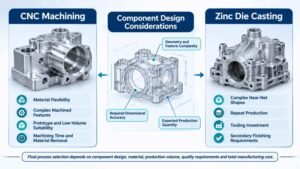
Each of these searches represents a different opportunity. A website that only focuses on a broad phrase such as CNC machining services may miss buyers looking for a very specific capability.
The following table gives examples of searches worth researching when planning a manufacturing website. These are examples of search intent, not verified daily search volumes.
| Search category | Example searches | Likely intent |
| Process-based | CNC milling services, CNC turning manufacturer | Service discovery |
| Capability-based | 5-axis CNC machining company, precision CNC machining | High commercial |
| Material-based | Stainless steel CNC machining, aluminium CNC components | Technical and commercial |
| Component-based | Custom machined brackets, precision metal housings | High commercial |
| Supplier-based | CNC machining supplier, zinc die casting manufacturer | Very high commercial |
| Customisation-based | Custom zinc alloy die casting, OEM zinc components | High commercial |
| Application-based | Zinc castings for electrical enclosures, machined automotive parts | Industry-specific |
| Location-based | CNC machining manufacturer in India, zinc die casting supplier in China | Local or export commercial |
| Quotation-based | CNC machining quote, custom zinc casting quotation | Purchase consideration |
| Agency-based | SEO services for CNC manufacturers, digital marketing agency for CNC manufacturers | Agency acquisition |
There are two different audiences AdsThrive can reach through this content.
The first is made up of buyers searching for CNC machining or zinc die casting suppliers. The second includes manufacturing businesses looking for a digital marketing partner to help them generate more enquiries. Both audiences are valuable, but their search intent is different. The website should address them without mixing supplier-related searches and agency-related searches on the same landing page.
Six Commercial Systems That Turn Manufacturing Capabilities into Enquiries
Instead of running SEO, advertisements and social media as unrelated activities, manufacturers should build a connected system that supports the buyer at different stages. Each channel should have a clear role in attracting, engaging or converting potential customers.
1. Turn the factory’s actual capabilities into searchable service pages
A manufacturer may offer several processes, materials and production options, but putting everything on one services page makes it difficult to explain each capability properly.
A CNC machining website should give buyers clear information about milling, turning, multi-axis machining, prototyping, production machining and the materials the facility handles. A zinc die casting website should explain its custom casting work, precision components, alloy options, tooling and finishing capabilities.
The aim is to make every important service easy to find through search.
SEO for Custom CNC Machining Company
A custom CNC machining page should tell potential customers what the company manufactures, which materials it works with, what types of components it accepts and how buyers can share their requirements.
Useful information includes:
- CNC milling and turning capabilities.
- Materials handled, such as aluminium, stainless steel, brass and engineering plastics, where applicable.
- Maximum component dimensions and machine capacity.
- Prototype, low-volume and production-run support.
- Inspection and quality-control procedures.
- Industries and applications served.
- Drawing, CAD-file and RFQ submission options.
Avoid adding tolerance figures, machine specifications or certifications simply to make the page look more technical. Include only information that the business can verify. Engineers may rely on these details when deciding whether to send a drawing for review.
For instance, if a page discusses deep cavities, thin walls or tight tolerances, explain the manufacturing considerations involved. Do not suggest that every design can be produced without limitations. Protolabs’ CNC design guidelines offer useful background on features such as cavity depth and machining tolerances.
A detailed service page is more useful to both search engines and the technical buyer evaluating the supplier.
2. Give Chinese and international manufacturing searches their own commercial context
Manufacturers looking for overseas customers need more than a translated homepage. International buyers usually want to understand the supplier’s production capabilities, communication process, quality documentation, delivery expectations and ability to support a project beyond the first order.
SEO for CNC Machining Manufacturers in China
A manufacturer in China targeting overseas customers should build website pages around the questions international procurement teams are likely to ask.
The content should explain:
- Which CNC machining processes are available.
- Which materials and component categories are handled.
- Whether the company supports prototypes and production quantities.
- How technical drawings and CAD files are reviewed.
- What inspection reports or quality documentation can be supplied.
- Which export markets the business serves, where this can be demonstrated.
- How buyers can communicate with the technical and sales teams.
A page that only claims to offer low-cost CNC machining may not give an international buyer enough confidence to consider the company for a production contract. They need to know whether the supplier understands the component and can meet its requirements.
The website should also make it easy for international buyers to contact the company. Clear contact details, professional technical documentation and a simple RFQ process can make a difference. If the manufacturer has genuine export experience, case studies can explain the application, production challenge and outcome without revealing confidential customer information.
How AdsThrive can support this: AdsThrive can plan search campaigns around the manufacturer’s target export markets, improve its service pages and run targeted campaigns to reach overseas procurement audiences. Its SEO services can focus on attracting commercially relevant searches and generating enquiries instead of simply increasing website traffic.
3. Build zinc die casting pages around engineering requirements, not just product names
Buyers looking for zinc die casting services often have questions that cannot be answered with a short product description. They may need to understand component geometry, alloy selection, wall thickness, tooling requirements, dimensional specifications and finishing options.
A manufacturing website should make this information easy to access without turning every service page into a lengthy technical document.
SEO for Customized Zinc Die Casting Company
A page targeting customised zinc die casting requirements should explain how the manufacturer handles a project, starting with the initial design review and continuing through production.
Include details about:
- Custom component development.
- Available zinc alloy options, where applicable.
- Tool and die development capabilities.
- Component complexity and design considerations.
- Secondary machining and finishing.
- Inspection and production consistency.
- Typical industries and applications served.
The page should also help buyers understand what they need to share before the manufacturer can evaluate a project. Simply asking visitors to contact the company leaves too many questions unanswered. Explain whether they should provide a 2D drawing, 3D CAD model, material requirement, estimated quantity or sample component.
SEO for Custom Zinc Die Casting Company
Buyers searching for custom zinc casting often have a particular component or product design in mind. They want a manufacturer who can review the requirement and determine whether it can be produced.
The page should explain how the company approaches custom projects rather than simply displaying a list of products. Discuss how tooling, part geometry, alloy selection and production quantities can affect manufacturing feasibility.
For example, the location of a parting line, wall thickness and draft requirements can influence the design and production of a zinc casting. The International Zinc Association’s zinc die casting design rules provide useful technical guidance on these considerations.
SEO for Custom Zinc Die Castings for Fishing Company
This is a good example of how a manufacturer can reach a specialised market. Fishing equipment manufacturers may need zinc alloy components for reels, handles, brackets, housings, connectors or other product-specific applications.
A general zinc die casting page may not attract these specific searches. If the manufacturer genuinely serves this industry, a dedicated application page can explain:
- Which fishing equipment components it can manufacture.
- Whether the parts require decorative finishes, corrosion considerations or assembly features.
- What customisation options are available.
- Whether the company supports prototypes, tooling and repeat production.
- Which technical details are needed to request a quotation.
There is little value in creating a page just to include the keyword. The manufacturer should have relevant experience, capability or a genuine offering for that application.
4. Make precision a verifiable selling point
Precision is a common claim on manufacturing websites. The problem is that almost every competitor can use the same word.
A more convincing approach is to explain what precision means for the components being manufactured and how the company maintains it.
SEO for Precision Zinc Die Casting Manufacturer
A precision zinc die casting page should explain the manufacturer’s approach to dimensional consistency, tooling quality, inspection and secondary operations. It should also clarify the difference between as-cast dimensions and features that may need machining or additional processing.
Useful supporting information includes:
- Dimensional inspection methods.
- Critical features and tolerance requirements.
- Tooling and process-control procedures.
- Surface finish options.
- Quality documentation.
- Component applications require repeatable dimensions.
The International Zinc Association explains that zinc alloys can offer strong dimensional capabilities and thin-wall casting potential. However, the actual result depends on the component design, alloy and manufacturing process. Avoid presenting one tolerance figure as achievable for every component.
“Discover how targeted online strategies can help precision manufacturers attract global customers and increase qualified enquiries in our guide to digital marketing for CNC machining companies.”
SEO for Precision Zinc Die Casting Company
This page should speak to buyers who need consistent component dimensions across repeat production. Explain how the manufacturer reviews drawings, identifies critical dimensions and plans inspection.
A useful addition would be a short explanation of how buyers can identify critical-to-function dimensions in their drawings. This gives engineers practical information instead of relying on promotional claims.
SEO for High Precision Zinc Alloy Die Casting Company
Projects requiring high precision may need closer attention to tooling, dimensional variation, finishing and assembly requirements.
The website should explain which features the facility can produce as-cast and which may require secondary machining. This helps set realistic expectations before a buyer sends a project enquiry.
It also gives the buyer a reason to contact the manufacturer: the page shows that the company understands the difference between a drawing specification and a component that can be produced consistently.
SEO for Custom Zinc Alloy Factory
A factory page should bring together information about alloy capabilities, manufacturing equipment, tooling, quality control and production capacity.
If the company works with particular zinc alloy grades, mention them accurately and explain where they are used. Include genuine factory photographs, machine details and inspection facilities wherever possible. This helps buyers understand whether they are dealing with a manufacturer that has in-house production capabilities or a trading company.
SEO for Zinc Alloy Die Casting Company
A broader zinc alloy die casting page can serve as the main service page. It should introduce the process, component categories, industries served and manufacturing support available. From there, buyers can explore more specific pages covering custom castings, precision components, alloy information and applications.
This structure allows the website to cover different buyer requirements without trying to fit every topic into one oversized page.
5. Use technical content to demonstrate expertise before a sales conversation
A buyer may not be ready to send an RFQ during the first website visit. An engineer might still be comparing materials, reviewing a component design or checking whether a part is better suited to CNC machining or zinc die casting.
Technical content helps manufacturers stay visible while these decisions are being made.
Useful topics include:
- CNC milling versus CNC turning: how to choose a component.
- What information should be included in a CNC machining RFQ?
- How material selection affects machined component costs.
- When should a component be evaluated for zinc die casting?
- Which design features influence zinc casting feasibility?
- When does a zinc die-cast component require secondary machining?
- How should manufacturers prepare a drawing for a custom quotation?
The best content comes from the people who understand the manufacturing work. Involve engineers, production managers and quality teams when preparing these articles. Their experience can turn a general topic into a useful explanation of a real machining or casting decision.
This is also where SEO for CNC Machining Manufacturers needs to go beyond basic on-page optimisation.
On-page SEO covers page titles, headings, descriptive URLs, internal links, image alt text, service content and structured information about the company’s capabilities.
Off-page SEO builds genuine authority through relevant industry directories, supplier profiles, trade associations, technical publications, partnerships and credible mentions. Avoid purchasing irrelevant links or publishing the same article across low-quality websites.
AI SEO helps make the company’s expertise easier for AI-powered search experiences to understand. Use clearly organised service descriptions, consistent company information, descriptive FAQs, technical explanations and reliable references. AI SEO should improve the clarity and usefulness of the website rather than replace traditional SEO.
AdsThrive’s AI SEO services can support this approach by bringing traditional search optimization and context-rich content together.
6. Connect search visibility to active sales opportunities
Organic SEO takes time to build. Manufacturers working towards immediate production targets may also need paid campaigns to reach buyers who are already searching for a supplier.
The important question is not simply whether to run Google Ads. It is whether the campaign is attracting enquiries that the business can actually convert.
A CNC machining campaign could focus on searches for precision CNC machining, five-axis machining, custom CNC parts or production machining. A zinc die casting campaign could target searches for custom zinc alloy components, zinc die casting manufacturers or OEM casting requirements.
Every campaign should take visitors to a relevant landing page. Sending all paid traffic to the homepage makes buyers search again for the information that encouraged them to click the advertisement.
AdsThrive’s Google Ads and PPC services can help with campaign planning, keyword targeting, landing-page alignment and conversion tracking.
A practical campaign structure:
| Campaign | Landing page | Conversion action |
| CNC milling and turning | CNC machining services | Request a machining quote |
| Custom CNC components | Custom machining page | Submit drawing or CAD file |
| Precision zinc castings | Precision zinc casting page | Request technical review |
| Custom zinc die casting | Custom casting page | Submit component requirements |
| Export manufacturing | International capability page | Contact export sales |
Measure qualified RFQs and actual sales conversations rather than focusing only on clicks. A campaign that brings in fewer but more relevant enquiries can be far more valuable than one attracting large numbers of unrelated contacts.
How LinkedIn and Social Media Can Reach Buyers Who Are Not Searching Yet
Not every potential customer uses Google when looking for a manufacturing supplier. Some business opportunities come through industry networks, referrals, trade events, supplier research and direct conversations.
LinkedIn gives manufacturers a way to reach people involved in purchasing, sourcing and product development, including:
- Procurement managers.
- Strategic sourcing professionals.
- Product development engineers.
- Design engineers.
- Operations managers.
- OEM business owners.
- Supply chain managers.
A good LinkedIn approach starts with knowing which companies and people are worth reaching. Identify the industries, company sizes, locations and job roles that match the manufacturer’s capabilities. Then share useful technical information and build relationships with relevant accounts.
For example, a CNC machining company could explain how it approaches complex component machining. A zinc die casting manufacturer could share a design consideration that helps product engineers decide whether a component is suitable for casting.
The goal should be to start relevant business conversations, not send the same sales message to hundreds of people.
Social media can strengthen the same message. Instead of posting only general factory photographs, manufacturers can share:
- Short videos of actual production processes.
- Component close-ups with application explanations.
- Quality inspection activities.
- New machine installations.
- Material and process comparisons.
- Project case studies approved for public use.
- Team expertise and facility updates.
AdsThrive’s social media marketing services can help manufacturers plan content that builds brand credibility and keeps the business visible to relevant audiences.
Why Enquiry Management Matters as Much as Lead Generation
A manufacturer can spend money on SEO, paid advertising and LinkedIn outreach and still lose potential business if incoming enquiries are not handled properly.
Imagine a procurement manager sending a drawing at the end of the working day. If the company takes several days to respond, the buyer may already have contacted other suppliers. An enquiry can also get delayed when it moves between departments without a clear person responsible for following up.
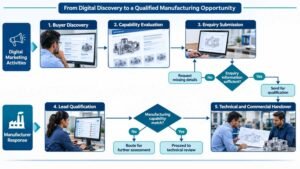
Manufacturers need a process that captures each enquiry, identifies the requirement and makes sure it reaches the right person.
What should a manufacturing lead qualification process capture?
| Enquiry information | Why it matters |
| Company name and contact details | Identifies the potential customer |
| Component or product requirement | Establishes the manufacturing need |
| Material and specifications | Helps assess technical suitability |
| Drawing or CAD file | Supports engineering review |
| Estimated production quantity | Indicates project scale |
| Target delivery date | Helps assess scheduling requirements |
| Industry and application | Adds commercial context |
| Destination market | Helps identify export requirements |
Not every buyer will provide all these details in the first enquiry. The initial response should help them share any missing information instead of immediately treating the enquiry as unsuitable.
AdsThrive can connect this process with its automation features.
- AI lead qualification: AI lead qualification can help organise incoming enquiries and identify which ones need priority attention.
- WhatsApp communication: A WhatsApp AI agent can support initial conversations and collect basic project details.
- Chat assistance: An AI chatbot can answer common questions about services, capabilities and how to submit an enquiry.
- AI calling: AI calling solutions can assist with follow-up communication where appropriate.
- Automated follow-ups: AI follow-up automation can help prevent enquiries from being overlooked.
These tools should make the sales team’s work easier, not take over technical evaluation. An AI assistant should not confirm that a component can be manufactured, promise a particular tolerance or issue a final quotation without approval from the appropriate engineering and commercial teams.
The Website Should Make It Easy to Move from Interest to RFQ
A potential buyer should not have to visit several pages just to find out how to request a quotation.
Make the enquiry option easy to find on service pages, capability pages and relevant technical articles. The form should collect information that helps the manufacturer understand the project, but it should not become so complicated that visitors decide not to complete it.
A useful RFQ form may include:
- Name and business email.
- Company name and country.
- Manufacturing service required.
- Material or alloy requirement.
- Estimated quantity.
- Project description.
- Drawing or CAD-file upload.
- Expected project timeline.
Tell buyers what will happen after they submit the form. For example, the company may review the drawing, request any missing details and then confirm whether it can prepare a quotation.
Some visitors may not be ready to upload a drawing. They may simply want to discuss a manufacturing requirement first, so keep a direct contact option available as well.
AdsThrive can help improve inquiry-focused website journeys and connect them with AI booking systems when a business wants prospects to schedule an initial discussion.
How Should Manufacturers Measure Whether Marketing Is Producing Commercial Results?
Website traffic by itself does not show whether marketing is bringing in business. A thousand visitors looking for machining tutorials may be less valuable than ten procurement professionals searching for a production supplier.
Manufacturers should measure how marketing contributes to enquiries and sales opportunities.
| Metric | What the manufacturer should evaluate |
| Organic service-page traffic | Are buyers finding relevant capabilities? |
| Search queries | Are visitors searching for services the company offers? |
| RFQ submissions | Are visitors taking commercial action? |
| Drawing uploads | Are enquiries becoming technically specific? |
| Qualified lead rate | How many enquiries match the facility’s capabilities? |
| Google Ads cost per qualified lead | Is paid acquisition commercially sustainable? |
| Enquiry response time | How quickly does the business engage with prospects? |
| Quotation rate | How many qualified enquiries receive a quotation? |
| Opportunity-to-order rate | Which channels contribute to actual business? |
Review these numbers every month. Identify which services are attracting the strongest opportunities, which landing pages are generating qualified enquiries and where potential customers are dropping out of the process.
The findings should guide the next round of improvements. If a CNC milling page attracts relevant visitors but receives very few RFQs, the problem may be the technical information or the enquiry process. If paid campaigns bring enquiries for services the factory does not offer, the targeting needs to be corrected.
How AdsThrive Can Build a Connected Growth System for CNC and Zinc Die Casting Manufacturers
Manufacturers need more than separate marketing activities that produce reports without contributing to sales. They need a connected approach that brings together visibility, buyer engagement and enquiry management.
AdsThrive can support this through a combination of SEO, AI SEO, paid advertising, social media, lead generation and automation.
Search visibility and technical content
AdsThrive can plan keyword targeting around manufacturing processes, materials, applications, custom components and buyer requirements. On-page SEO, off-page authority building and AI SEO can work together to improve how easily potential customers discover and understand the company’s capabilities.
Industry-specific landing pages
A CNC machining company and a zinc die casting manufacturer should not follow identical website structures. AdsThrive can help organise pages around the actual services, production capabilities and markets each business wants to target.
Google Ads for active demand
Paid campaigns can bring visibility to relevant searches while organic rankings develop. Dedicated landing pages and conversion tracking help identify which campaigns are producing meaningful enquiries.
LinkedIn and social media
Technical posts, facility updates, process explanations and project stories can help build credibility with engineers, procurement professionals and OEM buyers.
Lead generation and qualification
AdsThrive can connect lead-generation campaigns with AI-supported qualification, communication and follow-up processes, giving incoming enquiries a clearer route to the sales team.
Connected automation
Chat, WhatsApp, AI calling, follow-ups and booking can reduce delays and manual communication gaps. The idea is to help businesses respond more consistently while keeping technical and commercial decisions with the right people.
Explore AdsThrive to see how these services can work together as a marketing and automation system for manufacturing businesses.
Frequently Asked Questions
1. How can CNC machining manufacturers get more B2B enquiries?
Create dedicated pages for machining processes, materials, component types and industries served. Support these pages with SEO, Google Ads, LinkedIn outreach and clear RFQ forms. Respond to enquiries quickly and measure their quality rather than looking only at website traffic.
2. Why does a CNC machining company need separate service pages?
Buyers often search for specific capabilities such as CNC milling, turning, five-axis machining and precision components. Separate pages give manufacturers room to explain each service properly and help search engines understand what the business offers.
3. How can zinc die casting manufacturers attract international buyers?
Build international-facing service pages that explain alloy capabilities, tooling, component applications, quality processes and export support. Use relevant SEO, targeted advertising and LinkedIn outreach to connect with overseas OEMs and procurement teams.
4. What information should a zinc die casting manufacturer include on its website?
Include alloy options, component categories, tooling capabilities, design considerations, finishing services, inspection processes and industries served. Provide a clear RFQ option so buyers can share drawings, quantities and project requirements.
5. Is Google Ads useful for CNC machining and zinc die casting companies?
Yes. Google Ads can help manufacturers reach people who are actively searching for specific machining or casting services. Campaigns should use relevant keywords, dedicated landing pages and conversion tracking to identify qualified enquiries.
6. How does AI SEO help precision manufacturing businesses?
AI SEO helps make a website’s services, expertise, company information and technical knowledge easier for AI-powered search experiences to understand. It works alongside traditional SEO through structured content, clear answers and consistent business information.
7. How can manufacturers identify whether an online enquiry is worth pursuing?
Look at the buyer’s company, component requirement, material, drawing, production quantity, timeline and application. Compare these details with the factory’s actual capabilities before sending the enquiry for technical evaluation.
8. How long does SEO take to generate manufacturing enquiries?
There is no fixed timeline. Results depend on competition, website condition, content quality, existing authority, target locations and how consistently the strategy is implemented. Google Ads can help generate search visibility while organic rankings develop.
Make Your Manufacturing Capabilities Easier for the Right Buyers to Find
A good manufacturing business should not have to rely entirely on referrals or existing customer relationships to find its next project. Buyers are already searching for machining suppliers, custom zinc alloy components and specialist production partners. The opportunity is to make your capabilities visible when those buyers are researching and comparing suppliers.
SEO for CNC Machining Manufacturers should bring together technical service pages, useful engineering content, search visibility and a straightforward RFQ process. Zinc die casting businesses need the same commercial focus, with content that reflects their own alloy, tooling and component expertise.
AdsThrive brings SEO, AI SEO, Google Ads, social media, lead generation and AI-powered communication into one connected approach. If your manufacturing business wants to attract more relevant enquiries and manage them more effectively, contact AdsThrive to discuss a growth strategy based on your actual manufacturing capabilities.