For aluminium door and window manufacturers, fabricators and suppliers, getting more enquiries is not simply about increasing website traffic. The real challenge is reaching people who are planning construction projects, comparing product specifications, requesting quotations or looking for a reliable supplier. This is where SEO for aluminium door companies becomes an important part of a business growth strategy.
A builder searching for aluminium sliding windows has a different requirement from an architect looking for customised aluminium partitions. A homeowner may want a quotation for balcony doors, while a commercial contractor may need a supplier capable of handling a large project with specific dimensions, finishes and delivery timelines.
If your marketing treats all these buyers in the same way, you may attract visitors without generating enough genuine enquiries.
Aluminium door and window businesses need a marketing approach that connects product visibility with buyer requirements, local demand, project enquiries and consistent follow-ups. Your website should explain what you manufacture, which projects you serve, what makes your products suitable and how customers can request a quotation.
This article explores seven practical ways aluminium door and window companies can improve their online visibility, attract relevant buyers and convert more enquiries into business opportunities.
Make Your Product Range Easy for Buyers to Find
One common problem with manufacturer websites is that several products are grouped under a single page called Products or Our Solutions.
This may be convenient for website navigation, but it does not always match how customers search.
A person looking for aluminium sliding doors is unlikely to use the same search terms as someone looking for aluminium casement windows. Similarly, a contractor searching for aluminium office partitions may have no interest in residential balcony windows.
Your website should make these product differences clear.
Create separate pages for important product categories
Start by identifying the products that contribute most to your revenue and the products you want to sell more frequently.
Depending on your manufacturing capabilities, separate pages could include:
- Aluminium sliding doors
- Aluminium casement doors
- Aluminium folding doors
- Aluminium French doors
- Aluminium bathroom doors
- Aluminium sliding windows
- Aluminium casement windows
- Aluminium fixed windows
- Aluminium ventilators
- Aluminium office partitions
- Aluminium curtain wall systems
- Customised aluminium frames and fabrication
Each page should explain the product rather than simply repeat its name.
For example, an aluminium sliding door page can discuss its suitability for balconies, patios, residential apartments and commercial spaces. It can explain available configurations, frame finishes, glass options, hardware, custom dimensions and installation requirements.
A page about aluminium casement windows can focus on opening styles, ventilation, frame construction, hardware options and applications in residential or commercial buildings.
This makes the content more useful to buyers and gives search engines a clearer understanding of what each page offers.
Show technical information that influences purchase decisions
Customers buying building products often need more than attractive product photographs. They want to understand whether a product will meet their project requirements.
Include relevant information such as:
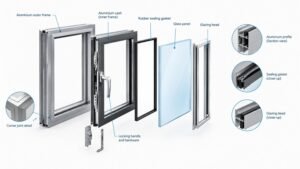
- Aluminium profile and section details
- Available frame thicknesses and finishes
- Glass compatibility and glazing options
- Opening mechanisms and configurations
- Hardware and locking arrangements
- Customisation possibilities
- Installation and maintenance requirements
- Project suitability and limitations
Only publish specifications that your company can substantiate. If a product has particular acoustic, thermal, water-resistance or structural performance characteristics, explain the available test reports or supporting documentation rather than making unsupported claims.
For Indian manufacturers, technical information can also be organised around relevant standards. For example, BIS lists IS 1948:2024 as the specification for aluminium-framed doors, windows and sliders. Companies can refer to the official BIS standards database when checking applicable standards and their current details.
The business benefit: A visitor who understands your product range and technical capabilities is more likely to contact your company with a specific requirement. Better product pages can also help attract searches that are closer to a purchase decision.
Build Your Website Around Real Project Requirements
An aluminium door and window manufacturer does not sell only a product. The business often provides a combination of material, fabrication, customisation, supply and installation.
This is particularly important when targeting architects, builders, contractors, developers and commercial property owners.
A buyer may not initially search for a manufacturer by name. They may search for a solution based on the building type, application or project requirement.
For example:
- Aluminium windows for apartment projects
- Aluminium doors for commercial buildings
- Aluminium glazing for office spaces
- Aluminium partitions for corporate interiors
- Aluminium sliding systems for villas
- Aluminium windows for hospitals and educational institutions
- Custom aluminium doors for hotels and resorts
These searches represent different buying situations. Your website should help each visitor understand whether your company can fulfil their requirement.
Organise content around applications
In addition to product pages, create useful application-focused sections where there is enough genuine information to support them.
Residential projects
Explain how your products can be used in apartments, independent houses, villas and renovation projects. Discuss design options, space utilisation, ventilation, finish choices and maintenance considerations.
Commercial buildings
Show how your products can be used in offices, retail spaces, hotels and commercial complexes. Highlight your experience with larger openings, project coordination, customised dimensions and delivery planning where applicable.
Institutional and infrastructure projects
If your business serves hospitals, schools, colleges or other institutional developments, explain your relevant capabilities. Buyers may want information about project volume, specifications, documentation and coordination with contractors.
Architectural and interior projects
Architects and interior designers may look for products that support particular design requirements. Show different finishes, opening styles, glass combinations and customised solutions with actual project examples.
Give every application page a clear purpose
Avoid creating multiple pages with almost identical content and only changing the industry name.
Each page should answer three questions:
- What type of project is this solution suitable for?
- What product options and customisation can your company provide?
- How can a buyer discuss their project or request a quotation?
Add relevant photographs, product details, completed work and a direct enquiry option.
A strong application page should feel like a useful introduction to your company’s capabilities, not a page created only to target another keyword.
Turn Completed Projects into Your Strongest Sales Content
For buyers evaluating aluminium door and window suppliers, seeing completed work can be more convincing than reading general claims about quality or experience.
A manufacturer may say that it handles customised aluminium windows, but a photograph of a completed residential project with details about the product, finish and application gives the visitor something concrete to evaluate.
Many companies already have valuable marketing material in their offices, production units and project records. The problem is that this information is rarely organised for their websites.
Create project pages with useful details
Instead of uploading photographs into a general gallery, build individual project highlights.
A project page can include:
- Project type: residential, commercial, institutional or hospitality.
- Location: city or region, where disclosure is permitted.
- Product supplied: sliding doors, casement windows, partitions or other systems.
- Project requirement: the specific problem or design requirement.
- Solution provided: the product configuration and relevant customisation.
- Execution details: fabrication, supply, installation or other work actually completed.
- Project photographs: clear images showing the finished application.
For example, consider a company that supplied customised aluminium sliding windows for a residential apartment development.
The project page could explain the number or type of units supplied, the required opening configuration, the selected finish, the glass options and how the solution aligned with the project’s requirements. Do not disclose confidential project information without permission.
Use project content to answer buyer objections
A prospective customer may have questions that are not answered by a standard product page:
- Can the manufacturer handle bulk requirements?
- Has the company completed similar projects?
- Can it work with customized dimensions?
- Does it supply products outside its home city?
- Can it coordinate with architects and contractors?
- What types of buildings has it worked on?
Your project portfolio can help answer these questions before the sales team receives a call.
It can also support other marketing activities. A completed project can be converted into a website case study, a LinkedIn post, a short video, a social media carousel or a sales presentation.
For example, one commercial project can generate several pieces of useful content:
- A detailed project page on the website.
- A LinkedIn post explaining the project requirement and solution.
- A short video showing the finished installation.
- A social media post highlighting the product configuration.
- A follow-up email to prospects in a similar industry.
This makes your existing project experience work harder across multiple channels.
The business benefit: Real project evidence helps buyers assess your experience and gives your sales team more relevant material to share during discussions.
Target High-Intent Searches That Can Generate Quotations
Website visitors are not equally valuable.
Someone searching for the meaning of aluminium extrusion may be researching the subject. Someone searching for an aluminium sliding window manufacturer in Bangalore may already be comparing suppliers.
Your search strategy should account for this difference.
A good keyword plan should include product searches, manufacturer searches, supplier searches, location searches and quotation-related searches.
Identify keywords based on buying intent
The following examples can help aluminium door and window companies identify relevant search opportunities. Actual keyword priorities should be finalised using search volume, keyword difficulty, competition and the company’s target locations.
| Search category | Example keywords | Likely buyer requirement |
| Manufacturer searches | Aluminium door manufacturer, aluminium window manufacturer | Finding a manufacturing company |
| Product searches | Aluminium sliding windows, aluminium folding doors | Exploring a particular product |
| Supplier searches | Aluminium window suppliers, aluminium door suppliers | Finding a source for supply |
| Location searches | Aluminium window manufacturer in Bangalore, aluminium door supplier in Chennai | Finding a nearby or regional supplier |
| Commercial searches | Commercial aluminium windows, aluminium doors for office buildings | Sourcing for a project |
| Enquiry searches | Aluminium windows price, aluminium door quotation | Comparing costs and requesting estimates |
Do not target every keyword on the same page
A common SEO mistake is trying to rank one page for every possible product and service keyword.
Instead, map keywords to the pages that best match the search intent.
For example:
- The homepage can introduce the company, its main capabilities and primary product categories.
- An aluminium doors page can target relevant door-related searches.
- An aluminium windows page can focus on window products and configurations.
- Individual product pages can target specific product types.
- Location pages can address genuine service areas.
- Project pages can demonstrate experience and applications.
- A quotation or contact page can make it easy for buyers to submit requirements.
This approach gives every page a defined purpose and reduces unnecessary keyword overlap.
Include commercial keywords naturally
The primary keyword for this article is SEO for aluminium door companies. The same principle applies when planning a company’s own keyword strategy: important search terms should appear naturally in relevant titles, headings, introductions and page content.
For example, a manufacturer targeting aluminium sliding windows in Bangalore should create a page that genuinely explains its sliding window range and service coverage. Simply inserting the location keyword several times into a generic page will not make it a useful local result.
Your keyword strategy should be based on what your company actually manufactures, supplies and installs.
The business benefit: A well-mapped keyword strategy helps attract visitors with relevant product and project requirements instead of chasing traffic that has little chance of becoming an enquiry.
Strengthen Local Visibility and Make Enquiries Easier
For many aluminium door and window companies, local and regional demand is an important source of business.
A homeowner may prefer a supplier who can visit the property, take measurements and discuss installation. A contractor may look for a manufacturer who can supply products to a particular project location. An architect may search for companies that serve the city where a building is being developed.
This makes local visibility an important part of SEO for aluminium door companies.
Optimise your Google Business Profile
Your Google Business Profile should provide accurate information about the business.
Check that it includes:
- Correct business name, address and contact details.
- Relevant primary and secondary business categories.
- Working phone number and website link.
- Accurate business hours.
- Clear photographs of products, manufacturing facilities and completed projects.
- Service areas, where applicable.
- Relevant updates and posts.
- Genuine customer reviews and responses.
Avoid adding unrelated keywords to the business name. Your profile should represent the actual business rather than act as a keyword-stuffing exercise.
Build location-focused website content
If your company serves multiple cities, explain your actual coverage.
For example, a manufacturer based in Bangalore may serve customers in Mysore, Hosur and other nearby markets. These areas can be mentioned where the company genuinely provides services or supplies products.
A useful location page should include:
- Products available in that area.
- Types of customers and projects served.
- Supply or installation coverage.
- Relevant completed projects, if available.
- Contact details and enquiry options.
Do not create dozens of location pages with identical text and only replace city names. This creates weak content and does little to help buyers.
Collect reviews that explain the customer experience
Reviews can provide useful information to potential customers.
Where customers are willing to share feedback, encourage them to describe their experience with the product, communication, delivery, installation or service.
Respond professionally to both positive and negative reviews. Avoid offering incentives in exchange for positive reviews or posting reviews that do not represent genuine customer experiences.
Make the quotation process simple
Once a visitor decides to contact you, the next step should be straightforward.
Your website should provide visible options such as:
- Request a quotation
- Call our sales team
- WhatsApp for product details
- Schedule a site visit
- Submit project requirements
Keep enquiry forms practical. Ask for the information your team needs to respond, such as name, phone number, location, product requirement and approximate project size.
You can ask for detailed drawings or measurements later, once the sales conversation begins.
The business benefit: Strong local visibility combined with an easy enquiry process reduces the gap between discovering your company and contacting your sales team.
Combine Google Ads, Social Media and LinkedIn to Reach More Buyers
SEO helps build long-term visibility, but it is not the only way to generate enquiries.
A company entering a new market, launching a product range or trying to reach contractors and builders may need additional channels to create demand.
The important thing is to use each channel for a specific purpose rather than publishing the same message everywhere.
Google Ads: Reach buyers who are actively searching
Google Ads can help your business appear when potential customers search for specific products or suppliers.
For example, campaigns can target relevant searches such as:
- Aluminium window manufacturers near me
- Aluminium sliding door suppliers
- Aluminium windows for commercial projects
- Aluminium door manufacturers in Bangalore
- Custom aluminium windows
The campaign should lead to a relevant landing page rather than sending every visitor to the homepage.
If someone clicks an advertisement for aluminium sliding windows, the landing page should explain your sliding window products, available options and quotation process.
Important campaign considerations:
- Separate campaigns or ad groups for different product categories.
- Use location targeting based on actual service coverage.
- Add negative keywords to reduce irrelevant clicks.
- Use clear calls to action.
- Track calls, forms and qualified enquiries.
- Review the quality of leads, not just the number of clicks.
A campaign that generates 100 clicks but no relevant enquiries is not necessarily performing well. A smaller campaign that brings in a few serious project enquiries may be more valuable.
Explore Google Ads and PPC services to understand how paid search campaigns can support your lead generation efforts.
Social media: Show your products and manufacturing capabilities
Aluminium products are highly visual. This creates an opportunity to use social media to demonstrate the company’s work rather than relying only on promotional graphics.
Your content can include:
- Before-and-after installation photographs.
- Product demonstrations.
- Different opening configurations.
- Frame finishes and colour options.
- Manufacturing and fabrication videos.
- Completed residential and commercial projects.
- Customisation examples.
- Customer testimonials.
- Frequently asked product questions.
A short video showing how a folding door operates may communicate more than a long promotional caption.
Similarly, a project walkthrough can help a contractor understand the scale and quality of your work.
Use social media marketing to create a consistent content strategy around your products, projects and customer requirements.
LinkedIn: Reach architects, builders and project decision-makers
LinkedIn can be useful when your company wants to reach business buyers rather than only individual homeowners.
Potential audiences include:
- Architects and architectural firms.
- Builders and construction companies.
- Real estate developers.
- Civil contractors.
- Interior design firms.
- Project consultants.
- Procurement managers.
- Facility management companies.
Instead of sending generic sales messages, start conversations around relevant project requirements.
For example, a manufacturer could share a completed commercial window project and connect with professionals working on similar developments.
A practical LinkedIn outreach approach involves:
- Identifying companies and professionals relevant to your target projects.
- Reviewing their business focus and project activity.
- Connecting with a short, relevant introduction.
- Sharing useful product or project information.
- Following up professionally when there is a genuine opportunity.
Avoid mass messaging unrelated contacts. The objective is to build relationships with people who may influence or make purchasing decisions.
How the channels work together
| Marketing channel | Primary purpose | Useful business outcome |
| SEO | Build organic visibility for product and supplier searches | Consistent relevant website traffic |
| Google Ads | Reach active searchers | Faster quotation opportunities |
| Social media | Demonstrate products and completed work | Product awareness and engagement |
| Reach professional and project-based buyers | Business connections and B2B enquiries | |
| Remarketing | Reconnect with previous website visitors | More opportunities to convert interested prospects |
A coordinated approach is more effective than expecting one channel to generate every type of customer.
The business benefit: Your company can reach buyers at different stages, from people discovering your products to contractors actively looking for a supplier.
Use AI and Automation to Convert More Enquiries into Sales Opportunities
Generating enquiries is only one part of business growth. What happens after someone submits a form, calls your company or sends a WhatsApp message is equally important.
Consider a typical situation.
A builder visits your website in the evening and requests a quotation for aluminium windows. The enquiry is submitted, but the sales team is unavailable. The customer waits until the next day and contacts another supplier.
This is not necessarily a marketing problem. It is a lead response and management problem.
For businesses receiving enquiries through multiple channels, manual handling can become difficult. Calls may be missed, WhatsApp messages may remain unanswered, and sales teams may forget to follow up with prospects who are still comparing quotations.
AI automation can help manage these interactions more consistently.
AI lead qualification: Identify serious prospects
Not every enquiry has the same level of commercial value.
A homeowner requesting one balcony window may need a different sales process from a developer enquiring about products for an entire apartment project.
An AI-powered lead qualification system can collect and organise relevant information.
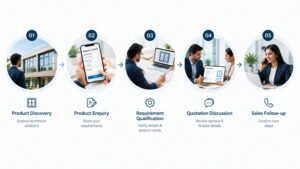
For an aluminium door and window company, the qualification process can capture:
- Customer name and contact details.
- Project location.
- Product category.
- Residential or commercial project type.
- Approximate quantity or project size.
- Expected purchase timeline.
- Whether a site visit or quotation is required.
The system can then help classify enquiries based on the information provided.
For example, a commercial contractor with an active project and a defined requirement may need immediate attention from the sales team. A customer who is still exploring product options may require product information and a scheduled follow-up.
This helps sales teams prioritise conversations instead of treating every enquiry identically.
WhatsApp AI Agent: Respond when customers are ready to ask questions
Many customers prefer WhatsApp for initial product enquiries because it is convenient to share messages, photographs and documents.
A WhatsApp AI Agent can help answer common questions and collect basic requirements even when the sales team is unavailable.
For example, a customer may ask:
- Do you manufacture aluminium sliding windows?
- What types of aluminium doors are available?
- Do you provide customised sizes?
- Which locations do you serve?
- Can I share my project drawings?
- How can I request a quotation?
The agent can provide approved business information, guide the customer through the enquiry process and collect contact details.
When the requirement needs technical discussion or a customised quotation, the conversation can be directed to the appropriate salesperson.
Explore the WhatsApp AI Agent solution.
AI Calling: Follow up with prospects faster
Some enquiries require a direct conversation.
For example, a customer may submit a quotation request but not provide enough information for the sales team to prepare an estimate.
An AI calling solution can help initiate follow-up conversations, ask predefined questions, confirm interest and schedule a callback or meeting.
It can also support businesses that receive a large number of enquiries and need a consistent first-response process.
For example, after a website enquiry, an AI calling workflow may contact the prospect to confirm:
- Which product they are interested in.
- Whether the requirement is residential or commercial.
- The project location.
- Whether they need a quotation or consultation.
- A suitable time for the sales team to connect.
The exact conversation should be designed around the company’s sales process, with clear disclosure and appropriate consent practices.
Explore AI calling solutions.
Automated follow-ups: Keep interested buyers engaged
Not every customer will finalise a purchase immediately.
A contractor may be waiting for project approval. A homeowner may be comparing different suppliers. An architect may need additional product details before recommending a particular system.
Without a follow-up process, these opportunities can gradually disappear.
Automated follow-ups can help the business maintain communication through appropriate WhatsApp or email messages.
Examples include:
- A confirmation message after an enquiry.
- A reminder when a quotation is ready.
- A follow-up after a product consultation.
- A message asking whether additional technical information is required.
- A reminder about a scheduled site visit.
- A follow-up after a quotation has been shared.
Messages should be relevant to the customer’s enquiry and should not become repetitive or intrusive.
Website chatbot and booking system: Make the next step easier
A website chatbot can guide visitors who need assistance choosing a product or understanding the company’s services.
It can answer common questions, collect enquiry details and direct visitors to the relevant product or contact page.
If your sales process involves consultations, site visits or product discussions, an AI booking system can also help customers select an available appointment slot.
This reduces unnecessary back-and-forth communication and makes it easier for interested buyers to take the next step.
You can explore AI chatbot solutions and AI booking systems.
How automation supports the sales process
| Enquiry stage | Automation support | Expected benefit |
| New website enquiry | Instant acknowledgement and lead capture | Faster initial response |
| Initial conversation | AI qualification questions | Better understanding of requirements |
| Missed call or delayed response | Automated calling or callback workflow | Fewer missed opportunities |
| WhatsApp enquiry | AI-assisted responses | Consistent customer communication |
| Quotation shared | Scheduled follow-up | Better enquiry continuity |
| Consultation required | Appointment booking | Easier coordination |
Automation does not replace the technical knowledge of your sales team. Product recommendations, measurements, technical approvals, pricing and final quotations may still require human involvement.
The objective is to reduce repetitive work and make sure genuine prospects receive timely attention.
The business benefit: When lead generation, communication and follow-ups are connected, your company can manage enquiries more systematically and reduce the chances of losing prospects due to delayed responses.
Why Aluminium Door and Window Companies Need a Connected Marketing Strategy
Each marketing activity has a different role. SEO helps customers discover your products. Paid advertising can bring immediate visibility for selected searches. Social media demonstrates your work. LinkedIn helps build connections with professional buyers. AI automation supports the enquiry and follow-up process.
The Ministry provides information about India’s MSME sector, government initiatives and support for enterprises
However, running these activities separately can create gaps.
For example, an advertisement may generate a lead, but the enquiry may not reach the right salesperson. A visitor may contact the business through WhatsApp, but the conversation may not be recorded. A quotation may be sent, but no one follows up.
A connected strategy helps address these gaps.
What a connected approach should include
A website that supports sales
Your website should clearly explain your products, applications, capabilities, project experience and service locations. It should also make it easy to call, WhatsApp or request a quotation.
A search strategy based on actual products
Your SEO plan should focus on relevant product, manufacturer, supplier, application and location searches. Content should reflect what the business actually offers.
Paid campaigns with measurable objectives
Google Ads should target relevant searches and direct users to suitable landing pages. Campaign performance should be evaluated using qualified enquiries and business outcomes, not clicks alone.
Social content that demonstrates capability
Use genuine project photographs, product demonstrations and manufacturing videos to build confidence among potential customers.
Lead management that keeps conversations organised
Every enquiry should have a clear response process, an assigned owner and an appropriate follow-up schedule.
Automation that supports the sales team
Use AI tools for initial responses, qualification, reminders, booking and repetitive communication while keeping technical and commercial decisions with the right people.
This is the difference between simply having multiple digital marketing activities and building a system that supports business development.
How AdsThrive Helps Aluminium Door & Window Companies Generate More Enquiries
For aluminium door and window manufacturers, marketing should contribute to measurable business opportunities. It should not stop at website visits, social media engagement or advertising impressions.
AdsThrive combines digital marketing services with AI-powered automation to help businesses improve online visibility and manage the enquiries they receive.
Instead of treating SEO, advertising, lead generation and customer communication as completely separate activities, the objective is to connect them through a practical business growth approach.
1. SEO and AI SEO for product visibility
AdsThrive helps businesses build search strategies around relevant product categories, buyer requirements and target locations.
For an aluminium door and window company, this can include product-page optimisation, keyword mapping, technical SEO, website content improvements, local search optimisation and ongoing performance monitoring.
The objective is to attract visitors who are more relevant to the company’s products and services.
2. Digital advertising for faster enquiry opportunities
Google Ads can help your business reach buyers actively searching for aluminium doors, aluminium windows and related manufacturing or supply services.
AdsThrive can help plan campaigns around product categories, locations, landing pages and enquiry objectives.
This allows businesses to test demand and generate opportunities while their organic search visibility develops.
3. Social media marketing to demonstrate your work
AdsThrive can help convert product photographs, completed projects and manufacturing activities into structured social media content.
Rather than relying only on promotional creatives, businesses can use product demonstrations, project highlights, educational posts and customer-focused content to communicate their capabilities.
4. AI-powered lead qualification
AdsThrive’s AI lead qualification capabilities help collect and organise prospect information so sales teams can focus on enquiries that match their business requirements.
This is useful when a company receives enquiries for different products, project sizes and locations.
5. WhatsApp and AI calling automation
With WhatsApp AI Agents and AI Calling solutions, businesses can improve the way they respond to incoming enquiries and initiate follow-up conversations.
Customers can receive assistance with common questions, while relevant enquiries can be directed to the sales team for further discussion.
6. Automated follow-ups, chatbot and booking
AdsThrive also offers automation for follow-ups, website conversations and appointment scheduling.
These tools can help businesses reduce manual communication and maintain a more consistent enquiry management process.
You can explore the complete range of services at AdsThrive.
The right combination will depend on your business model, product range, target markets, current website performance and sales capacity. A company primarily serving residential customers may need a different strategy from a manufacturer targeting large commercial projects.
The focus should always remain on attracting relevant prospects and helping the sales team convert those opportunities.
Frequently Asked Questions
1. How Can Aluminium Door Manufacturers Get More Enquiries Online?
Manufacturers can generate more enquiries by creating individual product pages, targeting product and location-specific searches, running Google Ads, showcasing completed projects and providing easy quotation options. AI-powered WhatsApp responses and follow-ups can help convert website visitors into sales conversations.
2. Which Keywords Should Aluminium Window Manufacturers Target?
They should target a combination of manufacturer, product, application, price, location and project-related searches.
Examples include:
- Aluminium window manufacturer.
- Aluminium sliding window supplier.
- Aluminium casement window manufacturer.
- Aluminium windows for commercial buildings.
- Aluminium window fabricator near me.
- Aluminium window installation services.
The final keyword selection should depend on the manufacturer’s actual products, locations and commercial priorities.
3. Is SEO Effective for Aluminium Door and Window Manufacturers?
Yes. SEO can help manufacturers attract buyers searching for specific products, suppliers, fabrication services and project solutions. Its effectiveness depends on website quality, competition, search demand, technical optimisation and the relevance of the content.
It is particularly useful for businesses wanting to build a consistent source of organic enquiries over time.
4. Should Aluminium Manufacturers Invest in Google Ads?
Google Ads can be useful when manufacturers want to capture immediate product demand or promote specific product categories and locations.
However, campaigns should use relevant keywords, negative keyword targeting, dedicated landing pages and conversion tracking. Measuring qualified enquiries rather than just form submissions helps businesses evaluate advertising performance.
5. How Can Manufacturers Attract Architects and Builders?
Manufacturers can attract architects and builders through project case studies, technical product information, LinkedIn outreach, professional networking and targeted commercial landing pages.
Sharing actual installations, available configurations, technical documentation and bulk supply capabilities can help establish credibility with these buyers.
6. How Can AI Help Aluminium Manufacturers Manage Enquiries?
AI can acknowledge incoming enquiries, collect product requirements, qualify prospects, answer approved basic questions and schedule follow-ups.
AI calling and WhatsApp automation can also help businesses reconnect with interested customers. Complex product specifications, pricing decisions and technical discussions should be handled by the relevant sales or engineering team.
7. How Long Does SEO Take to Generate Enquiries for Aluminium Manufacturers?
There is no fixed timeline. Results depend on the website’s existing authority, competition, location, keyword difficulty and implementation quality.
Google Ads can generate visibility sooner, while SEO generally requires sustained work to establish organic rankings. Using both channels can help businesses balance immediate demand capture with longer-term organic growth.
8. What Should an Aluminium Manufacturer Look for in a Digital Marketing Agency?
Look for an agency that understands product-based businesses, industrial and construction buyers, commercial search intent, lead tracking and conversion optimisation.
The agency should be able to explain how it will attract relevant buyers, capture their requirements and measure the enquiries that progress towards quotations and orders.
Conclusion
Aluminium door and window companies have several opportunities to reach buyers online, but generating more enquiries requires more than simply publishing a website or running occasional advertisements.
Your marketing should reflect the way customers actually evaluate manufacturers. They want to understand your product range, compare available options, review completed projects, check your capabilities and discuss their requirements before making a decision.
A well-planned SEO for aluminium door companies strategy can improve visibility for relevant product and supplier searches. When combined with targeted Google Ads, social media, LinkedIn outreach and AI-powered lead management, it can help create a more consistent process for attracting and handling business enquiries.
AdsThrive brings digital marketing and AI automation together to help businesses improve their online presence, generate relevant leads and manage customer communication more efficiently.
If you manufacture, supply or install aluminium doors and windows and want to build a stronger online enquiry system, contact AdsThrive to discuss a strategy aligned with your products, target locations and business goals.