A commercial HVAC contractor can have experienced engineers, skilled installation teams and the equipment needed to handle large projects, yet still struggle to secure a consistent flow of commercial enquiries. The problem is often not the quality of the service. It is that the right people cannot easily find, evaluate or contact the contractor when they need one.
A facility manager searching for an HVAC maintenance partner, a developer planning a commercial building or an MEP consultant looking for an installation contractor may all use different search terms and evaluation criteria. A generic website and occasional social media posts are unlikely to address all these requirements.
SEO for HVAC contractors should therefore do more than improve website rankings. It should help commercial buyers discover relevant services, understand the contractor’s capabilities and take the next step towards a project discussion.
The stronger approach combines targeted SEO, Google Ads, professional outreach, service-specific landing pages and AI-powered enquiry management. This article explains how HVAC contractors can use these strategies to attract commercial installation projects, maintenance contracts, system upgrades and other valuable business opportunities.
Why commercial HVAC enquiries require a different marketing approach
Commercial HVAC marketing is not simply residential air-conditioning marketing with a different audience.
A homeowner may search for an AC repair technician and make a decision within hours. A commercial buyer may evaluate several contractors, consult an MEP consultant, request technical information, arrange a site inspection and compare quotations before appointing a service provider.
The buying process is longer, involves more people and often requires a contractor to demonstrate specific capabilities.
Consider the different requirements:
| Commercial buyer | What they may be looking for | What the contractor must demonstrate |
| Facility manager | AMC, preventive maintenance, breakdown support | Service coverage, response process and maintenance experience |
| Property developer | HVAC installation for a new building | Project capability, execution experience and coordination |
| MEP consultant | HVAC contractor for a specified project | Technical understanding and ability to work with project requirements |
| Hotel or hospital management | HVAC upgrades and ongoing maintenance | Relevant experience, operational understanding and service support |
| Industrial facility | Ventilation, cooling and system improvements | Understanding of industrial applications and site requirements |
The marketing challenge is that these buyers do not necessarily use the same search terms. Some look for a specific service. Others search for a contractor in a particular location. Some discover companies through professional networks or recommendations rather than Google.
A contractor that promotes only one broad phrase such as “HVAC solutions” may miss several valuable opportunities.
A successful strategy needs to connect the contractor’s actual service capabilities with the different ways commercial buyers discover and evaluate suppliers.
Build a website around commercial HVAC requirements, not a list of services
A commercial buyer visiting an HVAC contractor’s website should be able to answer three questions quickly:
- Does this contractor handle the type of HVAC work I need?
- Has the company handled comparable projects or applications?
- How can I discuss my requirement or request a quotation?
If the website does not answer these questions, the visitor may return to Google and contact another company.
Instead of presenting every service on one general page, organise the website around the work the contractor wants to acquire.
Give each important commercial service its own page
For example, a contractor offering several commercial services could create dedicated pages for:
- Commercial HVAC installation.
- Central air-conditioning installation.
- Chiller installation and replacement.
- HVAC ducting and ventilation.
- Commercial HVAC maintenance.
- Annual maintenance contracts.
- Industrial cooling and ventilation.
- HVAC retrofitting and system upgrades.
Each page should explain the actual scope of work.
A commercial HVAC installation page might cover the types of buildings served, installation capabilities, project coordination, commissioning support and the process for requesting a site discussion.
An AMC page should focus on preventive maintenance, service coverage, maintenance schedules and how businesses can discuss their existing equipment requirements.
These differences matter because a buyer looking for an AMC is not necessarily interested in reading a page focused on new installations.
Use technical information to support the buying decision
Commercial buyers may need to understand whether a contractor can handle a particular type of system or project.
Depending on the services offered, useful information may include:
- Equipment and system types handled.
- Commercial building applications.
- Installation and maintenance scope.
- Project locations served.
- Relevant certifications or qualifications, where applicable.
- Commissioning and testing capabilities.
- Project photographs and documented experience.
- Service and enquiry contact details.
Do not publish technical specifications that the company cannot verify. A marketing page should communicate capability accurately, not make unsupported claims about performance.
For contractors working on public-sector projects, the CPWD General Specifications for HVAC Works can provide useful context about the scope and technical considerations addressed in HVAC works. Contractors should always refer to the relevant tender documents and applicable project requirements before making compliance claims.
Show the work, not just the company description
A statement such as “We provide complete HVAC solutions” does not give a commercial buyer much information.
A project profile is more useful.
For example:
Project: Commercial office HVAC installation
- Building type: Commercial office.
- Work undertaken: HVAC installation and associated ducting.
- Location: Actual project location, if disclosure is permitted.
- Scope: Work genuinely completed by the contractor.
- Project photographs: Approved site images.
- Enquiry option: Discuss a similar project.
If the client name is confidential, describe the project without identifying the organisation.
This type of content helps demonstrate experience and gives prospective buyers something concrete to evaluate.
Make the enquiry process easy
A visitor should not have to search through several pages to find a contact number.
Provide clear options such as:
- Request a commercial project discussion.
- Ask about HVAC maintenance.
- Request a site inspection.
- Discuss a chiller replacement.
- Submit an installation requirement.
A focused website is the foundation of digital marketing for HVAC contractors because every other channel eventually needs somewhere relevant to send potential buyers.
AdsThrive can help improve the website’s organic visibility through its AI SEO services, alongside service-page optimisation and content planning.
Capture commercial searches that competitors may be overlooking
Many contractors focus on broad terms such as “HVAC company” or “air conditioning services”. These searches can be useful, but they do not represent the full range of commercial demand.

A facility manager, consultant or developer may search using a more specific description of the work.
The opportunity is to identify the searches that connect directly with the contractor’s services and create useful pages for them.
Understand the difference between discovery searches and buying searches
Someone searching for “how does a chiller work?” may be researching a technical subject.
Someone searching for “commercial chiller replacement contractor in Bengaluru” is closer to finding a service provider.
Both searches can have value, but they need different content.
The first may be suitable for an educational article. The second should lead to a commercial service page with relevant project information and a clear enquiry option.
Here are examples of search themes an HVAC contractor may be missing:
| Search category | Example search terms | Suitable website destination |
| Installation | Commercial HVAC installation company, central AC installation contractor | Commercial installation page |
| Maintenance | HVAC AMC services, commercial HVAC maintenance company | AMC and maintenance page |
| Replacement | Chiller replacement contractor, HVAC system upgrade company | Replacement and upgrade page |
| Industrial work | Industrial ventilation contractor, industrial HVAC installation | Industrial HVAC page |
| Local intent | Commercial HVAC contractor in Bengaluru, HVAC installation company in Chennai | Relevant location and service page |
| Agency intent | SEO for HVAC contractors, SEO services for HVAC contractors | AdsThrive service or industry-focused marketing page |
These are keyword ideas, not verified daily search-volume figures. Use Google Search Console, Google Keyword Planner and an SEO research platform to check actual search demand, location relevance and competition before prioritising them.
Use search intent to decide what each page should accomplish
A useful keyword plan should not simply assign several phrases to one page.
Instead, identify the purpose behind each search.
Service intent: The user wants to understand whether the contractor provides a particular service.
Local intent: The user wants a contractor who can work in a specific city or service area.
Commercial intent: The user is comparing providers or preparing to request a quotation.
Informational intent: The user needs technical or maintenance information before making a decision.
For example, an article about common causes of poor cooling in a commercial building can attract facility professionals researching an issue. It can then direct relevant readers to the contractor’s maintenance or system assessment service.
A separate commercial page should target people actively seeking a maintenance partner.
Build location pages only when the business can support them
If the contractor serves Bengaluru, Chennai, Hyderabad and Pune, it may make sense to develop location-specific service pages.
However, changing only the city name on several pages is not a useful local SEO strategy.
Each page should contain meaningful location-specific information, such as:
- Actual service coverage.
- Relevant local project experience.
- Types of commercial properties served.
- Service and inspection availability.
- Local contact details, where applicable.
Avoid creating pages for locations the company does not genuinely serve.
This is where SEO services for HVAC contractors should focus on search intent, service relevance and useful local information rather than producing large numbers of nearly identical pages.
Use Google Ads to reach buyers who are ready to appoint a contractor
SEO takes time to build visibility. Google Ads can help an HVAC contractor reach people who are actively searching for commercial services while organic rankings develop.
However, a campaign should be designed around the work the company wants to win.
A contractor seeking commercial installation projects should not spend most of its budget attracting people looking for small residential AC repairs.
Separate campaigns by commercial service
A practical campaign structure could include the following.
Commercial HVAC installation
Target searches related to commercial HVAC installation, central air-conditioning installation, HVAC installation contractors and commercial building HVAC projects.
The landing page should explain installation capabilities, project experience and the process for arranging a discussion.
Commercial HVAC maintenance
Target businesses looking for annual maintenance contracts, preventive maintenance, central AC maintenance and commercial HVAC service providers.
The landing page should explain the maintenance services offered, coverage and enquiry process.
Chiller replacement and upgrades
Target searches related to chiller replacement, central cooling system upgrades and commercial HVAC retrofitting.
The landing page should demonstrate relevant project capability and make it easy to request an assessment.
Industrial ventilation
Target searches for industrial ventilation installation, exhaust systems, industrial ducting and related services.
The campaign should lead to a page that explains the contractor’s actual industrial work.
Reduce irrelevant advertising enquiries
Campaign targeting needs regular review.
Use negative keywords to filter irrelevant searches, such as:
- Jobs.
- Careers.
- Salary.
- Training.
- Courses.
- DIY.
- Home repair, if residential services are not offered.
- Free manuals or unrelated product research.
Also consider:
- Separating residential and commercial services.
- Restricting locations to areas the contractor can serve.
- Using service-specific advertisements.
- Testing different landing-page messages.
- Tracking calls and completed enquiry forms.
- Reviewing search terms that trigger advertisements.
Track commercial outcomes, not just form submissions
Suppose one campaign produces 50 enquiries, but most are residential repair requests. Another produces 12 enquiries, including four commercial maintenance opportunities and two installation discussions.
The second campaign may be more valuable even though it generates fewer submissions.
Measure:
- Qualified commercial enquiries.
- Site inspections requested.
- Requests for quotation.
- Meetings with consultants or facility managers.
- Quotations submitted.
- Projects won.
- Cost per qualified opportunity.
AdsThrive’s Google Ads and PPC services can help structure campaigns, align advertisements with relevant landing pages and improve conversion tracking.
The goal is not to maximise the number of leads at any cost. It is to attract enquiries that fit the contractor’s services and commercial objectives.
Reach consultants and facility managers before a project becomes a tender
Not every commercial HVAC opportunity starts with a Google search for a contractor.
A developer may appoint an architect and MEP consultant months before inviting HVAC contractors to submit quotations. A facility manager may begin evaluating maintenance providers before the current AMC expires. An industrial plant may discuss a ventilation upgrade internally before contacting potential suppliers.
If a contractor relies only on people searching for its services, it may miss these earlier opportunities.
This is where LinkedIn and professional outreach can support the acquisition process.
Identify the people who influence contractor selection
Depending on the type of project, relevant contacts may include:
- MEP consultants.
- Architects and project consultants.
- Commercial property developers.
- Facility management companies.
- Hotel engineering managers.
- Hospital facility managers.
- Industrial plant heads.
- Procurement managers.
- Project management consultants.
- Commercial builders and general contractors.
Not all these contacts will appoint the HVAC contractor directly. Some influence the shortlist, recommend service providers or share project requirements.
The outreach strategy should reflect their role.
For example:
| Audience | Relevant communication |
| MEP consultant | Project capabilities, technical experience and coordination |
| Facility manager | Maintenance coverage, service response and AMC capabilities |
| Developer | Installation experience, project execution and coordination |
| Procurement manager | Scope of work, company credentials and quotation process |
| Industrial plant head | Ventilation, cooling and operational requirements |
Use LinkedIn to demonstrate expertise
A company page that publishes only festival greetings and generic promotional messages is unlikely to demonstrate much technical capability.
Instead, share content that gives professional audiences a reason to pay attention.
Examples include:
- A completed commercial HVAC installation.
- A short explanation of a chiller replacement project.
- A photograph showing actual ducting or ventilation work.
- A practical maintenance observation.
- A project coordination challenge and how it was addressed.
- An explanation of the contractor’s service coverage.
- A technical discussion relevant to facility managers.
Use genuine project photographs and obtain permission before publishing identifiable client or site information.
Make outreach relevant rather than repetitive
Avoid sending the same sales message to hundreds of unrelated contacts.
A better approach is to identify a relevant professional, understand their business role and send a short introduction explaining why connecting may be useful.
For example:
We work on commercial HVAC installation and maintenance projects. I came across your work in facility management and thought it would be useful to connect. We share practical information about HVAC maintenance, system upgrades and project execution.
Once a connection is established, share relevant experience or ask whether the person is open to a short discussion.
Do not repeatedly send quotation requests to people who have not shown interest.
Use social media to support professional credibility
LinkedIn is useful for professional outreach, while other social platforms can help demonstrate project activity and brand presence.
Useful content formats include:
- Before-and-after photographs of approved installation work.
- Short clips of commissioning or maintenance activity.
- Site progress updates.
- Explanations of common HVAC maintenance issues.
- Introductions to engineering and service teams.
- Customer feedback shared with permission.
- Short videos explaining when a commercial system may need assessment.
AdsThrive can coordinate social media marketing with the contractor’s commercial positioning so that social content supports the same services promoted through search and advertising.
The objective is to make the business more recognisable and credible when a prospective client encounters it through another channel.
Turn website enquiries into organised commercial opportunities with AI qualification
Generating an enquiry is only the beginning.
An HVAC contractor may receive messages through website forms, phone calls, Google Ads, WhatsApp, LinkedIn and referrals. The sales team then has to identify what each person needs, whether the company provides the service and who should handle the next conversation.
This becomes difficult when several enquiries arrive at the same time.
Consider these examples:
Enquiry A: “We need an HVAC contractor for a new commercial office project. The site is in Bengaluru, and the consultant is preparing the project requirements.”
Enquiry B: “Need AC service.”
Enquiry C: “We are looking for an annual maintenance contract for a hotel with multiple central air-conditioning systems.”
All three are enquiries, but they represent different commercial situations.
The first may require a project discussion. The second needs clarification about the service and equipment. The third may be a recurring contract opportunity.
If the sales team receives only a name, phone number and short message, it must spend time collecting basic information before deciding what to do.
Collect the right information for each service
A single generic enquiry form may not be suitable for every HVAC service.
For a new installation, the initial form could ask for:
- Type of property.
- Project location.
- Type of HVAC work required.
- Approximate project stage.
- Whether drawings or specifications are available.
- Expected project timeline.
For maintenance:
- Type of building.
- Existing HVAC system.
- Approximate equipment count, if known.
- Whether the requirement is one-time servicing or an AMC.
- Location.
- Preferred time for discussion.
For breakdown or repair:
- Equipment type.
- Nature of the issue.
- Site location.
- Whether the system is operational.
- Preferred contact method.
Do not make the form unnecessarily long. Its purpose is to collect enough information for the contractor to decide the next action.
How AdsThrive’s AI Lead Qualification can help?
AdsThrive’s AI Lead Qualification can be configured to help identify the nature and potential relevance of incoming enquiries.
For example, an incoming message could be classified as:
- New commercial installation.
- Chiller replacement.
- HVAC maintenance contract.
- Breakdown or repair.
- Industrial ventilation.
- General information request.
- Outside the contractor’s service scope.
The system can use predefined business rules to identify which enquiries need immediate attention, which require more information and which can enter a follow-up process.
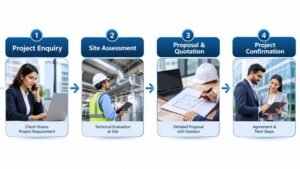
AI should not decide whether an HVAC design is technically suitable or replace an engineer’s assessment. Its role is to support initial information gathering and administrative qualification so the sales or technical team receives a more organised enquiry.
Make the qualification process specific to the business
An HVAC contractor that mainly handles commercial AMC work may prioritise maintenance enquiries and recurring contracts.
A contractor focused on new commercial installations may prioritise project location, building type, project stage and technical discussion requirements.
The qualification rules should reflect the services the business wants to sell.
This is more useful than simply labelling every form submission as a “hot lead”.
Keep prospects engaged through WhatsApp, AI calling and automated follow-ups
A commercial buyer may not be ready to appoint a contractor immediately after submitting an enquiry.
A facility manager may need internal approval. A consultant may be waiting for project drawings. A property owner may be comparing proposals. An AMC prospect may want to review the contract closer to its renewal date.
If the contractor does not maintain contact, the opportunity may go to a competitor who responds more consistently.
The solution is not to send repeated promotional messages. It is to organise follow-up around the prospect’s actual requirement.
Use WhatsApp for convenient communication
Many business enquiries begin with a phone call or WhatsApp message.
A visitor may want to ask whether the contractor handles a particular type of installation, works in a specific location or provides annual maintenance contracts.
AdsThrive’s WhatsApp AI Agent can be configured to help engage prospects, answer approved questions and collect initial requirements through a familiar communication channel.
For example, when someone asks about an HVAC maintenance contract, the agent could ask whether the property is a hotel, office, hospital or industrial facility, and collect the location and preferred contact details.
The conversation can then be passed to the relevant team member.
The agent should provide only information approved by the contractor. Questions involving engineering calculations, safety, equipment selection or site-specific diagnosis should be transferred to qualified personnel.
Use AI calling when a phone conversation is appropriate
Some commercial prospects prefer discussing a requirement rather than completing a long form.
AdsThrive’s AI Calling Solution can support configured outbound conversations, initial lead contact, requirement confirmation and appointment booking.
For example, after a prospect submits a request for a commercial HVAC site inspection, an AI calling workflow could contact the prospect, confirm basic details and help arrange a discussion with the sales team.
The system should identify itself appropriately, respect consent and applicable calling rules, and transfer technical or negotiation questions to a human representative.
Automate follow-ups based on enquiry status
A useful follow-up system should respond to the status of the opportunity.
For example:
- A new installation enquiry may need a call to discuss project scope.
- A prospect who requested a quotation may need a reminder after the proposal has been sent.
- An AMC prospect may need a follow-up before the existing contract expires.
- A consultant who is still preparing project documentation may need a later check-in.
- An enquiry missing the site location may need one clarification.
AdsThrive’s AI Follow-ups can support planned follow-up communication based on the business’s workflow.
A connected AI Chatbot Agent can also help website visitors get initial answers and submit their requirements without waiting for office hours.
Make it easy to schedule the next discussion
When a prospect is ready for a technical or commercial conversation, arranging the meeting should be straightforward.
An AI Booking System can help schedule a call, consultation or site-discussion appointment, reducing the back-and-forth involved in finding a suitable time.
The important point is that these features should work together. A contractor should not have to manually transfer the same enquiry between a website inbox, WhatsApp, spreadsheets, calling tools and a separate calendar.
The workflow should be configured around the contractor’s existing process and the integrations available.
Connect marketing performance with the contractor’s actual sales pipeline
A marketing campaign can produce website traffic, social media engagement and form submissions without generating meaningful commercial business.
The contractor needs to understand which activities lead to site inspections, quotations and confirmed projects.
This requires marketing and sales reporting to work together.
Measure the progress of each enquiry
Track the following stages:
New enquiry: A person has contacted the business through a website, advertisement, call, WhatsApp or another channel.
Qualified enquiry: The requirement appears relevant to the contractor’s service scope, location and customer profile.
Technical discussion: The contractor has spoken with the prospect or received enough information to understand the requirement.
Site inspection: A site visit or assessment has been requested or completed.
Quotation submitted: The contractor has prepared and shared a commercial proposal.
Opportunity won or lost: The business has recorded the final outcome and, where possible, the reason.
This provides a clearer picture of how marketing contributes to business development.
Review the right performance indicators
| Performance indicator | What it tells the contractor |
| Qualified commercial enquiries | Whether marketing is attracting relevant buyers |
| Site inspections | Whether prospects are progressing beyond initial contact |
| RFQs and quotations | Whether marketing is creating genuine sales opportunities |
| Cost per qualified enquiry | How much is being spent to attract a relevant prospect |
| Quotation conversion | Whether submitted proposals are progressing |
| Lead response time | Whether new opportunities are being handled promptly |
| Pipeline value | The potential commercial value of active opportunities |
| Won and lost reasons | What is influencing final appointment decisions |
For example, if Google Ads produces many enquiries but very few site inspections, the issue may be poor targeting, an unsuitable landing page or incomplete lead qualification.
If enquiries are relevant but quotations are not converting, the contractor may need to review pricing, proposal quality, response time, project fit or the sales process.
Marketing reports should not stop at traffic and clicks. The contractor should know which services and channels are contributing to commercial opportunities.
What industry resources can help HVAC contractors create more credible content?
Technical credibility matters when a contractor is communicating with consultants, facility managers and commercial property owners.
Content should be informed by recognised industry references, but it should not imply that reading or linking to a standard automatically proves the contractor’s compliance.
The Bureau of Indian Standards’ National Building Code of India includes a section on building services, including air-conditioning, heating and mechanical ventilation. This can be a useful reference when developing content about commercial building services and project considerations.
Contractors can also refer to ISHRAE’s published standards and position papers when preparing technically informed material about HVAC systems, commissioning, indoor environmental quality and building applications.
These resources can support educational articles, service explanations and discussions with professional audiences. Always check the relevant publication and project requirements before making claims about technical compliance, certification or performance.
How AdsThrive can bring the marketing and sales process together
For many HVAC contractors, the challenge is not a complete absence of marketing activity. It is the lack of coordination between visibility, lead capture and sales follow-up.
One agency may manage SEO, another may run advertisements, and a separate tool may handle website chat or WhatsApp. The contractor’s team is then left to connect the enquiries manually.
AdsThrive can help bring these activities into a more coordinated growth strategy.
SEO and AI SEO for relevant commercial searches
AdsThrive can help identify the services and commercial search themes the contractor should target, improve relevant website pages and develop useful content around installation, maintenance, replacement and project requirements.
The focus should be on attracting relevant commercial searches rather than publishing large volumes of generic HVAC articles.
Paid advertising for immediate visibility
Google Ads can support visibility for selected high-intent service searches. Landing pages and lead-generation campaigns can be structured around the type of work the contractor wants to acquire.
The campaigns should be evaluated using qualified enquiries, quotation opportunities and project outcomes—not clicks alone.
Social media and LinkedIn for professional visibility
Project updates, technical explanations and genuine work photographs can help demonstrate capability. LinkedIn outreach can support professional relationships with consultants, developers, facility managers and other relevant stakeholders.
AI-powered enquiry handling
AI Lead Qualification, website chat, WhatsApp AI and AI Calling can support the initial engagement process. Automated follow-ups and booking can help keep the next action organised.
Connected automation for better enquiry management
The aim is to configure the tools around the contractor’s business rather than make the contractor adapt to disconnected systems.
For example, a commercial installation enquiry could be captured through a landing page, receive an initial response, be classified according to project information and be routed to the appropriate salesperson.
A maintenance enquiry could follow a different path, with questions about the existing system, property type and service location.
This is how AdsThrive can address both sides of the problem: generating more relevant commercial enquiries and improving the process used to manage them.
“For HVAC equipment manufacturers looking to attract qualified business prospects, explore these effective B2B lead generation strategies for HVAC equipment companies to strengthen their digital marketing efforts and drive business growth.”
Frequently asked questions
1. How can HVAC contractors get more commercial clients?
Build visibility around specific commercial services such as HVAC installation, chiller replacement, ducting, ventilation and maintenance contracts. Use SEO for relevant searches, Google Ads for immediate demand, LinkedIn to connect with project stakeholders and service-specific landing pages to convert visitors. Follow up promptly and track which enquiries become quotations and projects.
2. Is SEO useful for commercial HVAC contractors?
Yes. SEO can help contractors appear when businesses search for installation, maintenance, replacement and other HVAC services. A useful strategy should include service-specific pages, relevant location targeting, genuine project experience, technical information and clear enquiry options. SEO for HVAC contractors should focus on attracting buyers who need the contractor’s actual services rather than chasing broad traffic.
3. How much should an HVAC contractor spend on Google Ads?
There is no fixed budget that suits every contractor. It depends on the target location, competition, service value, campaign goals and available sales capacity. Start with selected high-intent services, measure qualified enquiries and quotation opportunities, and increase investment when the campaign produces commercially relevant results.
4. How can HVAC contractors get leads from facility managers?
Facility managers can be reached through LinkedIn, professional networking, relevant search campaigns and targeted outreach. Share useful information about maintenance, system upgrades, project execution and service coverage. A clear website with genuine project experience can help them evaluate the contractor before making contact.
5. Can AI help HVAC contractors manage enquiries?
Yes. AI can collect initial requirements, classify enquiries, answer configured questions, support WhatsApp conversations, trigger follow-ups and help schedule discussions. It should not replace technical assessments or engineering decisions. Its role is to make the initial sales process more organised.
6. What should an HVAC contractor include on its website?
The website should clearly explain services, project capabilities, locations served, completed work, relevant technical information and contact options. Separate pages for installation, maintenance, chiller replacement, ducting and other important services can make it easier for commercial buyers to find the right information.
7. Should HVAC contractors hire a digital marketing agency?
A digital marketing agency for HVAC contractors should understand the difference between commercial installation, maintenance, repair and project enquiries. It should connect SEO, advertising, lead generation and enquiry management with the contractor’s business objectives. Evaluate an agency based on its strategy, reporting, lead quality and ability to connect marketing activity with commercial outcomes.
Generate commercial enquiries your team can actually pursue
Commercial HVAC growth requires more than appearing in search results. A contractor needs to be visible when the right buyer is looking, demonstrate the ability to handle the required work and make it easy to start a meaningful conversation.
Lead generation for HVAC contractors should bring together search visibility, service-focused landing pages, paid campaigns, professional outreach and an organised follow-up process. When these activities operate separately, potential projects can be missed between the first website visit and the sales discussion.
AdsThrive can help contractors connect SEO, AI SEO, Google Ads, social media, LinkedIn outreach, AI lead qualification, WhatsApp automation, AI calling, follow-ups and booking systems into a coordinated marketing and enquiry-management strategy.
If your business wants to attract more commercial installation projects, maintenance contracts, chiller upgrades or industrial HVAC enquiries, the first step is to identify where the current marketing and sales process is losing opportunities.
Explore AdsThrive and discuss a digital growth strategy built around your HVAC services.