HVAC manufacturers do not sell a single product to one type of buyer. A company supplying chillers, air handling units, cooling towers, ventilation equipment, VRF systems or industrial fans may need to reach consultants, MEP contractors, EPC companies, distributors, facility managers and procurement teams. Each buyer enters the purchasing process with a different requirement.
The lead-generation problem is often not a lack of website traffic. It is that marketing does not distinguish between a consultant researching technical specifications, a contractor requesting a project quotation and a distributor looking for a long-term supplier.
For HVAC Equipment businesses, the stronger commercial approach is to build a marketing system around the buying situation, the equipment category and the next sales action. SEO, paid search, LinkedIn outreach and AI-powered enquiry management should work together rather than operate as disconnected campaigns.
Why HVAC Manufacturers Often Struggle to Attract the Right Buyers
An HVAC manufacturer may receive website visits from people looking for domestic air conditioners, repair services, installation technicians or spare parts—even when the company primarily supplies commercial and industrial equipment. Those visits increase traffic without necessarily creating business opportunities.
The problem becomes more complicated when the manufacturer sells several categories. A consultant researching a chiller for a commercial building, an MEP contractor comparing air handling units and a distributor sourcing ventilation equipment have different expectations. A single generic product page and a common enquiry form rarely serve all three effectively.
A better strategy is to connect each product category with its actual buyer, application, technical information and enquiry route.
This requires more than conventional website promotion. SEO for HVAC equipment companies should help manufacturers become visible when relevant buyers search for their equipment, while advertising and automation should help turn that interest into a meaningful sales conversation.
Build Marketing Around the Projects Your Equipment Can Enter
A common marketing mistake is organising the entire website around a list of equipment names:
- Chillers
- Air handling units
- Cooling towers
- Ventilation fans
- VRF systems
- Ducting equipment
- Heat exchangers
- Packaged units
This is useful as a catalogue, but it does not fully explain where the equipment fits into a buyer’s project.
A consultant may not begin by searching for a particular manufacturer’s product name. They may be researching cooling requirements for a hospital, ventilation for a manufacturing facility, an HVAC upgrade for a hotel or an air-conditioning system for a commercial building.
Your marketing should connect equipment categories to the applications they serve.
Build application pages around real purchasing situations
Consider a manufacturer that supplies chillers and air handling units. Instead of relying only on separate product pages, it could create relevant application sections for:
- HVAC equipment for hospitals and healthcare facilities
- Central cooling systems for commercial buildings
- Industrial ventilation for manufacturing plants
- HVAC systems for hotels and hospitality projects
- Cooling solutions for data centres
- HVAC equipment for warehouses and logistics facilities
- Replacement equipment for existing commercial installations
Each page should explain the equipment relevant to that application, the manufacturer’s actual capabilities, and the information a buyer needs before making an inquiry.
For example, a data-centre application page should not simply say that the company manufactures cooling equipment. It should explain which equipment categories it supplies, what capacities or configurations are available, whether the business supports project-specific requirements and how a technical enquiry can be submitted.
Do not claim that your equipment is suitable for every application. Only publish applications that match your engineering capability, certifications and product range.
Why this creates better commercial opportunities
An application-led page can reach people who are researching a project but have not yet selected a supplier.
It also gives the sales team a clearer starting point. An enquiry from a hospital project is different from a distributor asking for a product catalogue. When the website captures that context, the company can respond more appropriately.
This is where product-focused search optimization becomes valuable. Rather than trying to rank every page for a broad HVAC term, the website can target the specific applications and equipment categories that matter commercially.
Turn Technical Specifications Into Reasons to Contact Your Sales Team
HVAC buyers often need more than a product photograph and a short description. They may need to review capacity, airflow, operating conditions, configuration, dimensions, energy performance, installation requirements and technical documentation.

However, many manufacturing websites either publish very little technical information or present specifications in a way that is difficult to understand.
A product page should help a technical buyer answer three questions:
- Does this equipment match my requirement?
- Can this manufacturer supply the configuration I need?
- What information should I share to receive a useful technical or commercial response?
Give each product category a useful information structure
For example, a chiller page could include:
- Chiller type and available configurations
- Cooling capacity range, where verified
- Air-cooled or water-cooled options, if manufactured
- Operating conditions and application suitability
- Relevant efficiency information
- Technical datasheet or catalogue
- Installation or project photographs
- Enquiry option for capacity and application requirements
An air handling unit page could instead focus on airflow, filtration options, casing construction, fan arrangement, available configurations and project suitability.
A cooling tower page may need to explain the type of tower, heat rejection capacity, construction materials, water-related operating considerations and maintenance requirements.
The important point is that the content should reflect the actual technical questions associated with each product. Do not copy the same specification template across unrelated equipment categories.
Use technical documents as enquiry opportunities
A datasheet download can be more than a website engagement metric.
A buyer downloading a detailed product document may be evaluating equipment for a project. Give that visitor a clear next step, such as:
- Request a technical consultation.
- Discuss equipment selection.
- Ask for a project-specific quotation.
- Submit a capacity requirement.
- Request a product comparison.
- Speak with the technical sales team.
You can also create separate enquiry routes for different requirements. A consultant looking for technical documentation should not have to complete the same long form as a procurement manager requesting a commercial quotation.
Make energy-efficiency information accurate and useful
Energy performance can be an important part of HVAC equipment evaluation. Manufacturers should explain relevant efficiency parameters carefully and avoid unsupported claims.
For Indian businesses, the Bureau of Energy Efficiency’s Standards and Labelling programme is a useful official resource. BEE publishes product-specific standards and labelling information, including requirements for certain categories of cooling and air-conditioning equipment. The applicable requirements depend on the particular product category, so manufacturers should verify the relevant schedule before publishing compliance statements.
The Energy Conservation Building Code also provides useful context on building energy efficiency requirements, including mechanical systems in applicable commercial buildings.
The commercial opportunity is to make technical credibility visible. A buyer should not need to contact the company just to discover whether it manufactures the required equipment.
For manufacturers looking to improve how these pages appear in search results, AdsThrive’s AI SEO services can support technical optimisation, content planning and search-intent mapping. The focus should be on useful product information and qualified search visibility rather than publishing large volumes of repetitive pages.
Capture Product and Application Searches Your Competitors May Be Missing
Many HVAC manufacturers target broad phrases such as “HVAC manufacturer” or “air conditioning equipment supplier”. These can be relevant, but they are not enough to cover the range of searches that may lead to a business enquiry.
A buyer could search by product, capacity, application, system type, operating requirement, replacement need or supplier location. If your website only targets broad terms, it may miss a large part of that demand.
The following keyword map shows search themes worth investigating. These are examples of search intent, not verified daily search-volume figures.
| Search theme | Example searches | Recommended website destination |
| Product-specific | Industrial chiller manufacturer, AHU manufacturer, cooling tower supplier | Dedicated product page |
| Application-specific | HVAC equipment for hospitals, industrial ventilation systems | Application page |
| Technical requirement | Air handling unit capacity, water-cooled chiller specifications | Technical resource or product page |
| Commercial supplier | Commercial HVAC equipment supplier, HVAC equipment manufacturer in India | Manufacturer or capability page |
| Replacement and upgrade | Industrial chiller replacement, HVAC system upgrade equipment | Replacement or service page |
| Agency-related | SEO services for HVAC equipment companies, digital marketing for HVAC manufacturers | Relevant marketing service page |
Build pages that answer different search intentions
Do not create multiple pages that simply replace one product keyword with another. Each page should offer a distinct reason to exist.
A useful website structure could include:
Product pages: Explain the equipment manufactured, its configurations and technical details.
Application pages: Show how the equipment fits particular industries and project environments.
Technical resources: Answer specific questions about selection, operation, specifications and performance.
Commercial pages: Explain manufacturing capabilities, supply locations, project experience and how buyers can request quotations.
Location pages: Target locations only where the company genuinely manufactures, supplies, distributes or serves customers.
This structure helps search engines understand the website while giving visitors a more relevant experience.
How AdsThrive approaches this opportunity?
The first step is to identify which equipment categories have commercial value and which searches are relevant to those categories. The next step is to improve existing pages, identify missing information and build content around genuine buyer requirements.
For businesses that need a structured approach to search visibility, SEO services for HVAC equipment companies should include technical SEO, product-page optimisation, keyword mapping, internal linking and content improvements.
The priority should not automatically be to publish dozens of pages. It should be to improve the pages that can attract the right buyers and create a clear path to enquiry.
Use Google Ads to Reach Buyers Who Are Already Searching for Equipment
SEO builds visibility over time, but it may take months to improve rankings for competitive equipment searches. Manufacturers launching a new product category, entering a new region or trying to generate enquiries for a particular product may need a more immediate source of demand.
This is where Google Ads can complement organic search.
However, running one campaign for every HVAC product is rarely the best approach. A person searching for a residential split AC is not necessarily a suitable prospect for an industrial chiller manufacturer.
Separate campaigns according to equipment and buying intent
A more commercially focused campaign structure could look like this:
Campaign A – Chillers
Target searches related to industrial chillers, commercial chillers, chiller manufacturers and relevant capacity requirements.
Campaign B – Air Handling Units
Target searches related to AHU manufacturers, commercial air handling units and industrial air handling equipment.
Campaign C – Cooling Towers
Target searches related to cooling tower manufacturers, industrial cooling towers and specific tower types the company supplies.
Campaign D – Industrial Ventilation
Target searches related to industrial ventilation equipment, exhaust systems and industrial fans, where these products match the manufacturer’s offering.
Each campaign should lead to a relevant landing page rather than the homepage.
Use negative keywords to protect the advertising budget
HVAC search campaigns can attract irrelevant clicks if the targeting is too broad.
Depending on the business model, negative keywords may include:
- Jobs
- Salary
- Training
- Course
- Repair
- Technician
- Second-hand
- DIY
- Domestic installation
- Free download
These are examples, not a universal exclusion list. A company that sells spare parts or offers maintenance should not automatically exclude repair-related searches. Search terms must be reviewed against the manufacturer’s actual business model.
Give every campaign a commercial conversion goal
Do not measure success only through impressions and clicks.
Track actions such as:
- Requesting a quotation
- Submitting a technical requirement
- Calling the sales department
- Requesting a product catalogue
- Booking a consultation
- Submitting a distributor enquiry
AdsThrive can manage Google Ads and PPC campaigns around product categories, buyer intent, geographic targeting and enquiry objectives.
The important part is to connect advertising data with actual sales outcomes. If one campaign generates many enquiries but very few relevant opportunities, the targeting, landing page or offer needs to be reviewed.
Use LinkedIn and Social Media to Reach Buyers Who May Not Be Searching Yet
Google is useful when buyers actively search for equipment. But not every HVAC purchasing opportunity begins with a search.
A consultant may already have a list of preferred manufacturers. An MEP contractor may be working on a project and gathering supplier information. A facility manager may not yet have approval for an equipment replacement.
These potential buyers may not search for a supplier today, but they can still be relevant prospects.
LinkedIn and social media help manufacturers reach these audiences before they submit an enquiry.
Make LinkedIn an account-development channel
For an HVAC equipment company, the objective should be to build relationships with organisations that purchase, specify, distribute or influence equipment selection.
Potential audiences include:
- MEP consultants
- HVAC consultants
- EPC contractors
- Building services contractors
- Industrial project managers
- Procurement managers
- Facility management companies
- HVAC distributors
- OEMs and system integrators
- Architects and engineering firms involved in relevant projects
Rather than sending the same promotional message to every contact, organise outreach around the recipient’s role.
For example, an MEP consultant may be interested in technical documentation and equipment specifications. A distributor may want to understand product availability, commercial terms and the manufacturer’s supply capabilities.
A practical LinkedIn outreach sequence could be:
- Identify companies operating in the target industries and regions.
- Find relevant decision-makers and technical influencers.
- Follow their company updates and understand their business focus.
- Connect with a short, relevant introduction.
- Share a useful product or technical resource when appropriate.
- Continue the conversation only when there is genuine interest.
- Move qualified requirements to the sales team.
This is more useful than sending repeated messages asking people to buy equipment.
Give social media a technical purpose
HVAC manufacturers often publish product photographs, festival greetings and company announcements. These can support brand visibility, but they rarely demonstrate the full capability of the business.
A stronger content plan should make the manufacturer’s engineering and project experience visible.
Consider publishing:
Equipment demonstrations: Short videos showing equipment features, construction quality and manufacturing processes.
Application explainers: Content explaining where particular HVAC systems are used and what factors buyers should consider.
Project documentation: Installation photographs, commissioning updates and project case studies, with client permission.
Technical discussions: Posts explaining capacity selection, system configurations, energy performance and common equipment-selection mistakes.
Manufacturing capability: Videos showing quality checks, assembly, testing and production facilities.
Product comparisons: Useful comparisons between equipment types, provided the information is technically accurate and does not make misleading performance claims.
AdsThrive’s social media marketing services can help plan and manage content that communicates product capability rather than filling a calendar with unrelated posts.
Combine LinkedIn and Google Ads carefully
The two channels have different roles.
Google Ads can reach a person actively looking for an HVAC supplier. LinkedIn can help introduce the manufacturer to a relevant consultant, contractor or procurement professional who may influence a future purchase.
Remarketing can reconnect with visitors who viewed product pages or technical resources, subject to applicable advertising and privacy requirements.
The objective is to make the manufacturer familiar to the right organisations before a purchasing decision becomes urgent.
Fix the Enquiry Process: Convert Incoming Interest Into Sales Conversations
A manufacturer can invest in SEO, Google Ads and LinkedIn campaigns and still lose opportunities because the enquiry process is poorly managed.
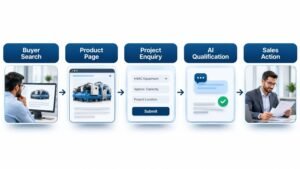
Consider three messages received by an HVAC manufacturer:
Enquiry A: “We need a 250 TR chiller for a commercial project. Please share the technical details and quotation process.”
Enquiry B: “Please send your complete HVAC catalogue.”
Enquiry C: “We are looking for an authorised distributor for your ventilation equipment in our region.”
All three may be legitimate enquiries, but they require different responses.
If every message enters the same inbox and receives a generic reply, the sales team must spend time discovering the requirement before it can decide what to do next.
Design enquiry forms around the information sales actually needs
A generic form asking only for a name, phone number and message does not provide much context.
An HVAC equipment enquiry form can collect:
- Equipment category
- Required capacity or approximate specification
- Application or industry
- Project location
- New installation or replacement
- Expected purchase timeline
- Company name and designation
- Technical document or requirement attachment, if needed
The form should remain manageable. Ask only the questions needed for the next sales conversation, and use conditional fields to display additional questions based on the selected equipment.
For example, a chiller enquiry may ask for cooling capacity and application. An AHU enquiry may ask for airflow requirements. A distributor enquiry may ask about the target region and existing distribution business.
This makes the form more relevant without turning it into a lengthy technical questionnaire.
Introduce AI lead qualification
This is where AdsThrive’s AI and automation capabilities can make a practical difference.
An AI-assisted system can engage a website visitor, collect basic requirements, categorise the enquiry and route it to the appropriate sales representative.
For example, a visitor submits:
“We need an AHU for a pharmaceutical manufacturing facility.”
An AI assistant can ask a few initial questions:
- Is this a new project or an existing facility upgrade?
- What is the approximate airflow requirement, if available?
- Where is the project located?
- Are you looking for equipment supply or a complete system?
- When do you expect to make the purchase?
The system can then organise the enquiry as a potential project requirement and pass the collected information to the sales team.
It should not calculate equipment sizing, make engineering recommendations or promise technical suitability unless the business has specifically configured and validated such a process. Engineering decisions remain with qualified professionals.
AdsThrive’s AI Lead Qualification solution can support this initial sorting process so sales representatives spend less time handling incomplete or irrelevant enquiries.
Use WhatsApp and website chat to reduce response delays
Some buyers prefer a quick WhatsApp conversation instead of completing a long form. Others may visit the website outside normal business hours.
A WhatsApp AI Agent can help respond to initial questions, capture contact details and collect basic product requirements.
An AI Chatbot Agent can support website visitors by directing them to product information, answering configured questions and collecting enquiry details.
For instance, a visitor browsing a cooling tower page could be offered a relevant prompt:
“Are you looking for a new cooling tower, a replacement unit or information for an upcoming project?”
The answer can help direct the conversation.
Follow up before the prospect moves on
HVAC equipment purchases can involve multiple discussions, technical approvals, budget planning and internal procurement processes. A buyer may not be ready to issue a purchase order immediately.
That does not mean the enquiry should be forgotten.
Automated follow-ups can remind prospects about a pending discussion, provide requested information or reconnect with a buyer at an agreed time.
AdsThrive’s AI Follow-ups can support structured follow-up communication. For suitable workflows, an AI Calling Solution can help with initial contact, reminders and meeting coordination.
When a prospect is ready to discuss technical or commercial requirements, an AI Booking System can help schedule a meeting with the appropriate representative.
The goal is to avoid losing a genuine opportunity simply because nobody responded, nobody followed up or the enquiry was sent to the wrong person.
How AdsThrive Can Connect Marketing With the HVAC Sales Process
A manufacturer does not necessarily need to manage one agency for SEO, another for paid advertising, a separate tool for chat, another platform for WhatsApp and an additional system for follow-ups.
The more useful approach is to identify the business’s biggest marketing bottleneck and build a connected solution around it.
For manufacturers that need Digital marketing for HVAC equipment companies, AdsThrive can bring the following activities into one coordinated strategy:
Search visibility: Technical SEO, AI SEO, product-page optimisation and content planning help the manufacturer become visible for relevant equipment and application searches.
Paid lead generation: Google Ads campaigns can target buyers actively searching for specific product categories and direct them to relevant landing pages.
Professional outreach: LinkedIn and social media activities can help communicate manufacturing capability and build relationships with relevant business audiences.
Enquiry capture: Website chat and WhatsApp automation can collect initial details and guide visitors towards the right contact route.
Lead organisation: AI qualification can categorise enquiries using the manufacturer’s predefined criteria.
Sales follow-up: AI calling, follow-up workflows and booking systems can help the sales team maintain communication and coordinate the next action.
The exact combination should depend on the manufacturer’s products, sales capacity, target geography and existing technology.
“For a broader example of how digital channels and lead management can work together in industrial markets, see How Industrial Equipment Companies Can Generate More Leads Online.”
What Should HVAC Manufacturers Measure to Know Whether Marketing Is Working?
A marketing report that focuses only on website traffic, impressions and keyword positions does not show the full commercial picture.
Management should be able to understand whether marketing is contributing to genuine business opportunities.
Track performance at four levels.
- Search visibility
- Organic impressions for product and application searches
- Rankings for relevant commercial keywords
- Organic clicks to product pages
- Visibility for target locations and industries
- Enquiry generation
- Product quotation requests
- Technical consultation requests
- Catalogue and datasheet enquiries
- Distributor enquiries
- Calls and WhatsApp conversations
- Lead quality
- Enquiries matching the manufacturer’s product range
- Relevant project locations
- Enquiries with technical requirements
- Prospects with realistic purchase timelines
- Sales-qualified opportunities
- Sales contribution
- Quotations issued
- Meetings completed
- Opportunities progressed
- Orders won
- Revenue influenced by marketing
A useful monthly review should compare the source of enquiries with the quality of opportunities generated.
For example, if Google Ads generates 40 enquiries but only three match the manufacturer’s product range, the campaign needs attention. If LinkedIn generates fewer enquiries but several come from relevant consultants or EPC contractors, it may be contributing valuable opportunities.
The objective is not to declare one marketing channel the winner based on lead volume. It is to understand which combination produces the strongest commercial results.
Frequently Asked Questions
1. How can HVAC equipment manufacturers generate more B2B leads?
They can combine product-specific SEO, application-focused website pages, Google Ads, LinkedIn outreach, technical content and AI-assisted enquiry management. The website should make it easy for buyers to understand the equipment and submit a relevant project or quotation request.
2. Which keywords should HVAC manufacturers target?
They should target product searches such as chiller manufacturer, AHU manufacturer and cooling tower supplier, along with application-based searches, technical requirements and commercial supplier terms. The keyword selection should reflect the company’s actual products, locations and target buyers.
3. Is SEO useful for industrial HVAC equipment companies?
Yes. SEO can help manufacturers appear when consultants, contractors, procurement teams and distributors search for relevant equipment or suppliers. Product-specific pages and useful technical content are generally more valuable than relying only on broad HVAC terms.
4. Should HVAC manufacturers use Google Ads?
Google Ads can be useful when a manufacturer wants to reach buyers actively searching for specific equipment. Separate campaigns, relevant landing pages and negative keyword management help reduce irrelevant traffic and improve enquiry relevance.
5. How can LinkedIn help HVAC manufacturers?
LinkedIn can help manufacturers connect with MEP consultants, HVAC consultants, EPC contractors, procurement managers, distributors and facility management companies. It can be used to share technical resources, introduce product capabilities and develop relevant business relationships.
6. Can AI help qualify HVAC equipment enquiries?
Yes. AI can collect initial details such as equipment category, application, capacity requirement, project location and expected timeline. It can then organise enquiries for the sales team. Technical recommendations and engineering decisions should remain with qualified professionals.
7. How long does it take to generate leads through SEO?
SEO timelines vary according to website condition, competition, product category, location and content quality. Paid advertising can help generate visibility sooner, while SEO builds a longer-term source of relevant organic traffic.
8. What should an HVAC manufacturer’s website include to generate enquiries?
It should include clear product pages, verified specifications, application information, technical documents, manufacturing capabilities, project evidence, contact details and simple enquiry options. Different buyer types should have relevant ways to contact the company.
Turn HVAC Website Traffic Into Genuine Business Opportunities
An HVAC manufacturer does not need more random website visitors. It needs to reach organisations that require its equipment, make its technical capabilities easy to evaluate and give interested buyers a straightforward way to start a conversation.
That requires more than publishing product pages or running occasional advertisements. SEO should capture relevant searches, Google Ads should reach active buyers, LinkedIn should support business relationships, and AI automation should help manage the enquiries generated by these channels.
A manufacturer looking for a Digital marketing agency for HVAC equipment companies should evaluate whether the agency understands industrial buying behaviour, product-specific search intent and the connection between marketing enquiries and actual sales opportunities.
AdsThrive can help build that system through SEO, AI SEO, Google Ads, social media, lead generation, AI chat, WhatsApp automation, AI calling, follow-ups and booking solutions.
If your HVAC business is receiving irrelevant enquiries, struggling to reach project buyers or losing prospects because of delayed follow-up, contact AdsThrive to discuss a digital marketing and AI automation strategy built around your equipment categories and sales process.