An industrial ventilation project rarely begins with someone searching for a fan and immediately requesting a quotation. A plant manager may first notice excessive heat near production equipment. An EHS professional may be investigating dust exposure. A factory consultant may be preparing specifications for a new production line, while a facility manager may need to replace an ageing exhaust system.
Each situation can create a commercial opportunity for an industrial ventilation company.
The problem is that many manufacturers and contractors present their businesses online through broad product descriptions, general service pages and downloadable catalogues. Buyers searching for local exhaust ventilation, industrial exhaust fans, dust extraction, fume removal or factory ventilation may never discover those businesses.
SEO for industrial ventilation companies needs to connect technical capabilities with the actual problems, applications and project requirements that buyers are researching. More importantly, the website must give those visitors a clear reason to enquire.
For companies seeking measurable growth, the opportunity is to connect search visibility, technical content, Google Ads, LinkedIn outreach, lead generation and AI-powered sales automation into one commercial acquisition system.
This article explains how to build that system and how AdsThrive can help industrial ventilation businesses turn online discovery into qualified project enquiries.
The Industrial Ventilation Buyer Is Not Always Searching for a Ventilation Product
Consider three potential customers.
- A metal fabrication plant wants to remove welding fumes from specific workstations.
- A pharmaceutical facility needs ventilation designed around its operational and environmental requirements.
- A food processing factory is reviewing air movement, heat removal and extraction requirements in its production area.
All three may need ventilation expertise, but they are unlikely to use identical search terms.
The first buyer may search for welding fume extraction systems. The second may investigate industrial exhaust solutions for a controlled facility. The third may look for factory ventilation or industrial air circulation solutions.
A company that only targets the broad term “industrial ventilation systems” misses the commercial context behind these searches.
The marketing opportunity is to organise the website around the reasons a buyer needs the service.
What creates a commercial requirement?
Industrial ventilation enquiries commonly originate from situations such as:
- A new factory or production facility is being planned.
- A manufacturing process generating fumes, dust, vapours or excessive heat.
- An existing extraction system failing to perform as expected.
- Production capacity is increasing and requires ventilation modifications.
- A facility planning equipment replacement or an upgrade.
- A consultant preparing mechanical ventilation specifications.
- A plant reviewing workplace conditions and operational requirements.
These are not interchangeable requirements. Each may involve different equipment, design considerations, site conditions, installation work and project budgets.
India’s industrial workplace requirements also make this subject more than a product-selection exercise. The Occupational Safety, Health and Working Conditions include provisions addressing ventilation and the removal of smoke, fumes, steam and dust in relevant factory environments.
For an industrial ventilation business, this creates an opportunity to publish useful, technically responsible information that answers the questions buyers and project consultants are already asking.
The marketing implication: Do not build every page around equipment names. Build pages around the application, operating problem and project requirement that lead a buyer to seek that equipment.
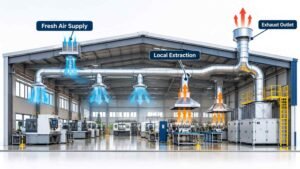
Make Your Website Explain What You Can Solve, Not Just What You Sell
A product catalogue is useful, but it is rarely enough to persuade a new commercial buyer.
Imagine a procurement manager landing on a website with the heading:
“Industrial Ventilation Products and Services”
The page lists exhaust fans, ducting, blowers and ventilation equipment. It may even contain photographs and a downloadable brochure.
However, the buyer still needs to establish:
- Can this company handle my type of industrial application?
- Does it undertake complete ventilation projects or only supply equipment?
- Can it assess an existing installation?
- Does it provide design, fabrication and installation?
- Can it work with consultants and project contractors?
- What information is required to obtain a quotation?
If the website does not answer these questions, the buyer may return to Google and investigate another supplier.
Create pages around actual commercial applications
Instead of relying on one broad service page, identify the important capabilities the company genuinely offers.
For example:
Industrial Exhaust Ventilation
Explain the applications, equipment options, typical project considerations and information required for an enquiry.
Local Exhaust Ventilation
Discuss how extraction can be planned near a process that produces airborne contaminants, subject to appropriate engineering assessment.
Dust Extraction Systems
Explain the industries and production processes served, the extraction requirements and the types of projects the company undertakes.
Fume Extraction Systems
Cover relevant applications such as welding, fabrication and industrial processing, where supported by the company’s actual capabilities.
Factory Ventilation Projects
Show how the company approaches ventilation requirements for new facilities, existing plants and operational upgrades.
These should not become five pages with the same paragraphs and different keywords. Each needs its own application details, photographs, project information and enquiry objective.
Give every page a commercial next step
A buyer investigating a ventilation solution should not have to navigate several pages to contact your company.
Useful conversion options include:
- Request a project assessment.
- Discuss an existing ventilation problem.
- Request a technical consultation.
- Submit project details.
- Ask for a quotation.
- Speak to the project team.
AdsThrive can support this website structure through SEO and AI SEO services, combining search-intent research, page optimisation, technical SEO and content development.
The objective is to help search engines understand the company’s capabilities while making it easier for a potential customer to identify the right service and take action.
Turn Technical Project Knowledge into a Competitive Marketing Asset
Industrial ventilation companies often possess information that competitors cannot easily reproduce: installation experience, engineering knowledge, application photographs, site challenges and practical lessons from completed projects.
Yet much of this knowledge stays inside the organisation.
The sales team explains the same things repeatedly. Engineers answer similar questions during site visits. Project managers discuss the challenges involved in routing ductwork, positioning extraction points or working around existing production equipment.
These conversations can become valuable website content.
What should industrial ventilation companies publish?
Rather than producing generic articles about the importance of ventilation, develop resources around real buyer questions.
Examples include:
- What information is needed before designing an industrial exhaust system?
- What should a factory consider before installing local exhaust ventilation?
- How can an existing ventilation system be assessed for an upgrade?
- What affects the positioning of extraction hoods?
- What should a buyer discuss before requesting a dust extraction quotation?
- What challenges can arise when installing ductwork in an operating factory?
- What is the difference between general ventilation and local exhaust ventilation?
These topics serve two purposes.
First, they attract visitors researching a specific technical requirement. Second, they help a buyer evaluate whether the company understands the nature of the project.
Use project evidence instead of unsupported marketing claims
A useful project page should describe the actual work completed.
Where permission is available, include:
- Industry and project type.
- Original requirement.
- Scope of work.
- Relevant system components.
- Site constraints.
- Installation considerations.
- Photographs of the actual project.
- Outcome, where it can be substantiated.
Avoid publishing invented performance improvements, unsupported air-quality claims or fabricated project figures.
A technically credible case study can be more persuasive than several pages filled with phrases such as “best quality”, “advanced technology” and “complete customer satisfaction”.
The Bureau of Indian Standards’ industrial ventilation standard provides a useful reference point for understanding the technical context of industrial ventilation. Companies should consult the applicable standards and qualified professionals when preparing engineering information; marketing content must not be presented as a substitute for technical compliance.
This is where SEO services for industrial ventilation companies should go beyond adding keywords to existing pages. Technical knowledge needs to be organised into useful, searchable resources that support a buyer’s decision.
Find the Searches That Reveal a Project Is Being Planned
A major opportunity is hidden in searches that do not contain the phrase “industrial ventilation company”.
A factory manager may search for a solution to a particular problem. A consultant may search for an equipment specification. A procurement executive may look for a manufacturer or installation contractor.
The following keyword map shows the kinds of searches an industrial ventilation business should investigate.
| Search category | Example searches | Commercial opportunity |
| Product | Industrial exhaust fan manufacturer, industrial ventilation blower supplier | Product enquiries |
| Application | Welding fume extraction system, factory dust extraction | Application-specific projects |
| Service | Industrial ventilation installation, ventilation system upgrade | Installation and service contracts |
| Problem | Remove fumes from factory, improve workshop air extraction | Problem-led enquiries |
| Project | Industrial ventilation contractor, factory ventilation project | New project opportunities |
| Location | Industrial ventilation company in Bangalore, ventilation contractor near me | Local enquiries |
| Technical | Local exhaust ventilation design, industrial ducting requirements | Consultant and engineering enquiries |
These are example search themes, not claimed daily search volumes. Actual keyword selection should be based on location, search data, competition, business capability and commercial intent.
Build keyword groups around the company’s actual services
For example, a company specialising in dust extraction should not spend the same budget and content effort as a company primarily undertaking general factory ventilation projects.
The keyword strategy should distinguish:
- Product searches.
- Application searches.
- Installation and contractor searches.
- Upgrade and replacement searches.
- Industry-specific searches.
- Location-based searches.
- Agency and marketing-service searches.
This is also where SEO for industrial ventilation companies becomes commercially useful: it connects the services the business can deliver with the searches that potential buyers are using.
Do not create a separate page for every minor keyword variation. Group closely related searches where the same page can genuinely satisfy the intent. Create separate pages only when the application, service or buyer requirement is meaningfully different.
Use Google Ads to Reach Buyers When a Project Has a Deadline
SEO can build organic visibility over time, but industrial ventilation companies may have immediate business requirements.
A company might have recently added an installation team, entered a new city, introduced a dust extraction service or decided to pursue larger factory projects.
Waiting for every new organic page to rank may not match the sales timeline.
Google Ads can help place the business in front of people actively searching for relevant services.
Campaigns should reflect the service being sold
A practical campaign structure could include:
Campaign A: Industrial Ventilation Contractors
Target searches related to industrial ventilation contractors, installation companies and project services.
Campaign B: Dust and Fume Extraction
Target specific extraction applications that the company is equipped to handle.
Campaign C: Factory Ventilation Projects
Reach businesses researching ventilation installation, modifications or upgrades.
Campaign D: Local Commercial Enquiries
Target relevant service searches in the geographical areas the company can serve.
Each campaign should direct users to a matching landing page.
Someone searching for a dust extraction contractor should not land on a generic page that mainly discusses ventilation fans. The landing page should explain the relevant application, project scope, service area and enquiry process.
Improve the quality of paid enquiries
Google Ads performance should not be judged only by clicks or form submissions.
Track:
- Search terms generating enquiries.
- Calls from relevant commercial prospects.
- Project assessment requests.
- Quotation requests.
- Qualified enquiries.
- Cost per qualified opportunity.
- Projects progressing to the proposal stage.
AdsThrive can manage Google Ads and PPC campaigns around specific services and commercial requirements. Campaigns can be refined using actual enquiry quality rather than simply increasing traffic.
Paid advertising also provides useful market feedback. If a particular application produces better enquiries, the business can consider expanding its landing page, organic content and outreach around that service.
Use LinkedIn to Reach the People Who Influence Industrial Projects
Not every industrial ventilation project begins with a direct Google search.
A project may be discussed internally by a plant head, facility manager, EHS professional, engineering consultant or procurement team before a contractor is invited to participate.
This creates an opportunity for targeted B2B outreach.
Identify the right decision-making roles
Depending on the company’s services, relevant audiences may include:
- Plant heads.
- Factory managers.
- Facility managers.
- EHS managers.
- Project managers.
- Mechanical engineering consultants.
- Procurement managers.
- Industrial contractors.
- EPC companies.
- Manufacturing business owners.
A manufacturer that wants to reach industrial consultants should not use the same message as one targeting factory owners who need an existing system upgraded.
Make outreach relevant to the recipient
A weak LinkedIn message might say:
“We are the leading industrial ventilation company. Contact us for all your requirements.”
It gives the recipient little reason to respond.
A more relevant message could introduce the company’s experience with a particular application, explain the types of projects it handles and ask whether the recipient is currently evaluating similar requirements.
The same principle applies to content.
Instead of posting only product photographs, share:
- Project installation updates.
- Ducting and extraction work.
- Engineering observations.
- Application-specific information.
- Maintenance and upgrade considerations.
- Factory project photographs.
- Technical team insights.
AdsThrive can support this through social media marketing and focused B2B communication strategies.
LinkedIn outreach should be targeted and permission-conscious. The objective is to begin relevant business conversations, not send bulk messages to unrelated contacts.
Stop Treating Every Website Enquiry as an Equal Sales Opportunity
A company may invest in SEO, advertising and social media and still struggle to convert enquiries into projects.
The reason may be the way enquiries are handled.
Consider the different messages an industrial ventilation company might receive:
Enquiry A: “We need a complete exhaust ventilation solution for a new manufacturing unit.”
Enquiry B: “Please share your product catalogue.”
Enquiry C: “We need to modify an existing dust extraction system.”
Enquiry D: “Do you provide ventilation equipment for residential use?”
These messages do not represent the same commercial opportunity.
A sales team should not have to manually investigate every basic detail before deciding how to respond.
Use AI to collect useful project information
An AI chatbot or WhatsApp assistant can ask relevant preliminary questions, such as:
- What type of facility do you operate?
- Is this a new installation or an existing system?
- What process or application requires ventilation?
- Is the requirement related to dust, fumes, heat or general air movement?
- Which city is the project located in?
- Is a site assessment required?
- What is the expected project timeline?
- Do you have drawings or project specifications available?
The exact questions should be customised to the company’s services. AI should collect information, not independently approve engineering designs or make safety decisions.
Classify enquiries before they reach the sales team
A practical classification might be:
New project: A new facility or production area requiring a ventilation solution.
Existing system upgrade: A buyer considering changes to an installed system.
Product enquiry: A prospect interested in equipment supply.
Consultant or contractor enquiry: A professional exploring a supplier or project partner.
Early-stage enquiry: A prospect researching options without a confirmed project.
This is where AdsThrive’s AI lead qualification solution can help businesses organise incoming leads and collect useful information before sales follow-up.
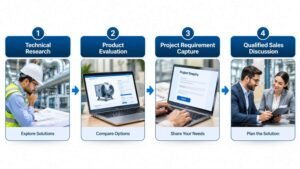
The commercial benefit is better visibility into the enquiries entering the business and a clearer basis for prioritising sales activity.
Build a Follow-up Process That Does Not Depend on Someone Remembering to Call
Industrial projects can take time to move from initial enquiry to technical discussion, site visit and quotation.
A buyer may submit a form while comparing suppliers. A project manager may ask for a brochure and respond only after internal discussions. A consultant may need additional technical documents before shortlisting a contractor.
If the company responds once and then waits indefinitely, potential opportunities can disappear.
A structured follow-up process helps prevent this.
Connect enquiry capture with WhatsApp, calling and CRM updates
A connected workflow can work as follows:
- A prospect submits an enquiry through the website or a campaign.
- The system records the contact and project details.
- An immediate acknowledgement is sent.
- AI asks any missing preliminary questions.
- A qualified enquiry is assigned to the appropriate sales representative.
- A sales discussion or site visit is scheduled.
- Follow-up reminders are created.
- The CRM is updated as the opportunity progresses.
For example, a prospect requesting a factory ventilation assessment should receive a relevant acknowledgement, not an unrelated promotional message.
AdsThrive can connect this process with its WhatsApp AI agent, AI calling solution and automated AI follow-ups.
An AI chatbot can also help answer basic service questions and direct visitors towards the appropriate enquiry option.
Where appropriate, AI booking systems can help organise consultation or appointment requests.
The important point is that automation should support the sales team. Technical discussions, project feasibility, engineering recommendations and commercial negotiations still require the relevant human professionals.
How AdsThrive Can Connect These Activities into One Commercial Growth Strategy
Industrial ventilation businesses do not necessarily need more disconnected marketing activities. They need a system in which each activity supports the next stage of the buyer’s decision.
AdsThrive approaches digital marketing for industrial ventilation companies by connecting visibility, lead generation and enquiry management.
The work can be organised around the business’s actual commercial challenges.
| Business challenge | AdsThrive solution | Intended outcome |
| Buyers cannot find relevant services | SEO and AI SEO | Better search visibility |
| Technical pages do not attract the right audience | Search-intent and content strategy | More relevant visitors |
| New projects need immediate enquiries | Google Ads | Paid search opportunities |
| Decision-makers are difficult to reach | LinkedIn and social media marketing | Targeted B2B visibility |
| Website visitors do not enquire | Landing-page and conversion improvements | Easier enquiry submission |
| Too many irrelevant enquiries | AI lead qualification | Better lead organisation |
| Visitors need immediate answers | AI chatbot and WhatsApp AI | Faster initial responses |
| Sales follow-ups are inconsistent | AI calling and follow-up automation | More organised communication |
| Appointments are difficult to coordinate | AI booking systems | Simplified scheduling |
| Management cannot identify useful campaigns | Lead and campaign reporting | Better marketing decisions |
A company evaluating a digital marketing agency for industrial ventilation companies should look beyond the number of keywords an agency promises to rank.
Ask whether the agency understands how your business gets projects, what information a buyer needs before contacting you, and how the marketing system will distinguish a genuine project opportunity from an irrelevant enquiry.
What makes this approach commercially useful?
It connects the marketing activity to the sales process.
- SEO helps buyers discover relevant services.
- Technical content helps them understand the company’s capabilities.
- Google Ads captures searches with immediate commercial intent.
- LinkedIn helps build relationships with relevant business audiences.
- Lead generation creates focused enquiry opportunities.
- AI qualification organises incoming prospects.
- WhatsApp, calling and follow-up automation support timely communication.
The combination can be adapted to a company that supplies ventilation equipment, undertakes installation projects, offers extraction solutions or provides a broader industrial ventilation service.
The strategy should reflect the actual business model rather than forcing every company into the same campaign structure.
What Should Industrial Ventilation Companies Measure Every Month?
Rankings and website visits are useful indicators, but they do not tell management whether marketing is producing commercially valuable opportunities.
A better reporting system should connect the first interaction with the sales outcome.
Track these indicators:
Search performance
- Organic impressions and clicks.
- Rankings for relevant product and application searches.
- Performance of service-specific pages.
- Search terms producing enquiries.
Campaign performance
- Google Ads spend.
- Cost per enquiry.
- Relevant calls and form submissions.
- Campaigns producing qualified prospects.
Lead quality
- Industry of the prospect.
- Project location.
- Type of ventilation requirement.
- New installation versus upgrade.
- Technical information received.
- Enquiry qualification status.
Sales progress
- Site assessments scheduled.
- Quotations requested.
- Proposals submitted.
- Opportunities progressing.
- Orders generated.
For example, a campaign may generate 40 enquiries, but only six may match the company’s target services. Another campaign may generate 12 enquiries, of which eight become genuine project discussions.
The second campaign may be commercially more valuable even though it produces fewer total leads.
This is why reporting should focus on qualified opportunities and sales progress instead of celebrating raw lead counts.
A Practical 90-Day Starting Plan for Industrial Ventilation Businesses
A company does not need to launch every marketing activity simultaneously. A phased rollout can help identify the most important gaps before increasing investment.
Days 1–30: Identify the commercial gaps
Start with a review of:
- Existing website pages and search visibility.
- Main services and profitable project categories.
- Target industries and geographical markets.
- Competitor positioning.
- Existing enquiry sources.
- Website conversion points.
- Sales response and follow-up practices.
The first objective is to identify where potential customers are being lost.
Days 31–60: Improve visibility and enquiry capture
Prioritise the most commercially important service pages.
Depending on the business, this may include:
- Industrial exhaust ventilation.
- Dust and fume extraction.
- Local exhaust ventilation.
- Factory ventilation projects.
- Installation and upgrade services.
Improve the page content, technical information, enquiry forms and calls to action. Launch focused Google Ads campaigns where immediate demand needs to be captured.
Prepare relevant LinkedIn content and outreach lists for the industries the company wants to serve.
Days 61–90: Connect lead generation with automation
Introduce or improve:
- AI enquiry capture.
- Preliminary lead qualification.
- WhatsApp communication.
- Automated follow-ups.
- Sales notifications.
- CRM updates.
- Appointment scheduling.
- Campaign and qualified-lead reporting.
Review which services, search themes and campaigns are producing relevant enquiries.
Use those findings to decide where the next investment should go.
This is a starting framework, not a guarantee of rankings or a fixed lead volume. Actual timelines and outcomes depend on the website, market, competition, campaign budget, service capability and sales response.
Manufacturers looking to attract more qualified B2B enquiries and strengthen their online presence can explore these effective strategies for digital marketing for acoustic panel manufacturers.
Frequently Asked Questions
1. How can industrial ventilation companies get more enquiries online?
Build dedicated pages for the services and applications the company actually handles. Combine SEO, Google Ads, technical content, LinkedIn outreach and focused lead-generation campaigns. Make it easy for buyers to request a quotation or discuss a project.
2. Which keywords should an industrial ventilation company target?
Prioritise searches related to industrial exhaust systems, local exhaust ventilation, dust extraction, fume extraction, factory ventilation, installation services and system upgrades. Add industry and location terms where they reflect genuine business capabilities.
3. Is SEO useful for industrial ventilation contractors?
Yes. SEO can help contractors appear when businesses search for installation, extraction, ventilation upgrades and specialist services. The website should clearly explain project experience, service coverage and the type of work undertaken.
4. Can Google Ads generate industrial ventilation project leads?
Google Ads can capture buyers actively searching for relevant services. Campaigns should be separated by application and service, with matching landing pages and conversion tracking. Lead quality matters more than the number of clicks.
5. How can industrial ventilation companies reach factory managers and consultants?
LinkedIn outreach, relevant industry content, targeted advertising and professional networking can help businesses reach plant heads, facility managers, EHS professionals, consultants and procurement teams. Communication should be relevant to each audience’s role.
6. Can AI help qualify industrial ventilation enquiries?
Yes. AI can collect preliminary information about the facility, application, location, project stage and requirement. It can organise enquiries and route them to the appropriate sales representative. Engineering decisions should remain with qualified professionals.
7. How long does SEO take to generate enquiries?
The timeframe varies according to website quality, competition, existing authority, technical issues and the content being developed. Google Ads can support immediate visibility while organic search work builds over time.
8. What should I look for in a digital marketing agency for an industrial ventilation business?
Look for an agency that understands B2B project acquisition, technical service pages, commercial keyword research, Google Ads, LinkedIn outreach, lead qualification and sales follow-up. Ask how it will measure qualified opportunities rather than reporting only rankings and traffic.
Turn Industrial Ventilation Expertise into More Commercial Opportunities
Your company may already have the engineering knowledge, equipment, installation experience and technical team required to handle industrial projects. The challenge is making those capabilities visible to the right buyers and giving them a straightforward way to start a conversation.
A connected strategy can help achieve that: SEO for industrial ventilation companies to improve discovery, Google Ads to capture active demand, LinkedIn to reach relevant decision-makers, and AI-powered lead qualification and follow-ups to organise the enquiries that come in.
AdsThrive brings these activities together through SEO, AI SEO, digital marketing, lead generation, chatbots, WhatsApp AI, AI calling, automated follow-ups and CRM-connected workflows.
If your business wants to attract more relevant industrial enquiries rather than simply increase website traffic, contact AdsThrive to discuss a strategy based on your services, target industries and project goals.