An acoustic panel manufacturer can have a wide product range, modern production facilities and the ability to supply large commercial projects, yet still receive enquiries that are mostly about small quantities, residential use or products outside its manufacturing capabilities. Meanwhile, architects, interior contractors, auditorium developers and corporate procurement teams may be sourcing panels from competitors.
The problem is not always product quality or pricing. Often, the manufacturer’s marketing does not communicate what it produces, which projects it can support, what makes its products different or how a serious buyer can start a commercial discussion.
SEO for acoustic panel manufacturers needs to solve more than a visibility problem. It must help the right buyers recognise the product’s value, understand its suitability and contact the manufacturer with a meaningful requirement.
For manufacturers, the commercial opportunity lies in improving the entire journey: from how products are presented online to how enquiries are captured, qualified and followed up. This is where a coordinated strategy involving SEO, Google Ads, social media, LinkedIn outreach and AI automation can make a measurable difference.
Why are acoustic panel manufacturers not getting the enquiries they expect?
Before investing more money in advertising, manufacturers should identify where potential business is being lost.
A website may receive visitors without generating quotation requests. A Google Ads campaign may produce leads, but most may be looking for low-cost foam sheets or individual retail products. Social media may attract likes without reaching architects or contractors. Even when a serious buyer submits an enquiry, a delayed response can give a competitor the opportunity to secure the discussion.
These are different problems. They should not be addressed with one generic marketing campaign.
Consider six common situations.
Problem 1: Buyers cannot identify what makes your products different
Several manufacturers may offer PET panels, wooden acoustic panels, fabric-wrapped panels, ceiling baffles and decorative acoustic treatments. A visitor comparing suppliers may see similar product photographs and descriptions.
If your website only says “premium quality acoustic panels” or “high sound absorption,” the buyer has little reason to choose your company.
AdsThrive’s solution: Build product differentiation into the marketing strategy.
The first step is to identify the commercial strengths of the manufacturer’s actual product range. These could include:
- In-house manufacturing and custom production.
- Specific material compositions.
- Different panel thicknesses and dimensions.
- Custom patterns, colours and finishes.
- Tested acoustic performance.
- Manufacturing capacity for bulk orders.
- Experience supplying commercial or institutional projects.
- Installation support or coordination, if offered.
- Dealer and distributor supply arrangements.
AdsThrive can use these differentiators to plan product-focused SEO pages, landing pages, advertising messages and social media content. Instead of promoting every product with the same description, each campaign communicates a reason to enquire.
Problem 2: The website attracts people who are not commercial buyers
A person searching for acoustic foam for a home recording setup may have a very different requirement from a contractor sourcing panels for a 200-seat auditorium.
Both searches may contain the words “acoustic panels,” but they do not represent the same commercial opportunity.
AdsThrive’s solution: Separate search intent and campaign targeting.
A manufacturer that primarily supplies commercial projects should not spend its entire advertising budget attracting general product searches.
The marketing plan should distinguish between:
- Commercial manufacturer and supplier searches.
- Bulk procurement and quotation searches.
- Product-specific searches.
- Custom manufacturing requirements.
- Application-specific searches.
- Retail and residential searches that may not match the business.
AdsThrive can use SEO keyword mapping, Google Ads targeting, negative keywords and separate landing pages to improve the relevance of incoming traffic.
Problem 3: Product enquiries are arriving without useful information
A message saying “Need acoustic panels, send price” does not tell the sales team whether the requirement is for a small room, a commercial office, an auditorium or a large institutional project.
The salesperson must start by asking basic questions before understanding whether the opportunity is worth prioritising.
AdsThrive’s solution: Use AI lead qualification to collect and organise requirements.
AI-powered forms, chatbots and WhatsApp conversations can collect information such as product type, project location, approximate quantity, application and expected purchase timeline.
The objective is to give the sales team a better starting point instead of forwarding every enquiry as an unqualified contact.
Problem 4: Marketing and sales are operating separately
A campaign may generate a lead, but nobody records whether the quotation was sent, whether the buyer requested samples or whether another follow-up is due.
Without a clear process, potential customers can be overlooked.
AdsThrive’s solution: Connect enquiry capture with CRM updates and automated follow-ups.
An incoming lead can be recorded with its source, product requirement, contact details, assigned salesperson and next action. Automated reminders and follow-ups can help the team maintain communication.
Problem 5: Buyers cannot find enough information to shortlist your company
Architects and consultants may want technical information. Contractors may need quantities and installation details. Procurement teams may want a quotation and supply timeline.
If the website does not provide useful information, buyers may move to another supplier whose capabilities are easier to evaluate.
AdsThrive’s solution: Create a content and conversion strategy around actual buying questions.
This includes product pages, technical resources, application-focused content, project examples and enquiry routes that help a buyer take the next step.
Problem 6: Interested prospects are not followed up at the right time
A buyer who requests a sample today may be ready to discuss pricing next week. A contractor who receives a quotation may need a reminder after internal approval. A distributor may want a scheduled discussion rather than repeated promotional messages.
AdsThrive’s solution: Automate follow-ups through WhatsApp, email and AI calling.
The follow-up should depend on what the buyer has already done. This creates a more relevant sales conversation and reduces the burden of manually tracking every enquiry.
Stop promoting every acoustic product with the same message
An acoustic panel manufacturer’s product range may serve several markets, but each product has a different commercial selling point.
PET panels may appeal to buyers looking for lightweight, design-flexible products. Wooden acoustic panels may be selected for their appearance and integration with premium interiors. Fabric-wrapped panels may suit projects where finish choices and wall treatment matter. Acoustic baffles and ceiling clouds may be relevant for spaces with exposed or high ceilings.
The manufacturer should not try to communicate all these differences in one generic advertisement or on one crowded product page.
Create a product-positioning plan
Start by listing the products you manufacture and the buyers most likely to specify or purchase each category.
| Product category | Commercial positioning to communicate | Potential buyer |
| PET acoustic panels | Material, colour, thickness, custom cutting and tested performance | Architects, interior contractors |
| Wooden acoustic panels | Surface finish, groove or perforation options and interior integration | Designers, consultants |
| Fabric-wrapped panels | Fabric choices, panel dimensions and project applications | Offices, auditoriums, hospitality projects |
| Acoustic ceiling baffles | Suspension options, dimensions and ceiling applications | Commercial fit-out contractors |
| Custom acoustic panels | Design flexibility, manufacturing capability and minimum order requirements | Architects, specialist project teams |
The exact claims must be based on the products your company actually manufactures and the supporting documentation available.
Give each major product category a commercial destination
A buyer searching for PET acoustic panels should find a page dedicated to that product, not a homepage that gives equal attention to every category.
Each important product page should answer:
- What is the product made from?
- Which thicknesses and dimensions are available?
- What finishes or customisation options can be supplied?
- What applications is it designed for?
- What acoustic test information is available?
- What installation arrangements are supported?
- Can the buyer request samples or a quotation?
This is where SEO services for acoustic panel manufacturers should focus: building useful, differentiated product destinations instead of creating pages simply to repeat keywords.
AdsThrive can plan the page structure, optimise the content, improve internal linking and align each product page with its commercial search intent. The goal is to make the website function as a product-sales resource, not just an online brochure.
Make your technical information a reason to choose your company
A product photograph can attract an architect’s attention, but technical information can help move the discussion forward.
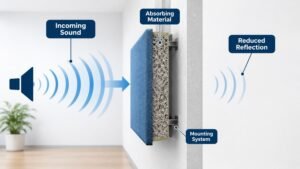
Acoustic products are often evaluated through more than appearance. Depending on the project, buyers may ask about sound absorption, thickness, material, fire performance, mounting arrangements, surface finish and installation requirements.
A manufacturer should turn its available technical information into clear, accessible website resources.
Explain the performance information buyers need
For example, if a product has an NRC rating, explain what the published figure represents and provide the relevant test documentation where available.
The Noise Reduction Coefficient is a single-number rating used to describe sound absorption performance. It should not be presented as a complete measure of every acoustic characteristic or as proof that a panel provides sound insulation between rooms.
This distinction matters. A sound-absorbing panel used to control reverberation inside a meeting room does not automatically prevent external noise from entering that room.
The Bureau of Indian Standards’ National Building Code of India includes Part 8, Section 4, covering acoustics, sound insulation and noise control. Manufacturers can refer to this broader building-acoustics context when developing technical resources for Indian projects.
Build a technical resource section
Instead of leaving technical information inside downloadable brochures alone, make important details accessible on the website.
Useful resources include:
- Product datasheets.
- Acoustic test reports.
- Material and construction details.
- Installation guides.
- Available dimensions and thicknesses.
- Finish and colour catalogues.
- Fire-performance documents, where applicable.
- Maintenance information.
- Frequently asked technical questions.
Do not publish a rating or certification unless it is supported by documentation for the relevant product and tested configuration.
AdsThrive can convert these resources into SEO-friendly pages, downloadable assets and social media content. A single technical document can support a product page, a short educational post, a LinkedIn update and a sales follow-up resource.
That gives the marketing team more useful content without repeatedly publishing generic promotional graphics.
Target the searches that can turn into manufacturing orders
A manufacturer may receive traffic for broad searches but miss the terms used by people who are ready to compare suppliers or request bulk pricing.
The keyword strategy should therefore include both product discovery and supplier-selection intent.
Search categories worth targeting
| Search type | Example keywords | Marketing opportunity |
| Supplier discovery | Acoustic panel manufacturer, acoustic panel supplier | Reach buyers comparing manufacturers |
| Product-specific | PET acoustic panels, wooden acoustic panels | Promote individual product ranges |
| Commercial application | Acoustic panels for offices, auditorium acoustic panels | Reach project-based requirements |
| Custom production | Custom acoustic panels, CNC acoustic panels | Attract specialised manufacturing enquiries |
| Procurement | Acoustic panel price, bulk acoustic panels, acoustic panel quotation | Capture buyers evaluating purchase |
| Technical research | NRC acoustic panels, acoustic panel thickness | Build credibility and support product evaluation |
These are keyword themes, not verified daily search volumes. Use Google Keyword Planner, Search Console and an SEO platform to check current search volume, keyword difficulty, regional demand and competition before finalising the target list.
Build campaigns around the products you want to sell
Suppose a manufacturer wants to increase orders for PET acoustic panels.
A dedicated campaign can target relevant supplier and product searches, direct visitors to the PET product page and encourage them to request a sample or quotation.
A separate campaign can promote wooden acoustic panels to buyers interested in design-led commercial interiors.
This prevents different products from competing for the same generic advertising message.
AdsThrive can support this with keyword research, campaign planning, SEO optimisation, landing-page development and conversion tracking. Its AI SEO services can form part of a wider organic visibility strategy.
Use Google Ads to generate enquiries for the products you want to grow
SEO can build long-term visibility, but manufacturers may also need enquiries within a shorter time frame, particularly when introducing a new product, entering a market or increasing production capacity.
Google Ads can reach people actively searching for a relevant product or supplier.
The important decision is not simply whether to run ads. It is which product, buyer and commercial action each campaign should target.
Divide the advertising budget by business priority
A manufacturer may have several goals:
- Increase bulk orders for its standard PET panel range.
- Introducing a new wooden panel collection.
- Find contractors for ceiling baffle projects.
- Attract distributors in selected regions.
- Generate custom manufacturing enquiries.
These should not all be placed in one campaign.
Create separate campaigns or ad groups according to product and intent. Use relevant search terms, geographic targeting, negative keywords and landing pages that match the advertisement.
What should the landing page achieve?
A landing page should make the next action obvious.
For a bulk product campaign, useful actions may include:
- Request bulk pricing.
- Submit a BOQ.
- Request a product datasheet.
- Arrange a product discussion.
For a design-led product campaign, the next step may be to request a sample kit or view available finishes.
AdsThrive’s Google Ads and PPC services can help manufacturers build campaigns around these business objectives, monitor lead quality and identify which product categories generate meaningful commercial interest.
Do not judge the campaign only by clicks or the lowest cost per lead. Track how many enquiries match the product range, how many request quotations and how many progress towards an order.
Turn manufacturing activity into content that attracts the right buyers
Acoustic panel manufacturers often have valuable content available inside their own operations.
Product development, material selection, cutting, finishing, quality checks, packaging and completed installations can all provide useful material for marketing.
Yet many manufacturers rely on repetitive festival graphics, generic product posters and occasional company updates.
That approach does little to show why a commercial buyer should shortlist the company.
Use social media to demonstrate manufacturing capability
Instead of publishing the same product photograph repeatedly, build content around different parts of the business.
Manufacturing and production content
Show how panels are cut, shaped, finished or prepared for dispatch. Explain the available customisation options and manufacturing capabilities without revealing confidential processes.
Product comparison content
Compare different panel finishes, thicknesses, patterns or mounting options. Keep the comparison accurate and avoid claiming that one product is suitable for every room.
Application content
Show how products are used in offices, conference rooms, educational spaces, auditoriums and hospitality interiors, using actual projects where possible.
Technical education
Explain the difference between sound absorption and sound insulation, what NRC means, why mounting arrangements matter and which information a buyer should request before purchasing.
Commercial proof
Share approved project photographs, client testimonials, production capacity information and completed supply examples.
Each post should serve a purpose: product discovery, technical understanding, brand credibility or enquiry generation.
AdsThrive’s social media marketing services can help create a planned content strategy that presents the manufacturer’s products and capabilities to relevant audiences.
Make LinkedIn a business-development channel
LinkedIn should not be treated as another platform for posting product posters.
It can support direct outreach to:
- Architects and interior design firms.
- Acoustic consultants.
- Commercial fit-out contractors.
- Auditorium and institutional project companies.
- Hospitality project teams.
- Procurement managers.
- Furniture and interior solution dealers.
- Distributors and channel partners.
The approach should be relevant to the recipient.
For example, an architect may receive a short introduction to the manufacturer’s finish and sample range. A contractor may be more interested in supply capacity, standard dimensions and quotation support. A consultant may want technical documentation.
A useful LinkedIn outreach process includes identifying suitable companies, finding relevant decision-makers, reviewing their business focus, sending personalised introductions and following up only where appropriate.
AdsThrive can help connect LinkedIn outreach with the wider marketing strategy so that prospects who discover the company through search or social media encounter consistent product information.
Stop losing enquiries after the first contact
Generating a lead is only one part of the commercial process.
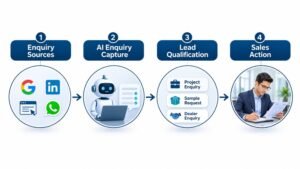
A manufacturer may receive enquiries from Google Ads, website forms, WhatsApp, LinkedIn, email and phone calls. If these channels are managed separately, the sales team may miss messages, duplicate records or forget follow-ups.
This is where AdsThrive’s AI and automation services can solve a practical business problem.
AI lead qualification: Identify which enquiries need attention first
An AI lead qualification system can organise incoming enquiries using information such as:
- Product category.
- Project type.
- Location.
- Approximate quantity.
- Purchase timeline.
- Requirement for samples.
- Availability of drawings or BOQ.
- Buyer category.
- Preferred contact method.
Consider three incoming enquiries.
Enquiry A:
“We need 500 square metres of acoustic ceiling baffles for an office project. Please share pricing and delivery details.”
This contains a defined product, quantity and project requirement. It should be prioritised for commercial review.
Enquiry B:
“Please send your product catalogue.”
This may be an early-stage prospect. The system can share approved information and record the enquiry for further nurturing.
Enquiry C:
“Do you have dealership opportunities in Hyderabad?”
This should be routed to the person responsible for distribution or channel partnerships.
AI qualification helps organise these conversations. It does not replace the technical team’s responsibility to confirm product suitability or the sales team’s responsibility to approve pricing.
Explore AI lead qualification.
WhatsApp AI Agent: Respond to product enquiries without waiting for office hours
A WhatsApp AI Agent can answer approved questions about product categories, collect initial requirements and direct visitors towards the appropriate next step.
For example, a buyer may ask about PET panel thickness, colour options, available sizes or how to request a sample.
The agent can provide approved information, collect the buyer’s project details and route questions requiring technical review to a human representative.
This can help manufacturers respond consistently when enquiries arrive outside normal working hours.
AI calling: Follow up on enquiries that need a conversation
Some commercial enquiries are easier to qualify through a phone discussion.
AI calling can support approved outbound workflows such as confirming whether a quotation was received, checking whether a sample was reviewed, asking whether a project discussion is required or arranging a meeting with the sales team.
The system should identify itself appropriately and follow the company’s communication preferences. Sensitive technical or pricing discussions should be transferred to the relevant employee.
Automated follow-ups: Keep the discussion moving
A prospect may need several interactions before placing an order.
A follow-up schedule can be triggered after:
- A catalogue is shared.
- A sample is requested or dispatched.
- A technical datasheet is downloaded.
- A BOQ is received.
- A quotation is submitted.
- A meeting is completed.
The communication should reflect the prospect’s last action. A buyer who has received a quotation needs a different message from someone who has only requested a catalogue.
AdsThrive’s AI follow-up solutions can help automate these reminders and maintain continuity.
Chatbots, booking and CRM updates
A website chatbot can help visitors identify the right product category, collect contact details and direct complex questions to the sales team.
An AI booking system can help prospects schedule discussions without repeated back-and-forth messages.
CRM updates can record the enquiry source, product requirement, assigned employee and next follow-up date. This gives the company a clearer view of its sales pipeline.
Connect marketing activity to actual orders, not just lead counts
A manufacturer may receive 100 enquiries in a month and still struggle to identify which marketing activity produced the most valuable business.
This happens when campaign reporting stops at form submissions.
Marketing performance should be reviewed alongside the sales process.
| Business metric | What it helps you understand |
| Product-page enquiries | Which products attract commercial interest |
| Sample requests | Which visitors are evaluating the product |
| BOQ submissions | Which prospects have defined project requirements |
| Qualified leads | How many enquiries match the target market |
| Quotations submitted | How many prospects move into pricing discussions |
| Orders received | Which campaigns contribute to sales |
| Repeat enquiries | Whether the company is building ongoing relationships |
For example, a campaign that produces 15 relevant contractor enquiries may be more valuable than one that produces 60 unrelated retail enquiries.
The sales team should record the lead source and enquiry outcome. Over time, this information can help management decide whether to invest more in SEO, Google Ads, LinkedIn, social media or a particular product category.
AdsThrive can help connect campaign tracking, lead capture and AI automation so that the business has a clearer view of what happens after a prospect makes contact.
How AdsThrive can build a connected growth strategy for acoustic panel manufacturers
The challenge for an acoustic panel manufacturer is rarely solved by one marketing activity alone.
SEO may bring visitors, but the website must communicate product differences. Google Ads may generate enquiries, but the landing page must match the search. Social media may build recognition, but it needs to reach relevant professional audiences. AI automation may speed up responses, but it needs to collect the right information and support the sales process.
AdsThrive can bring these activities together through a strategy based on the manufacturer’s product range, target market and commercial priorities.
What the strategy can include
Organic search and AI SEO: Improve visibility for product, supplier, application and commercial searches through keyword research, technical optimisation, content planning and product-page improvements.
Google Ads: Run targeted campaigns for the product categories, regions and enquiry types the manufacturer wants to grow.
Social media marketing: Present product finishes, manufacturing capability, technical information and completed projects to relevant audiences.
LinkedIn outreach: Support business development with targeted communication to architects, consultants, contractors, procurement teams and distributors.
AI lead qualification: Organise incoming enquiries according to product, quantity, project stage and buyer requirement.
WhatsApp and chatbot automation: Provide faster initial responses, answer approved questions and collect enquiry details.
AI calling and follow-ups: Support reminders, callbacks and conversations after sample requests or quotation submissions.
CRM and booking integration: Help maintain lead records, schedule discussions and track the next sales action.
The advantage is that these services can be planned around one commercial process instead of being managed as disconnected activities. AdsThrive can customize the combination according to the manufacturer’s needs rather than requiring every business to adopt every tool.
For manufacturers looking to improve their online visibility and enquiry management, contact AdsThrive to discuss a strategy based on their product range and target buyers.
“Learn how facade companies can attract more high-value clients and generate quality architectural project leads with our latest blog: How Facade Companies Can Generate More Architectural Project Leads.”
Frequently asked questions
1. How can acoustic panel manufacturers get more B2B enquiries?
They can improve product-specific SEO pages, run targeted Google Ads, publish manufacturing and project content, reach architects and contractors through LinkedIn and use enquiry forms that collect project requirements. AI qualification and timely follow-ups can help convert incoming interest into useful sales discussions.
2. Which digital marketing channels work best for acoustic panel manufacturers?
SEO is useful for capturing product and supplier searches. Google Ads can reach active buyers, LinkedIn can support professional outreach, and social media can demonstrate product finishes and manufacturing capability. The right combination depends on the manufacturer’s products, target markets and sales capacity.
3. How can manufacturers attract bulk acoustic panel orders?
Create dedicated landing pages for bulk supply, commercial projects and custom manufacturing. Communicate production capability, available dimensions, technical documentation, delivery information and quotation procedures. Target relevant supplier and procurement searches rather than relying only on broad product keywords.
4. Why are acoustic panel manufacturers receiving irrelevant leads?
Broad keywords, poorly targeted advertisements, unclear product positioning and generic enquiry forms can attract visitors whose requirements do not match the manufacturer’s products. Better keyword targeting, negative keywords, dedicated landing pages and lead qualification can improve relevance.
5. Can Google Ads help generate enquiries for PET and wooden acoustic panels?
Yes. Separate campaigns can target PET panels, wooden panels, fabric-wrapped products and other categories. Each campaign should use relevant search terms and direct visitors to a matching product page with a clear sample or quotation option.
6. How can AI help manage acoustic panel enquiries?
AI can collect basic requirements, classify leads, answer approved product questions, route enquiries, schedule meetings and trigger follow-ups. It can reduce repetitive administrative work while leaving technical evaluation, product approval and final pricing to the company’s team.
7. Why should an acoustic panel manufacturer invest in SEO?
SEO can help the manufacturer appear for searches related to its product categories, applications and supplier requirements. It can also bring buyers to pages containing technical information and commercial actions. Results depend on competition, content quality, site performance and the relevance of the pages.
8. How should a manufacturer choose a digital marketing partner?
Look for a partner that understands B2B lead generation, can distinguish product and buyer intent, tracks qualified enquiries and connects marketing with sales follow-up. The partner should be able to explain how campaigns will support actual business objectives rather than promise rankings or a fixed number of leads.
Turn your product range into a stronger source of commercial enquiries
An acoustic panel manufacturer should not have to depend entirely on referrals, trade contacts or occasional project enquiries. Buyers are actively researching products, comparing suppliers and looking for manufacturers who can meet their requirements.
The challenge is making sure your company appears in those searches, communicates its capabilities clearly and responds when a prospect is ready to discuss a project.
SEO for acoustic panel manufacturers should be part of a wider growth strategy that connects search visibility with product positioning, paid campaigns, professional outreach and enquiry management.
AdsThrive can help manufacturers address these challenges through SEO, AI SEO, Google Ads, social media, LinkedIn outreach, WhatsApp automation, AI calling, lead qualification, CRM updates and automated follow-ups.
Rather than treating these as separate services, the objective is to create a connected system that attracts relevant buyers, captures their requirements and helps the sales team act on opportunities.
Speak with AdsThrive about building a digital marketing and AI automation strategy for your acoustic panel manufacturing business.