Architectural concrete is rarely purchased on price alone. Architects, facade consultants, landscape designers, contractors and developers evaluate surface finish, colour consistency, texture, dimensions, performance, installation requirements and the manufacturer’s ability to deliver the specified product across a project. A company may manufacture architectural precast panels, decorative concrete screens, facade elements, terrazzo products, textured cladding or bespoke landscape components, but potential buyers cannot consider those capabilities if they cannot find the manufacturer or understand what it can deliver.
That creates a commercial challenge: the quality of the product may be visible at a project site, but the manufacturer’s capabilities are not always visible during the buyer’s search and selection process.
SEO for architectural concrete companies should therefore do more than increase website traffic. It should help manufacturers reach the right project professionals, present their product capabilities convincingly, generate specification-led enquiries and ensure every promising opportunity receives a timely response.
Adsthrive connects SEO, AI SEO, Google Ads, social media, lead generation, LinkedIn outreach and AI-powered sales automation into a coordinated growth strategy. Each service has a different role in moving a potential buyer from discovering a product to discussing a real project.
Why architectural concrete needs a different marketing approach
Architectural concrete is a specification-led and visually evaluated product category. Buyers may be looking for a particular appearance, but their final decision also depends on technical and commercial considerations.
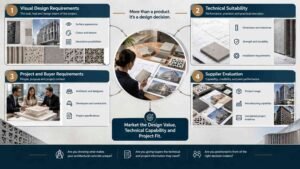
An architect may search for a façade finish that matches a design concept. A landscape consultant may need custom concrete seating, planters or paving elements. A contractor may be comparing manufacturers based on production capacity, dimensions, delivery schedules and installation support. A developer may want a supplier capable of maintaining consistency across multiple buildings.
These buyers do not necessarily use the same search terms or follow the same route to a supplier.
For example, someone searching for architectural precast concrete panels may have a defined product requirement. Someone searching for decorative concrete façade manufacturers may still be comparing design possibilities. A contractor looking for custom concrete screens for commercial buildings may already have a project and need a quotation.
A manufacturer that uses one generic services page to address all these requirements makes the buyer do too much work.
The commercial opportunity is to make each capability easier to discover and evaluate. That requires a combination of product-focused search visibility, convincing visual presentation, targeted advertising and an enquiry process that captures useful project information.
The following sections explain how Adsthrive’s individual services can support those objectives.
SEO: Make every architectural concrete capability discoverable
A manufacturer may have an extensive product catalogue, but a catalogue does not automatically create search visibility. If the website only has broad pages such as “Products”, “Services” or “Our Work”, it may fail to appear for more specific searches.
A company producing architectural precast panels, decorative screens, concrete façade cladding and custom landscape elements should not expect one page to rank for every product category.
Build search visibility around what the company actually manufactures
The first step is to identify the product categories, applications and buyer requirements that deserve individual website coverage.
A practical website structure could include:
- Architectural precast concrete panels
- Decorative concrete façade systems
- GRC and textured façade elements, where offered
- Concrete screens and perforated panels
- Custom architectural concrete components
- Landscape and urban design products
- Bespoke concrete elements for commercial projects
Each page should explain the product, its possible applications, available finishes, dimensions or customisation options, relevant technical information and the process for requesting a quotation.
The page should also show real product photographs. A buyer evaluating a textured façade panel needs to see the finish, scale and detailing rather than a generic photograph of a concrete building.
Match the page to the buyer’s search intent
Consider these example search opportunities:
| Buyer search example | Likely requirement | Recommended website destination |
| Architectural precast concrete manufacturers | Find a manufacturer | Main capability page |
| Decorative concrete façade panels | Compare façade products | Façade product page |
| Custom concrete screen manufacturers | Source a bespoke product | Concrete screens page |
| Textured concrete wall panels | Evaluate surface finishes | Finish and application page |
| Architectural concrete planters | Source landscape products | Landscape product page |
| Precast concrete cladding suppliers | Identify a supplier | Cladding capability page |
These are keyword opportunities, not verified daily search-volume figures. Search volume and competition should be validated against the target locations and the manufacturer’s actual product range before final keyword mapping.
How Adsthrive helps
Adsthrive’s SEO service can help architectural concrete manufacturers organise their website around commercial product searches rather than broad industry terms.
The work can include keyword research, competitor analysis, technical SEO, page structure, on-page optimisation, internal linking and content development. The objective is to help the right product pages become discoverable when architects, consultants, contractors and developers search for relevant capabilities.
Explore Adsthrive’s SEO services.
The website should also provide credible technical context. In India, the Bureau of Indian Standards publishes the National Building Code and standards relevant to building materials and construction. Manufacturers should use applicable standards and verified product documentation when presenting technical claims; marketing copy should never imply certification or compliance that the company does not hold.
AI SEO: Improve how architectural concrete brands appear in AI-led discovery
Search behaviour is changing. Buyers may still use conventional Google searches, but they can also ask AI assistants questions such as:
- Which manufacturers supply decorative concrete façade panels?
- What should architects consider when selecting precast concrete screens?
- Where can I find custom architectural concrete components for a commercial project?
- What information should I request from a concrete façade supplier?
These questions are more conversational than traditional product searches. They also require useful explanations rather than pages that simply repeat product names.
Create content that answers the questions behind product selection
Architectural concrete manufacturers have useful knowledge that can be turned into search-focused content.
For example:
- Differences between architectural precast finishes.
- Where decorative concrete screens can be used.
- What information is needed before manufacturing a bespoke panel.
- How colour and texture samples are evaluated.
- What affects the dimensions and detailing of a precast component.
- What architects should confirm before specifying a manufacturer.
- How transportation and handling influence large-format concrete elements.
The content should be based on the company’s actual expertise. If a manufacturer offers only a limited set of finishes, the website should not suggest an unlimited customisation range. If a product is suitable only for particular applications, that limitation should be explained.
How Adsthrive helps
Adsthrive’s AI SEO service focuses on making website content easier for search engines and AI-driven discovery systems to interpret. Its published approach includes conversational, people-first content, structured information, topical authority and technical optimisation.
For an architectural concrete business, this can mean developing connected content around product categories, applications, technical questions and manufacturer capabilities.
The aim is to make the brand easier to understand when buyers research a product or compare suppliers. AI SEO should complement a strong conventional SEO foundation, not replace it.
Learn more about Adsthrive AI SEO services.
Website design and landing pages: Turn product interest into a project discussion
A visitor can arrive at a manufacturer’s website through Google, a LinkedIn post, a paid advertisement or a recommendation. The next question is whether the website gives that visitor enough information to take the next step.
For architectural concrete, a visually weak or poorly organised website can undermine the perceived quality of the product.
Imagine a designer searching for a custom concrete façade system. The website opens with a generic company introduction, a few unrelated factory photographs and a single contact button. The visitor still does not know which façade systems are available, whether custom designs are considered, what finishes can be supplied or how to discuss a project.
That is not simply a design issue. It is a lost commercial opportunity.
What should an architectural concrete website communicate?
A useful product page should help a buyer answer five questions:
- What product does the manufacturer supply?
- What architectural or construction applications is it intended for?
- What finishes, dimensions or customisation options are available?
- What evidence demonstrates the manufacturer’s capability?
- How can the buyer discuss specifications or request pricing?
Use a combination of product photography, close-up finish images, completed project photographs, technical drawings and concise explanations.
Where available, include downloadable product catalogues, technical data sheets, sample-request options and project reference information. Do not publish confidential project information or unverified performance claims.
Build conversion paths for different visitors
Not every visitor is ready to request a quotation. A designer may first want to view a catalogue, while a contractor may need to discuss quantities and delivery.
Useful website actions can include:
- Request a project quotation.
- Discuss a custom product.
- Request a product catalogue.
- Enquire about finishes and samples.
- Share drawings for technical review.
- Arrange a product consultation.
Each action should lead to a relevant form or contact route. A generic contact form that asks only for a name, email and message may not collect enough information to help the sales team respond effectively.
How Adsthrive helps
Adsthrive’s website design, development and conversion optimization capabilities can help manufacturers create a more commercially useful website.
The work can focus on product-page layouts, landing-page structure, enquiry forms, mobile usability, calls to action and the relationship between advertising campaigns and the pages visitors reach.
The objective is not to make the website look attractive in isolation. It is to help a potential buyer understand the manufacturer’s capabilities and take a clear next step.
4. Google Ads: Reach buyers who are already searching for architectural concrete
SEO builds visibility over time. Google Ads can help a manufacturer appear for relevant searches while organic visibility is developing or when the business wants to promote a specific product, location or commercial offering.
This is particularly useful when the company has a clear product category to promote, such as architectural precast panels, decorative concrete screens or bespoke façade elements.
Avoid sending every paid visitor to the homepage
A campaign targeting people searching for decorative concrete façade panels should lead to a page about those products—not a general homepage containing every service the company offers.
Similarly, an advertisement for custom concrete screens should direct users to a page showing screen designs, finishes, applications and the process for discussing a custom requirement.
A more focused campaign structure could look like this:
Campaign A: Architectural concrete façade products
- Target searches related to concrete façade panels and cladding.
- Direct visitors to a façade product page.
- Offer a project discussion or quotation request.
Campaign B: Decorative concrete screens
- Target relevant searches for concrete screens and architectural screening.
- Show available patterns, finishes and project applications.
- Offer a custom-design enquiry.
Campaign C: Bespoke architectural concrete
- Target searches indicating custom manufacturing requirements.
- Explain the design and specification discussion process.
- Invite buyers to submit drawings or project details.
Negative keywords and search-term reviews are important. A manufacturer may not want to pay for searches from students, DIY users, job seekers or people looking for ready-made consumer products if the business sells project-scale architectural components.
How Adsthrive helps
Adsthrive’s Google Ads and performance marketing services can help manufacturers plan campaigns around product categories, commercial search intent, location and relevant landing pages.
The campaign process can include keyword selection, ad copy, audience targeting, conversion tracking and ongoing optimisation. Enquiry quality should be reviewed alongside cost per lead. A low-cost form submission is not necessarily valuable if it comes from someone who has no project, budget or relevant requirement.
Explore Adsthrive’s lead generation services to understand how paid acquisition can connect with a wider enquiry strategy.
Social media and video: Let buyers evaluate the product before contacting sales
Architectural concrete is a highly visual category. A product’s texture, finish, scale, colour variation and installation detail can influence whether a designer or contractor considers it for a project.
This makes social media useful for more than brand awareness. It can become a product evaluation channel.
A manufacturer that posts only festival greetings, company anniversaries and generic corporate graphics misses an opportunity to demonstrate what makes its products relevant to architects and project teams.
What should architectural concrete companies publish?
Build content around the way a product is designed, manufactured, evaluated and used.
Product-detail content
Show close-up photographs of different textures, surface finishes, patterns, edges and connection details. Include dimensions or finish names where the information is accurate and useful.
Manufacturing content
Show mold preparation, casting, curing, finishing, quality checks and product handling. Explain what the process demonstrates about the company’s manufacturing capability.
Application content
Present completed installations in commercial buildings, public spaces, façades, landscape projects or other relevant applications. Explain the product’s role in the design rather than posting an unexplained project photograph.
Design-led content
Show how a particular pattern or finish changes the appearance of a façade, screen or landscape element. Where possible, use approved drawings, renders and completed-project photographs together.
Technical education
Create short videos answering practical questions, such as how buyers compare finishes, what information is needed for a custom product enquiry or what should be checked before a sample is approved.
How Adsthrive helps
Adsthrive’s social media management and content services can help manufacturers plan a consistent content calendar, create product-focused posts, develop short-form videos and present project work in a professional format.
The content can also support other campaigns. A product video can be used in a LinkedIn campaign, a remarketing advertisement or a landing page. This gives the manufacturer more value from its photography and project documentation.
The commercial purpose is to help potential buyers recognise the company’s products and capabilities before they contact the sales team.
“For concrete product manufacturers looking to expand their online reach, explore how digital marketing strategies for concrete product manufacturers can help generate quality leads, increase brand visibility, and drive business growth.”
LinkedIn marketing: Reach the professionals who influence product selection
Architectural concrete purchases can involve several people. An architect may specify the appearance, a façade consultant may review technical suitability, a developer may approve the budget, and a contractor or procurement team may manage supplier selection.
Reaching only a broad audience interested in construction does not guarantee access to these decision-makers.
LinkedIn can help manufacturers build visibility among relevant professional groups and start conversations with people involved in design, specification and procurement.
Build a focused professional outreach strategy
Potential audience groups may include:
- Architects and architectural design studios.
- Façade consultants and building-envelope specialists.
- Landscape architects and urban designers.
- Commercial and industrial developers.
- Main contractors and specialist contractors.
- Interior and exterior design firms.
- Procurement and project management professionals.
The outreach message should be relevant to the recipient’s work. A message to an architect could introduce a manufacturer’s decorative concrete finishes and offer a catalogue. A message to a contractor could focus on manufacturing capacity, project coordination and quotation discussions.
Avoid sending the same sales pitch to hundreds of unrelated contacts. Build a relevant list, personalise the first interaction and follow up with useful product information rather than repeated requests for a meeting.
How Adsthrive helps
Adsthrive can support LinkedIn and social campaign planning, professional content creation, audience targeting and lead-generation activity.
For architectural concrete manufacturers, this can mean positioning the business around the products and applications that matter to specific professional audiences.
LinkedIn outreach should be treated as a relationship-building channel. It can create conversations and introduce the manufacturer to relevant professionals, but the sales team still needs to establish project fit, timing and commercial requirements.
Lead generation: Collect project information, not just contact details
A form submission becomes commercially useful when the manufacturer can understand what the prospect needs.
For architectural concrete, a buyer may enquire about a particular finish, but the actual project requirement could involve custom dimensions, a large quantity, a specific installation location or a design that needs technical discussion.
If the enquiry form captures only a name and phone number, the sales team may spend several calls discovering basic information.
Design forms around the product and project
The information requested should depend on the product category. A short form for a catalogue request may need only basic contact details. A quotation request for a custom façade element may require more information.
Useful fields can include:
- Product or component of interest.
- Project type and application.
- Approximate dimensions or quantity, if known.
- Required finish or design reference.
- Project city or location.
- Expected project timeline.
- Drawing, photograph or specification upload.
- Preferred contact method.
Do not make every field mandatory. An architect exploring a product may not yet know the final quantity. The form should collect enough information to start a useful conversation without discouraging early-stage prospects.
Create separate enquiry paths
A manufacturer can distinguish between:
- Catalogue and product-information requests.
- Sample or finish enquiries.
- Custom-design discussions.
- Project quotation requests.
- Dealer or distribution enquiries.
- General business enquiries.
This helps sales teams prioritise conversations and route them to the right person.
How Adsthrive helps
Adsthrive’s lead generation service can connect campaigns, landing pages and enquiry forms to a structured acquisition process.
The strategy can be designed to attract relevant audiences, communicate the product offer and capture information that helps the manufacturer assess each opportunity.
The goal is to move beyond counting form submissions. Manufacturers should evaluate how many enquiries match their products, how many progress to technical discussions and how many become quotations or orders.
AI chatbot and WhatsApp AI: Respond when a potential buyer is ready to ask questions
A potential buyer may visit a product page outside normal office hours. They may want to know whether a particular finish is available, whether custom dimensions can be discussed or how to share a project drawing.
If the only option is a contact form, the visitor may leave and contact another supplier.
A website chatbot can provide an immediate first point of contact, answer approved general questions and collect information for the sales team.
What should an architectural concrete chatbot handle?
A chatbot can be configured to:
- Explain the manufacturer’s product categories.
- Direct visitors to relevant product pages.
- Share catalogue or technical-document links.
- Collect basic project information.
- Ask whether the enquiry concerns a standard or custom product.
- Capture contact details and preferred callback times.
- Route complex technical questions to the appropriate employee.
It should not invent technical specifications, promise delivery dates or make engineering decisions. Questions involving structural suitability, compliance, installation design or project-specific performance should be escalated to a qualified person.
WhatsApp can extend this interaction. A prospect who submits a website enquiry can receive an acknowledgement and a convenient way to continue the conversation, subject to appropriate consent and communication preferences.
How Adsthrive helps
Adsthrive provides AI chatbot and WhatsApp AI agent capabilities that can be configured around business conversations.
For an architectural concrete manufacturer, the workflow can help capture after-hours enquiries, collect initial project details and direct the conversation to the right sales contact.
Explore the AI chatbot agent to see how website conversations can become part of a connected lead-handling process.
AI calling and follow-ups: Reduce the time between enquiry and sales response
Architectural concrete enquiries can require several interactions. A prospect may submit a drawing, request a sample, ask for a technical discussion and then wait for a quotation.
If the first response is delayed, the prospect may move to another manufacturer. Even when the initial response is quick, a missed follow-up can cause a promising project to go quiet.
A structured follow-up process is particularly important when the company receives enquiries from multiple channels.
Build a response process around enquiry type
For example:
New product enquiry: Acknowledge the request and confirm which product the prospect is interested in.
Custom project enquiry: Collect drawings, dimensions, location and the details required for a technical review.
Catalogue request: Send the relevant catalogue and ask whether the visitor is researching a specific project.
Quotation follow-up: Remind the assigned sales representative to check whether the buyer needs clarification or a revised proposal.
Inactive opportunity: Follow up at an appropriate interval rather than allowing the lead to disappear from the sales team’s records.
Where AI calling can help
An AI calling solution can support initial outreach, appointment scheduling, reminders and routine follow-up conversations. It can also help a team manage a larger volume of enquiries without relying entirely on manual calling.
However, an AI voice agent should not replace technical sales consultation. A conversation about a bespoke architectural concrete component may require a designer, engineer or experienced sales representative.
How Adsthrive helps
Adsthrive’s AI calling solution can support outbound calls, lead response, appointment booking and connected follow-up workflows. The system can be planned around the manufacturer’s sales process, including when a human representative must take over.
Learn more about Adsthrive’s AI calling solution.
AI lead qualification and CRM: Help the sales team focus on suitable projects
Not every enquiry has the same commercial value. A student requesting general information, a homeowner looking for a small decorative item and a contractor sourcing architectural concrete for a commercial development should not automatically receive the same priority.
Lead qualification helps the manufacturer identify which enquiries deserve immediate attention.
Define what makes an enquiry commercially suitable
An architectural concrete business could assess leads using criteria such as:
- Product fit: Does the company manufacture the requested component?
- Application: Is the product intended for a relevant project?
- Quantity: Is the requirement within the manufacturer’s commercial range?
- Location: Can the company serve the project location?
- Timeline: Is the requirement active or still exploratory?
- Specification: Is enough information available for technical review?
- Buyer role: Is the contact involved in design, procurement or project decisions?
These criteria should be set by the manufacturer. A marketing platform should not automatically label an enquiry as qualified simply because someone submitted a form.
How Adsthrive helps
Adsthrive’s AI lead qualification and automation capabilities can help organise incoming enquiries, identify missing information and prioritise follow-up based on agreed business rules.
When connected to a CRM workflow, the process can make it easier to see which leads are new, contacted, awaiting technical details, under quotation or inactive.
This gives management a clearer view of the pipeline and helps prevent enquiries from being lost between marketing and sales.
Performance marketing and remarketing: Re-engage buyers who are still evaluating
A buyer may visit a manufacturer’s website several times before making contact. They may review product photographs, compare finishes, download a catalogue and then return later with a project requirement.
A single visit does not always lead to an enquiry.
Remarketing can help a business reconnect with eligible website visitors who have shown interest in its products. For example, a visitor who viewed a decorative concrete screen page may later see a campaign featuring completed screen installations or available design options.
The message should reflect the visitor’s likely interest. A broad advertisement showing unrelated products is less useful than one that reinforces the category they previously explored.
How Adsthrive helps
Adsthrive’s performance marketing capabilities can support remarketing and campaign optimisation across relevant advertising channels.
The strategy can use product-specific creative, landing pages and conversion tracking to understand which audiences return and which campaigns contribute to useful enquiries.
Remarketing should follow applicable platform policies and privacy requirements. It should not be used to make unsupported claims about a visitor’s identity or project.
Measure marketing by the projects it helps create
For an architectural concrete manufacturer, website traffic is only an early indicator. The more important question is whether marketing activity contributes to commercially relevant project conversations.
A campaign may generate many enquiries but few quotations. Another may produce fewer enquiries but attract architects and contractors with active projects. The second campaign may be more valuable even if its lead count is lower.
A useful reporting process should connect marketing records with sales outcomes.
| Measurement area | What to review | Commercial question |
| Search visibility | Product keyword impressions and clicks | Are relevant buyers discovering the company? |
| Website engagement | Product-page visits and catalogue requests | Are visitors exploring the right capabilities? |
| Enquiry generation | Forms, calls and WhatsApp enquiries | Which channels create conversations? |
| Lead suitability | Product fit, location and project details | Are the enquiries relevant to the business? |
| Sales progression | Meetings, technical reviews and quotations | Are opportunities moving forward? |
| Business outcomes | Orders and acquired customer cost | Is marketing contributing to sales? |
How Adsthrive helps
Adsthrive can connect campaign tracking, lead generation and automation workflows to help businesses understand the path from first interaction to sales follow-up.
The reporting framework should be agreed with the manufacturer before campaigns begin. This includes defining a qualified enquiry, deciding which sales stages to track and establishing how the team will record quotations and orders.
The purpose is to identify which services and campaigns contribute to real opportunities—not simply which ones generate the most clicks.
What should an architectural concrete company expect from a digital marketing agency?
Choosing a partner should involve more than comparing monthly packages or the number of social media posts promised.
A manufacturer needs a marketing partner that can understand the difference between a decorative concrete screen, a façade panel, a bespoke architectural element and a standard concrete product. It should also understand that the buyer may be an architect, consultant, contractor, developer or procurement professional.
When evaluating a digital marketing agency for architectural concrete companies, consider whether it can explain how each service contributes to the commercial process.
A useful partner should be able to answer:
- How will product categories and applications be mapped to search intent?
- Which pages need to be created or improved?
- How will Google Ads avoid irrelevant consumer and DIY enquiries?
- What product and project content should be published on social media?
- How will LinkedIn activity reach relevant professional audiences?
- What information should an enquiry form collect?
- How will chatbot and AI calling workflows handle complex questions to employees?
- How will qualified enquiries be tracked through quotations and orders?
How Adsthrive brings the services together
Adsthrive’s approach combines search visibility, performance marketing, lead generation and AI-powered automation rather than treating them as unrelated activities.
For an architectural concrete manufacturer, that can mean:
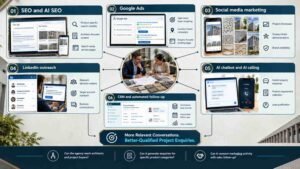
- SEO and AI SEO help relevant buyers discover the company’s products and expertise.
- Website pages and landing pages explain the products and provide clear enquiry options.
- Google Ads and social campaigns promote specific capabilities to relevant audiences.
- LinkedIn marketing helps build visibility among architects, consultants and project professionals.
- Lead generation captures product and project requirements.
- Chatbots and WhatsApp agents provide an immediate first response.
- AI calling and follow-up workflows help maintain contact.
- Lead qualification and CRM processes help the sales team prioritise suitable opportunities.
- Reporting connects marketing activity with commercial progression.
The combination should be tailored to the company’s products, target markets, sales capacity and project cycle. Not every manufacturer needs every service at the same intensity from day one.
Frequently Asked Questions
1. Why do architectural concrete companies need digital marketing?
Architectural concrete manufacturers need digital marketing to make their products and capabilities discoverable to architects, designers, consultants, contractors and developers. SEO, paid advertising, social media and lead generation can help the business reach relevant buyers and create more opportunities for project discussions.
2. How can SEO help architectural concrete manufacturers?
SEO can help manufacturers appear for searches related to their product categories, finishes, applications and manufacturing capabilities. Dedicated product pages and useful technical content can attract visitors who are actively researching architectural concrete suppliers.
3. Which digital marketing channels are useful for architectural concrete businesses?
SEO, Google Ads, LinkedIn, social media, video content and remarketing can all play a role. The right combination depends on the products, target buyers, locations and sales cycle. Website enquiry forms and follow-up systems help convert interest into conversations.
4. How can a manufacturer attract architects and façade consultants online?
Manufacturers can publish product-specific pages, technical information, finish photography, completed project references and design-focused content. LinkedIn campaigns and relevant professional outreach can also help introduce the brand to architects, façade consultants and other specification influencers.
5. Can Google Ads generate enquiries for custom architectural concrete products?
Yes. Google Ads can target relevant searches for custom concrete components, decorative façade products and other specific product categories. Campaigns should use focused landing pages, relevant keywords and enquiry tracking to reduce irrelevant traffic and assess lead quality.
6. How can AI chatbots help architectural concrete manufacturers?
AI chatbots can answer approved general questions, direct visitors to product information, collect initial project details and capture contact information. Technical questions involving structural design, compliance or project-specific suitability should be transferred to qualified employees.
7. How should architectural concrete companies measure lead generation?
They should track relevant enquiries, qualified prospects, technical discussions, quotation requests, sales progression and confirmed orders. Website visits and form submissions are useful indicators, but they do not independently demonstrate commercial success.
8. How does Adsthrive support architectural concrete companies?
Adsthrive offers SEO, AI SEO, Google Ads, social media marketing, lead generation, AI chatbot agents, WhatsApp automation, AI calling and lead qualification. These services can be coordinated around a manufacturer’s product categories and sales process to support discovery, enquiry capture and follow-up.
Turn architectural concrete visibility into project enquiries
Architectural concrete manufacturers compete on more than product availability. Buyers need to see the quality of the finish, understand the application, evaluate the manufacturer’s capability and establish whether the company can support their project.
A website that communicates those details, supported by focused SEO, paid campaigns, professional content and responsive enquiry management, gives potential buyers a clearer reason to start a conversation.
Adsthrive brings these services together through a connected digital marketing and automation approach. Instead of treating SEO, advertising, lead generation and follow-up as separate activities, the strategy can be built around the manufacturer’s actual commercial process.
If your company manufactures architectural precast elements, decorative concrete products, façade components or bespoke concrete features, connect with Adsthrive to discuss a digital growth strategy aligned with your products and target buyers.