An AAC block manufacturing plant may have sufficient production capacity, consistent product quality and competitive pricing, but still miss business because potential buyers cannot find the company when they need a supplier. A contractor searching for bulk AAC blocks, a developer comparing manufacturers or a dealer exploring distribution opportunities may contact whichever company provides the most relevant information first.
For an AAC Block Manufacturer, the opportunity is to make manufacturing capabilities visible to these buyers and give them a straightforward way to enquire. This requires more than a website or occasional social media posts. It requires a customer acquisition strategy connecting search visibility, advertising, professional outreach and enquiry management.
The commercial objective is to attract buyers whose requirements match the company’s products, supply locations and production capabilities.
The Real Customer Acquisition Problem Starts Before the First Enquiry
Consider a manufacturer supplying AAC blocks to residential and commercial construction projects.
The company has a production facility, a product catalogue and an established sales team. However, most new business comes through existing contacts, distributor relationships and referrals.
This creates a dependency.
When an existing dealer reduces purchases or a contractor moves to another supplier, the manufacturer needs new business opportunities. If the company has limited online visibility, finding new buyers becomes dependent on its sales team’s ability to identify and approach prospects manually.
The problem is not necessarily product quality or manufacturing capacity. It may be that potential customers do not know the company exists.
Understand the different buyers in the AAC market
AAC blocks are purchased by different types of customers, and each group evaluates suppliers differently.

| Buyer category | What they typically look for | What can encourage an enquiry |
| Real estate developers | Consistent bulk supply for construction projects | Manufacturing capacity, specifications and commercial quotation |
| Civil contractors | Availability for ongoing site requirements | Product dimensions, delivery timelines and pricing |
| Building material dealers | Wholesale supply and distribution opportunities | Dealer terms, product range and supply consistency |
| Construction companies | Suppliers for multiple projects | Technical information and dependable fulfilment |
| Architects and consultants | Product suitability and technical documentation | Verified specifications and application information |
| Individual property owners | Product availability for smaller construction work | Nearby supplier details and straightforward communication |
A manufacturer should not approach all these audiences with the same advertisement or website message.
A dealer interested in distribution arrangements has different expectations from a contractor who needs 5,000 blocks for an active project.
The first step is therefore to identify which customer categories contribute most to the company’s revenue and which categories it wants to expand.
Why regional demand deserves particular attention
AAC blocks are physical building materials. Their transportation, handling and delivery arrangements influence the commercial viability of an order.
A manufacturer may have a strong product offering, but a buyer located too far from the production facility may find another supplier more economical.
This makes geographical targeting especially important.
For example, a manufacturer operating near Hyderabad might prioritise construction companies, contractors and dealers across commercially viable surrounding markets rather than spending its entire advertising budget targeting buyers across India.
Its online presence should communicate:
- Manufacturing location.
- Actual supply locations.
- Available block dimensions.
- Bulk-order capabilities.
- Delivery arrangements.
- Product specifications.
- Contact details for quotations.
The objective is to attract demand that the business can realistically fulfil.
Capture the Product Searches That Competitors May Be Receiving
A potential buyer does not always search for a company by its brand name.
They may search for a product, specification, supplier, price or manufacturing location.
If your website only targets a broad phrase such as “AAC blocks”, you may miss people searching with much clearer purchasing requirements.
This is where SEO for AAC block manufacturers needs an industry-specific keyword strategy.
What are potential AAC buyers searching for?
The following table identifies search categories that manufacturers should investigate when planning their website and content.
| Search category | Example search query | Likely intent | Recommended content |
| Manufacturer discovery | AAC block manufacturers in India | Supplier discovery | Manufacturer page |
| Local procurement | AAC block manufacturers in Hyderabad | Find a regional supplier | Location-specific page |
| Product availability | AAC blocks 600 x 200 x 150 mm | Check dimensions | Product page |
| Bulk purchasing | AAC blocks bulk order | Purchase planning | Bulk enquiry page |
| Pricing | AAC block price per cubic metre | Compare costs | Quotation information |
| Technical evaluation | AAC block density and compressive strength | Verify product properties | Technical specification page |
| Dealer opportunities | AAC block dealership | Distribution enquiry | Dealer enquiry page |
| Project requirements | AAC blocks for apartment construction | Find project suppliers | Application-focused page |
These are representative keyword opportunities, not verified daily search volumes. Search demand and keyword difficulty must be checked using Google Keyword Planner, Search Console or an SEO research platform before selecting the final targets.
Make product specifications part of your search strategy
AAC buyers frequently evaluate product properties before contacting a supplier.
Important information can include:
- Nominal length, height and width.
- Dry density.
- Compressive strength.
- Thermal conductivity.
- Drying shrinkage.
- Surface finish.
- Product grade.
- Applicable standards and testing documentation.
For Indian manufacturers, the Bureau of Indian Standards provides an important reference through IS 2185 (Part 3), which covers autoclaved cellular aerated concrete blocks. The BIS product manual discusses product classification, dimensions, density and inspection and testing requirements.
A useful product page should explain the specifications your company actually manufactures and supports.
For example, instead of publishing a short description saying that your blocks are lightweight and suitable for construction, provide a technical table showing the available dimensions, verified density range, applicable grade and relevant test documentation.
This helps potential customers evaluate the product without repeatedly contacting the sales team for basic information.
It also gives search engines meaningful, product-specific information to understand.
Build pages around commercial requirements, not just keywords
A manufacturer’s website could include:
| Page | Recommended information | Business objective |
| AAC block products | Product range and dimensions | Product enquiries |
| Bulk supply | Order requirements and supply capabilities | Bulk quotations |
| Dealer opportunities | Distribution requirements | Dealer acquisition |
| Technical specifications | Verified product data and testing information | Technical evaluation |
| Manufacturing facility | Production process and actual capabilities | Supplier credibility |
| Supply locations | Genuine delivery coverage | Regional enquiries |
Each page should have a distinct purpose.
Creating multiple location pages with identical content and only changing city names will not provide meaningful value. A regional page should contain genuine information about the company’s supply coverage, delivery arrangements and local commercial relevance.
How AdsThrive can support this work
AdsThrive can help manufacturers research commercial search terms, optimize product pages, improve website structure and develop content around actual buyer requirements.
Its AI SEO services can complement traditional search optimisation through conversational content, structured information, topical coverage and visibility planning for AI-powered search experiences.
The focus should remain on attracting relevant purchasing searches rather than increasing traffic from unrelated informational keywords.
2. Make Your Website Answer the Questions That Determine Whether a Buyer Contacts You
A buyer who visits a manufacturer’s website is often trying to establish whether the company is worth contacting.
They may already know what AAC blocks are. What they need now is information that helps them shortlist suppliers.
Consider a contractor who needs blocks for a residential project. They visit three manufacturer websites.
- Website A displays product photographs and a general company description.
- Website B provides dimensions, product specifications and manufacturing details.
- Website C provides all of this, along with bulk-order information, supply locations and a direct quotation request option.
Website C makes the evaluation process easier.
That is the difference between a website that merely introduces a manufacturer and one that supports commercial enquiries.
What should a buyer be able to find without calling your office?
Product information: Clearly display the block dimensions, available grades and verified technical properties.
Manufacturing information: Explain your production facility, manufacturing process and actual supply capabilities.
Quality information: Provide relevant testing documentation, product data sheets and applicable certifications.
Commercial information: Explain how customers can enquire about bulk orders, dealer arrangements and project requirements.
Delivery information: Identify the regions you serve and explain how buyers can obtain delivery quotations.
The website does not need to publish confidential pricing or sensitive manufacturing information. It should provide enough information to help a potential customer understand your offering.
Replace the generic contact form with a commercial enquiry form
A basic contact form generally asks for a name, phone number and message.
That information is useful, but it does not tell the sales team much about the potential order.
An AAC manufacturer can collect a few additional details to make the first conversation more productive.
| Form field | Information it helps collect |
| Customer type | Contractor, dealer, developer or other buyer |
| Product requirement | Required AAC block category |
| Dimensions | Desired block size |
| Estimated quantity | Approximate order requirement |
| Project location | Delivery destination |
| Purchase timeline | Immediate or future requirement |
| Additional details | Special specifications or documentation |
Do not make every field compulsory.
A buyer who is still evaluating suppliers may not know the exact quantity. Allowing them to submit an initial enquiry without completing every detail can reduce unnecessary friction.
Create dedicated quotation destinations
Instead of sending every visitor to the same contact page, provide relevant actions throughout the website.
For example:
- A product page can offer a product enquiry.
- A bulk supply page can offer a bulk quotation request.
- A dealer page can offer a distribution enquiry.
- A technical page can offer a request for product documentation.
This gives buyers a clear next step based on what they are looking for.
It also helps the sales team understand why someone contacted the company.
How AdsThrive fits into this strategy: AdsThrive can support website development, landing-page optimisation, conversion-focused content and digital campaign planning. The objective is to connect the visitor’s search or advertisement with a relevant page and a clear enquiry action.
Use Google Ads to Reach Buyers With Immediate Purchasing Requirements
Organic search visibility takes consistent work. Manufacturers who want to test commercial demand in selected locations can also use paid search campaigns.
Google Ads allows a company to appear for relevant searches while potential buyers are looking for manufacturers, suppliers or bulk purchasing options.
However, campaign success depends heavily on targeting.
A manufacturer should not spend its budget attracting every person searching for construction materials. It should focus on the product requirements and locations that match its supply capabilities.
Separate campaigns according to the type of business enquiry
Consider a company that wants to expand both bulk orders and dealer relationships.
These objectives should not be combined into a single generic campaign.
| Campaign type | Example targeting | Advertisement direction |
| Manufacturer enquiries | AAC block manufacturer | Enquire directly with the manufacturer |
| Bulk supply | AAC blocks bulk supplier | Request a bulk quotation |
| Regional demand | AAC blocks supplier in Pune | Check supply availability |
| Dealer acquisition | AAC block dealership | Discuss distribution opportunities |
| Product-specific demand | AAC blocks 100 mm and 150 mm | Enquire about available dimensions |
The advertisement should make the product and intended action clear.
For instance, a bulk supply advertisement can communicate the manufacturer’s actual product range, relevant location and quotation process.
A dealer acquisition advertisement should focus on distribution discussions rather than generic product purchases.
Why location targeting affects campaign profitability
Imagine that a manufacturer receives enquiries from five different cities.
Some locations are close to its factory and have established transportation arrangements. Others are significantly farther away.
Even if the distant enquiries are genuine, transportation expenses may make those orders less competitive.
A manufacturer should evaluate:
- Distance from its manufacturing facility.
- Transportation availability.
- Order quantity.
- Delivery feasibility.
- Expected commercial value.
- Competition from local suppliers.
This information can guide geographical campaign targeting.
The goal is not to attract the largest possible number of enquiries. It is to attract enquiries that the business can commercially serve.
What should the manufacturer measure?
Google Ads reports should go beyond impressions and clicks.
Track:
- Actual enquiry submissions.
- Phone calls and WhatsApp enquiries.
- Search terms that generated enquiries.
- Cost per enquiry.
- Cost per qualified enquiry.
- Quotations generated.
- Orders associated with advertising campaigns.
A campaign that produces 30 irrelevant enquiries may be less valuable than one that generates eight genuine bulk requirements.
AdsThrive’s Google Ads and PPC services and performance marketing services can support campaign planning, audience targeting, advertising and performance optimisation.
The manufacturer should also ensure that conversion tracking is configured correctly so that form submissions, calls and other meaningful enquiries can be evaluated separately.
Build Business Relationships Through LinkedIn and Targeted Outreach
Not every buyer discovers a manufacturer through Google.
Construction companies may identify suppliers through professional recommendations, procurement networks, project discussions and existing business relationships.
LinkedIn provides another way for manufacturers to reach relevant decision-makers.
For AAC companies, the platform can be used to identify people and organisations involved in construction material purchasing and distribution.
Which professionals should manufacturers approach?
| Professional audience | Possible business opportunity |
| Real estate developers | Project-based bulk supply |
| Procurement managers | Supplier evaluation |
| Civil contractors | Ongoing construction requirements |
| Construction company owners | Long-term supply discussions |
| Building material dealers | Distribution partnerships |
| Architects and consultants | Product awareness and technical discussions |
| Project managers | Upcoming material requirements |
The outreach should be based on the recipient’s professional relevance.
Sending the same promotional message to hundreds of unrelated profiles is unlikely to create meaningful business conversations.
What should a LinkedIn outreach message communicate?
A short, relevant introduction is generally more appropriate than a long sales pitch.
For example:
Hello,
We are an AAC block manufacturer supplying building material requirements for residential and commercial construction projects.
We would be glad to share our product specifications and discuss potential supply requirements for your upcoming projects.
Please let us know if this would be relevant to your current or future procurement needs.
The purpose is to start a conversation.
If the recipient is interested, the manufacturer can share its catalogue, technical documents and commercial information.
Use social media to demonstrate manufacturing credibility
LinkedIn outreach becomes more useful when the company also has a credible online presence.
A procurement professional who receives a message may visit the company’s profile or website before responding.
Manufacturers should publish content that demonstrates their actual business operations.
Examples include:
- Manufacturing facility videos.
- Product dimension explanations.
- Quality-testing activities.
- Finished-product dispatches.
- Manufacturing capacity updates.
- Product application demonstrations.
- Dealer and distribution announcements.
- Technical information for construction professionals.
Instagram and Facebook can support brand familiarity, while LinkedIn is particularly useful for professional communication.
YouTube can be used for longer factory walkthroughs, product demonstrations and technical explanations.
Avoid treating social media as a daily poster requirement
A manufacturer’s social media strategy should be connected to specific commercial objectives.
A post about available block dimensions should help buyers understand the product. A manufacturing video should demonstrate actual production operations. A dealer-focused campaign should direct interested distributors to an appropriate enquiry page.
AdsThrive can support social media planning, creative development, campaign management and professional audience targeting as part of its broader customer acquisition services.
Give Buyers Technical Reasons to Trust Your Manufacturing Business
In building material procurement, a supplier’s marketing claims are not enough.
Buyers may need to evaluate whether the product meets the technical requirements of their project.
This is an opportunity for manufacturers to use technical information as a commercial advantage.
Present specifications with supporting information
A manufacturer should avoid describing every AAC product simply as lightweight, durable or energy-efficient.
Instead, provide measurable information supported by appropriate product documentation.
For example:
| Product information | What to communicate |
| Dimensions | Actual available nominal sizes |
| Density | Verified product density range |
| Compressive strength | Tested values and applicable grade |
| Thermal conductivity | Verified test information |
| Drying shrinkage | Relevant test results |
| Quality standards | Applicable standards and certification details |
| Surface finish | Available product finish |
| Testing documentation | Relevant reports and product data sheets |
The BMTPC and CBRI building technology compendium provides technical information about AAC walling systems, including dimensions, density and construction-related properties.
Manufacturers can use such authoritative references to understand the technical context, but their own product claims must be supported by their own test results.
Turn technical information into useful website content
Instead of publishing only one general product page, consider answering specific buyer questions through dedicated content.
Examples:
- What AAC block dimensions are available for different wall requirements?
- What is the difference between block density and compressive strength?
- Which technical documents should a buyer request from an AAC supplier?
- How should AAC blocks be stored before installation?
- What information should a contractor provide when requesting a bulk quotation?
These topics help potential customers understand the product and give the manufacturer’s website more meaningful industry coverage.
Publish content that your sales team can actually use
Technical content should not exist only to attract search traffic.
Your sales representatives should be able to share a product specification page or testing document when a buyer asks about quality.
A well-maintained technical resource section can reduce repeated explanations and make the company’s communication more consistent.
This is also an opportunity to build trust before a buyer requests a quotation.
Convert Website Traffic Into Qualified Commercial Enquiries With AI
Generating enquiries is only one part of customer acquisition.
The next challenge is understanding which enquiries deserve immediate attention and ensuring that potential customers receive a response.
Consider a manufacturer that receives the following messages through its website and WhatsApp account:
Enquiry A
“We need 10,000 AAC blocks for a residential project. Please share the quotation.”
Enquiry B
“We are interested in becoming a distributor in our district.”
Enquiry C
“Please send the product catalogue.”
All three are genuine enquiries, but they represent different commercial opportunities.
Enquiry A may require an immediate discussion with the bulk sales team. Enquiry B needs a distribution conversation. Enquiry C may be at an early product research stage.
If all three are simply stored as phone numbers in a spreadsheet, the sales team has to identify the differences manually.
How AI Lead Qualification can improve enquiry handling
An AI-powered qualification system can collect relevant information and categorise enquiries according to the manufacturer’s predefined sales requirements.
For an AAC business, the qualification process can consider:
| Qualification detail | Why it is useful |
| Buyer category | Identifies the type of customer |
| Product interest | Establishes which AAC product is required |
| Dimensions | Helps identify the required specification |
| Estimated quantity | Indicates the approximate order size |
| Project location | Helps assess supply feasibility |
| Project type | Provides construction context |
| Purchase timeline | Identifies the expected buying stage |
| Additional requirements | Captures documents or commercial questions |
The system can use this information to identify enquiries that need immediate sales attention.
It should not independently approve technical suitability, determine final pricing or make unsupported promises about product availability.
Use an AI Chatbot to answer initial product enquiries
Imagine someone visiting your website outside business hours.
They want to know whether your company manufactures 100 mm AAC blocks, whether bulk orders are accepted and how they can obtain a quotation.
If the only available option is a contact form, the visitor may leave without making an enquiry.
An AI chatbot can provide an additional way to engage that visitor.
For example:
Visitor: Do you manufacture 100 mm AAC blocks?
AI Assistant: Our product information lists the available dimensions. Would you like to view the specifications?
Visitor: Yes, and I also need a quotation.
AI Assistant: Certainly. Could you share your project location and approximate quantity?
Visitor: Around 4,000 blocks in Chennai.
AI Assistant: Thank you. I can record these details for the sales team to review your requirements.
The conversation gives the manufacturer more useful information than a basic website visit.
AdsThrive’s AI Chatbot Agent can support website conversations, enquiry capture, knowledge-base-based responses and human handoff.
Its knowledge base should contain approved product information and clearly distinguish between questions the AI can answer and those requiring a technical or commercial representative.
Use WhatsApp AI to continue conversations
Many construction businesses prefer WhatsApp for sharing product catalogues, quotations, photographs and other documents.
A WhatsApp AI Agent can support the initial enquiry conversation and collect relevant details.
For example, a dealer interested in distribution can be asked about:
- Business location.
- Existing building material operations.
- Areas of distribution.
- Interest in wholesale supply.
- Preferred contact time.
The system can then pass the collected information to the appropriate sales representative.
AdsThrive’s WhatsApp AI Agent can form part of this communication process.
The purpose is to make it easier for buyers to begin a conversation without requiring the sales team to manually respond to every initial question.
AI Calling can support follow-ups
A potential customer may submit a bulk enquiry and then become unavailable when the sales representative calls.
Another buyer may request a quotation but need time to discuss it internally.
A third may enquire about dealership opportunities and expect a discussion later.
An appropriately configured AI calling workflow can support activities such as:
- Acknowledging and following up on new enquiries.
- Confirming basic requirements.
- Asking for missing information.
- Arranging a callback.
- Reminding prospects about agreed next steps.
- Scheduling sales discussions.
AdsThrive’s AI Calling Solution can support outbound calling and configured business workflows, including prospect qualification and appointment coordination.
Automated communication should respect consent and applicable privacy and communication requirements. Buyers should also have a clear route to speak with a human representative.
“Discover how digital marketing can help architectural concrete companies boost visibility, attract quality leads, and drive business growth.”
Keep follow-ups connected with CRM
An enquiry should not disappear after the first conversation.
A structured CRM process can maintain the prospect’s details and current status.
For example:
| CRM stage | Sales activity |
| New enquiry | Review incoming details |
| Requirement confirmed | Identify product and quantity |
| Technical discussion | Share relevant documents |
| Quotation preparation | Calculate commercial requirements |
| Quotation sent | Record the quotation and next action |
| Negotiation | Track buyer feedback |
| Order confirmed | Record the business outcome |
| Future requirement | Schedule an appropriate reminder |
AdsThrive also offers AI Follow-ups and Reminders and AI Booking Systems, which can complement enquiry management and sales coordination.
This creates a more organised process from the initial enquiry to the next sales action.
Measure Marketing by Orders and Commercial Opportunities, Not Website Visits
A manufacturer may receive 5,000 website visitors in a month and still struggle to generate meaningful enquiries.
Another manufacturer may receive considerably fewer visitors but attract more relevant contractors, dealers and bulk buyers.
The difference is the quality of the audience and how effectively the website converts their interest into business conversations.
This is why SEO for AAC block manufacturers should be evaluated through commercial performance rather than rankings alone.
Create a reporting system that connects marketing with sales
The marketing and sales teams should work with a common understanding of what counts as a qualified enquiry.
For example, an enquiry might be considered commercially relevant when:
- The customer needs a product the company manufactures.
- The project is within a feasible supply area.
- The estimated requirement is commercially relevant.
- The buyer has a genuine purchasing or distribution requirement.
- The sales team can take the conversation forward.
The exact definition should be decided by the manufacturer.
What should management review every month?
| Metric | Business question it answers |
| Organic enquiries | Is search visibility generating contacts? |
| Commercial keyword rankings | Are relevant supplier searches improving? |
| Paid campaign enquiries | Are advertisements generating demand? |
| Qualified leads | Are enquiries relevant to the business? |
| Bulk quotation requests | Are larger purchasing opportunities coming in? |
| Dealer enquiries | Is the distribution network expanding? |
| Cost per qualified lead | Is customer acquisition spending efficient? |
| Quotation-to-order rate | Are opportunities converting into business? |
| Revenue by source | Which marketing channels contribute to sales? |
An example of why lead quality matters
Consider a hypothetical campaign report:
| Sales pipeline stage | Number |
| Total enquiries | 50 |
| Relevant enquiries | 18 |
| Quotations issued | 10 |
| Confirmed orders | 3 |
These are illustrative figures, not industry averages or AdsThrive results.
The report gives management a better understanding of performance than a traffic report alone.
If the company receives many enquiries but few are relevant, the targeting or messaging may need improvement.
If relevant buyers receive quotations but do not place orders, the business should investigate pricing, product availability, transportation costs, payment terms and follow-up quality.
Marketing reports should help management make decisions, not simply demonstrate that campaigns are active.
Compare channels using the same commercial outcome
SEO, Google Ads, LinkedIn and social media do not necessarily produce enquiries in the same way.
Organic search may attract buyers actively comparing suppliers. LinkedIn may introduce the company to a developer who has an upcoming project. Social media may help a dealer become familiar with the manufacturer’s products.
Evaluate each channel based on its contribution to qualified opportunities and eventual orders.
This makes budget allocation more practical.
Select a Marketing Partner That Understands the Commercial Side of Manufacturing
A manufacturing company should not select a marketing partner based only on promises of first-page rankings or a fixed number of monthly leads.
The agency must understand the relationship between products, purchasing requirements, regional markets and sales operations.
For example, an agency promoting an AAC manufacturer should know the difference between attracting someone researching AAC block properties and attracting a contractor looking for a supplier for an active project.
The two searches may look related, but their commercial intent is different.
What should manufacturers evaluate before selecting an agency?
Industry understanding
The agency should understand how construction companies, dealers, contractors and developers evaluate material suppliers.
Commercial keyword research
It should identify manufacturer, supplier, bulk purchase, pricing and location-based searches rather than focusing only on broad product keywords.
Website and landing-page capabilities
The agency should be able to improve product presentation, enquiry forms, quotation destinations and website conversion paths.
Paid advertising experience
It should understand how to target relevant locations, manage campaign budgets and evaluate the quality of incoming enquiries.
Lead management and automation
It should be capable of connecting marketing campaigns with enquiry qualification, WhatsApp conversations, follow-ups and CRM workflows.
Performance reporting
The company should receive understandable reports covering search visibility, campaign spending, qualified leads, quotations and business opportunities.
Why an integrated approach matters
When a manufacturer hires separate providers for SEO, advertisements, social media, chatbots and follow-up systems, the activities may become disconnected.
For example, the advertising team generates an enquiry, but the sales team does not know which campaign produced it.
The website receives a buyer’s requirement, but the information is not transferred to the CRM.
A quotation is sent, but nobody records the next follow-up.
These problems are not necessarily caused by poor advertising. They can result from gaps between marketing and sales operations.
AdsThrive approaches this through a combination of search optimisation, paid campaigns, lead generation and AI-powered business automation.
Its digital marketing and growth solutions can be considered by manufacturers looking to connect customer acquisition with enquiry management.
Professional SEO services for AAC block manufacturers should ultimately be evaluated on their ability to improve relevant search visibility and support the company’s commercial objectives.
How to Bring These Strategies Together Without Wasting Your Marketing Budget
A manufacturer does not need to launch every channel at once.
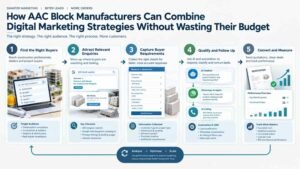
The order of implementation should depend on the current condition of the website, available budget, sales capacity and business priorities.
A company with an outdated website may need to improve its product pages before investing heavily in advertising.
A manufacturer with a well-established website but limited enquiries may need to investigate keyword visibility and paid search opportunities.
A business receiving enquiries but failing to follow up consistently may benefit more from automation and CRM improvements.
A practical implementation plan
| Implementation stage | Priority activity | Expected business contribution |
| Stage 1 | Website and product-page improvements | Make manufacturing capabilities easier to evaluate |
| Stage 2 | Commercial keyword research and SEO | Improve relevant search visibility |
| Stage 3 | Google Ads campaigns | Test active purchasing demand |
| Stage 4 | LinkedIn and social media outreach | Reach additional business audiences |
| Stage 5 | AI enquiry qualification | Organise incoming requirements |
| Stage 6 | WhatsApp, calling and follow-up automation | Improve enquiry handling |
| Stage 7 | CRM and sales reporting | Measure commercial performance |
These stages can overlap where the business is ready. They are not fixed timelines.
What should the marketing budget prioritise?
Budget allocation should be based on actual business needs.
| Business situation | Initial priority |
| Website receives little relevant traffic | Technical SEO and commercial keyword targeting |
| Website receives traffic but few enquiries | Product pages and conversion improvements |
| Immediate demand generation is required | Targeted Google Ads |
| Dealer network expansion is the priority | Regional outreach and dealer campaigns |
| Enquiries are being missed | AI chatbot, WhatsApp and follow-up automation |
| Marketing produces leads but few orders | Lead-quality analysis and sales-process improvements |
The most effective combination is the one that addresses the manufacturer’s current bottleneck.
Digital marketing for AAC block manufacturers should therefore be planned around the company’s actual customer acquisition requirements, rather than a predetermined list of marketing activities.
Frequently Asked Questions
1. How can AAC block manufacturers get more bulk orders online?
Manufacturers can attract bulk orders by improving their visibility for commercial supplier searches, publishing detailed product specifications, running location-targeted Google Ads and creating dedicated bulk enquiry pages.
The website should communicate available dimensions, product grades, supply locations and the process for requesting a quotation. AI-based enquiry qualification can also help collect estimated quantities and project details before the sales team responds.
2. Which keywords should AAC manufacturers target?
Manufacturers should target keywords covering different stages of the purchasing process.
Examples include:
- AAC block manufacturer.
- AAC block suppliers near me.
- AAC blocks wholesale price.
- AAC blocks bulk order.
- AAC block manufacturers in India.
- AAC block dealership.
- AAC block dimensions.
- AAC block density.
- AAC blocks for construction projects.
The final keyword list should be based on actual search demand, competition, geographical relevance and the company’s products.
3. Can Google Ads generate enquiries for AAC block manufacturers?
Yes. Google Ads can help manufacturers reach buyers searching for suppliers, bulk orders, product prices and regional availability.
Campaigns should be separated according to the intended enquiry type. A bulk-order campaign should have different messaging and a different landing page from a dealership campaign.
Manufacturers should track qualified enquiries and quotations rather than relying only on clicks and impressions.
4. How can manufacturers attract construction companies and builders through LinkedIn?
Manufacturers can identify procurement managers, construction company owners, project managers, contractors and real estate developers through LinkedIn.
Relevant company introductions, product information, manufacturing updates and personalised outreach can help initiate business discussions.
The approach should focus on professional relevance rather than sending identical promotional messages to large numbers of users.
5. How does AI help manufacturers handle incoming enquiries?
AI can assist with initial customer conversations, product-related questions, enquiry collection, lead classification and follow-up reminders.
For example, a chatbot can collect the buyer’s required block dimensions, estimated quantity, project location and preferred purchasing timeline.
The information can then be shared with the appropriate sales representative for technical and commercial review.
6. What information should an AAC manufacturer include on its website?
A manufacturer should provide:
- Product dimensions and specifications.
- Available product grades.
- Verified quality and testing information.
- Manufacturing facility details.
- Actual production and supply capabilities.
- Delivery locations.
- Bulk-order information.
- Dealer enquiry details.
- Contact information and quotation options.
These details help buyers assess the manufacturer before initiating a commercial discussion.
7. How long does SEO take to generate enquiries?
SEO timelines vary according to website quality, existing search visibility, competition, keyword demand and the amount of optimisation required.
Paid advertising can help test demand while organic search visibility develops.
Manufacturers should monitor search impressions, relevant website visits, enquiries and qualified opportunities to understand whether the strategy is progressing.
8. How should manufacturers choose a digital marketing partner?
A manufacturer should evaluate the agency’s experience with B2B marketing, commercial keyword research, website optimisation, paid advertising and lead management.
It should also understand how marketing connects with the sales process, including enquiry qualification, follow-ups and reporting.
A suitable partner should be able to explain how its activities contribute to relevant business opportunities, rather than promising rankings or enquiry numbers without understanding the manufacturer’s requirements.
A More Consistent Way to Win New Manufacturing Customers
An AAC manufacturing business should not have to depend entirely on existing dealers, referrals or occasional project enquiries to find new customers.
Its website can become an important business-development asset when buyers can discover its products, evaluate its manufacturing capabilities and request quotations without unnecessary difficulty.
A focused SEO for AAC block manufacturers strategy can improve the company’s visibility for relevant supplier searches. Paid advertising can capture active purchasing demand, while LinkedIn and social media can introduce the manufacturer to additional business audiences.
The next step is ensuring that incoming enquiries are handled properly.
AdsThrive combines search optimization, paid advertising, social media marketing, lead generation and AI-powered automation to support this process.
Its AI Lead Qualification, WhatsApp AI Agent, AI Chatbot, AI Calling and automated follow-up capabilities can help manufacturers organise incoming enquiries and support their sales teams.
For manufacturers looking to expand their customer base, lead generation for AAC block manufacturers should be connected with the actual products, locations and order requirements the company can fulfil.
Choosing a digital marketing agency for AAC block manufacturers should therefore be about finding a partner that understands both customer acquisition and the commercial realities of manufacturing.
Explore AdsThrive to discuss a digital growth strategy for your manufacturing business.