Why fire-safety companies need a different kind of digital strategy
A Fire Fighting Equipment is rarely purchased because someone likes its appearance. A project consultant may specify a sprinkler system, an EPC contractor may request a hydrant package, a facility manager may need replacement extinguishers, and an industrial buyer may evaluate a specialised suppression system. Each buyer has a different requirement, purchasing timeline and set of technical questions.
That creates a specific marketing challenge: a company may manufacture reliable products but still remain invisible when a project team searches for the exact equipment it supplies.
The commercial answer is to build a digital acquisition system around product categories, project specifications, buyer industries and enquiry readiness. Search visibility brings the right people to the website; technical content gives them reasons to consider the company; paid campaigns and professional outreach create additional demand; and AI-powered enquiry handling helps sales respond before an opportunity goes cold.
For fire-safety businesses, this is more useful than simply publishing general fire-safety articles or running advertisements that generate unqualified phone numbers.
The buying process is the real marketing map
A fire protection purchase can involve several people:
- Architects and MEP consultants who review building requirements and technical specifications.
- Fire protection consultants who evaluate system suitability and design requirements.
- EPC contractors and system integrators who source products for a project.
- Procurement teams that compare approved makes, quantities, delivery and commercial terms.
- Facility and maintenance managers who arrange replacement, servicing or upgrades.
- Industrial safety teams responsible for equipment requirements at factories, warehouses and high-risk facilities.
- Distributors and dealers looking for manufacturers and supply partners.
These audiences do not necessarily search using the same words. A consultant may search for a technical standard or system configuration. A contractor may search for a manufacturer, supplier or quotation. A facility manager may search for a replacement product or maintenance support.
A digital strategy must recognise these differences. If every visitor is sent to the same generic page, the company loses the opportunity to address the reason that visitor came to the website.
What the Indian market tells manufacturers
The Indian fire protection market is not one uniform product category. A 2025 draft prospectus filed with SEBI, drawing on CRISIL Intelligence research, describes a market divided across sprinkler-based systems, hydrant-based systems, extinguishers, foam equipment and gas-based systems. Its FY2025 estimates put sprinkler-based products at 27% of the fire suppression segment, hydrant-based products at 26%, and extinguishers at 22%.
That segmentation has a direct marketing implication: a manufacturer should not expect one broad page to represent every product line equally well. A company supplying hydrant valves, hose reels and fire monitors needs a different product story from a company supplying clean-agent suppression systems or fire alarm panels.
The opportunity is to organise marketing around the actual products and applications that the company wants to sell.
Give every important product category its own route to an enquiry
One of the most common problems on industrial websites is that a large catalogue is compressed into a single Products page. The company may list extinguishers, hydrant accessories, sprinkler components, fire pumps, alarms and suppression systems, but the buyer has to work out which products are relevant.
A better website structure makes each commercial category easy to discover.
For example:
| Main category | Product-level pages to consider | Typical buyer |
| Fire extinguishers | ABC, CO₂, foam, water-based, clean-agent and trolley-mounted products | Facility manager, dealer, procurement |
| Hydrant systems | Landing valves, hose reels, hose boxes, hoses, couplings and monitors | EPC contractor, MEP consultant |
| Sprinkler systems | Sprinkler heads, alarm valves, flow switches and accessories | Fire protection contractor |
| Fire detection | Control panels, smoke detectors, heat detectors and manual call points | Consultant, system integrator |
| Fire suppression | Foam, gas-based, water-mist and specialised suppression products | Industrial project team |
| Fire pumps | Electric, diesel and jockey pumps, controllers and accessories | MEP contractor, project procurement |
| Safety equipment | Fire blankets, protective clothing and related accessories | Industrial safety team |
The categories above are examples. A company should publish pages only for products it genuinely manufactures, distributes or supports.
What should a product page actually contain?
A useful page should answer the questions a buyer needs to resolve before making contact:
- What is the product and what is its intended application?
- Which variants, sizes or configurations are available?
- What technical information can the company provide?
- Which relevant standards or approvals apply to the product?
- Is the product intended for a new installation, replacement or project supply?
- What documentation can be shared?
- Can the company support bulk or project-based requirements?
- What information should the buyer submit to request a quotation?
For example, a hydrant-system component page should not stop at a product photograph and a sentence saying that the product is high quality. It can explain available component types, relevant connection details, materials, product documentation and the information required for a project quotation.
Similarly, a fire alarm page should help buyers understand the product range and compatibility considerations. It should not imply that every detector, panel or accessory works with every system.
This product architecture is a foundation of SEO for fire fighting equipment companies because it gives search engines and potential customers clearer destinations for specific requirements.
It also gives paid campaigns somewhere relevant to send traffic. A search for a particular fire pump should lead to a fire pump page, not a homepage where the visitor has to search through the catalogue.
Turn compliance information into buyer confidence—not unsupported claims
Fire protection is a technical and safety-sensitive category. Buyers may need to evaluate standards, test documentation, product certification, installation requirements and compatibility before considering a supplier.
That means technical credibility should be part of the website’s conversion strategy.
The Bureau of Indian Standards overview of the National Building Code explains that NBC 2016 is a model code covering building requirements, including fire and life safety. The Directorate General of Fire Services also explains that the National Building Code provides fire-safety guidance that states are advised to incorporate into local building bye-laws.
For a manufacturer, this does not mean writing a generic article claiming that every product is NBC-compliant. It means helping buyers find accurate, product-specific information.
Build a technical evidence section
Depending on the product and the company’s actual documentation, a page can include:
- Applicable Indian Standard or other relevant specification.
- Product datasheet and model details.
- Test reports or certification documents, where available.
- Manufacturing and quality-control information.
- Installation or operating documentation, where within the company’s scope.
- Product limitations and compatibility notes.
- Available variants and accessories.
- Contact details for technical clarification.
A useful example is portable fire extinguishers. BIS identifies IS 15683:2018 as the specification for portable fire extinguishers in its product-certification information. The company should make sure any claim about its own product is supported by the relevant certificate, mark and product documentation; simply mentioning an IS number on a page is not proof of certification.
For another example, BIS lists IS 2190:2024 as the code of practice for selection, installation and maintenance of portable and mobile first-aid fire extinguishers. That subject can support a useful educational resource explaining the distinction between manufacturing a product and selecting, installing or maintaining it under the applicable guidance.
Make documentation accessible to genuine buyers
A technical document can become a lead-generation asset when it is presented properly.
Instead of hiding all documentation behind a generic contact form, consider a clear structure:
- Product overview available publicly.
- General technical information available on the page.
- Relevant downloadable documents where authorised.
- A request option for additional model-specific documentation.
- A technical enquiry form for project-specific questions.
The form can ask for the product category, project type, quantity, location and the document required. This gives the sales or technical team a more useful starting point.
Important: Never use marketing copy to imply that a product has a certification, approval, test result or performance rating that the manufacturer cannot substantiate. In this industry, inaccurate claims can damage trust much faster than they can improve conversion.
Build project-specific landing pages around the buyer’s application
A product category explains what a company supplies. An application page explains why a buyer might need it.
This distinction creates a different kind of search opportunity.
A manufacturer supplying fire protection products may serve:
- Manufacturing plants
- Warehouses and logistics facilities
- Hospitals and healthcare buildings
- Hotels and commercial properties
- Data centres
- Educational institutions
- Oil, gas and petrochemical facilities
- Infrastructure and transport projects
The product requirement can vary by occupancy, hazard, asset sensitivity, system design and project specification. The National Building Code and applicable local requirements should be reviewed by the responsible professionals; marketing pages should not attempt to replace fire engineering or statutory advice.
Example: Build an industrial project page
A page targeting industrial fire protection requirements could cover:
The buyer’s context: A factory or industrial facility is planning a new installation, expansion or system upgrade.
Relevant product categories: Depending on the company’s genuine supply scope, this may include hydrant equipment, sprinkler components, fire pumps, alarms or specialised suppression products.
What the buyer needs to evaluate: Product availability, technical documentation, system compatibility, applicable standards, quantities, delivery location and project timeline.
The next action: Share the BOQ, product list or project requirement for review.
Example: Build a warehouse and logistics page
A warehouse project may involve a different combination of products and procurement questions. The page could explain the company’s relevant equipment range, the information needed to prepare a quotation and how the team handles project-based supply.
It should not claim that one standard equipment package is suitable for every warehouse. The design depends on the actual building, stored materials, hazard classification and professional fire-protection assessment.
Why application pages matter commercially
They give the company a way to reach buyers before the buyer has selected a specific product model.
They can also support account-based campaigns. For instance, a LinkedIn campaign targeting warehouse developers can direct visitors to a warehouse-specific page, while a Google Ads campaign targeting fire pump searches can lead to the relevant product page.
The content is different because the visitor’s problem is different. This helps prevent the website from becoming a collection of near-identical pages created only to accommodate keyword variations.
Use search data to find the enquiries competitors may be capturing
Keyword research should not stop at broad phrases such as “fire fighting equipment” or “fire safety products”. Those terms are useful, but they do not show the full range of commercial demand.
The research should identify how buyers describe a product, a project, a supplier requirement and a technical problem.
Search opportunities that deserve dedicated coverage
| Buyer search type | Example search | Useful destination |
| Manufacturer search | fire extinguisher manufacturer India | Manufacturer or category page |
| Product search | fire hydrant valve supplier | Product page |
| System search | industrial sprinkler system components | System category page |
| Technical search | fire pump controller specifications | Technical product page |
| Project search | fire fighting equipment for warehouse project | Application page |
| Procurement search | fire safety equipment bulk quotation | RFQ landing page |
| Dealer search | fire extinguisher dealership or distributor enquiry | Dealer/distributor page |
| Replacement search | replacement fire alarm control panel | Product or upgrade page |
| Specialised application | clean agent suppression for data centre | Application and solution page |
| Documentation search | portable fire extinguisher IS 15683 | Standards/documentation resource |
These are illustrative keyword themes, not verified daily search volumes. Use Google Search Console, Keyword Planner and paid-search term reports to confirm actual demand, location, competition and conversion potential before assigning targets.
Make Google Ads work at the product and project level
Organic search can build long-term visibility, but it may not deliver immediate enquiries for a new product range, a new market or a campaign with a specific sales target.
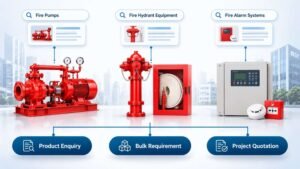
Google Ads can capture existing demand while the organic strategy develops.
The key is to separate campaigns by the type of enquiry the business wants.
Campaign A: Product-specific searches
Examples include:
- Fire extinguisher manufacturer
- Fire hydrant equipment supplier
- Fire pump manufacturer
- Fire sprinkler system components
- Fire alarm control panel supplier
Each campaign should lead to the closest matching product page.
Campaign B: Project and bulk requirements
These campaigns can target buyers looking for equipment for a factory, warehouse, commercial building or infrastructure project.
The landing page should explain the company’s relevant supply scope and allow the buyer to share a BOQ or itemised requirement.
Campaign C: Dealer and distribution enquiries
If the company wants regional dealers or channel partners, that should be a separate campaign. A dealer prospect needs information about product range, territory, commercial terms and the process for becoming a partner—not the same page used by a project procurement team.
Campaign D: Retargeting
A visitor may review a product page, download a datasheet and leave without contacting the company. Retargeting can bring the company back into consideration with a relevant message, such as requesting a product catalogue or discussing a project requirement.
What should be measured?
Do not optimise only for clicks or low-cost form submissions. Track:
- Search terms that generated enquiries.
- Product category selected by the visitor.
- Number of project or bulk enquiries.
- Number of dealer enquiries.
- Qualified enquiry rate.
- Cost per qualified enquiry.
- Sales discussions and quotations generated.
A campaign that produces fewer but more relevant project enquiries may be more valuable than one producing a large volume of generic forms.
Use LinkedIn to reach the people who influence specifications and purchasing
Not every project opportunity starts with a Google search. A consultant may already be preparing a building specification. An EPC contractor may be preparing a tender response. A procurement manager may be shortlisting manufacturers before the final BOQ is issued.
LinkedIn can help a fire protection business reach these professionals before they submit a formal enquiry.
The objective should not be to send mass messages saying, “We are a leading fire safety company.” The objective is to introduce a relevant capability to a relevant professional.
Build audiences around actual project roles
Depending on the company’s products and sales model, target audiences may include:
- MEP consultants and fire protection consultants.
- EPC and MEP contracting companies.
- Project procurement managers.
- Industrial facility and plant managers.
- Warehouse and logistics developers.
- Data-centre project teams.
- Fire safety officers and facility managers.
- Dealers, distributors and system integrators.
The audience should be narrowed by industry, geography, company size and role. A manufacturer selling specialised suppression systems may need a different audience from a business selling portable extinguishers through dealers.
Use capability-led outreach
A useful introduction can mention a specific product category, application or technical capability, then offer a relevant next step.
For example:
We supply fire hydrant and sprinkler-system components for commercial and industrial project requirements. If your team is currently evaluating suppliers, we can share our product range and relevant technical documentation for review.
The message should be truthful and specific to the company’s actual offering. It should not claim that the manufacturer is approved by a consultant, listed on a project or certified by an authority unless that is documented.
LinkedIn content can support outreach through:
- Product and manufacturing capability updates.
- Technical explainers.
- New product or range announcements.
- Project supply capabilities.
- Relevant certification and documentation updates.
- Case studies with permission and substantiated details.
- Short videos showing manufacturing, inspection or product features.
This is where social media marketing and professional outreach can support each other. The profile and content help validate the company after a prospect receives an introduction.
Connect lead generation with AI enquiry qualification and follow-up
A fire-safety company can attract the right visitor and still lose the opportunity if the enquiry process is slow or unclear.
Imagine a contractor submitting a BOQ for hydrant valves, hose reels and sprinkler accessories. The sales team receives a short message saying, “Please send a quotation.” Someone must then call the buyer, identify the project, clarify quantities, ask for the delivery location and collect missing information.
That manual process takes time. If several enquiries arrive together, some may wait too long for a response.
Lead generation for fire fighting equipment companies should therefore include the process that happens after the form is submitted.
Ask questions that help sales understand the requirement
An enquiry form or AI assistant can collect relevant details such as:
| Enquiry field | Why it helps |
| Product category | Identifies the correct sales or technical team |
| Product or model requirement | Clarifies what the buyer is asking for |
| Quantity or BOQ | Indicates the scale of the requirement |
| Project type | Separates project procurement from replacement or dealer enquiries |
| Project location | Helps establish delivery and service requirements |
| Required documentation | Identifies datasheets, certificates or technical details requested |
| Purchase timeline | Helps prioritise follow-up |
| Company and contact role | Provides useful business context |
Not every buyer will know all the details. The form should allow a partial enquiry, with the AI assistant asking only the most useful follow-up questions.
Use AI chat for immediate first responses
A website visitor may want to know whether a particular product category is available, request a catalogue or ask how to submit a BOQ.
An AI chatbot agent can provide an initial response, collect basic details and route the conversation to the appropriate team. It should not provide engineering approvals, make product suitability decisions or invent technical specifications. Those questions should be escalated to qualified personnel.
Make WhatsApp part of the enquiry journey
Some buyers prefer WhatsApp because it makes it easy to share a product list, BOQ extract, site details or reference document.
An AI WhatsApp agent can help acknowledge a new enquiry, ask for missing information and route the conversation. For example, it can distinguish between a dealer asking for a product catalogue and a contractor requesting a project quotation.
Follow up when the buyer does not respond
A quotation request may not convert immediately. The buyer may be comparing suppliers, waiting for a consultant’s clarification or obtaining internal approval.
An automated follow-up process can remind the sales team to reconnect at an appropriate time. AI follow-up automation can support reminders and communication sequences, while AI calling can assist with initial contact or follow-up where the buyer has provided the appropriate contact details and consent.
The important distinction is that automation should support the sales team, not replace technical review or pressure a buyer with repetitive calls.
Route qualified enquiries to the right person
A business supplying several product categories may need different sales owners for extinguishers, hydrant equipment, alarms and specialised suppression systems. A qualified enquiry should reach the person who can respond accurately.
For example:
- Dealer enquiry → Channel sales.
- Project BOQ → Project sales.
- Technical documentation request → Product or technical team.
- Replacement requirement → Service or product sales.
- Large industrial requirement → Relevant project specialist.
Adsthrive’s AI lead qualification can form part of this workflow by collecting and organising enquiry details before the sales handover.
This is the point at which marketing begins to function as a connected commercial operation rather than a collection of disconnected campaigns.
The commercial search terms worth building around
The five supporting keywords should serve two different objectives: reaching businesses already looking for a marketing partner and reaching fire-safety companies that need more enquiries.
| Search objective | Keyword | Intent |
| Find an SEO partner | SEO services for fire fighting equipment companies | High commercial |
| Find an agency | Digital marketing agency for fire fighting equipment companies | High commercial |
| Understand the service | Digital marketing for fire fighting equipment companies | Commercial |
| Solve an enquiry problem | Lead generation for fire fighting equipment companies | Problem + commercial |
| Find a specialist | SEO for fire fighting equipment companies | Commercial |
These phrases should appear in relevant sections rather than being grouped into one keyword-heavy paragraph. The supporting content should also cover the wider topic naturally: product-page SEO, technical SEO, off-page SEO, AI SEO, paid acquisition, LinkedIn outreach and conversion optimization.
What SEO work should cover beyond publishing blogs
A company investing in SEO needs more than a monthly article. The work should address the website’s technical health, the relevance of its pages and the authority signals that help search engines understand the business.
On-page SEO
For a fire-safety manufacturer or supplier, on-page work should include:
- Product-specific title tags and meta descriptions.
- Clear H1 and H2 structure.
- Useful product and application descriptions.
- Relevant internal links between categories and supporting resources.
- Descriptive image names and alt text.
- Technical specifications presented in readable page content.
- Clear enquiry and quotation calls to action.
- Structured data where it accurately represents the page.
Avoid using the same title and description across every product category. A fire pump page and a fire alarm panel page should communicate different products and buyer requirements.
Technical SEO
Technical checks should include:
- Indexability and crawl access.
- XML sitemap accuracy.
- Canonical tags.
- Mobile usability.
- Page speed and Core Web Vitals.
- Broken links and redirect chains.
- Duplicate or thin product pages.
- Image size and format.
- HTTPS and secure forms.
A technically accessible website makes it easier for search engines to crawl and understand important product pages. It also reduces friction for buyers using mobile devices to review a catalogue or submit an enquiry.
Off-page SEO
Off-page work should focus on credible references and relevant visibility, not the volume of random backlinks.
Possible activities include:
- Relevant industry association listings, where eligibility is genuine.
- Manufacturer or distributor partner references.
- Trade publication coverage.
- Participation in relevant industry events.
- Useful technical contributions to industry publications.
- Genuine business and supplier directories.
- Links earned through original resources and case studies.
Do not purchase large batches of unrelated links or use irrelevant directory submissions as a shortcut. A smaller number of relevant references is more defensible than a large collection of links that have no connection to fire protection.
AI SEO and contextual search coverage
AI SEO should expand the way the business explains its products and applications. A page about a fire pump, for example, should connect the product to relevant system requirements, technical documents, buyer questions and related components where those connections are accurate.
The goal is not to create hundreds of AI-generated pages. It is to make the company’s actual expertise easier to understand across search engines and AI-assisted discovery experiences.
Adsthrive’s AI SEO services can support this broader approach alongside traditional on-page, technical and off-page SEO.
How Adsthrive can connect marketing activity with the sales process
A fire-safety company may already have a website, social media accounts and a sales team. The missing piece may be the connection between those activities.
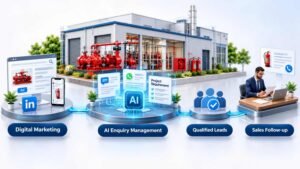
Adsthrive’s role is to help build that connection through a combination of search visibility, paid campaigns, lead generation and AI automation.
| Business requirement | Adsthrive capability | Intended commercial role |
| Improve product search visibility | SEO and AI SEO | Reach relevant product and application searches |
| Fix website conversion gaps | Website and landing-page optimisation | Make it easier to request a quote |
| Capture immediate demand | Google Ads and PPC | Reach buyers actively searching |
| Build professional visibility | Social media and LinkedIn content | Support awareness and buyer confidence |
| Collect enquiries | Lead-generation campaigns | Create a clear route to contact |
| Respond to website visitors | AI chatbot | Provide an initial response |
| Handle WhatsApp enquiries | WhatsApp AI agent | Collect details and route conversations |
| Organise lead information | AI lead qualification | Help sales prioritise enquiries |
| Contact prospects | AI calling | Support timely communication |
| Recover missed opportunities | Automated follow-ups | Reduce dependence on manual reminders |
| Arrange discussions | AI booking systems | Move qualified prospects towards a meeting |
The services should be selected according to the company’s actual bottleneck. A manufacturer with good search traffic but very few RFQs may need conversion work. A company with strong enquiry volume but slow response may need AI qualification and follow-up. A new business entering a market may need product-led SEO and paid search together.
The objective is not to sell every service to every client. It is to identify what is preventing the business from generating or progressing commercial enquiries and build the right combination of solutions.
What a connected enquiry journey looks like in practice
Consider a manufacturer supplying portable extinguishers, hydrant accessories and sprinkler components. The business wants more project enquiries, but it also wants to attract dealers and distributors.
Instead of running one general campaign, the marketing and sales process can be organised around three distinct enquiry routes.
Route 1: Project procurement
Search / Ads
Product page
BOQ enquiry
AI collects product categories, quantities, project location and timeline before routing the requirement to project sales.
Route 2: Dealer or distributor
LinkedIn / Ads
Dealer page
Partner enquiry
The enquiry is routed to channel sales for territory, product range and partnership discussions.
Route 3: Technical or product enquiry
SEO / Website
Technical page
Documentation request
The relevant product or technical team receives the request for datasheets, certificates or clarification.
This separation prevents every enquiry from entering the same generic sales queue. It also helps the marketing team understand which campaigns attract project buyers, which attract dealers and which generate technical questions.
“For a practical example of how a broader industrial business can connect online visibility with sales opportunities, see How Industrial Equipment Companies Can Generate More Leads Online. This is the only previous blog referenced here.”
How to decide which marketing investment comes first
Not every fire protection company needs the same starting point. The best first investment depends on the gap between the current marketing activity and the commercial outcome.
| Current business situation | Recommended starting point |
| Important products are not appearing in search | Product-category SEO and technical SEO |
| Website receives visits but few enquiries | Landing-page and conversion improvements |
| New product range needs immediate visibility | Product-focused Google Ads |
| Project buyers are difficult to reach | LinkedIn targeting and account-based outreach |
| Enquiries arrive but lack project details | AI enquiry qualification |
| Sales team responds late | WhatsApp, AI chat and follow-up automation |
| Dealer and project leads get mixed together | Separate forms, routing and qualification |
| Marketing reports clicks but cannot show sales value | Lead-source and pipeline tracking |
The right sequence can also change as the company grows. A business may start with SEO and paid search, then add automation once enquiry volume increases. Another may already have sufficient website traffic but need a better system for qualifying and following up with prospects.
A suitable digital marketing agency for fire fighting equipment companies should be able to identify these gaps before recommending a package of services. It should understand the difference between a product enquiry, a project BOQ, a dealer lead and a technical documentation request.
That is also why SEO services for fire fighting equipment companies should not be limited to keyword placement. The work should connect search visibility with product information, buyer intent, technical credibility and enquiry conversion.
Frequently asked questions
1. How can fire fighting equipment companies generate more project enquiries?
Create dedicated pages for the products and systems you supply, target searches related to project requirements, run Google Ads for high-intent terms and reach relevant consultants, contractors and procurement teams through LinkedIn. Use enquiry forms and AI qualification to collect useful project details before the sales handover.
2. Which keywords should fire-safety manufacturers target?
Prioritise product, manufacturer, supplier, specification, application, project, bulk procurement and quotation-related searches. Examples include fire pump manufacturer, fire hydrant equipment supplier, sprinkler system components and industrial fire suppression systems. Validate actual search demand and competition before finalising the keyword plan.
3. Is SEO useful for a company that sells through dealers?
Yes. SEO can help a manufacturer reach both end users and potential channel partners. The website should have separate routes for product enquiries and dealer or distributor applications so that each audience receives relevant information.
4. Should fire protection companies use Google Ads?
Google Ads can help capture immediate demand for specific products, project requirements and supplier searches. Campaigns should use relevant landing pages and track qualified enquiries rather than optimising only for the cheapest form submission.
5. How can AI help manage fire-safety product enquiries?
AI can acknowledge enquiries, ask for product and project details, collect basic information and route requests to the appropriate team. Technical suitability, certification claims and system design questions should still be reviewed by qualified professionals.
6. What information should a project enquiry form collect?
At a minimum, consider the product category, project type, quantity or BOQ, location, company name, contact details and expected timeline. Add fields for documentation or technical requirements when relevant. Keep the form manageable so that genuine buyers are not discouraged from submitting it.
7. How long does SEO take to generate enquiries?
SEO is a long-term channel, and the time required depends on the website’s current condition, competition, authority, product coverage and content quality. Google Ads can support immediate visibility while organic search develops. Neither channel guarantees a specific ranking or enquiry volume.
Final recommendation: Market the product, support the specification and automate the response
Fire protection companies need to be visible where product research and project procurement begin. But visibility alone does not make a website commercially effective.
A buyer should be able to identify the relevant product, review useful technical information, understand the company’s actual supply capability and submit a clear enquiry without unnecessary steps. The sales team should then receive enough information to respond appropriately.
A strong Digital marketing for fire fighting equipment companies strategy should therefore connect six areas:
- Product-led SEO and AI SEO.
- Technical and application-specific website content.
- Google Ads for high-intent searches.
- LinkedIn and social media for professional reach.
- AI-powered enquiry capture and qualification.
- WhatsApp, calling and automated follow-ups.
The goal of SEO for fire fighting equipment companies is not to make every product page repeat the same keyword. It is to make the company’s genuine product range, technical capabilities and commercial relevance discoverable to the right buyers.
Adsthrive can help bring these activities together through SEO, AI SEO, paid advertising, lead generation, AI chatbot, WhatsApp automation, AI calling and follow-up systems.
Want to build a connected marketing and enquiry system for your fire-safety business?
Discuss your product categories, target buyers and current enquiry challenges with the Adsthrive team through the Adsthrive contact info.