An industrial equipment company can have excellent machines, experienced engineers and strong manufacturing capacity and still lose enquiries before its sales team ever knows a buyer was looking. A plant may be researching a new production system, a procurement team may be comparing equipment suppliers, or an engineering manager may be searching for a machine based on capacity, application or specification. If your website does not appear for that requirement—or appears but does not make the next step obvious—the opportunity can move to another supplier.
SEO for industrial equipment companies should therefore be treated as a commercial acquisition channel, not simply a ranking exercise. The objective is to connect relevant searches with product information, generate enquiries, qualify those enquiries and move genuine prospects toward a sales conversation.
This article looks at the problem from a revenue perspective: where Industrial Equipment companies lose online opportunities, how to capture higher-intent demand, how Google Ads and LinkedIn can supplement organic search, and how Adsthrive’s AI-powered chat, WhatsApp, calling, lead qualification and follow-up capabilities can help turn more enquiries into usable sales opportunities.
The Real Problem Is Not “We Need More Traffic”
Many industrial companies start their marketing discussion with:
“We need more visitors to our website.”
That is usually too broad a target.
Suppose an equipment manufacturer receives 5,000 monthly visitors but most visitors are students, job seekers, competitors, suppliers or people looking for general information. The traffic number looks healthy, but it does not necessarily create sales.
Now consider a different situation:
- 800 relevant visitors
- 150 product-page visits
- 60 specification-page visits
- 25 RFQs
- 15 qualified enquiries
- 7 sales discussions
The second scenario provides a much clearer commercial path.
This is why lead generation for industrial equipment companies should be measured beyond traffic and rankings.
The important questions are:
- Are the right industries finding you?
- Are buyers reaching the correct equipment pages?
- Can they understand whether the machine fits their requirement?
- Can they request a quotation quickly?
- Are enquiries being qualified?
- Do sales receive enough information to act?
- Are prospects followed up when they do not respond?
- Can marketing identify which campaigns produced actual opportunities?
That is the foundation of a commercial digital strategy.
Start With a Revenue-Leak Audit
Instead of beginning with “Which keywords should we rank for?”, start with:
Where are potential customers disappearing?
An industrial equipment business can lose opportunities at several points.
| Revenue leak | What may be happening | Commercial response |
| Search visibility | Buyer searches for equipment but finds competitors | SEO + AISEO |
| Product visibility | Website ranks for generic terms but not products | Product-focused SEO |
| Application visibility | Buyer searches by industry/use case | Application landing pages |
| Website conversion | Visitors cannot find RFQ/contact options | Conversion optimisation |
| Paid traffic | Ads send users to generic pages | Intent-specific landing pages |
| Lead quality | Sales receives irrelevant enquiries | AI lead qualification |
| Slow response | Buyer waits hours for a reply | AI chat/WhatsApp/calling |
| Follow-up | Interested buyer goes silent | Automated follow-up |
| Attribution | Marketing cannot identify revenue sources | Lead and pipeline tracking |
This approach changes the marketing conversation.
You are no longer asking:
“How do we get more website traffic?”
You are asking:
“Where are potential equipment buyers being lost, and what can we automate or improve?”
That is a much more useful starting point for digital marketing for industrial equipment companies.
Build Your Marketing Around Equipment Economics, Not Generic Keywords
Industrial equipment can represent a high-value purchase.
That changes the economics of marketing.
A buyer searching for:
“industrial equipment”
may simply be researching.
A buyer searching for:
“automatic packaging machine manufacturer”
has a clearer requirement.
A buyer searching for:
“industrial packaging machine 100 packs per minute”
may have an even more specific technical need.
And someone searching:
“packaging machine manufacturer India quotation”
is potentially much closer to contacting suppliers.
The important point is that search demand exists at different levels of commercial intent.
A practical keyword structure
For an equipment company, keyword research should usually examine at least these groups:
| Search type | Example | Commercial intent |
| Product | industrial cutting machine | Medium–High |
| Product + manufacturer | CNC machine manufacturer | High |
| Product + supplier | industrial compressor supplier | High |
| Specification | 500 kg capacity lifting equipment | High |
| Application | equipment for food processing plant | High |
| Problem | machine for reducing production downtime | Medium–High |
| Comparison | automatic vs semi automatic machine | Medium |
| Location | industrial equipment manufacturers India | High |
| Commercial action | machine quotation | Very High |
| Service/support | industrial equipment installation | High |
This is also where SEO services for industrial equipment companies should go deeper than simply collecting broad industry keywords.
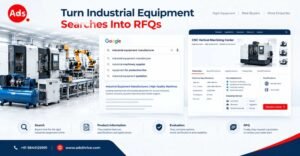
The objective is to identify searches that can eventually produce a commercial conversation.
Turn the Website Into a Product Catalogue That Can Sell
A surprising number of industrial websites treat their entire equipment range as one category.
For example:
Products → Industrial Equipment
That may be convenient for the company, but it does not necessarily help a buyer.
A stronger structure separates the commercial offering.
For example:
Industrial Equipment
- CNC Equipment
- Material Processing Equipment
- Packaging Equipment
- Industrial Automation Equipment
- Conveying Equipment
- Heavy-Duty Machinery
- Custom Equipment
- Spare Parts
- Maintenance & Service
Each major product category can then have individual pages for:
- Machine type
- Model
- Capacity
- Application
- Material handled
- Industry served
- Technical specifications
- Installation
- Maintenance
- Customisation
- Frequently asked questions
This matters because search engines need clear information about what a page actually represents.
It also matters commercially.
A procurement manager searching for a particular machine should not have to browse through five pages to understand whether your company manufactures it.
SEO for industrial equipment companies becomes more valuable when every important commercial offering has a clear digital destination.
Make Technical Specifications Searchable
Industrial buyers do not always search using marketing language.
They search using engineering language.
Depending on the equipment category, searches can involve:
- Capacity
- Load
- Power
- Speed
- Accuracy
- Dimensions
- Pressure
- Temperature
- Material
- Voltage
- Output
- Automation level
- Operating environment
- Installation requirements
- Application
- Industry
- Model number
These details should not be hidden exclusively inside downloadable PDFs.
Important specifications should also appear as readable HTML content on relevant product pages.
For example:
Industrial Equipment Specification
| Parameter | Specification |
| Capacity | 500 kg |
| Operating speed | Up to X units/hour |
| Application | Production handling |
| Power requirement | X kW |
| Control system | PLC-based |
| Configuration | Customisable |
| Installation | Available |
| Service support | Available |
The exact information will obviously depend on the equipment.
The point is to make commercially useful technical information accessible to both buyers and search engines.
This is particularly relevant because equipment buyers often evaluate technical suitability before contacting sales.
Industry standards can also become useful content resources. BIS maintains a searchable standards portal, and its machinery-related standards cover specific equipment and safety requirements. For example, BIS currently lists standards covering machinery and electrical equipment, while its standards database includes equipment-specific entries such as overhead travelling and gantry cranes.
That creates opportunities for companies to publish genuinely useful pages around standards, specifications, compliance and equipment selection—provided the content accurately reflects the applicable requirements.
Capture the “Before They Ask for a Quote” Searches
Not every potential customer begins with:
“Buy industrial equipment.”
Many start with a problem.
For example:
- How to increase production capacity?
- How to automate a manual process?
- Which machine is suitable for high-volume production?
- What equipment is required for a new production line?
- How much capacity do I need?
- What is the difference between two machine configurations?
- How can downtime be reduced?
- How can material handling be automated?
- What equipment is required for a specific industry?
These searches may not look like traditional “buy now” keywords.
But they can introduce your company much earlier in the evaluation process.
Search opportunities Industrial Equipment companies may be missing
| Buyer problem | Example search | Suggested content |
| Capacity increase | equipment to increase production capacity | Solution guide |
| Automation | industrial equipment for process automation | Application page |
| Equipment selection | how to choose industrial equipment | Buying guide |
| Industry application | equipment for automotive manufacturing | Industry page |
| Upgrade | replacing old industrial machinery | Solution article |
| Cost | industrial equipment operating cost | Technical/commercial guide |
| Maintenance | industrial equipment maintenance checklist | Resource |
| Comparison | automatic vs semi automatic equipment | Comparison page |
| Integration | equipment integration with production line | Technical guide |
| Procurement | industrial equipment supplier India | Commercial landing page |
This is where content becomes a lead-generation asset instead of simply a publishing exercise.
Use Google Ads Where Organic Search Takes Time
SEO is a long-term acquisition channel.
But an equipment company may have an immediate sales target.
Perhaps a new machine has been launched.
Perhaps a manufacturer is entering a new geographical market.
Perhaps a particular equipment category has excess production capacity.
Perhaps a trade exhibition is approaching and the company wants more enquiries before and after the event.
Google Ads can help capture relevant searches immediately.
However, the campaign should not simply send every click to the homepage.
Example
Search:
“industrial cutting machine manufacturer”
Landing page:
Industrial Cutting Machines
Not:
Home
The landing page should answer:
- What equipment do you manufacture?
- What applications does it support?
- What capacity ranges are available?
- What industries use it?
- What technical specifications matter?
- What configurations are possible?
- Can the equipment be customised?
- Where do you supply?
- How can the buyer request a quotation?
This is where paid acquisition becomes much more commercially useful.
Google Ads can capture immediate demand while SEO services for industrial equipment companies build organic visibility around the same commercial themes over time.
Stop Treating LinkedIn as a Company Notice Board
For industrial businesses, LinkedIn can do more than announce:
“We are happy to announce our new product.”
The platform can be used to reach the people involved in equipment purchasing.
Depending on the business, that may include:
- Plant managers
- Procurement managers
- Production heads
- Engineering managers
- Operations directors
- Project managers
- Maintenance managers
- Founders
- OEM purchasing teams
- Industrial consultants
- System integrators
- Distributors
The content should therefore answer commercial questions.
Instead of:
“Our latest machine is now available.”
Try:
“What should a plant evaluate before replacing a 10-year-old production machine?”
Or:
“Three equipment specifications procurement teams should verify before requesting quotations.”
Or:
“What changes when a production line moves from manual handling to automated equipment?”
This gives LinkedIn a role in demand creation and account engagement rather than simply follower growth.
For companies selling complex Industrial Equipment, that distinction matters because the person who first discovers your company may not be the final purchasing authority.
Give Every Enquiry a Commercial Qualification Layer
Getting an enquiry is not the end of marketing.
It is the beginning of sales handling.
Consider two forms.
Form A
Name: Rahul
Phone: 98XXXXXX
Message: Need machine.
Form B
Company: ABC Manufacturing
Industry: Automotive components
Equipment required: CNC production machine
Application: High-volume component manufacturing
Required capacity: X
Location: Pune
Quantity: 3
Expected purchase timeline: 3 months
Requirement: New production line
Contact: Rahul – Procurement
The second enquiry gives sales considerably more context.
This is where AI lead qualification can become commercially valuable.
An AI system can ask relevant questions before routing the enquiry to the sales team.
For an equipment company, those questions might include:
- What equipment are you looking for?
- What is the application?
- What capacity do you require?
- What quantity is required?
- Which industry are you in?
- Where is the installation location?
- Is this a new purchase or replacement?
- What is your expected timeline?
The questions should be customized to the actual equipment being sold.
This is far more useful than asking every website visitor the same generic chatbot questions.
Turn WhatsApp Into a Sales Response Channel
Industrial buyers frequently want a quick answer before committing to a formal enquiry.
A WhatsApp-based AI agent can provide an immediate interaction layer.
For example:
Buyer:
“I need an automated packaging machine.”
AI:
“Sure. I can help with the initial requirement. What product are you packaging?”
Buyer:
“Food products.”
AI:
“What approximate production volume do you require per hour?”
The system can continue collecting basic requirements and then route the conversation to the appropriate sales team.
This can be particularly useful when:
- Sales teams are busy
- Enquiries arrive outside working hours
- Multiple product categories exist
- Buyers need basic information before speaking to sales
- The company receives enquiries from different regions
Adsthrive’s AI Chatbot Agent can be positioned as part of this type of enquiry-handling system rather than simply as a website chatbot.
The commercial objective is simple:
Reduce the distance between “I am interested” and “sales has the information needed to act.”
Recover Missed Opportunities With AI Calling
Not every enquiry becomes a conversation.
Someone may submit a form and become busy.
Someone may request a quotation and stop responding.
Someone may provide a phone number but never answer the first call.
For high-value equipment, losing such an enquiry can mean losing a significant sales opportunity.
An automated calling system can support follow-up workflows such as:
New enquiry → Initial call → Requirement confirmation → Follow-up → Sales appointment
The purpose is not to replace the sales team.
It is to prevent every enquiry from depending on a salesperson remembering to follow up manually.
Adsthrive’s AI Calling Solution can be integrated into a broader lead-handling workflow for businesses that need automated calling and follow-up.
For an Industrial Equipment business, the calling workflow can be designed around the actual sales process.
For example:
- New RFQ received
- Buyer contacted
- Requirement confirmed
- Technical discussion requested
- Sales meeting scheduled
- Follow-up reminder created
The exact workflow should depend on the company’s sales process.
Make Booking Part of Lead Generation
A qualified buyer should not have to exchange ten emails just to arrange an initial conversation.
If a prospect is ready to speak with:
- Sales
- An application engineer
- A technical consultant
- A product specialist
the website or AI system should make the next step easy.
A booking workflow can allow a qualified prospect to select an available meeting time.
This creates a useful distinction:
Lead generated
versus
Sales conversation scheduled
The second is usually a more commercially meaningful event.
A digital strategy can therefore track:
| Stage | Measurement |
| Visibility | Relevant impressions |
| Acquisition | Qualified website visits |
| Engagement | Product/application engagement |
| Conversion | RFQs/enquiries |
| Qualification | Sales-qualified leads |
| Action | Calls or meetings |
| Pipeline | Opportunities |
| Revenue | Closed business |
This is much more useful than reporting only monthly website traffic.
Use AISEO to Expand Beyond Exact-Match Keywords
Search behaviour is changing.
Industrial buyers may search using technical phrases, natural-language questions, application descriptions and increasingly AI-assisted research.
That means a content strategy should not be built only around:
“industrial equipment manufacturer”
It should also understand the concepts surrounding the equipment.
For example:
Equipment
→ Application
→ Industry
→ Technical specification
→ Problem
→ Compliance
→ Installation
→ Maintenance
→ Integration
→ Commercial requirement
This semantic relationship helps create a more complete information architecture.
Adsthrive’s AI SEO services can be used to develop broader contextual search coverage around products, applications, technical requirements and buyer questions.
The goal should remain commercial:
Appear for the searches that can introduce the company to relevant buyers.
Not:
Publish hundreds of pages simply to increase the number of indexed URLs.
Build Landing Pages Around Commercial Use Cases
One of the strongest opportunities for Industrial Equipment companies is to separate product pages from application pages.
Imagine a manufacturer selling one machine that serves three industries:
- Automotive
- Food processing
- Pharmaceutical
The machine page explains the equipment.
But an application page can explain:
Equipment for Automotive Manufacturing
- Production requirement
- Typical applications
- Equipment configuration
- Capacity considerations
- Integration
- Quality requirements
- Installation
- Maintenance
- Request quotation
Then:
Equipment for Food Processing
The content changes around that industry’s requirements.
This gives marketing more opportunities to match search intent without creating thin, duplicate pages.
It also provides landing pages for Google Ads and LinkedIn campaigns.
Use Lead Generation Campaigns to Create a Controlled Acquisition Channel
Organic traffic is valuable, but some companies need a predictable enquiry-generation mechanism.
This is where lead generation for industrial equipment companies can combine:
- Google Ads
- Landing pages
- LinkedIn outreach
- Retargeting
- Lead forms
- AI chat
- Calling
- Automated follow-ups
- CRM tracking
The important point is that these should not operate as isolated campaigns.
For example:
- A buyer clicks a Google Ad.
- They visit a product landing page.
- They submit an enquiry.
- AI qualification collects application details.
- WhatsApp provides an immediate response.
- AI calling follows up.
- The qualified lead is routed to sales.
- A meeting is booked.
Marketing can then identify the campaign that generated the opportunity.
That is a lead-generation system rather than simply an advertising campaign.
Retarget Buyers Who Were Interested but Not Ready
Industrial purchases are rarely impulse purchases.
A visitor might spend time on:
- Product specifications
- Case studies
- Applications
- Technical documents
- Pricing information
- Installation requirements
and still not enquire.
That does not necessarily mean the visitor was irrelevant.
They may be:
- Comparing suppliers
- Waiting for management approval
- Preparing a technical specification
- Discussing the purchase internally
- Waiting for project approval
Remarketing can help maintain visibility during this research period.
For example, someone who visits a specific equipment page could later see an advertisement highlighting:
Request Technical Consultation
or:
Get Equipment Specification
rather than another generic company advertisement.
This makes remarketing more relevant to the actual commercial interaction.
Use Existing Sales Questions as Your Content Engine
Industrial companies often already have a huge content library.
It simply exists inside the sales team’s conversations.
Ask sales:
What questions do prospects ask before requesting a quotation?
The answers can become content.
For example:
- Which capacity should I choose?
- Can this equipment be customised?
- What installation space is required?
- What is the expected operating life?
- What maintenance is required?
- Can it integrate with existing machinery?
- What certifications are available?
- What information is required for a quotation?
- What is the expected delivery timeline?
- What happens after installation?
These questions can become:
- FAQs
- Product-page sections
- Buying guides
- Comparison pages
- Videos
- LinkedIn posts
- Google Ads landing-page content
- Sales enablement material
This creates a content system based on actual buyer objections rather than generic blog topics.
Create Proof Around the Equipment, Not Just the Company
Industrial buyers need reasons to believe that a supplier can deliver.
Instead of writing:
“We are a leading manufacturer.”
show evidence.
Useful proof can include:
- Equipment photographs
- Factory images
- Production capacity
- Technical capabilities
- Industries served
- Installation examples
- Case studies
- Certifications
- Quality processes
- Engineering capabilities
- Service coverage
- Customer applications
- Performance information where substantiated
Safety and compliance information can also be important depending on the equipment category. OSHA’s machinery guidance, for example, addresses machine guarding and hazards associated with moving machine parts, while ISO 12100 provides principles and methodology for machinery risk assessment and risk reduction.
For Indian manufacturers, BIS also provides processes and resources for identifying applicable Indian Standards and documenting manufacturing infrastructure, process controls and testing capabilities for relevant products.
The marketing lesson is straightforward:
Technical credibility should be visible online.
What Should a Complete Digital Marketing System Include?
A modern digital marketing agency for industrial equipment companies should not treat every service as a separate activity.
The services should work together.
| Business requirement | Digital solution |
| More organic visibility | SEO |
| Broader technical search coverage | AISEO |
| Immediate search demand | Google Ads |
| Decision-maker reach | |
| Technical authority | Content marketing |
| More enquiries | Lead generation |
| Better website conversion | Landing pages/CRO |
| Immediate responses | AI Chat |
| WhatsApp engagement | WhatsApp AI |
| Lead qualification | AI qualification |
| Faster follow-up | AI calling |
| Meeting conversion | Booking automation |
| Returning prospects | Remarketing |
| Commercial reporting | Lead/pipeline tracking |
The company does not necessarily need every component on day one.
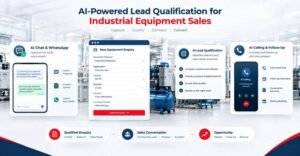
The right sequence depends on where the largest commercial leak currently exists.
Why an All-in-One AI Automation System Can Matter
One common problem with digital transformation is tool overload.
A business may end up using:
- One chatbot
- One WhatsApp platform
- One calling tool
- One CRM
- One booking platform
- One email automation system
- One lead qualification platform
- One reporting tool
The tools may work individually but create unnecessary complexity when they are not designed around the same workflow.
Adsthrive’s approach is to build customized AI automation around the client’s actual requirements, connecting areas such as:
- Chat
- Calling
- Lead qualification
- Follow-up
- Booking
- Lead generation
- Marketing
rather than expecting every business to assemble the same collection of disconnected tools.
That fits particularly well with complex B2B businesses where the sales process is different from one equipment category to another.
What Should Industrial Equipment Companies Measure Every Month?
Do not stop at:
“We increased organic traffic by 40%.”
Ask what happened after the visitor arrived.
SEO metrics
- Commercial keyword visibility
- Product-page traffic
- Application-page traffic
- Organic enquiries
- Organic RFQs
- Qualified organic leads
Paid advertising metrics
- Cost per enquiry
- Cost per qualified lead
- Search-term quality
- Landing-page conversion rate
- Qualified lead rate
AI and automation metrics
- Chat conversations
- Qualified conversations
- WhatsApp enquiries
- Calls completed
- Follow-ups completed
- Meetings booked
Sales metrics
- Qualified opportunities
- Quotations generated
- Pipeline value
- Sales meetings
- Won opportunities
- Revenue by source
The final objective is not:
More clicks.
It is:
More relevant commercial opportunities from the right buyers.
How Adsthrive Can Help Industrial Equipment Companies Build This System
Adsthrive can combine multiple acquisition and automation capabilities rather than treating SEO, advertising and lead management as separate activities.
For example:
Search visibility
SEO Services can focus on product, application, technical and commercial searches.
AI-powered search strategy
AI SEO Services can expand the strategy into broader contextual and semantic search opportunities.
Paid acquisition
Google Ads and performance marketing can capture high-intent demand that should not wait for organic rankings.
Lead generation
Lead Generation Services can connect campaigns with actual enquiry-generation objectives.
AI conversation
AI Chatbot Agent can help answer initial questions and collect requirements.
AI calling
AI Calling Solution can support automated calling and follow-up workflows.
The important part is not the number of services.
It is how they are connected to the sales process.
8 Practical Strategies at a Glance
If an equipment company wants a practical starting framework, these are the core actions:
- Audit revenue leaks across search, website conversion and follow-up.
- Build keyword clusters around products, specifications, applications and problems.
- Create dedicated product and industry landing pages.
- Use Google Ads for high-intent commercial searches.
- Use LinkedIn to reach technical and procurement decision-makers.
- Qualify enquiries automatically through AI chat and WhatsApp.
- Use AI calling and automated follow-ups to recover missed opportunities.
- Measure qualified opportunities and pipeline, not traffic alone.
This is the practical difference between running digital campaigns and building a digital sales channel.
Frequently Asked Questions
How can industrial equipment companies generate more leads online?
Industrial equipment companies can combine SEO, Google Ads, LinkedIn, technical content, conversion-focused landing pages and lead-generation campaigns. AI chat, WhatsApp, lead qualification and automated follow-ups can then help turn website enquiries into more actionable sales opportunities.
Is SEO effective for industrial equipment companies?
Yes, when SEO is connected to commercial search intent. Product names, specifications, applications, industries, equipment problems and supplier-related searches can all create opportunities to reach relevant B2B buyers.
What keywords should industrial equipment companies target?
Start with product, manufacturer, supplier, application, specification, industry, location and quotation-related searches. Long-tail technical searches can also be valuable because they often describe a more specific requirement.
Should industrial equipment companies invest in Google Ads?
Google Ads can be useful when the company wants immediate visibility for high-intent searches, new products, specific markets or time-sensitive campaigns. The landing page should closely match the search and provide a clear enquiry path.
How can LinkedIn help industrial equipment companies?
LinkedIn can help companies reach professionals involved in engineering, procurement, production, operations and project management. Technical insights, application examples, case studies and problem-solving content can be more useful than simply posting company announcements.
How does AI lead qualification help?
AI lead qualification can collect information such as equipment requirement, application, capacity, quantity, location and purchase timeline before passing the enquiry to sales. The exact questions should be customised to the company’s products and sales process.
Can AI calling help convert industrial leads?
AI calling can support initial contact and follow-up after a form submission or enquiry. It can be particularly useful when sales teams receive more enquiries than they can immediately contact manually.
How long does SEO for industrial equipment companies take?
SEO is generally a longer-term channel. Results depend on the website’s technical condition, competition, authority, content quality, search intent and existing visibility. High-intent Google Ads can be used alongside SEO when immediate acquisition is required.
Conclusion: Build a Digital Sales Channel, Not Just a Marketing Presence
Industrial equipment businesses do not need thousands of random visitors.
They need the right companies to discover the right equipment at the right stage of their purchasing process—and then they need a reliable mechanism for turning that interest into a sales conversation.
That means SEO for industrial equipment companies should connect search demand with products, specifications, applications and commercial landing pages.
- Google Ads can capture immediate demand.
- LinkedIn can create access to relevant decision-makers.
- Technical content can answer questions before the first sales call.
- AI chat and WhatsApp can respond to enquiries.
- AI qualification can collect useful requirements.
- AI calling can support follow-up.
- Booking automation can move qualified prospects toward conversations.
And marketing analytics can connect those activities to pipeline instead of stopping at traffic.
The strongest digital strategy is therefore not simply about ranking for more keywords. It is about building a system where visibility, enquiry generation, qualification and sales follow-up work together.
Ready to Generate More Industrial Equipment Leads?
Turn your equipment capabilities into a stronger digital sales channel with SEO, AISEO, Google Ads, LinkedIn outreach, lead generation and AI-powered enquiry automation.
Get found by the right industrial buyers. Capture better enquiries. Qualify opportunities faster. Automate follow-up with Adsthrive.