A conveyor manufacturer may have the engineering capability to build belt conveyors, roller conveyors, screw conveyors, slat conveyors, bucket elevators or complete material-handling systems, yet still receive very few enquiries online. The problem is often not manufacturing capacity. It is that the right buyer does not discover the right capability at the moment they are looking for it.
For example, a food-processing company may search for a sanitary conveyor system, while an e-commerce warehouse may need a powered roller conveyor and an engineering company may be looking for a custom conveyor manufacturer for a new production line. SEO for conveyor manufacturers has to capture these different commercial requirements rather than simply target the phrase “conveyor manufacturer.”
This article takes a different approach: instead of treating marketing as a collection of SEO, advertising and social-media activities, it looks at how a conveyor business can build a commercial enquiry system where search, advertising, landing pages, AI, follow-ups and sales work together.
The Conveyor Buyer Is Not Searching for “A Conveyor”
This is one of the biggest mistakes manufacturers make with digital marketing.
A buyer rarely begins with:
“I need a conveyor manufacturer.”
Their search may be much more specific:
- Belt conveyor manufacturer for packaging industry
- Roller conveyor for warehouse automation
- Stainless steel conveyor for food processing
- Heavy-duty conveyor system manufacturer
- Inclined belt conveyor supplier
- Conveyor system for carton handling
- Custom conveyor manufacturer India
- Conveyor for pharmaceutical production line
- Screw conveyor manufacturer for bulk material
- Conveyor automation company for assembly line
These searches reveal something important.
The buyer is already describing the application, product, industry or problem.
That means the website needs to meet the buyer at that level.
Current search results for manufacturing marketing increasingly emphasize product-specific and high-intent searches rather than generic traffic. A recent conveyor-focused SEO case study, for example, reports ranking improvements around terms such as “belt conveyor manufacturer” and “slat conveyor manufacturer,” with the objective of connecting search visibility to B2B enquiries rather than traffic alone.
What Should the Commercial Marketing System Look Like?
Instead of building marketing around individual services, think about the commercial journey:
Buyer searches → relevant page → understands capability → sees proof → enquires → AI responds → requirement is qualified → sales receives context → follow-up happens → meeting or quotation
This changes the role of every marketing activity.
| Business requirement | Marketing/automation role |
| Buyer cannot find you | SEO + AISEO |
| Buyer needs immediate visibility | Google Ads |
| Buyer needs application information | Technical content |
| Buyer lands on the wrong page | Landing-page optimisation |
| Buyer has questions | AI Chatbot |
| Buyer contacts through WhatsApp | WhatsApp AI Agent |
| Sales receives incomplete enquiries | AI Lead Qualification |
| Buyer does not respond immediately | AI Follow-Up |
| Buyer needs a conversation | AI Calling |
| Buyer wants to speak with sales | Booking automation |
| Management wants measurable results | Lead and pipeline tracking |
This is where SEO for conveyor manufacturers becomes more than a ranking exercise.
The objective is to create a system that can generate, capture and progress commercial opportunities.
Start With the Enquiries You Actually Want
Before creating content or launching advertisements, define the enquiries that have commercial value.
A conveyor manufacturer might want:
- Complete conveyor system projects
- OEM requirements
- Custom conveyor requirements
- Replacement conveyor requirements
- Conveyor automation projects
- Export enquiries
- Plant expansion projects
- Material-handling system requirements
- Industry-specific conveyor enquiries
- Spare and replacement component enquiries
These should become the foundation of the digital marketing strategy.
Build a commercial demand map
Instead of one large keyword list, divide demand into five areas:
| Search category | Example search | Commercial purpose |
| Product | belt conveyor manufacturer | Find a supplier |
| Application | conveyor for carton handling | Solve an application |
| Industry | food processing conveyor system | Find an industry solution |
| Problem | conveyor for inclined material handling | Solve a requirement |
| Geography | conveyor manufacturer in India | Find a supplier in a market |
This creates a much stronger foundation for SEO services for conveyor manufacturers because each important search group can be connected to an appropriate page.
Turn the Website Into a Sales Catalogue, Not a Company Brochure
A common industrial website has pages such as:
- Home
- About Us
- Products
- Services
- Contact
That structure may explain the company, but it does not necessarily help a procurement manager decide whether to enquire.
A stronger website architecture could include:
Product pages
- Belt Conveyors
- Roller Conveyors
- Screw Conveyors
- Slat Conveyors
- Chain Conveyors
- Modular Belt Conveyors
- Inclined Conveyors
- Bucket Elevators
- Overhead Conveyors
Application pages
- Conveyor Systems for Packaging
- Conveyor Systems for Food Processing
- Conveyor Systems for Warehousing
- Conveyor Systems for Automotive
- Conveyor Systems for Pharmaceutical Manufacturing
- Conveyor Systems for Material Handling
Capability pages
- Custom Conveyor Manufacturing
- Conveyor Automation
- Conveyor Integration
- Conveyor Design and Engineering
- Turnkey Material Handling Systems
The objective is not to create hundreds of thin pages.
It is to create useful commercial pages around real products, applications and capabilities the company can actually deliver.
CEMA’s current standards library itself reflects how broad the conveyor industry is, covering categories such as belt conveyors, screw conveyors, roller conveyors, slat conveyors and other conveyor equipment.
3. Make Every Product Page Capable of Generating an Enquiry
Getting a visitor to a conveyor product page is only half the job.
The page should answer the questions that normally delay an enquiry.
For example, a belt conveyor page could include:
- Conveyor type
- Belt width
- Conveyor length
- Load capacity
- Speed
- Material handled
- Drive configuration
- Frame construction
- Belt options
- Inclination
- Application
- Industries served
- Customisation options
- Installation support
- Testing or inspection information
- Request-for-quotation option
Then give the buyer an obvious next step.
Example CTA
Need a Conveyor for Your Application?
Tell us your material, capacity, dimensions and application requirements.
Request a Conveyor Quote
This is where digital marketing for conveyor manufacturers becomes commercially useful.
The website is no longer simply proving that the company exists. It is helping a buyer move toward an enquiry.
Capture the Search Before the Buyer Reaches the Competitor
SEO should target the point at which the buyer starts researching.
A useful content strategy should therefore cover questions such as:
- What type of conveyor is suitable for carton handling?
- Belt conveyor vs roller conveyor
- How to select conveyor width?
- What conveyor is suitable for food-grade applications?
- How much load can a roller conveyor handle?
- What factors affect conveyor speed?
- When should a company use a screw conveyor?
- What information is required for conveyor design?
- How is a custom conveyor system designed?
- What should be included in a conveyor RFQ?
These searches may not all produce immediate quotations.
But they can bring engineers and procurement teams into the company’s digital ecosystem before they have selected a supplier.
The more commercial pages then give those visitors a path toward enquiry.
That is the role of SEO for conveyor manufacturers: capture relevant demand before the supplier shortlist has been finalised.
Build a Search Strategy Around Real Conveyor Applications
One of the strongest opportunities for conveyor businesses is application-based search.
A buyer may not know the exact conveyor model they need.
They know what they are trying to move.
For example:
“We need to move cartons between packaging and dispatch.”
That requirement can translate into searches around:
- carton conveyor systems
- conveyor for boxes
- warehouse conveyor systems
- powered roller conveyors
- package handling conveyors
Another company may say:
“We need to move food products through a processing line.”
That creates a completely different search environment:
- food processing conveyors
- stainless steel conveyors
- hygienic conveyor systems
- food-grade belt conveyors
This is why application pages can be commercially valuable.
They connect what the buyer wants to achieve with what the manufacturer can build.
Searches Conveyor Manufacturers May Be Missing
Instead of focusing only on broad keywords, identify the types of searches that could be generating enquiries every day.
| Buyer intent | Example search |
| Product | belt conveyor manufacturer |
| Product | roller conveyor manufacturer |
| Application | conveyor for carton handling |
| Industry | conveyor system for food processing |
| Specification | heavy-duty conveyor system |
| Customisation | custom conveyor manufacturer |
| Automation | conveyor automation system |
| Replacement | replacement conveyor system |
| Geography | conveyor manufacturer India |
| Project | turnkey material handling system |
These are examples of search-intent categories, not claimed search-volume figures. Actual priorities should be validated against the manufacturer’s target markets, competitors, Search Console data and keyword research.
Use Google Ads When the Requirement Cannot Wait for SEO
SEO is valuable for building long-term visibility.
But a manufacturer may not want to wait for organic rankings when a new product line, target market or sales territory needs enquiries immediately.
This is where Google Ads can complement SEO.
Instead of sending every advertisement to the homepage, create campaigns around specific commercial requirements.
Example
Campaign: Belt Conveyor Manufacturer
Landing page:
Belt Conveyor Systems for Industrial Material Handling
The page can then show:
- Conveyor configurations
- Applications
- Technical capabilities
- Industries served
- Images
- Project examples
- RFQ form
- Call option
- WhatsApp option
Another campaign could target:
Custom Conveyor Manufacturer
with a landing page focused specifically on engineered or customised conveyor requirements.
This approach reduces the gap between the advertisement and the buyer’s requirement.
Turn Website Enquiries Into Conversations With AI
This is where the commercial system becomes different from traditional SEO.
A website visitor may have questions before submitting an enquiry:
“Can you manufacture this conveyor in stainless steel?”
“Can you handle 500 kg loads?”
“We need 20 metres of conveyor belt. Can you customize the length?”
“Can you integrate this with our existing production line?”
A static contact form cannot handle these questions.
An AI Chatbot Agent can provide an immediate conversational layer on the website.
Adsthrive’s AI chatbot offering is designed around using AI conversations to support lead handling rather than treating the website as a static information page.
The AI can be configured to:
- Answer common questions
- Collect project requirements
- Ask about application
- Capture quantity
- Ask about dimensions
- Identify timeline
- Collect location
- Capture contact details
- Direct qualified enquiries toward sales
The important part is not simply having a chatbot.
It is what information the chatbot collects.
Make WhatsApp Part of the Lead System
For many B2B buyers, clicking a WhatsApp button is easier than filling out a long form.
But simply opening WhatsApp is not automation.
A stronger setup can use a WhatsApp AI Agent to begin the conversation.
For example:
Buyer:
“We need a conveyor for carton handling.”
AI Agent:
“Sure. Could you share the approximate carton weight, conveyor length, required quantity and your delivery location?”
The conversation can then collect the commercial information sales actually needs.
Possible qualification fields include:
- Product/application
- Material
- Load
- Conveyor dimensions
- Quantity
- Location
- Project stage
- Expected timeline
- Budget range, where appropriate
- Contact information
This can significantly improve the context attached to a new enquiry.
Use AI Lead Qualification Before Sending Everything to Sales
Not every website enquiry has the same commercial value.
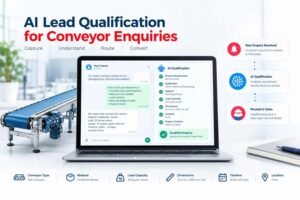
A visitor asking for a brochure is different from a company requesting a quotation for a complete conveyor line.
AI lead qualification can help categorise enquiries according to predefined business criteria.
For example:
| Lead information | Possible classification |
| Product requirement identified | Relevant |
| Application identified | Relevant |
| Quantity provided | Stronger context |
| Project timeline provided | Higher urgency |
| Drawing/specification uploaded | Strong buying signal |
| Only general information requested | Nurture |
| Outside manufacturing capability | Low fit |
The purpose is not for AI to replace the sales team.
The purpose is to give sales better information before the conversation begins.
That distinction matters.
A sales representative should not receive:
Name: Rahul
Phone: XXXXX
Message: Need conveyor.
They could instead receive:
Product: Belt conveyor
Application: Carton handling
Length: 18 metres
Load: 30 kg/carton
Quantity: 2 systems
Location: Bengaluru
Timeline: Within 60 days
Requirement: Custom design
That is a much more useful sales handoff.
Don’t Let a Good Lead Wait for Someone to Call Back
Industrial sales teams are often busy.
Engineers may be on the shop floor. Salespeople may be visiting customers. Management may be travelling.
The enquiry did not stop existing because nobody answered immediately.
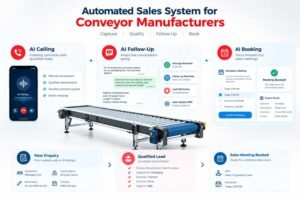
This is where AI Calling can support the process.
Depending on the workflow, an AI calling system can:
- Contact a new lead
- Confirm basic requirements
- Ask qualifying questions
- Follow up after an enquiry
- Remind prospects
- Confirm interest
- Route important information to sales
Adsthrive’s current industrial marketing approach specifically positions AI calling alongside chatbot support, lead qualification and follow-up automation rather than as an isolated technology.
The commercial objective is simple:
Reduce the time between enquiry and meaningful conversation.
Turn “Call Me” Into an Actual Sales Appointment
Another common problem is the gap between:
“Interested buyer”
and
“Actual conversation with sales.”
The buyer may say:
“Call me tomorrow.”
Tomorrow arrives.
Nobody calls.
Or the sales representative calls when the buyer is unavailable.
A booking system can remove some of this friction.
Instead of asking the buyer to coordinate manually, the system can allow them to select an available meeting time.
For example:
Discuss Your Conveyor Requirement
Choose a convenient time to speak with our sales or engineering team.
The workflow can connect:
Enquiry → Qualification → Booking → Sales Meeting
This is particularly useful for complex conveyor projects where the buyer needs to discuss:
- Layout
- Capacity
- Product dimensions
- Material flow
- Integration
- Automation
- Installation
- Project timeline
The booking step should therefore be treated as a commercial conversion point, not simply a calendar feature.
LinkedIn Should Be Used for Account-Level Prospecting
Search captures buyers who are already looking.
LinkedIn can help reach companies that fit the manufacturer’s ideal customer profile even before they search.
For example, a conveyor manufacturer could target companies in:
- Food processing
- Automotive
- Warehousing
- Logistics
- E-commerce
- Packaging
- Pharmaceuticals
- Manufacturing
- FMCG
- Distribution
The objective is not to send generic messages to thousands of people.
A more useful approach is account-focused outreach.
Example
Identify:
Company: Packaging manufacturer
Role: Plant Head
Requirement: Production-line expansion
Potential need: Conveyor integration
The message can then be built around the business requirement rather than:
“We are a leading conveyor manufacturer. Please check our website.”
This makes LinkedIn part of the commercial acquisition system.
Social Media Should Demonstrate Manufacturing Capability
For industrial companies, social media should not become a collection of generic motivational posts.
Use it to show what the company can actually manufacture.
Useful content includes:
Manufacturing content
- Conveyor assembly
- Fabrication
- Welding
- Testing
- Installation
- Quality inspection
Engineering content
- Conveyor design
- Drive systems
- Belt selection
- Load considerations
- Application engineering
Commercial proof
- Completed projects
- Before/after installations
- Industry applications
- Customer use cases
- Custom conveyor solutions
Buyer education
- Conveyor selection
- Maintenance considerations
- Common design mistakes
- Application-specific guidance
The objective is to make the company’s expertise visible before the buyer speaks with sales.
AISEO Can Help Connect Technical Knowledge With Search Behaviour
Conveyor manufacturers already possess valuable information.
The problem is that much of it remains inside:
- Engineering documents
- Product catalogues
- Quotations
- Sales presentations
- Project discussions
- Technical drawings
- Internal knowledge
AISEO can help structure content around the questions buyers actually ask.
For example, instead of a page saying:
“We provide advanced conveyor solutions.”
A useful page could explain:
“Our belt conveyor systems can be configured according to conveyor length, belt width, material handled, load requirements, speed and application.”
That gives search engines and AI-driven search systems clearer information to interpret.
The current B2B SEO landscape is increasingly focused on making complex manufacturing products, specifications and applications easier for buyers and search systems to understand.
This is another reason SEO for conveyor manufacturers should be built around actual engineering information rather than generic marketing language.
Use Industry Standards and Technical Proof to Strengthen Trust
A conveyor website should not rely entirely on claims such as:
- Best quality
- Best manufacturer
- High-performance systems
- World-class conveyors
Technical buyers need evidence.
Depending on the product and market, useful proof may include:
- Certifications
- Testing procedures
- Material specifications
- Load capabilities
- Engineering drawings
- Quality-control processes
- Installation capabilities
- Project references
- Case studies
- Industry experience
CEMA maintains standards covering multiple conveyor categories and provides technical resources relating to conveyor design, application and safety.
For belt-related businesses, ISO 14890:2026 is also a current international standard covering certain rubber- or plastics-covered textile conveyor belting for general surface use.
The point is not to add standards simply for SEO.
The point is to show buyers that the manufacturer understands the technical environment in which its equipment is specified.
What Should Lead Generation for Conveyor Manufacturers Actually Deliver?
Lead generation for conveyor manufacturers should not be measured only by the number of form submissions.
A useful lead-generation system should help answer:
- Where did the lead come from?
- Which product did they enquire about?
- What industry are they in?
- What application do they have?
- What quantity do they require?
- What is their location?
- How urgent is the requirement?
- Was the lead qualified?
- Did sales contact them?
- Did they request a quotation?
- Did the opportunity progress?
This allows management to distinguish:
Traffic → Enquiry → Qualified Lead → Sales Opportunity → Customer
rather than:
Traffic → Traffic → Traffic
How Adsthrive Can Build the Commercial System
Choosing a digital marketing agency for conveyor manufacturers should not mean purchasing isolated services such as “SEO package,” “social media package” and “Google Ads package.”
The more important question is:
Can the marketing system connect acquisition, enquiry handling and sales follow-up?
Adsthrive’s industrial marketing approach is built around connecting these functions. Its existing manufacturing work describes a combination of SEO, AISEO, Google Ads, lead generation, landing pages, LinkedIn, AI chatbot, AI lead qualification, AI calling, AI follow-ups and booking automation.
The system can be structured around:
SEO & AISEO
Build visibility around products, applications, industries and commercial searches.
Adsthrive AI SEO Services
Google Ads
Capture high-intent buyers who are actively searching for conveyor solutions.
Lead Generation
Build campaigns and landing pages designed around relevant commercial requirements.
Adsthrive Lead Generation Services
AI Chatbot
Give website visitors an immediate way to ask questions and begin an enquiry.
Adsthrive AI Chatbot Agent
WhatsApp AI Agent
Allow prospects to start conversations through a familiar communication channel while collecting relevant requirements.
AI Lead Qualification
Identify and organise stronger opportunities before they reach the sales team.
AI Calling
Support faster conversations and automated follow-up for suitable enquiries.
AI Follow-Up
Keep prospects engaged when the buying process takes time.
Booking Automation
Move qualified prospects toward scheduled conversations with sales or engineering.
Why an All-in-One Automation Approach Matters
A manufacturer can technically purchase:
- One SEO tool
- One chatbot
- One WhatsApp platform
- One CRM
- One calling platform
- One booking system
- One follow-up tool
- One lead-generation platform
But then someone has to connect all of them.
The data can become fragmented.
A lead might enter through Google Ads.
The website records it.
WhatsApp receives another message.
A salesperson records something in a spreadsheet.
The calling platform has separate information.
The appointment sits in another calendar.
This creates operational gaps.
Adsthrive’s positioning is different: instead of forcing every manufacturer to assemble disconnected tools, it can customise an AI automation system around the company’s actual workflow and requirements. Its current industrial marketing material similarly describes connecting SEO, advertising, lead qualification, WhatsApp, calling, follow-ups and booking into a broader lead-generation system.
For a conveyor manufacturer, that system could be configured around the company’s actual sales process.
What a Conveyor Lead System Could Look Like
Consider a company searching for:
“Custom conveyor manufacturer for packaging line”
Stage 1 — Discovery
The buyer finds the manufacturer through Google SEO or Google Ads.
Stage 2 — Evaluation
They reach a relevant application or product page.
Stage 3 — Enquiry
They submit an RFQ or start a website/WhatsApp conversation.
Stage 4 — Qualification
AI collects:
- Application
- Conveyor type
- Load
- Dimensions
- Quantity
- Location
- Timeline
Stage 5 — Follow-Up
WhatsApp, email or AI calling can support the next interaction.
Stage 6 — Booking
The buyer schedules a conversation with sales or engineering.
Stage 7 — Sales
The sales team receives the enquiry with useful context.
Stage 8 — Measurement
Management can see whether the enquiry became a quotation or sales opportunity.
That is the difference between having digital marketing and building a digital sales system.
What Should You Measure?
A conveyor manufacturer should track commercial metrics rather than only marketing activity.
| Metric | Why it matters |
| Organic commercial keywords | Shows search visibility |
| Product-page traffic | Shows product discovery |
| Landing-page conversion rate | Shows page effectiveness |
| Enquiries | Measures demand captured |
| Qualified enquiries | Measures lead relevance |
| RFQs | Measures commercial intent |
| Meetings booked | Measures sales engagement |
| Sales opportunities | Measures pipeline contribution |
| Cost per qualified lead | Measures advertising efficiency |
| Lead-to-opportunity rate | Shows lead quality |
| Opportunity-to-customer rate | Connects marketing to sales |
This is the reporting framework that digital marketing for conveyor manufacturers should ultimately support.
Common Mistakes That Reduce Conveyor Enquiries
1. Targeting only “conveyor manufacturer”
The term is too broad to represent every application.
2. Sending Google Ads traffic to the homepage
A buyer searching for a specific conveyor should reach a relevant page.
3. Showing products without technical information
Buyers need enough information to determine whether the product may fit their requirement.
4. Using a long generic enquiry form
Too many fields can create unnecessary friction.
5. Treating WhatsApp as just an icon
A WhatsApp button is not the same as an automated enquiry workflow.
6. Waiting hours to respond
High-intent enquiries should have a clear response process.
7. Measuring only traffic
Traffic does not automatically equal qualified opportunities.
8. Keeping marketing and sales disconnected
Marketing should know which enquiries become opportunities, and sales feedback should influence marketing.
Frequently Asked Questions
How can conveyor manufacturers generate more B2B enquiries?
Build visibility around products, applications and industries, then connect SEO and Google Ads with conversion-focused landing pages, RFQs, AI chat, WhatsApp, lead qualification and sales follow-up.
What keywords should conveyor manufacturers target?
Prioritise commercial searches related to conveyor types, applications, industries, custom manufacturing, automation, geography and specific buyer requirements. Broad terms should be supported by more specific long-tail searches.
Is SEO useful for conveyor manufacturers?
Yes. SEO for conveyor manufacturers can help capture buyers researching specific conveyor products, applications and suppliers. The effectiveness depends on the quality of the website, search targeting, competition and implementation.
Can Google Ads generate conveyor enquiries?
Google Ads can provide immediate visibility for relevant commercial searches. The landing page, targeting, offer and lead-handling process determine whether clicks become useful enquiries.
How can AI help conveyor manufacturers handle leads?
AI can assist with website chat, WhatsApp conversations, requirement collection, lead qualification, calling, follow-ups and appointment booking. It should support the sales process rather than replace technical or commercial decision-making.
What information should a conveyor enquiry form collect?
Depending on the business, useful information may include conveyor type, application, material handled, dimensions, load, quantity, location and project timeline. Keep the initial form focused on information that genuinely helps sales.
Should conveyor manufacturers use LinkedIn for lead generation?
LinkedIn can be useful for reaching specific companies and decision-makers, particularly when the manufacturer has defined target industries or account types. It works best when outreach is based on relevant business requirements rather than generic promotional messages.
How does AI lead qualification help sales teams?
It can collect predefined requirements and organise incoming leads so sales representatives have more context before contacting prospects. This can help separate relevant opportunities from enquiries that do not match the manufacturer’s capabilities.
Build a Conveyor Marketing System That Sales Can Actually Use
A conveyor manufacturer’s digital presence should do more than display machines and company information.
It should help a buyer:
Find the right capability → understand the solution → evaluate the manufacturer → ask questions → submit requirements → receive a response → speak with sales → move toward a quotation.
That is where SEO for conveyor manufacturers becomes part of a larger commercial strategy rather than an isolated traffic-generation activity.
The strongest system combines organic search, paid advertising, application-focused content, LinkedIn outreach, conversion optimisation, lead generation and AI-assisted enquiry handling.
Adsthrive can connect these activities with AI chatbot, WhatsApp automation, AI lead qualification, AI calling, follow-ups and booking workflows, creating a customised automation system around the manufacturer’s actual sales process.
Ready to Generate More Qualified Conveyor Enquiries?
Turn your conveyor capabilities into a stronger digital sales channel with SEO, Google Ads, lead generation and AI-powered automation.
Get found by the right buyers. Capture better enquiries. Automate the follow-up. Contact Adsthrive today.