An industrial ETP project usually starts somewhere other than the ETP itself. A textile unit adds a dyeing line. A pharmaceutical plant changes its production process. A food-processing factory increases capacity. A chemical manufacturer introduces a new stream. An existing treatment plant stops handling the required load. A factory starts looking at water reuse.
Those events create the commercial opportunity.
That matters because ETP Companies are not selling one standard product to one standard buyer. The treatment requirement changes according to the industry, wastewater characteristics, production process, flow, treatment objective and existing infrastructure. India’s standards framework even includes IS 18832:2025 for Industrial Wastewater Classification, reflecting the need to classify industrial wastewater according to its source and characteristics.
So the question is not simply, “How can an ETP manufacturer get more website traffic?”
The better question is:
How can an ETP company become visible when an industrial problem turns into a treatment project—and then convert that visibility into a qualified enquiry?
That requires a different commercial approach to SEO for ETP manufacturers, combining industry-focused search visibility, Google Ads, LinkedIn outreach, technical content, lead generation and AI-powered qualification.
Where do industrial ETP opportunities actually originate?
Before deciding what to publish or advertise, an ETP manufacturer should identify the events that create demand.
A new factory is only one source.
Existing industrial facilities can generate just as many opportunities through expansion, modification, compliance requirements, treatment failures and reuse projects.
| Industrial trigger | Potential ETP opportunity |
| New production facility | New ETP plant |
| Production expansion | ETP capacity expansion |
| New manufacturing process | Treatment-system modification |
| Existing ETP underperformance | ETP revamp or upgrade |
| Higher COD/BOD/TDS load | Additional treatment stages |
| Water shortage | Recycling and reuse system |
| Stricter discharge requirement | Treatment improvement |
| ZLD requirement | RO, MEE and advanced treatment |
| Industrial cluster | CETP/ETP-related project |
| Ageing equipment | Replacement or modernization |
This gives ETP Companies a much wider commercial market than the generic search term “ETP plant.”
The marketing strategy should therefore follow these commercial triggers.
Start with the industries that generate wastewater, not with the treatment technology
A common mistake is to structure an ETP website entirely around technologies:
- ETP
- MBBR
- SBR
- MBR
- RO
- UF
- ZLD
- Filtration
- Chemical treatment
These pages can be useful, but they do not necessarily answer the first question a manufacturing company has:
“Can this company solve the wastewater problem in my industry?”
The answer needs to be visible.
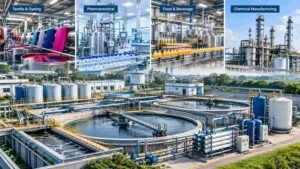
Textile manufacturing
Textile processing can involve dyeing, printing, washing and other processes that produce wastewater with different treatment requirements.
A commercial page should therefore discuss:
- Colour
- COD and BOD
- TDS
- Chemical loads
- Process-water reuse
- ETP upgrades
- Tertiary treatment
- ZLD where applicable
CPCB’s textile-related documentation and standards address parameters including BOD, COD, TDS and colour, making textile wastewater a clear example of why industry-specific treatment information matters.
Pharmaceutical manufacturing
Pharmaceutical wastewater can involve multiple streams and varying characteristics.
The marketing opportunity is not simply “pharma ETP.”
The content should address:
- Process wastewater
- High-COD streams
- Stream segregation
- Physical and chemical treatment
- Tertiary treatment
- ETP adequacy
- Treatment upgrades
- High-TDS treatment
CPCB’s draft pharmaceutical guidelines specifically discuss flow measurement, physical and chemical treatment, tertiary treatment, ETP adequacy assessment and upgrading, and treatment of high-COD/TDS wastewater.
Food and beverage
Content can focus on:
- High organic load
- BOD and COD
- Fats, oils and grease
- Production fluctuations
- Dairy wastewater
- Food-processing wastewater
- Treated-water reuse
Chemical manufacturing
The conversation can move toward:
- Variable pH
- High TDS
- Complex chemical streams
- COD reduction
- Segregation
- Advanced treatment
- Recovery and reuse
Metal processing and electroplating
The focus can shift again toward:
- Surface-treatment wastewater
- Pickling
- Plating
- Heavy metals
- Chemical treatment
- Sludge management
CPCB’s action-plan documentation for industrial areas provides real examples of pharmaceutical, textile, metal-treatment and other manufacturing units operating with ETP requirements.
The important SEO lesson is simple:
One generic ETP page cannot represent every industrial application equally well.
Build pages around the problem that creates the project
This is where the website can move beyond a product catalogue.
Instead of creating only:
“Effluent Treatment Plant Manufacturer”
build commercially useful pages around situations such as:
ETP capacity expansion
For a factory whose production has increased.
Existing ETP upgrade
For a plant that is no longer achieving the required performance.
ETP revamp
For an ageing system where some components need replacement or modification.
Wastewater reuse
For facilities trying to recover treated water for process or utility use.
ZLD implementation
For industries where wastewater recovery and discharge restrictions make advanced treatment necessary.
ETP for a new production line
For companies adding manufacturing capacity.
These pages can rank for different problem-led searches while giving sales teams highly relevant landing pages.
That is far more useful than putting every keyword on the homepage.
What should an industrial ETP landing page contain?
A strong commercial page should answer the questions a project team actually needs answered.
| Page element | Commercial question answered |
| Industry/application | Do you understand our process? |
| Wastewater challenge | Can you handle our effluent? |
| Treatment approach | What type of system may be required? |
| Capacity | Can you handle our flow? |
| Existing plant | Can you upgrade what we already have? |
| Reuse objective | Can treated water be recovered? |
| Project evidence | Have you handled similar applications? |
| Technical information | What do you need from us? |
| Enquiry option | How do we discuss the project? |
This approach makes SEO services for ETP manufacturers more commercially useful because every ranking page has a defined conversion purpose.
Make project evidence do the selling
Industrial buyers are not persuaded by a page filled with phrases such as:
Advanced technology
Best quality
Complete solution
Experienced team
Innovative treatment
Reliable service
Those statements are easy for every competitor to make.
Project evidence is harder to copy.
An ETP manufacturer should create a project library showing the type of work it has actually completed.
A useful case study can show:
Industry: Textile processing
Requirement: ETP capacity expansion
Existing condition: Existing treatment system unable to handle increased production load
Project requirement: Additional treatment capacity and improved treated-water quality
Treatment approach: Relevant treatment stages
Capacity: Project-specific flow
Result: Improvement achieved
The same structure can be used for pharmaceutical, food, chemical, engineering or other industrial applications.
Why this matters for marketing
A prospect searching for:
“ETP upgrade for textile industry”
can be shown an actual textile upgrade project.
A pharmaceutical manufacturer can be shown a pharmaceutical application.
A factory considering reuse can see an example involving recovery and reuse.
This creates a direct connection between:
Search → Evidence → Confidence → Enquiry
That is one of the strongest commercial uses of content for an industrial manufacturer.
Turn technical data into searchable commercial content
ETP manufacturers already possess valuable information.
The problem is that much of it may exist only inside:
- PDF brochures
- Technical proposals
- Project reports
- Quotations
- Drawings
- Presentation decks
- Internal engineering documents
That information can often be converted into useful website content.
For example, instead of keeping everything inside a PDF titled:
“ETP Technical Specification”
create pages and articles answering questions such as:
- What determines ETP capacity?
- What information is required to design an industrial ETP?
- Why does wastewater flow matter?
- What affects ETP treatment performance?
- When is tertiary treatment required?
- What is the role of RO after an ETP?
- When should an existing ETP be upgraded?
- What changes when wastewater is intended for reuse?
This gives search engines more context while giving potential customers useful information before they speak to sales.
It also supports AI search visibility because the website contains direct answers rather than only promotional language.
That is an important part of modern SEO for ETP manufacturers: make the technical knowledge of the company understandable, searchable and connected to commercial intent.
Create a search portfolio instead of chasing one “ETP” keyword
An ETP company does not need every page to rank for the same phrase.
A better approach is to build a portfolio of search intent.
| Search category | Example | Commercial intent |
| Core | ETP manufacturer | High |
| Industry | textile ETP plant | High |
| Industry | pharmaceutical ETP | High |
| Problem | ETP upgradation | Very high |
| Project | industrial ETP plant | High |
| Capacity | 500 KLD ETP plant | High |
| Reuse | industrial wastewater reuse plant | High |
| Technology | industrial RO wastewater treatment | High |
| Service | ETP operation and maintenance | Medium/High |
| Location | ETP manufacturer in India | High |
This is also where the keyword strategy for the marketing agency itself can be separated from the manufacturer’s commercial keywords.
For example:
Primary: SEO for ETP manufacturers
Secondary:
- SEO services for ETP manufacturers
- Digital marketing for ETP manufacturers
- Lead generation for ETP manufacturers
- Digital marketing agency for ETP manufacturers
These terms should appear naturally where the article discusses the marketing challenge—not be forced repeatedly into unrelated paragraphs.
Use Google Ads when a project cannot wait for organic rankings
SEO builds an acquisition channel over time.
Google Ads can capture demand immediately.
But broad advertising can waste a budget if every wastewater-related search is sent to one generic page.
Instead, separate campaigns by commercial requirement.
Campaign: Textile ETP
Landing page:
ETP Solutions for Textile Manufacturing
Campaign: Pharmaceutical ETP
Landing page:
Effluent Treatment Solutions for Pharmaceutical Manufacturing
Campaign: ETP Upgrade
Landing page:
Industrial ETP Upgradation and Revamp
Campaign: Wastewater Reuse
Landing page:
Industrial Wastewater Recycling and Reuse
The landing page should match the search intent.
A company searching for ETP upgradation should not have to navigate through a generic product catalogue.
A pharmaceutical manufacturer should immediately see pharmaceutical-relevant information.
A textile company should see textile-specific project evidence.
This improves the commercial connection between:
Search term → advertisement → landing page → enquiry
Google Ads should therefore complement SEO rather than operate as a completely separate campaign.
Use LinkedIn to reach factories before they search
Google captures existing demand.
LinkedIn can help create conversations with companies that may be approaching an industrial project but have not yet started searching for an ETP supplier.
This is particularly useful for high-value B2B projects.
Target accounts can include:
- Textile manufacturers
- Pharmaceutical companies
- API manufacturers
- Food-processing companies
- Chemical manufacturers
- Engineering companies
- Metal-processing companies
- Industrial parks
- Manufacturing clusters
- Export-oriented factories
Relevant roles can include:
- Plant Head
- EHS Manager
- Engineering Head
- Operations Manager
- Project Manager
- Utility Manager
- Environmental Manager
- Factory Manager
The message should not start with:
“We are the leading ETP manufacturer. Please contact us.”
Instead, use the business situation.
For example:
Expanding production? Your existing ETP capacity may need to be reviewed before the new line becomes operational.
Or:
Planning wastewater reuse in your manufacturing facility? The existing treatment train may need additional tertiary treatment.
The first message should create relevance.
The sales conversation can come later.
Social media should demonstrate engineering capability
For an industrial ETP company, social media should not become a stream of generic motivational graphics.
It can be used to demonstrate technical capability.
Useful content includes:
Plant walkthroughs
Show actual treatment equipment and explain its function.
Before-and-after upgrades
Show how an existing plant was modified.
Industry explainers
For example:
“Why textile wastewater can require different treatment stages from food-processing wastewater.”
Project snapshots
Show capacity, industry, treatment requirement and completed infrastructure.
Engineering questions
Examples:
- What information is needed before designing an ETP?
- When should an existing ETP be upgraded?
- What affects treatment capacity?
- When does wastewater reuse become practical?
Water reuse examples
Explain how suitable treatment can enable industrial reuse.
The objective is not simply social engagement.
The objective is to make the company look technically relevant when a potential customer begins evaluating suppliers.
What kinds of searches are ETP Companies missing every day?
The biggest opportunity is often not another generic “ETP manufacturer” keyword.
It is the collection of smaller searches connected to specific industrial problems.
| Search type | Example missed search | Potential page |
| Industry | ETP for textile industry | Textile ETP page |
| Industry | ETP for pharma industry | Pharmaceutical ETP page |
| Problem | Existing ETP upgrade | ETP upgrade page |
| Project | ETP for production expansion | Expansion solution |
| Reuse | Industrial wastewater recycling | Reuse page |
| Technology | RO after ETP | RO/reuse guide |
| Capacity | 1000 KLD ETP | Capacity/project page |
| Service | ETP revamp company | Revamp service page |
| Location | ETP manufacturer in Hyderabad | Location page |
| Information | How to calculate ETP capacity | Technical article |
There is no need to attach unsupported daily search-volume numbers to these categories.
The commercial point is that search demand is fragmented across industries, problems, applications and project stages.
A website that targets only one broad keyword can miss that long tail.
The enquiry form should behave like the first sales conversation
This is one of the most overlooked areas in industrial lead generation.
A form saying:
Name | Phone | Email | Message
does not tell a sales engineer much.
For an ETP project, the form can capture selected technical information.
Useful fields can include:
Industry
Textile / Pharma / Food / Chemical / Engineering / Other
Approximate wastewater flow
KLD
Existing ETP
Yes / No
Main requirement
New plant / Upgrade / Expansion / Reuse / ZLD / Other
Project stage
Planning / Budgeting / Active project / Urgent
Location
City and state
The form does not need twenty questions.
It needs enough information to determine what happens next.
A person requesting a 1,000 KLD ETP for a pharmaceutical plant should not enter the same sales queue as someone simply downloading a brochure.
This is where Lead generation for ETP manufacturers becomes more sophisticated than simply collecting contact details.
AI Lead Qualification can separate project enquiries from casual enquiries
Once enquiries begin arriving through SEO, Google Ads, LinkedIn and social media, another problem appears:
Which leads should the sales team contact first?
AI can help classify them.
For example:
Lead A
“We are a textile processing company expanding from 400 KLD to approximately 700 KLD and need ETP augmentation with water reuse.”
This is a high-context project enquiry.
Lead B
“Send ETP brochure.”
This may be an early-stage enquiry.
Lead C
“Need STP for apartment.”
This may not match an industrial ETP manufacturer’s target market at all.
AI qualification can help classify enquiries using available information such as:
- Industry
- Project requirement
- Capacity
- Location
- Existing plant
- Treatment objective
- Project stage
- Buyer intent
Adsthrive currently positions AI Lead Qualification as a way to identify and prioritize high-intent prospects, alongside AI follow-ups, WhatsApp AI, AI ChatBot and AI Calling.
The purpose is not to let AI make engineering decisions.
The purpose is to help the sales team identify which conversation needs attention first.
Existing ETPs can become a second source of industrial enquiries
New plant projects are attractive, but existing factories create another substantial commercial opportunity.
An ETP may need attention because:
- Production has increased
- Wastewater characteristics have changed
- Equipment has aged
- Treatment performance has declined
- Discharge requirements have changed
- Water reuse is being considered
- New treatment stages are required
- Automation needs improvement
- RO or tertiary treatment needs to be added
This creates a separate marketing category:
ETP upgrade, revamp and modernization.
That category deserves its own search pages, advertising campaigns and case studies.
An existing plant also gives an ETP manufacturer a different sales proposition.
Instead of selling an entirely new system, the company may be able to provide:
Assessment → modification → additional treatment → reuse → monitoring → maintenance
That can create repeat business from an industrial facility.
Water reuse can move the conversation from treatment cost to operational value
An ETP is often discussed as an environmental requirement.
But industrial reuse can change the commercial discussion.
The Ministry of Jal Shakti’s material on wastewater recovery and reuse describes industrial applications involving treatment followed by UF and RO, including reuse in cooling and process applications. It also notes the use of membrane treatment in textile, food processing, alcohol distillery and engineering-component industries.
That gives ETP Companies another content and sales angle.
Instead of:
“We manufacture ETP plants.”
the conversation can become:
“How can your facility recover more usable water from its wastewater?”
This opens opportunities around:
- Wastewater recycling
- RO
- UF
- Tertiary treatment
- Process-water reuse
- Cooling-water reuse
- ZLD
- Freshwater reduction
The marketing message becomes more commercially interesting because it connects wastewater treatment with the operation of the factory.
Where Adsthrive fits into the commercial system
An ETP manufacturer does not need separate disconnected tools for every part of its acquisition process.
The commercial system can connect:
SEO → Google Ads → Website → Enquiry → AI Qualification → WhatsApp → AI Calling → CRM → Sales Follow-up
Adsthrive can build this around the manufacturer’s actual workflow.
Its SEO services can focus organic visibility on the industries, applications and problems the manufacturer wants to target. Adsthrive also offers lead generation services covering search, paid campaigns and conversion-focused acquisition.
For the enquiry stage, an AI ChatBot Agent can handle website conversations, capture information and provide human handoff when required. Adsthrive’s AI Calling Solution can support outbound follow-up, qualification and meeting-booking workflows.
The advantage is that the marketing system can be designed around the ETP company’s sales process rather than forcing the company to operate several unrelated tools.
For example:
Google search
A pharmaceutical company searches for an ETP solution.
↓
Relevant landing page
It reaches a pharmaceutical-specific treatment page.
↓
Technical enquiry
The visitor submits industry, KLD, existing ETP and project requirement.
↓
AI qualification
The enquiry is classified according to available information.
↓
WhatsApp / calling
The prospect receives an appropriate response or follow-up.
↓
CRM
The lead and its source are recorded.
↓
Sales team
A qualified industrial opportunity reaches the appropriate person.
That is where Digital marketing for ETP manufacturers becomes a commercial operating system rather than simply a collection of campaigns.
Use AI SEO to expand the way technical expertise is discovered
Search is no longer limited to ten blue links.
Industrial buyers increasingly use search engines, AI tools and conversational interfaces to investigate suppliers and technical questions.
That makes structured technical information increasingly valuable.
An ETP manufacturer’s website should clearly explain:
- Industries served
- Treatment technologies
- Applications
- Project capacities
- Treatment challenges
- Existing-plant upgrades
- Reuse applications
- Case studies
- Technical terminology
- Frequently asked questions
This gives both conventional search and AI-driven discovery more context.
Adsthrive’s AI SEO services can be integrated into the wider search strategy rather than treated as a separate activity.
The objective remains the same:
Make the company’s expertise discoverable when an industrial problem is being researched.
One previous industrial lesson ETP manufacturers can apply
ETP marketing has a lot in common with other technical manufacturing sectors, but the content should still remain industry-specific.
For example, Adsthrive’s recent guide on How Industrial Component Manufacturers Can Generate More Leads takes a similar principle from another manufacturing market: buyers often search for a capability, material, process, application or technical requirement before they search for a company name.
For ETP Companies, the equivalent searches can revolve around industry, wastewater characteristics, capacity, treatment objective, upgrade requirement and reuse.
The lesson transfers.
The content itself should not.
Measure enquiries, not just rankings
An ETP manufacturer can rank for dozens of keywords and still generate poor commercial results.

Marketing reports should therefore connect visibility to sales.
| Measurement | Commercial question |
| Industry-specific rankings | Are target sectors finding us? |
| Organic enquiries | Is SEO creating demand? |
| Google Ads enquiries | Which paid searches produce interest? |
| Qualified leads | Are enquiries relevant? |
| Industry-wise leads | Which sectors respond best? |
| Project type | New plant, upgrade or reuse? |
| Technical completeness | Does sales have enough information? |
| Quotations | Are leads reaching the proposal stage? |
| Opportunities | Which leads become genuine projects? |
| Sales | Which marketing sources create revenue? |
Suppose pharmaceutical enquiries are fewer than textile enquiries but produce substantially more qualified projects.
The answer is not necessarily to generate more pharmaceutical traffic.
The answer may be to invest more intelligently in pharmaceutical content, case studies, paid search and account targeting.
That is why the final KPI should move from:
“How much traffic did we generate?”
to:
“How many commercially relevant industrial opportunities did marketing create?”
A practical content plan for ETP Companies
Once the core commercial pages are established, the blog should expand around real industrial questions.
Industry-specific topics
- ETP for textile manufacturing
- ETP for pharmaceutical companies
- ETP for food-processing industries
- ETP for chemical manufacturing
- ETP for metal-processing industries
- ETP for dairy plants
Problem-led topics
- Signs an existing ETP needs an upgrade
- How production expansion affects ETP capacity
- Why an industrial ETP may underperform
- When should an ETP be revamped?
- How to prepare for an ETP capacity expansion
Reuse-focused topics
- Industrial wastewater recycling
- ETP with RO for water reuse
- How treated wastewater can be reused in manufacturing
- ZLD and wastewater recovery
- Tertiary treatment for industrial reuse
Technical-commercial topics
- Information required before designing an ETP
- How ETP capacity is determined
- Factors affecting industrial ETP cost
- New ETP vs ETP upgradation
- What to include in an ETP technical enquiry
Each article should have a defined purpose.
One should generate an industry lead.
Another should capture upgrade demand.
Another should support an RO/reuse service.
Another can answer a technical question and internally link to a project page.
This avoids publishing multiple articles that all compete for the same keyword.
Frequently Asked Questions
How can ETP Companies generate more industrial enquiries?
They should market around the industries and situations that create wastewater-treatment projects. Industry-specific SEO, technical landing pages, project evidence, Google Ads, LinkedIn outreach, structured enquiry forms and AI lead qualification can work together to generate and prioritize better enquiries.
Which industries use ETPs?
ETPs are used across many industrial sectors, including textile processing, pharmaceuticals, food and beverage, chemicals, metal processing, electroplating, engineering, dairy, paper and other manufacturing operations. The treatment requirement depends on the wastewater characteristics and the facility’s discharge or reuse objective.
What is the most important SEO strategy for an ETP manufacturer?
Build search visibility around industries, wastewater problems, applications and project requirements, not only the generic term “ETP manufacturer.” Pages for textile, pharma, chemical, food, ETP upgrades, reuse and other genuine commercial applications can capture more specific demand.
Should an ETP company invest in Google Ads?
Yes, particularly for high-intent searches where a potential customer is actively looking for an ETP, industry-specific treatment solution or ETP upgrade. Each campaign should ideally lead to a page closely matching the search.
What information should an ETP enquiry form collect?
Useful information includes industry, location, approximate wastewater flow, existing ETP status, primary requirement and project stage. The form should collect enough information to help sales prioritize the enquiry without making the form unnecessarily difficult to complete.
Can AI qualify ETP leads?
Yes. AI can classify enquiries based on information such as industry, project requirement, capacity, location, urgency and project stage. It can help sales teams prioritize leads, while technical assessment and final project decisions remain with the appropriate human team.
Can existing ETP plants generate new business?
Yes. Existing plants may require capacity expansion, revamping, additional treatment, tertiary treatment, RO, reuse systems, automation, monitoring or performance improvements. These can be marketed as separate commercial opportunities.
How can LinkedIn help ETP manufacturers?
LinkedIn can help identify plant heads, engineering managers, EHS professionals, project managers and other decision-makers within industries that use ETPs. Instead of sending generic promotional messages, outreach should focus on relevant industrial situations such as production expansion, wastewater reuse or ETP upgrades.
Generate More Industrial Enquiries With a Connected Marketing System
An ETP manufacturer does not need to rank for every wastewater-related search.
It needs to be visible when a relevant industrial company has a reason to buy.
That reason could be a new production line, an overloaded ETP, a factory expansion, a treatment-performance problem, a water-reuse project or a new treatment requirement.
The marketing strategy should therefore follow the commercial reality of the industry:
Industrial problem → Search → Relevant expertise → Project evidence → Technical enquiry → Qualification → Follow-up → Sales opportunity
That is the role of SEO for ETP manufacturers when it is treated as a revenue channel rather than simply a ranking exercise.
Adsthrive can connect SEO, AI SEO, Google Ads, social media, LinkedIn outreach, lead generation, AI Chat, WhatsApp automation, AI Lead Qualification, AI calling and follow-up into a customized system based on the manufacturer’s actual sales workflow.
The objective is straightforward:
Reach the right industries. Demonstrate technical relevance. Generate better enquiries. Qualify them faster. Give sales a clearer path to the opportunity.
For ETP manufacturers looking to build a stronger industrial lead pipeline, talk to Adsthrive.