The enquiry problem starts before a buyer contacts your sales team
An industrial cooling buyer rarely begins with a general search for a supplier. They may be trying to stabilise a moulding process, replace an unreliable chiller, reduce cooling-water consumption, control a chemical process temperature or expand a production line. Each requirement leads to a different search, and each buyer needs different technical information before requesting a quotation.
For an industrial cooling company, the commercial challenge is not simply getting more website visitors. It is attracting buyers whose applications match the company’s equipment, capacity range, engineering capability and service coverage.
SEO for industrial cooling companies should therefore connect real industrial requirements with useful product information and a clear route to an enquiry. Combined with Google Ads, LinkedIn outreach, targeted social media, lead generation and AI-powered follow-ups, this creates a more organised way to find potential projects and move them towards a sales discussion.
This article looks at the opportunity from the buyer’s perspective: what triggers a cooling-system search, what makes a manufacturer worth contacting, where potential enquiries get lost and how AdsThrive can help build a connected marketing and lead-management system.
Industrial cooling buyers are not all looking for the same solution
A company selling industrial chillers, cooling towers, heat exchangers, dry coolers or process-cooling systems may serve several industries. However, those industries do not purchase cooling equipment for identical reasons.
A plastics manufacturer may need stable mold temperature. A food-processing plant may require controlled cooling at different stages of production. A pharmaceutical facility may have strict process and environmental requirements. A machine-tool manufacturer may need cooling for laser equipment, CNC machines or hydraulic systems.
The product category may be similar, but the buying conversation is different.
Consider these examples:
- Plastics and injection moulding: The buyer may be evaluating mould cooling, water temperature stability, production-cycle consistency and the number of machines connected to the cooling circuit.
- Food and beverage processing: The enquiry may involve process-water cooling, refrigeration, hygiene requirements, temperature control and continuous operating schedules.
- Pharmaceutical and chemical manufacturing: The buyer may need a cooling arrangement suited to a particular process, fluid, temperature range and operating environment.
- Automotive and engineering plants: Cooling may be required for machine tools, hydraulic systems, furnaces, welding equipment or production lines.
- Data centres and large facilities: The discussion may involve heat rejection, redundancy, equipment footprint, energy consumption and integration with existing infrastructure.
A manufacturer that markets only the phrase “industrial cooling solutions” may miss these application-specific searches. A buyer searching for a process chiller for injection moulding may not immediately recognise that a general cooling-equipment website can meet that requirement.
This is where a more focused approach to Digital marketing for industrial cooling companies becomes commercially useful: make the right application visible, explain the equipment’s relevance and help the buyer take the next step.
What makes an industrial cooling enquiry commercially valuable?
Website enquiries should not all be treated as equal. A request for a product brochure is different from a project enquiry that includes a production application, cooling capacity, operating temperature and installation location.
The marketing system should help the sales team identify the difference.
A useful enquiry may contain some of the following details:
- Industry and application.
- Equipment or process that needs cooling.
- Required cooling capacity, where known.
- Desired supply and return temperatures.
- Fluid or coolant information.
- Operating hours and load pattern.
- Indoor or outdoor installation.
- Existing equipment details, if it is a replacement.
- Project location and expected installation timeline.
- Whether the requirement is for a new plant, expansion, retrofit or breakdown replacement.
Not every buyer will know all these specifications. A marketing form should not demand an engineering document before allowing someone to contact the company. Instead, it should collect enough information to start a useful conversation.
A prospect who only knows that a production machine is overheating should still be able to submit an enquiry. The sales or technical team can gather the remaining details during the next interaction.
The objective is to capture intent without making the process difficult.
Six commercial opportunities industrial cooling companies should build into their marketing
The following are not six versions of the same SEO activity. Each addresses a different point at which a cooling-equipment business can lose a potential project.
1. Own the application search, not just the equipment name
A buyer may know the industrial problem but not the exact equipment category. Someone responsible for a plastic injection molding line might search for mold temperature control, process water cooling or a chiller for injection molding before searching for a particular manufacturer.
A chemical plant engineer may search for reactor cooling or temperature control for a process vessel. A production manager may look for machine cooling equipment after experiencing inconsistent operating temperatures.
These searches are valuable because they reveal the application behind the requirement.
Build website content around the industries and processes your company actually serves. Each page should explain the relevant cooling requirement, the equipment options you supply and the information a buyer should share to receive a suitable recommendation.
For example, a manufacturer could create focused content for:
- Process cooling for injection moulding.
- Industrial chillers for laser cutting equipment.
- Cooling towers for manufacturing facilities.
- Water cooling systems for compressors.
- Industrial cooling for food-processing operations.
- Heat exchangers for process applications.
- Cooling solutions for chemical and pharmaceutical plants.
Do not create pages for applications that your company cannot support. A page that attracts an unsuitable enquiry may increase traffic while wasting sales time.
The content should also explain the limits of the solution. If a particular chiller configuration is suitable only under specified operating conditions, communicate that clearly. Honest technical information helps the right buyer assess whether a conversation is worth having.
For technical context, the AHRI guidance on liquid chiller selection discusses considerations such as load profile, installation space, sound requirements, climate and full-load versus part-load performance. These are useful examples of the type of decision-making information that can make a product page more helpful than a basic catalogue listing.
How AdsThrive can help: AdsThrive can plan application-led SEO pages, improve existing product content and build a connected organic search strategy. Its AI SEO services can support the work of organising content around buyer questions, product categories and commercial search intent.
2. Turn technical product information into a reason to enquire
A product page should do more than display a photograph and a list of specifications. Industrial buyers need enough information to decide whether the manufacturer is worth contacting.
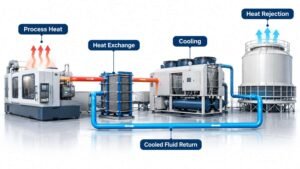
For a cooling tower, the buyer may want to understand the type of tower, operating arrangement, application suitability, water-related considerations and maintenance requirements.
For a process chiller, the buyer may need information about cooling capacity, temperature range, fluid compatibility, compressor configuration, installation conditions and available controls.
For a heat exchanger, the discussion may involve the process fluid, heat-transfer duty, material selection, operating pressure and temperature conditions.
A product page does not have to publish every engineering detail. Some information may be project-specific or require a technical review. However, it should explain what the equipment does, where it is used and what information the company needs to recommend a configuration.
A practical product page can include:
- A clear product description.
- Applications and industries served.
- Product photographs or technical drawings.
- Available configurations, where confirmed.
- Key specifications approved by the engineering team.
- Installation or operating considerations.
- Downloadable brochures or product documents, if available.
- A visible request-a-quotation option.
- A short enquiry form.
The quotation form should be relevant to the product. A cooling tower enquiry may ask about the application, water flow, heat-rejection requirement and project location. A process chiller enquiry may ask about the process, cooling capacity, target temperature and fluid.
The form should allow buyers to submit partial information. A sales engineer can follow up to complete the technical picture.
A useful external reference is the industrial chiller technical quotation format. It illustrates how application, cooling capacity, target temperature, flow rate, pump pressure, electrical requirements and site conditions can contribute to a more useful technical enquiry. The exact fields should always be adapted to your own equipment and engineering process.
How AdsThrive can help: AdsThrive can improve product landing pages, create enquiry-focused website sections and connect forms with automated follow-up. Its AI chatbot agent can help visitors ask initial product questions and move towards an enquiry rather than leaving the website without taking action.
3. Build a replacement and retrofit opportunity channel
New industrial projects are only one source of revenue. Existing plants also need cooling-equipment replacement, system upgrades, additional capacity and performance improvements.
A manufacturer that focuses only on new equipment searches may overlook buyers who already have a cooling system but are experiencing operational problems.
Potential buying situations include:
- Existing equipment is unable to meet a changed production load.
- A factory is adding machinery or a new production line.
- The current cooling system has become unreliable.
- Maintenance costs are increasing.
- The plant is reviewing energy consumption.
- The facility needs a different cooling arrangement because of space or water constraints.
- The business is replacing an older unit with a more suitable configuration.
- A new process requires tighter temperature control.
These buyers often have a more immediate reason to speak with a supplier than someone conducting general product research.
Create content and campaigns that address these situations. A page about industrial chiller replacement, for example, should explain what information helps assess an existing installation. A retrofit page can discuss the importance of reviewing the current load, operating conditions, available space and connected equipment before recommending a change.
Avoid promising a fixed percentage of energy savings or a guaranteed reduction in operating cost unless the claim is supported by verified project data.
The Bureau of Energy Efficiency’s energy conservation guidelines for industries discusses areas such as insulation, heat recovery, efficient cooling utilities and reducing avoidable energy use. This provides useful context for content addressing plant-level efficiency and equipment improvement. It should not be used to claim that every replacement project will produce the same result.
How AdsThrive can help: AdsThrive can build separate landing pages and campaigns for replacement, retrofit and new-installation enquiries. Google Ads can target people actively searching for these requirements, while automated follow-ups can help the sales team respond before the prospect moves to another supplier.
Explore Google Ads and PPC services for paid search campaign support.
4. Use LinkedIn to reach the people who influence equipment selection
Industrial cooling purchases can involve several decision-makers. The plant head may identify the operational problem, the maintenance manager may provide equipment details, the project engineer may evaluate the technical solution and the procurement team may manage quotations and supplier comparisons.
Marketing only to a general company audience makes it harder to reach these individuals.
LinkedIn can help industrial cooling companies identify and engage with relevant professionals, including:
- Plant heads and factory managers.
- Maintenance and utility managers.
- Project and mechanical engineers.
- Procurement managers.
- Facility managers.
- EPC and project consultants.
- Industrial system integrators.
- OEM and machinery manufacturers.
The objective should not be to send the same sales message to hundreds of people. Outreach should be based on industry, role and a plausible business requirement.
For example, a company supplying process chillers could share a technical post about cooling requirements in plastics manufacturing. Its sales team could then connect with relevant production and engineering professionals who work in that sector.
A cooling-tower manufacturer might publish a practical explanation of what a plant should review when planning a replacement. A company specialising in industrial heat exchangers could share application-focused material for process industries.
A sensible LinkedIn outreach sequence might include:
- Identify a relevant company and professional role.
- Review the organisation’s industry and likely application.
- Connect with a short, relevant introduction.
- Share a useful technical resource when appropriate.
- Ask whether the organisation has a current or upcoming requirement.
- Move interested prospects into a sales conversation.
This is a relationship-building activity, not a bulk messaging exercise.
How AdsThrive can help: AdsThrive can support social media content planning, professional brand communication and campaign coordination. Its social media marketing services can help industrial companies present technical capabilities consistently and build recognition among relevant business audiences.
5. Make Google Ads compete for high-intent project enquiries
Organic search visibility takes time to build. If an industrial cooling company wants to target active buyers while its SEO work develops, paid search can provide an additional route to relevant enquiries.
However, a broad campaign for “cooling solutions” can attract residential air-conditioning searches, repair requests, consumer product enquiries and other traffic that does not match an industrial manufacturer’s offering.
Campaigns should be separated according to commercial intent.
A practical structure could include:
- Product campaigns: Industrial chillers, cooling towers, dry coolers and heat exchangers.
- Application campaigns: Process cooling for plastics, machine cooling, food-processing cooling and other supported applications.
- Project campaigns: Industrial cooling system installation, plant expansion and new project requirements.
- Replacement campaigns: Industrial chiller replacement, cooling tower replacement and retrofit requirements.
- Location campaigns: Regions where the company can realistically supply, install or service equipment.
Each campaign should lead to a relevant landing page. A person searching for an industrial cooling tower should not be sent to a generic homepage and expected to locate the correct product.
Use negative keywords to reduce irrelevant traffic. Depending on the business model, these may include residential, home, portable, personal, small domestic appliance or repair-related terms.
Track more than clicks. A campaign that produces fewer but technically relevant enquiries may be more commercially valuable than one that generates a high number of unqualified forms.
Measure:
- Enquiries received.
- Relevant application matches.
- Valid business contact details.
- Quotations requested.
- Site visits or technical discussions arranged.
- Opportunities accepted by the sales team.
- Orders and revenue where tracking is available.
This allows marketing decisions to be based on sales quality rather than traffic alone.
How AdsThrive can help: AdsThrive can manage campaign planning, keyword targeting, landing-page alignment and enquiry tracking. The goal is to make paid search work alongside SEO instead of treating it as a separate activity.
6. Connect enquiry capture with AI qualification and sales follow-up
An industrial cooling enquiry may arrive when the sales team is at a site visit, attending a technical meeting or handling another customer. If the prospect receives no response, they may contact another manufacturer.
The problem is not always a lack of leads. Sometimes there is a gap between receiving an enquiry and acting on it.
AI automation can help close this gap.
For example, a website visitor may submit a request for a process chiller. An automated system can acknowledge the enquiry and ask a few relevant questions:
- What process or machine requires cooling?
- Is the requirement for a new installation or replacement?
- What cooling capacity is required, if known?
- What temperature is needed?
- Where will the equipment be installed?
- When is the project expected to proceed?
The answers can be organised for the sales team. A request with a clear application and project timeline can be prioritised for a technical discussion. A brochure request can be handled differently. A spare-parts or service enquiry can be routed to the relevant team if the company offers those services.
AI should not independently approve an engineering design or promise that a particular unit is suitable. Technical selection still requires qualified personnel and the necessary operating data.
The useful role of automation is to collect information, acknowledge the enquiry, organise the details and make sure the next action is not forgotten.
How AdsThrive can help: AdsThrive offers connected automation capabilities that can support this process:
- AI lead qualification to organise incoming prospect information.
- WhatsApp AI agent to handle initial conversations and collect basic requirements.
- AI calling solutions to support prompt call-based follow-up.
- AI follow-ups to reduce missed callbacks and unanswered enquiries.
- AI booking systems to help arrange sales or technical discussions.
These capabilities can work together as a connected lead-management process rather than forcing the company to manage every enquiry manually across separate channels.
The search opportunities industrial cooling companies may be missing
The following table is a practical starting point for keyword research. It represents search themes worth checking in Google Keyword Planner, Search Console and paid-search reports; it is not a claim about verified daily search volumes.
| Search theme | Example buyer search | Commercial opportunity |
| Product-specific | Industrial water chiller manufacturer | Buyer comparing equipment suppliers |
| Application-specific | Chiller for injection moulding machine | Buyer with a defined production requirement |
| Replacement | Industrial chiller replacement | Existing plant evaluating a new unit |
| System-specific | Industrial cooling tower supplier | Buyer looking for a particular system |
| Project-specific | Process cooling system installation | New plant or expansion opportunity |
| Technical requirement | Cooling capacity for process equipment | Buyer researching equipment suitability |
| Supplier-focused | Industrial cooling companies in India | Buyer shortlisting manufacturers |
The actual search volume and competition will vary by location, product category and wording. Some highly specific searches may have low recorded volume but still produce valuable enquiries because the searcher has a defined requirement.
For SEO for industrial cooling companies, the objective is not to rank for every possible cooling-related phrase. It is to identify the searches that match the company’s products, applications, service capabilities and commercial priorities.
Give buyers a way to compare your capabilities before they request a quotation
Industrial buyers rarely evaluate a supplier on one specification alone. They may compare equipment suitability, manufacturing capability, delivery timelines, service support, customisation and the supplier’s experience with similar applications.
A website should help answer these questions without making unsupported claims.
Show evidence of actual engineering and manufacturing capability
If your company manufactures equipment, show the manufacturing and testing capabilities that are relevant to buyers. Useful material can include:
- Factory and assembly photographs.
- Product testing and inspection processes.
- Engineering and design capabilities.
- Quality certifications that are current and applicable.
- Available product configurations.
- Installation and commissioning support, if offered.
- Service and maintenance coverage, if offered.
- Case studies with customer permission.
A case study should explain the original requirement, the equipment supplied and the project context. For example, a process-cooling project could describe the type of production operation, the cooling challenge and the system configuration selected. Do not publish confidential customer details or performance figures without approval.
Explain what makes your company suitable for a particular project
A buyer looking for a standard packaged chiller may need a different supplier profile from a buyer seeking a custom cooling system for a complex industrial process.
Your website should make it easy to understand:
- Which equipment categories you supply.
- Which industries you serve.
- Whether you handle standard or customised requirements.
- Whether you support installation or commissioning.
- Which regions you can serve.
- How a buyer can request technical assistance.
This is also where SEO services for industrial cooling companies should go beyond inserting keywords into headings. The work should improve the information architecture of the website so buyers can move from an application page to a product page, from a product page to technical details and from there to a relevant enquiry route.
Make technical documents useful instead of hiding them
Brochures, product catalogues and technical documents can help buyers assess a supplier. However, placing a PDF on a website without any explanation limits its usefulness.
Introduce each document with a short description:
- What equipment does it cover?
- Which applications does it address?
- What information will the buyer find inside?
- Is it a general brochure or a project-specific technical document?
Where appropriate, provide a separate enquiry option beside the download. Do not force every visitor to submit a form simply to read basic product information. Make the next step available when the visitor is ready.
“Discover how industrial ventilation businesses can attract more qualified leads, improve online visibility, and drive business growth with effective digital marketing strategies for industrial ventilation companies.”
Reach buyers at the locations where industrial projects are happening
A cooling-equipment company may supply nationally, serve selected industrial clusters or export to international markets. Its marketing should reflect its actual operating territory.
If the company has strong service coverage in a particular region, location-specific pages and campaigns can help buyers understand where support is available. These pages should contain meaningful information about the company’s service area, relevant industries, project capabilities and contact process.
Avoid publishing dozens of near-identical city pages with only the place name changed. Such pages provide little value to buyers and can create a poor website experience.
A stronger approach is to build a few substantial regional pages around genuine business coverage. For example, a company serving manufacturing clusters in Pune, Chennai, Bengaluru, Hyderabad or Ahmedabad could explain the industries it supports and the type of cooling equipment it supplies in those markets.
For export-oriented manufacturers, the website may also need international product information, clear enquiry routing and content that helps overseas buyers understand the company’s capabilities. Product terminology, units of measurement, electrical requirements and service expectations should be reviewed for the target market rather than copied unchanged from a domestic page.
The marketing message should match the company’s ability to deliver. If installation is available only in selected regions, say so. If equipment can be exported but on-site service is handled through partners, explain the arrangement accurately.
Why social media can influence an industrial cooling purchase
Social media is not usually the final place where a plant engineer chooses a cooling system. However, it can help the company remain visible while buyers research suppliers, discuss projects and evaluate technical options.
For industrial cooling companies, useful social content is often closer to engineering communication than conventional promotional advertising.
Examples include:
- A short video showing a chiller assembly or factory testing process.
- A visual explanation of air-cooled and water-cooled system differences.
- A project photograph with a brief explanation of the application.
- A maintenance checklist for cooling towers.
- A post explaining what information is needed before requesting a process-cooling quotation.
- A technical team’s explanation of a common equipment-selection question.
- An update about a new product range or manufacturing capability.
Each post should have a clear purpose. A manufacturing video can build confidence in production capability. An application post can help a buyer recognise that the company serves their industry. A technical explainer can encourage a prospect to ask a more informed question.
Paid social campaigns can also be used to reach selected business audiences, promote a technical resource or bring relevant visitors to a product page. However, the campaign should be judged by the quality of business enquiries it generates, not by likes or impressions alone.
What a connected AdsThrive marketing system can look like
Industrial cooling companies often use different vendors or tools for SEO, advertising, social media, website enquiries, WhatsApp and sales follow-ups. When these activities are disconnected, a prospect may interact with the company several times without the sales team having a clear view of the conversation.
AdsThrive’s approach can bring these activities into a more coordinated system.
| Business requirement | AdsThrive support | Commercial purpose |
| Buyers cannot find the right product pages | SEO and AI SEO | Improve visibility for relevant searches |
| Active buyers are choosing competitors | Google Ads and landing pages | Capture high-intent search demand |
| Technical capability is not visible | Social media marketing | Build awareness and credibility |
| Enquiries arrive with incomplete details | AI lead qualification and chatbot | Collect and organise initial requirements |
| Prospects are not contacted promptly | WhatsApp AI agent and AI calling | Support timely communication |
| Sales discussions are delayed | Follow-up and booking automation | Help organise the next action |
This is not a promise that automation will replace the technical or sales team. It is a way to reduce repetitive administrative work so that the team can focus on application review, quotations and project discussions.
For instance, an enquiry received through a Google Ads landing page can be captured with its source information. An AI assistant can collect the initial application and location details. The sales team can then review the enquiry, contact the prospect and arrange a technical meeting. If the prospect is not ready to proceed, an appropriate follow-up can be scheduled.
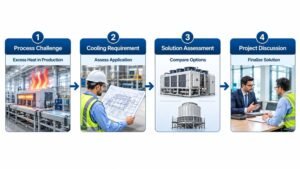
The same process can support enquiries received through the website or WhatsApp, provided the channels and systems are configured correctly.
For companies that need a more coordinated marketing and automation setup, a digital marketing agency for industrial cooling companies should understand both sides of the requirement: generating relevant demand and helping the business respond to it.
What should an industrial cooling company measure every month?
A monthly marketing report should explain whether the company is attracting the right buyers and whether those buyers are progressing towards a commercial discussion.
Traffic and rankings are useful indicators, but they do not tell the full story.
Track these measures:
Search visibility
- Organic clicks and impressions for product and application pages.
- Search terms generating relevant visitors.
- Pages gaining or losing visibility.
- Enquiries generated through organic search.
Paid campaigns
- Cost per enquiry.
- Search terms triggering advertisements.
- Landing-page conversion rate.
- Percentage of enquiries matching the company’s products and service area.
Lead quality
- Number of valid business enquiries.
- Product or application fit.
- Project location.
- New installation versus replacement requirement.
- Enquiries progressing to technical discussions or quotations.
Sales movement
- Time taken to respond.
- Follow-ups completed.
- Technical meetings arranged.
- Quotations issued.
- Opportunities converted into orders, where the sales team can share this information.
A useful distinction is between a marketing conversion and a sales-qualified opportunity. A person downloading a brochure has completed a marketing action. A buyer with a relevant application, a genuine project and an intention to evaluate suppliers may represent a stronger sales opportunity.
This distinction helps the company decide which campaigns deserve more investment.
Frequently asked questions about industrial cooling marketing
1. How can industrial cooling companies get more B2B enquiries?
Build visibility around the applications and equipment you supply, improve product pages, run targeted Google Ads, use LinkedIn to reach relevant professionals and make it easy to request a technical quotation. AI-assisted enquiry capture and follow-ups can help the sales team respond consistently.
2. Why is SEO important for industrial cooling manufacturers?
SEO helps manufacturers appear when engineers, plant managers, procurement teams and project consultants search for equipment or application-specific cooling solutions. It can also help buyers understand product capabilities before contacting the company.
3. Which keywords should an industrial cooling company target?
Target a combination of product, application, project and supplier searches. Examples include industrial chiller manufacturer, process cooling system, industrial cooling tower supplier, chiller for injection moulding and industrial cooling equipment replacement. Choose terms that match the company’s actual capabilities.
4. Can Google Ads generate enquiries for industrial cooling equipment?
Yes. Google Ads can target people actively searching for products, applications or replacement solutions. Campaigns should use relevant keywords, negative keywords and product-specific landing pages to reduce irrelevant enquiries.
5. How can LinkedIn help industrial cooling companies?
LinkedIn can help manufacturers reach plant heads, maintenance managers, project engineers, procurement professionals, consultants and industrial partners. Technical posts and relevant one-to-one outreach can support supplier awareness and business conversations.
6. What information should an industrial cooling enquiry form collect?
Start with the applicant’s name, company, contact details, application, equipment requirement and project location. Where relevant, ask for cooling capacity, target temperature, fluid type and project timeline. Allow buyers to submit the information they currently have rather than making every technical field mandatory.
7. Can AI qualify industrial cooling leads?
AI can collect initial project details, categorise enquiries, acknowledge submissions and help schedule follow-ups. It should not replace engineering review, equipment sizing or technical approval by qualified personnel.
8. How long does SEO take to generate industrial cooling enquiries?
SEO is a longer-term activity. The timeline depends on the website’s existing authority, competition, technical condition, content quality and target search terms. Paid search can be used alongside SEO when a company needs an additional source of active enquiries while organic visibility develops.
Turn technical visibility into a consistent source of enquiries
For industrial cooling companies, marketing should not be measured by how many people visit a website. It should be measured by whether the right businesses discover the company, understand its capabilities and take the next step towards a project discussion.
A manufacturer may have excellent equipment, engineering knowledge and production facilities, yet lose opportunities because its website does not explain the applications it serves. Another company may attract visitors through advertising but fail to follow up when buyers submit incomplete requirements.
Both problems need to be addressed together.
A well-planned strategy for SEO for industrial cooling companies should connect application-based search visibility, technically useful product pages, paid campaigns and organised enquiry management. The primary keyword should appear naturally across the page, supported by the secondary terms where they genuinely fit the discussion.
AdsThrive can help bring these activities together through SEO, Google Ads, social media, lead generation, AI chat, WhatsApp automation, AI calling, follow-ups and booking systems.
If your industrial cooling business wants to attract more relevant project enquiries and improve the way incoming leads are handled, contact AdsThrive to discuss a marketing and automation strategy aligned with your products, target industries and sales process.