An Industrial UPS is rarely purchased simply because a company wants “backup power.” A manufacturing plant may need it to keep PLCs, CNC machines, robotics or process controls running through a power disturbance. A hospital may need continuous power for critical medical systems. A telecom operator needs dependable power for network infrastructure, while an oil and gas facility may require UPS protection for control, instrumentation and emergency systems. Data centres, railways, airports, pharmaceuticals, food processing and utilities all have different reasons for specifying an UPS.
That difference is a major marketing opportunity.
Instead of marketing every UPS product with the same message — reliable backup power, high efficiency, long battery life — companies can build their digital presence around where Industrial UPS systems are actually used, what they protect and what happens when that equipment loses power.
This article takes that approach. Rather than starting with procurement behaviour or a generic digital marketing funnel, it looks at the industries using Industrial UPS systems and shows how manufacturers can turn those applications into search visibility, product enquiries, paid campaigns, qualified leads and sales opportunities.
The real commercial opportunity is inside the application
An UPS manufacturer can have dozens of models, multiple power ratings, battery options and custom configurations, yet still struggle to generate enquiries.
The problem is often not the product range.
It is how the product range is presented online.
Consider two searches:
- “Industrial UPS manufacturer”
- “UPS for CNC machines manufacturing plant”
Both can lead to a commercial enquiry, but the second search reveals much more about the application.
The buyer is not merely looking for an UPS. They are looking for a solution to protect a manufacturing process.
The same pattern appears across industries:
| Industry | What the UPS may protect | Potential commercial search |
| Manufacturing | PLCs, CNC machines, robotics, automation | UPS for manufacturing automation |
| Data centres | Servers, networking, storage and critical IT | 3 phase UPS for data centres |
| Healthcare | Critical medical and hospital systems | UPS for hospital equipment |
| Telecom | Network and communication infrastructure | Industrial UPS for telecom |
| Oil & gas | Instrumentation, control and emergency systems | UPS for oil and gas applications |
| Rail & transport | Signalling, control and communication | UPS for railway signalling |
| Pharmaceuticals | Process control, monitoring and production systems | UPS for pharmaceutical manufacturing |
| Water treatment | Control systems, instrumentation and automation | UPS for water treatment plants |
| Utilities | Control, protection and monitoring systems | Industrial UPS for power utilities |
These applications are not hypothetical categories invented for marketing. UPS manufacturers themselves organise solutions around sectors such as manufacturing, transportation, healthcare, telecom, oil and gas, data centres and power infrastructure. ABB, for example, describes UPS applications covering industrial automation, SCADA, DCS, instrumentation, sensors, telecom, security and rail control systems.
That gives Industrial UPS companies a much stronger content direction than simply publishing another generic “Benefits of UPS Systems” article.
Build your website around industries, not just UPS models
A product catalogue tells a buyer what you sell.
An application-led website tells them where your product fits.
That distinction matters.
Suppose a manufacturer sells:
- 10 kVA UPS
- 20 kVA UPS
- 60 kVA UPS
- 120 kVA UPS
- 250 kVA UPS
- Modular UPS
- Online UPS
- Industrial UPS
- Battery systems
A conventional website may create product pages for each model and stop there.
A stronger commercial website could also have:
- UPS for manufacturing
- UPS for CNC machines
- UPS for industrial automation
- UPS for pharmaceutical plants
- UPS for healthcare
- UPS for telecom
- UPS for railway systems
- UPS for oil and gas
- UPS for water treatment
- UPS for data centres
- UPS for power and utility infrastructure
The purpose is not to create hundreds of thin SEO pages.
The purpose is to connect real applications with appropriate products.
Schneider Electric, for example, distinguishes industrial UPS applications from commercial UPS use and specifically discusses industrial environments such as power plants and refineries.
This gives manufacturers a useful model for their own content architecture: product + application + industry + technical requirement.
What an application page should contain
An industry-specific UPS page should answer practical questions such as:
- What equipment requires UPS protection?
- What type of power interruption creates the biggest operational risk?
- What UPS capacity ranges are relevant?
- What type of environment will the system operate in?
- What battery backup duration may be required?
- Is redundancy required?
- What monitoring or communication interfaces are available?
- What installation conditions matter?
- What standards or certifications may apply?
- Can the system be integrated with existing electrical infrastructure?
- What maintenance and service support is available?
This creates useful content for both search engines and prospective customers.
It also gives sales teams something more valuable than a generic product brochure.
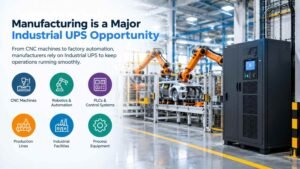
Manufacturing is a major Industrial UPS opportunity — but break it down further
“Manufacturing” is still too broad.
A pharmaceutical plant and an automobile factory do not necessarily have the same UPS requirements.
Neither does a semiconductor facility and a food-processing plant.
For example, UPS systems can support automation equipment, sensors, controls and production systems. ABB identifies applications including SCADA, DCS, sensors, valves, meters, data concentrators, emergency lighting, fire and gas monitoring, telecom and security systems. This means a manufacturer can create content around specific production environments.
Manufacturing applications worth building content around
CNC and machine tools
A page could explain how UPS protection can support sensitive controls and prevent an unexpected interruption from affecting a machining operation.
Potential content:
UPS Systems for CNC Machines and Machine Tools
Rather than simply listing specifications, explain:
- What happens when control power is interrupted?
- Which systems need protection?
- What type of UPS architecture is suitable?
- How should capacity be calculated?
- What information should a plant engineer provide before requesting a quotation?
Robotics and automation
Automation-heavy factories depend on PLCs, controllers, sensors, networking and other electronic systems.
A dedicated page can target searches around:
- UPS for industrial automation
- UPS for PLC systems
- UPS for robotics
- UPS for factory automation
- UPS for control systems
Automotive manufacturing
Automotive plants contain highly automated production lines where interruption to control systems can create operational disruption.
Content can focus on:
- assembly-line automation
- robotic systems
- control systems
- machine communication
- production monitoring
- safe shutdown requirements
Pharmaceutical manufacturing
The message changes again.
Here, the content can focus on:
- process monitoring
- automation
- control systems
- data integrity
- laboratory equipment
- production continuity
This application-based approach gives SEO for industrial UPS companies a much larger and more commercially relevant topic universe than repeatedly targeting “best Industrial UPS.”
Data centres are important — but don’t let them become the entire website
Data centres are an obvious UPS market, but many manufacturers make the mistake of positioning every UPS product as a data-centre solution.
That can weaken differentiation.
Data centres have specific requirements around availability, redundancy, scalability, monitoring and efficiency. Schneider Electric’s data-centre and facility UPS portfolio, for example, covers modular and three-phase systems designed for data centres and other business-critical applications.
A manufacturer targeting this sector should therefore create content that addresses the actual environment.
Possible commercial pages include:
- Three-phase UPS for data centres
- Modular UPS for data centres
- UPS redundancy for critical infrastructure
- UPS for server rooms
- UPS for edge data centres
- UPS battery backup for data centres
- UPS monitoring and remote management
But the opportunity goes beyond a product page.
A strong article could answer:
How Much UPS Capacity Does a Data Centre Need?
Another:
Centralised vs Modular UPS for Data Centre Infrastructure
Another:
What Should Engineers Check Before Selecting a Data Centre UPS?
These topics attract visitors at different stages of technical evaluation.
The important point is that content should help a potential customer make a technical decision, rather than merely tell them that your product is reliable.
Healthcare needs a different message
Healthcare is another industry where generic UPS messaging can fall short.
A hospital is not simply trying to “avoid downtime.”
Different areas may have different criticality requirements.
UPS applications can include hospital IT systems, laboratories, patient-care equipment and other critical infrastructure. Riello UPS, for example, identifies hospital IT services, critical laboratories and patient-care equipment among healthcare applications.
That gives an Industrial UPS manufacturer several content opportunities.
Useful healthcare content
UPS Systems for Hospitals
Could discuss:
- critical equipment
- hospital IT infrastructure
- laboratory systems
- monitoring systems
- emergency applications
- power-quality requirements
- installation considerations
Then create supporting content:
- UPS for hospital IT systems
- UPS for medical laboratories
- UPS for diagnostic equipment
- UPS backup for critical healthcare systems
- UPS maintenance for hospitals
The marketing benefit is significant.
Someone searching for “industrial UPS manufacturer” may be researching suppliers.
Someone searching for “UPS for hospital laboratory equipment” has already revealed an application.
The latter page can therefore produce a more context-rich enquiry.
Telecom, railway and infrastructure applications create another demand category
Not every UPS requirement comes from a factory.
Industrial UPS systems can also support infrastructure where power continuity affects communications, signalling, control or safety.
ABB identifies railway control and signalling, paging and information distribution, emergency lighting, telecom and security systems as UPS applications.
Riello also identifies airports, toll gates, marine applications, railways and metros among transportation-related UPS applications.
This creates several possible commercial content clusters.
Telecom
Content can address:
- telecom network power backup
- communication infrastructure
- remote monitoring
- battery autonomy
- network equipment protection
- site-specific power requirements
Railway
Content can address:
- railway signalling
- communication systems
- control systems
- emergency lighting
- station infrastructure
Airports and transportation
Content could focus on:
- control systems
- communication infrastructure
- security systems
- emergency systems
- critical facility equipment
This is where digital marketing for industrial UPS companies can become much more specific.
Instead of advertising “reliable UPS solutions,” campaigns can be built around the actual application.
Oil & gas, utilities and process industries need environment-specific content
Industrial environments can be substantially different from controlled IT rooms.
Oil and gas facilities, refineries, power plants and process industries may require power protection for control, instrumentation, monitoring and emergency systems.
Schneider Electric specifically distinguishes industrial UPS use in harsh environments such as power plants and refineries.
That means an Industrial UPS manufacturer should explain the environment rather than simply promoting a power rating.
For example:
Oil & gas UPS content
Potential topics:
- UPS for oil and gas facilities
- UPS for refinery control systems
- UPS for process instrumentation
- UPS for emergency systems
- Industrial UPS for harsh environments
Power generation and utilities
Potential topics:
- UPS for power plant control systems
- UPS for utility substations
- UPS for protection and monitoring systems
- UPS for electrical utility infrastructure
Water and wastewater
Potential topics:
- UPS for water treatment plants
- UPS for SCADA systems
- UPS for pumping stations
- UPS for process control systems
This is particularly useful because the buyer is often not searching for an UPS by itself.
They may be searching for a solution to protect SCADA, instrumentation, controls, communications or plant operations.
Turn industry applications into an SEO content map
This is where SEO services for industrial UPS companies should become more than keyword placement.
Instead of creating ten articles around the phrase “Industrial UPS,” build clusters around the industries and equipment the UPS protects.
A practical content map could look like this:
| Commercial theme | Example content |
| Manufacturing | UPS for CNC machines and factory automation |
| Automotive | UPS for automotive production lines |
| Pharmaceuticals | UPS for pharmaceutical manufacturing |
| Healthcare | UPS systems for hospitals and laboratories |
| Data centres | Three-phase and modular UPS for data centres |
| Telecom | Industrial UPS for telecom infrastructure |
| Railways | UPS for railway signalling and communication |
| Oil & gas | UPS for refinery control and instrumentation |
| Water treatment | UPS for SCADA and process control |
| Utilities | UPS for power and utility infrastructure |
This also creates opportunities for supporting blog content.
For example:
Main page: UPS for Industrial Automation
Supporting articles:
- UPS for PLC Systems
- UPS for SCADA Systems
- UPS for CNC Machines
- UPS for Robotics
- How to Select UPS Capacity for Automation Equipment
- Online UPS vs Other UPS Architectures for Industrial Automation
That is a much stronger topical structure than publishing unrelated generic articles every week.
What searches could Industrial UPS companies be missing?
Exact search volume and keyword-difficulty figures should come from a verified keyword platform rather than being invented. The following table is therefore a search-theme map, not a claim about daily search volume.
| Search theme | Example query | Commercial intent |
| Product | industrial UPS manufacturer | High |
| Product | three phase industrial UPS | High |
| Application | UPS for CNC machines | High |
| Application | UPS for industrial automation | High |
| Industry | UPS for pharmaceutical industry | High |
| Industry | UPS for manufacturing plants | High |
| Infrastructure | UPS for railway signalling | High |
| Infrastructure | UPS for telecom systems | High |
| Data centre | modular UPS for data centre | High |
| Technical | industrial UPS battery backup time | Medium |
| Technical | UPS sizing for industrial applications | Medium |
| Service | industrial UPS maintenance | High |
The important point is not to create a page for every phrase mechanically.
First determine whether the search represents a real product, application, service or technical problem that your company can genuinely solve.
Make technical documentation work harder commercially
Industrial UPS companies already possess valuable content.
It is often sitting inside PDFs.
Typical assets include:
- product datasheets
- technical specifications
- installation manuals
- application notes
- brochures
- test reports
- certifications
- battery documentation
- product comparison sheets
- drawings
- communication-interface information
- maintenance documentation
The marketing opportunity is to turn those assets into searchable website content.
For example, a five-page product datasheet might contain:
- input voltage
- output voltage
- power rating
- efficiency
- battery configuration
- operating temperature
- communication interfaces
- dimensions
- protection features
Instead of hiding all of this behind a PDF download, create a useful HTML product page containing the important information.
Then provide the PDF as an additional download.
That gives search engines more context and gives potential customers a better experience.
It also gives your sales team something useful to send after an enquiry.
Use standards as proof, not as decoration
Industrial buyers often need to verify whether a product meets applicable requirements.
IEC 62040-1 covers safety requirements for UPS systems and applies to relevant UPS configurations used in low-voltage distribution systems.
IEC 62040-2 addresses electromagnetic compatibility requirements for UPS systems and covers equipment used in residential, commercial, light-industrial and industrial environments within its scope. (IEC Webstore)
This does not mean an SEO page should simply copy standard numbers into a paragraph.
Instead, create useful explanations:
Which UPS Standards Should Industrial Buyers Check?
Then explain:
- which standard relates to what
- whether the standard applies to the product
- what documentation the manufacturer provides
- what certification or test evidence is available
- what buyers should confirm before purchase
Be precise about certifications. Never imply that a product is certified to a standard unless the manufacturer can substantiate that claim.
That improves both credibility and commercial trust.
Build Google Ads around applications instead of one generic Industrial UPS campaign
Google Ads can capture existing demand much faster than waiting for every SEO page to rank.
But a single campaign containing every UPS-related keyword can produce poor-quality enquiries.
Instead, separate campaigns according to commercial intent.
Campaign group: Industrial applications
Examples:
- industrial UPS manufacturer
- industrial UPS supplier
- industrial UPS systems
Campaign group: Manufacturing
Examples:
- UPS for CNC machines
- UPS for factory automation
- UPS for PLC systems
Campaign group: Data centres
Examples:
- three phase UPS data centre
- modular UPS data centre
- data centre UPS supplier
Campaign group: Healthcare
Examples:
- UPS for hospitals
- UPS for medical equipment
- healthcare UPS systems
Campaign group: Infrastructure
Examples:
- railway UPS system
- telecom UPS system
- UPS for utility applications
Each campaign should lead to the most relevant page.
Someone searching for a UPS for CNC machines should not land on a generic homepage containing twenty different product categories.
A dedicated landing page can immediately answer:
What equipment does this solution protect?
What power range is available?
What technical information is required?
Can the system be customized?
How can the buyer request a technical recommendation?
That is where lead generation for industrial UPS companies becomes connected to actual product demand rather than simply generating form submissions.
The enquiry form should collect engineering information
An Industrial UPS enquiry form should not look like a generic marketing form.
Instead of:
Name
Email
Phone
Message
consider collecting information such as:
- Application/industry
- Required UPS capacity
- Existing load
- Equipment being protected
- Required backup time
- Input/output voltage
- Single-phase or three-phase
- Installation environment
- Quantity
- Project location
- Expected project timeline
- Technical specification/document upload
Not every field needs to be mandatory.
The objective is to help the sales or engineering team understand the requirement before the first conversation.
For a technically complex product, better information can be more valuable than a higher number of form submissions.
AI can help Industrial UPS enquiries move faster
An enquiry arriving at 11:30 PM should not necessarily sit in an inbox until the next morning.
This is where AI automation can complement the website.
An AI Chat or WhatsApp agent can ask basic questions such as:
- What application is the UPS required for?
- What is the approximate load?
- What backup duration do you require?
- Is this for a new installation or replacement?
- Where is the project located?
- Do you already have a technical specification?
The AI does not need to replace the engineering team.
Its job is to gather context, identify obvious qualification signals and pass useful information to the appropriate sales person.
Adsthrive’s AI Chatbot Agent can be positioned within this type of workflow, while AI Calling can support follow-up where a conversation requires a faster response.
For example:
Website enquiry → AI conversation → requirement captured → lead qualified → sales team notified → follow-up call → quotation process
That is considerably more useful than simply installing a chatbot that answers “What is an UPS?”
AI lead qualification is particularly useful when enquiries vary by industry
Imagine an Industrial UPS manufacturer receives 50 enquiries.
Some are:
- genuine plant projects
- EPC requirements
- replacement requirements
- distributor enquiries
- service requests
- low-capacity commercial requirements
- students researching UPS
- unrelated enquiries
- incomplete requirements
Treating every enquiry identically wastes sales time.
AI-assisted qualification can help organise enquiries according to information such as:
Application
Manufacturing / Healthcare / Telecom / Data Centre / Railway / Oil & Gas / Other
Project status
New project / Replacement / Expansion / Evaluation
Technical requirement
Capacity / voltage / backup duration / equipment
Commercial signals
Quantity / location / timeline / specification availability
This allows sales teams to spend more time on enquiries that have enough context to move forward.
The key is to configure the qualification process around the company’s actual workflow rather than using generic lead-scoring rules.
LinkedIn should show where the UPS is being used
For Industrial UPS companies, LinkedIn content should not become a stream of product posters.
Show applications.
For example:
Post idea:
“What happens to a CNC production line when control power is interrupted?”
Then explain the role of UPS protection.
Another:
“Why UPS requirements change between a data centre and a manufacturing plant.”
Another:
“What should engineers check before specifying a UPS for a pharmaceutical facility?”
Another:
“UPS protection for railway signalling: what makes the application different?”
These posts can be aimed at engineering, operations, maintenance, electrical and project professionals.
LinkedIn outreach can then support account-based prospecting around:
- manufacturing groups
- EPC companies
- system integrators
- data-centre operators
- healthcare infrastructure companies
- telecom operators
- railway contractors
- oil & gas companies
- industrial automation companies
The objective is not to send the same sales message to everyone.
The application should determine the message.
Don’t ignore existing customers — replacement and service can become a lead source
New installations are not the only commercial opportunity.
UPS systems have ongoing requirements around:
- battery replacement
- maintenance
- upgrades
- capacity expansion
- monitoring
- refurbishment
- replacement of ageing systems
- additional UPS capacity
- service contracts
That means a manufacturer can create dedicated service pages such as:
Industrial UPS Maintenance Services
UPS Battery Replacement for Industrial Systems
Industrial UPS Upgrade and Replacement
UPS Annual Maintenance Services
These pages can generate enquiries from customers who already understand their requirement.
They may not be looking for “the best Industrial UPS.”
They may simply be searching for a replacement or maintenance provider.
This is one reason a complete digital marketing for industrial UPS companies program should cover both new-product acquisition and aftermarket demand.
Create comparison content that helps engineers narrow the decision
Technical buyers often need to compare alternatives before contacting a supplier.
Useful comparison topics include:
Online UPS vs other UPS architectures for industrial applications
Explain the differences without turning the article into a generic textbook.
Modular UPS vs conventional UPS
Discuss:
- scalability
- redundancy
- maintenance
- footprint
- expansion requirements
- application suitability
Lithium-ion vs traditional battery systems
Discuss the factors that should be evaluated, including:
- operating requirements
- maintenance
- space
- lifecycle considerations
- installation conditions
The purpose of comparison content is not to declare one technology universally better.
It is to help a buyer understand which configuration may be appropriate for a particular application.
Measure enquiries by application, not just by keyword
Traffic is not enough.
A manufacturer should be able to answer:
- How many enquiries came from manufacturing?
- How many came from data centres?
- How many came from healthcare?
- Which application pages generate RFQs?
- Which Google Ads campaigns generate qualified opportunities?
- Which industries have the highest enquiry-to-opportunity rate?
- Which products generate repeat enquiries?
- Which content assists sales conversations?
A practical reporting structure could include:
| Metric | What it tells you |
| Qualified enquiries | Whether acquisition is producing relevant prospects |
| Enquiries by industry | Which applications are generating demand |
| Cost per qualified enquiry | Paid acquisition efficiency |
| RFQ rate | Whether visitors are taking commercial action |
| Product-page enquiries | Which products attract demand |
| Application-page enquiries | Which industries are responding |
| Response time | How quickly prospects are contacted |
| Enquiry-to-opportunity rate | Lead quality |
| Opportunity value | Commercial impact |
| Service/replacement enquiries | Aftermarket demand |
This creates a much clearer connection between marketing activity and sales.
Where Adsthrive fits into the Industrial UPS growth process
A manufacturer does not necessarily need another collection of disconnected tools.
The more useful approach is to connect acquisition and enquiry handling around the actual sales process.
Adsthrive can combine SEO, AI SEO, Google Ads, lead generation, AI Chat, WhatsApp, AI lead qualification, AI calling and automated follow-up into a customized workflow.
For an Industrial UPS company, that could mean:
Application-specific content
→ attracts relevant searches
SEO + AI SEO
→ expands visibility across product, industry and technical searches
Google Ads
→ captures existing commercial demand
→ reaches industrial accounts and decision-makers
Website enquiry
→ collects application and technical information
AI Chat / WhatsApp
→ handles immediate questions and gathers missing information
AI lead qualification
→ separates relevant project enquiries from low-value or incomplete requests
AI calling
→ supports faster follow-up
CRM/sales workflow
→ gives the sales team the enquiry context needed for the next conversation
This is where a lead generation system becomes more commercially useful than simply running ads and forwarding form submissions.
The website should make an engineer think “this company understands my application”
That should be the standard.
Not:
“This company sells UPS systems.”
But:
“They understand UPS requirements for my type of plant.”
That difference can influence whether a visitor stays on the website, downloads technical documentation, submits an enquiry or contacts the company directly.
A strong Industrial UPS website should therefore demonstrate:
- product capability
- industry experience
- application knowledge
- technical documentation
- standards and certifications
- installation capability
- service support
- case studies
- project experience
- response capability
- clear enquiry routes
If possible, add genuine project examples.
For example:
Manufacturing plant — UPS for automation and control systems
Explain:
- application
- challenge
- equipment
- solution
- capacity
- configuration
- outcome
Another:
Hospital — UPS protection for critical infrastructure
Another:
Railway project — UPS for signalling and communication
Real project evidence can do more for commercial credibility than another generic “Why Choose Us?” section.
A practical content plan for the next 90 days
Rather than publishing dozens of unrelated articles, an Industrial UPS company can build content around the applications it actually serves.
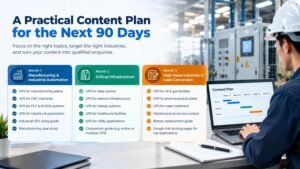
Month 1 — Manufacturing and industrial automation
Create:
- Industrial UPS for manufacturing plants
- UPS for CNC machines
- UPS for PLC and SCADA systems
- UPS for robotics and factory automation
- Industrial UPS sizing guide
- Manufacturing UPS case study
Month 2 — Critical infrastructure
Create:
- UPS for data centres
- UPS for telecom infrastructure
- UPS for railway signalling
- UPS for healthcare facilities
- UPS for utility applications
- Relevant product/application comparison content
Month 3 — High-value industries and commercial acquisition
Create:
- UPS for oil and gas facilities
- UPS for pharmaceutical manufacturing
- UPS for water treatment
- Industrial UPS maintenance
- UPS battery replacement
- Google Ads landing pages for the strongest applications
At the same time, promote the strongest pages through LinkedIn and paid search.
This creates an expanding commercial content library rather than a blog filled with variations of the same keyword.
Frequently Asked Questions
What industries use Industrial UPS systems?
Industrial UPS systems are used across manufacturing, data centres, telecom, healthcare, transportation, railways, oil and gas, utilities, pharmaceuticals, water treatment and other environments where critical electrical or electronic systems require continuous or conditioned power. Industry suppliers identify applications including manufacturing automation, healthcare, telecom, rail, marine, data centres and process industries.
Why should an Industrial UPS manufacturer create industry-specific pages?
Because the application changes the customer’s requirements. A manufacturing plant may be concerned with automation and process continuity, while a railway project may focus on signalling and communication. Industry-specific pages allow manufacturers to explain the relevant application, equipment, technical considerations and available solutions.
How does SEO help Industrial UPS companies generate enquiries?
SEO can help manufacturers appear for product, application and technical searches such as industrial UPS manufacturer, UPS for CNC machines, UPS for data centres and UPS for industrial automation. The strongest pages connect those searches to relevant products and a clear enquiry process.
What should an Industrial UPS enquiry form ask?
It can ask about the application, required capacity, equipment being protected, backup duration, voltage, installation environment, quantity, project location, timeline and whether the prospect has a technical specification. The exact fields should match the manufacturer’s sales and engineering workflow.
Can Google Ads work for Industrial UPS companies?
Yes. Google Ads can capture existing commercial searches while SEO builds longer-term visibility. Campaigns should ideally be segmented around applications and products rather than sending every keyword to one generic Industrial UPS page.
How can AI help qualify UPS enquiries?
AI can collect initial application and technical information through website chat or WhatsApp, identify missing details, categorise enquiries and route relevant information to sales. AI calling and automated follow-up can also help reduce delays between an enquiry and the next sales interaction.
What standards are relevant to UPS systems?
IEC 62040 is an important UPS standards series. IEC 62040-1 covers safety requirements for UPS systems within its scope, while IEC 62040-2 addresses electromagnetic compatibility requirements. Manufacturers should identify the standards and certifications that actually apply to their particular products and markets rather than making blanket claims.
Should an Industrial UPS company focus only on data centres?
No. Data centres are an important UPS application, but Industrial UPS systems are also used in manufacturing, healthcare, telecom, transportation, oil and gas, utilities and other critical environments.
Final takeaway
The strongest digital strategy for an Industrial UPS company does not have to begin with the phrase “Industrial UPS.”
It can begin with the machine, facility or infrastructure that the UPS protects.
A factory engineer may be looking for protection for a CNC machine. A hospital may need dependable power for critical infrastructure. A telecom operator may need backup for network equipment. A railway project may need UPS protection for signalling and communication. An oil and gas facility may need dependable power for control and instrumentation.
Those are different commercial problems — and they create different search opportunities.
That is why SEO for industrial UPS companies should connect products with applications, industries, technical requirements and genuine project evidence.
Combine that visibility with SEO services for industrial UPS companies, targeted Google Ads, LinkedIn outreach, application-specific landing pages, lead generation for industrial UPS companies, AI Chat, WhatsApp, AI lead qualification and faster follow-up, and the website becomes more than a product catalogue.
It becomes a source of commercially useful enquiries.
For companies looking to build that kind of connected acquisition and automation system, Adsthrive can help bring SEO, AI SEO, paid acquisition, lead generation and AI-powered enquiry handling into a workflow built around the company’s actual sales process.