A power distribution company can have technically strong products, experienced engineers and years of project experience and still struggle to generate enough qualified enquiries online.
The problem is often not a lack of capability. It is that potential buyers cannot quickly find the right product, understand whether the supplier fits their application, verify technical information and move from research to an enquiry.
That matters because the modern power-distribution market is becoming more technically complex. Grid modernization increasingly involves digital monitoring, automation, distributed energy resources, storage and more connected distribution infrastructure. The IEA’s 2026 work on modernising grids specifically highlights digitalisation, monitoring, control systems and AI as increasingly important parts of distribution networks.
For manufacturers and solution providers, this creates a commercial opportunity.
The company that makes its products easier to discover, easier to evaluate and easier to enquire about can turn its website into a much more useful sales channel.
That is where SEO for power distribution companies becomes more than a rankings exercise. The objective is to bring the right industrial buyer to the right product or solution page, give that buyer enough technical and commercial information to continue the conversation, and make sure the resulting enquiry reaches sales with useful context.
The Lead Is Usually Lost Before the Enquiry Form
Imagine a procurement manager searching for a supplier of distribution equipment for a new industrial project.
They may search for a product, an application, a voltage range, a technical specification, a location or even a particular standard.
They find several suppliers.
One website has a generic homepage.
Another has a catalogue PDF but little product information.
Another has product pages with technical specifications, applications, downloadable documentation and a clear enquiry option.
The third company may not have generated the highest amount of traffic.
But it has made the buying decision easier.
That distinction is important.
Lead generation for power distribution companies should not begin with “How do we get more visitors?”
It should begin with:
“What does a serious buyer need to see before they are willing to contact us?”
Once that question is answered, SEO, paid search, content and automation have a much clearer commercial purpose.
What a Buyer Actually Needs Before Contacting a Supplier
A technical buyer rarely wants to submit a form simply because a company says it is a “leading manufacturer.”
They want evidence.
Depending on the product and project, that evidence can include:
- Product ratings and technical specifications
- Voltage and current ranges
- Product configurations
- Installation conditions
- Indoor or outdoor suitability
- Applications
- Standards and certifications
- Technical drawings
- Datasheets
- Testing information
- Manufacturing capabilities
- Customisation options
- Project experience
- Delivery or geographic coverage
- Warranty information
- Installation or service support
- A straightforward way to request pricing or technical assistance
For example, IEC 61439-5 specifically covers low-voltage switchgear and controlgear assemblies intended for power distribution in public networks. Product and solution pages that discuss relevant standards need to be accurate and appropriate to the equipment being offered rather than simply displaying a long list of certifications.
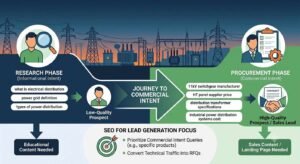
This creates a simple commercial principle:
Your website should answer enough of the buyer’s questions to earn the enquiry.
That changes how the entire marketing program should be built.
Start With Products, Not Marketing Channels
One of the biggest mistakes in industrial digital marketing is deciding to “do SEO” before deciding what the website actually needs to sell.
For a power distribution business, the commercial structure should start with the products and solutions that generate revenue.
That could include:
- Distribution panels
- LT and HT panels
- Switchboards
- Distribution boards
- Transformers
- Ring main units
- Switchgear
- Protection equipment
- Metering equipment
- Busbar systems
- Power quality equipment
- Distribution automation solutions
- Monitoring and control systems
- Custom electrical assemblies
The exact product mix depends on the business.
The important point is that each important commercial offering should have somewhere meaningful for a buyer to land.
A homepage saying:
“We are a leading electrical solutions provider”
does not compete effectively with a page that says:
“11kV Distribution Panel Manufacturer”
and then explains the product’s applications, specifications, documentation, testing, configuration options and enquiry process.
This is one of the foundations of SEO services for power distribution companies: mapping commercial search intent to useful commercial pages.
Build Pages Around How Buyers Search
A buyer doesn’t always search for the name of your company.
They search for the problem, product or application.
Consider the difference between these searches:
| Search intent | Example search | Useful destination |
| Product | distribution panel manufacturer | Product/manufacturer page |
| Technical | 11kV distribution panel specifications | Technical product page |
| Application | distribution panels for industrial plants | Application page |
| Commercial | distribution panel supplier in India | Location/supplier page |
| Project | electrical distribution equipment for data centres | Industry/application page |
| Custom requirement | custom electrical distribution panel manufacturer | Custom-solution page |
| Documentation | distribution panel technical datasheet | Product/documentation page |
| Service | distribution equipment installation support | Service page |
| Marketing | SEO for power distribution companies | Commercial marketing article/service page |
This is where many industrial websites leave search demand untouched.
They have one product page trying to rank for ten different intentions.
Instead, the website can connect the commercial dots:
Product → application → technical proof → documentation → enquiry
That structure is much more useful than producing dozens of generic blog posts.
The Search Opportunity Is Often Hidden in Technical Questions
A buyer looking for a supplier may not initially search:
“best power distribution company”
They may search:
- distribution transformer specifications
- HT panel manufacturer
- electrical distribution panel supplier
- 11kV switchgear manufacturer
- power distribution equipment supplier
- distribution board manufacturer
- industrial power distribution systems
- electrical distribution equipment for factories
- transformer supplier for industrial projects
- distribution automation equipment supplier
These searches are commercially different from broad educational queries.
A person searching for “what is electrical distribution” may be researching.
A person searching for “11kV switchgear manufacturer” is much closer to a commercial conversation.
That is why SEO for power distribution companies should prioritize commercial intent instead of simply chasing large search volumes.
Search-volume numbers should only be added when they come from a reliable keyword dataset. Without verified keyword-tool data, publishing invented monthly volumes or arbitrary KD scores creates more noise than value.
Your Technical Content Should Help Sales, Not Just Search Rankings
Technical content has an important role in industrial SEO, but it should not exist simply to increase word count.
A useful technical article can answer a question that appears repeatedly during sales conversations.
For example:
Instead of:
What Is Power Distribution?
Create:
How to Select Distribution Equipment for a High-Load Industrial Facility
Or:
What Specifications Should You Check Before Buying an 11kV Distribution Panel?
Or:
Distribution Panel Selection: Voltage, Current, Protection and Installation Considerations
Or:
How Power Distribution Equipment Changes for Data Centre Applications
These subjects can attract technically relevant visitors while also giving the sales team content they can send to prospects.
That is the difference between content that creates traffic and content that supports revenue.
Turn Product Documentation Into Marketing Assets
Many manufacturers already possess valuable content.
It is simply trapped inside PDFs, catalogues, quotation documents and sales presentations.
A product catalogue might contain:
- Product dimensions
- Ratings
- Configurations
- Technical drawings
- Applications
- Standards
- Testing details
- Accessories
- Optional features
Instead of hiding all of that behind a single catalogue download, important information can be surfaced directly on the website.
For example, a product page could include:
Product overview
What the equipment does and where it is used.
Technical specifications
The information engineers need for initial evaluation.
Applications
Where the equipment fits.
Available configurations
Useful for buyers comparing requirements.
Technical documentation
Datasheets, drawings and relevant documents.
Project capability
Evidence that the company can execute similar requirements.
Request a quotation
A clear commercial action.
This approach also creates more indexable, useful content for search engines.
The website becomes an extension of the sales catalogue rather than simply a digital company brochure.
Application Pages Can Bring a Different Kind of Buyer
Product pages capture product-led demand.
Application pages capture project-led demand.
This distinction is particularly useful for power-distribution businesses.
Suppose a manufacturer sells electrical distribution equipment.
Instead of only creating:
Distribution Panel Manufacturer
the company could develop relevant application pages such as:
- Electrical distribution equipment for manufacturing plants
- Power distribution solutions for commercial buildings
- Electrical distribution systems for data centres
- Distribution equipment for infrastructure projects
- Power distribution solutions for renewable-energy projects
- Electrical equipment for industrial expansion projects
The content should not simply replace the industry name and reuse the same paragraphs.
Each page should explain:
Application → electrical requirement → relevant equipment → technical considerations → project capability → enquiry
This gives digital marketing for power distribution companies a much stronger commercial foundation.
Make Google Ads Work With the Website You Already Built
SEO takes time.
That does not mean a manufacturer should wait months before testing commercial search demand.
Google Ads can be used to capture searches where there is already clear purchase intent.
But sending every advertisement to the homepage wastes much of the opportunity.
If someone searches for:
11kV switchgear manufacturer
the destination should explain 11kV switchgear.
If they search for:
distribution transformer supplier
the landing page should be about distribution transformers.
If they search for:
industrial power distribution equipment
the page should explain the company’s relevant solutions.
The advertisement gets the click.
The landing page has to earn the enquiry.
That means paid search and SEO should share information.
Search terms producing qualified enquiries can inform future SEO content.
Organic pages attracting relevant visitors can reveal opportunities for paid campaigns.
This is a more commercial use of digital marketing for power distribution companies than simply increasing website traffic.
Give the Enquiry Form Some Intelligence
A generic contact form usually asks:
- Name
- Phone
- Message
That is easy to build.
It is not necessarily useful to the sales engineer.
A better RFQ form can collect information such as:
- Product or equipment required
- Voltage/rating
- Quantity
- Application
- Project location
- Expected requirement date
- Whether technical drawings are available
- Whether a BOQ/specification can be uploaded
- Installation requirement
- Customisation requirement
The form should not become an interrogation.
Only collect information that helps the sales team determine what happens next.
For example, a buyer looking for a standard product may need a simple enquiry.
A large project requiring multiple distribution systems may justify a more detailed RFQ form.
The objective is not to make every lead “qualified” through a long form.
The objective is to make the first sales conversation more informed.
This Is Where AI Can Improve Lead Handling
Generating an enquiry is only one part of the commercial process.
Consider what happens after a visitor submits a form at 11:30 PM.
If the enquiry sits in an inbox until the next working day, the company has created a lead but has not necessarily created momentum.
AI-powered chat and WhatsApp can help handle the initial interaction, collect basic requirements and guide the prospect toward the correct next step.
For example:
Buyer:
“I need an 11kV panel for a manufacturing project.”
Instead of simply displaying:
“Thank you. Our team will contact you.”
an AI-assisted conversation could ask relevant preliminary questions:
- What is the project location?
- What quantity is required?
- Is the requirement for a new installation or replacement?
- Do you have a technical specification or BOQ?
- What is the expected project timeline?
The information can then be passed to the sales process.
AI does not need to replace the sales engineer.
Its job is to reduce repetitive first-level communication and make sure useful information travels with the enquiry.
From Lead Generation to Lead Qualification
This is where lead generation for power distribution companies becomes commercially meaningful.
Imagine two enquiries arrive.
Enquiry A
“Send price for panels.”
Enquiry B
“Requirement for 12 units of 11kV panels for a manufacturing expansion project in Pune. Technical specification attached. Installation expected in Q1. Please advise configuration and quotation.”
Both are leads.
They are not equally useful to a sales team.
AI lead qualification can help identify information such as:
- Product requirement
- Application
- Quantity
- Location
- Timeline
- Project stage
- Documentation available
- Commercial intent
The sales team can then prioritize its response based on the information available.
That creates a much stronger connection between marketing and sales.
For a broader look at generating qualified B2B enquiries in the electrical sector, explore our guide on How Electrical Equipment Companies Can Generate More B2B Leads.
AI Calling Can Handle the Leads That Need a Conversation
Some industrial enquiries are better handled through a conversation than a long email exchange.
AI calling can be used as part of the follow-up process for suitable enquiries.
For example, after an enquiry arrives, an AI calling workflow could:
- Confirm the enquiry was received.
- Collect basic missing information.
- Confirm the buyer’s preferred contact method.
- Identify whether the requirement is immediate or exploratory.
- Pass the conversation and captured details to the sales team.
This becomes especially useful when the enquiry volume grows and sales representatives cannot manually follow up with every prospect immediately.
The objective isn’t to make the interaction sound robotic.
It is to prevent good enquiries from disappearing into an unattended inbox.
LinkedIn Has a Different Commercial Role
Search captures existing intent.
LinkedIn can help create awareness among the people who may influence future projects.
For power-distribution businesses, that can include:
- Procurement professionals
- Project managers
- Electrical engineers
- EPC decision-makers
- Infrastructure companies
- Plant engineering teams
- Facility managers
- Consultants
- System integrators
- Utility professionals
The content should therefore be different from consumer-style social media posts.
Useful subjects could include:
- Project lessons
- Equipment selection considerations
- Technical explainers
- Application-specific content
- New product capabilities
- Factory/testing content
- Project documentation
- Engineering insights
- Case studies
LinkedIn should support the credibility layer around search and sales rather than simply become another place to publish company announcements.
Build Search Visibility Around Real Industry Developments
The power-distribution sector itself is changing.
The IEA’s latest grid research points to growing electricity demand, grid-capacity constraints and the increasing importance of digital technologies, monitoring, control and AI in modern grids.
The U.S. Department of Energy similarly describes distribution-grid transformation in terms of changing planning and operating requirements, distributed energy resources and more advanced distribution-system design.
For a manufacturer, these developments create content opportunities.
For example:
Grid Modernization
Explain how your equipment supports modern distribution requirements.
Distribution Automation
Explain relevant products, communication requirements and applications.
Monitoring
Discuss measurement, monitoring and operational visibility where relevant to your product portfolio.
Renewable Integration
Explain how equipment is used when distributed generation changes system requirements.
Industrial Electrification
Address the distribution requirements created by expanding industrial loads.
The content should always connect the industry topic back to the company’s actual expertise.
That prevents the blog from becoming generic energy commentary.
Standards Should Build Trust, Not Become Keyword Stuffing
Technical buyers care about standards.
But adding ten standards to a page does not automatically make the page trustworthy.
The better approach is to explain:
What standard is relevant?
Which product does it apply to?
What does compliance mean for the buyer?
What documentation can the company provide?
For example, IEC’s documentation for IEC 61557-1 addresses electrical safety requirements for equipment used to test and monitor protective measures in low-voltage distribution systems.
Likewise, IEC 61439-5 defines specific requirements for public-network distribution assemblies.
A manufacturer’s content should therefore refer to standards in the context of the actual equipment being offered.
This is much more useful than creating a generic “certifications” paragraph filled with acronyms.
The Website Should Give Sales Something to Work With
A successful B2B website does not only generate enquiries.
It gives the sales team material to continue the conversation.
A prospect may ask:
“Do you have experience with this type of project?”
The sales team should be able to send a relevant case study.
They may ask:
“Can you meet this technical requirement?”
The sales team should be able to send the appropriate technical page or datasheet.
They may ask:
“Can you customise the equipment?”
There should be a page explaining the company’s engineering and manufacturing capability.
They may ask:
“Can you supply to our location?”
There should be clear information about geographic coverage and support.
This is why website architecture matters so much.
The website becomes a sales enablement library that is also searchable.
What to Measure Instead of Just Counting Leads
A company can generate 500 enquiries and still have a poor marketing program if most enquiries are irrelevant.
For an industrial business, useful measurements can include:
| Metric | What it tells you |
| Qualified enquiries | Whether marketing is reaching relevant buyers |
| RFQs received | Whether traffic is turning into commercial requests |
| Technical-document downloads | Whether buyers are seriously evaluating products |
| Product-page enquiries | Which offerings attract demand |
| Cost per qualified enquiry | Efficiency of paid acquisition |
| Response time | How quickly sales engages |
| Enquiry-to-opportunity rate | Quality of captured leads |
| Opportunity-to-quotation rate | Sales readiness |
| Quotation-to-order rate | Commercial outcome |
| Revenue influenced by marketing | Actual business contribution |
This changes the conversation from:
“How much traffic did SEO generate?”
to:
“Which products, searches and campaigns are producing opportunities?”
That is the measurement framework a commercial marketing program should eventually move toward.
How AdsThrive Can Connect the Pieces
This is where an industrial marketing partner needs to do more than run isolated campaigns.
AdsThrive SEO Services can help build search visibility around product, application and commercial-intent queries.
AdsThrive AI SEO Services can support the creation and optimisation of technically focused content while keeping the strategy centred around search intent and commercial pages.
For immediate demand capture, AdsThrive Lead Generation can be connected with paid campaigns and conversion-focused landing pages.
The lead-handling side can then extend beyond the website.
AdsThrive AI Chat can help handle initial website conversations.
WhatsApp can be used for faster enquiry communication.
AI lead qualification can collect and organise the information required to understand the enquiry.
AdsThrive AI Calling can support follow-up where a voice interaction is appropriate.
The important part is that these should not become five disconnected tools operated independently.
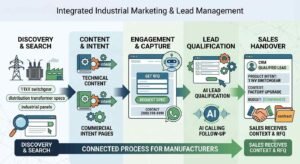
For a manufacturer, the useful outcome is a connected process:
Buyer discovers the company → evaluates the product → submits an enquiry → information is captured → lead is qualified → follow-up happens → sales receives useful context.
That is the point at which digital marketing becomes connected to the commercial operation.
AdsThrive positions its services around customised digital marketing and AI automation rather than requiring businesses to assemble unrelated tools for every individual task.
A Better Content Mix for a Power Distribution Business
If a company wants to build this gradually, its content should not consist of 30 generic blog posts.
A more commercially useful mix could look like this:
Product content
Pages targeting actual products and equipment.
Application content
Pages showing how those products fit specific industries and projects.
Technical content
Articles answering engineering and specification questions.
Proof content
Case studies, testing capability, factory information and project experience.
Commercial content
Supplier, manufacturer, quotation and service-related pages.
Decision content
Comparison guides, selection guides and buying considerations.
Conversion assets
Datasheets, drawings, catalogues, RFQ forms and technical-document requests.
This gives SEO for power distribution companies more depth because the site is not dependent on a single type of page.
The Commercial Keyword Map Should Follow Revenue
Keyword research should ultimately connect to what the company sells.
For example:
| Commercial area | Example search theme | Recommended asset |
| Product | Distribution panel manufacturer | Product page |
| Supplier | Distribution equipment supplier | Supplier/manufacturer page |
| Technical | Distribution panel specifications | Technical guide |
| Application | Industrial power distribution equipment | Application page |
| Custom | Custom distribution panel manufacturer | Capability page |
| Location | Electrical equipment manufacturer in India | Location/service page |
| Project | Distribution equipment for industrial projects | Industry page |
| Documentation | Distribution panel datasheet | Product/documentation hub |
| Commercial | Request quotation for distribution equipment | RFQ page |
The exact keyword set should be validated against the company’s target market, geography, products and actual keyword-tool data.
This is also where keyword difficulty should be used intelligently.
A high-volume keyword is not automatically more valuable than a lower-volume phrase that closely matches the company’s product and buying intent.
Why a Generic Digital Marketing Campaign Is Not Enough
A generic agency can deliver:
- Blog posts
- Social media posts
- Google Ads
- SEO reports
- Monthly traffic numbers
But a power-distribution business needs those activities connected to its commercial reality.
The marketing team needs to understand:
Which products should generate enquiries?
Which applications have the highest commercial value?
Which buyer searches indicate active requirements?
Which technical information is missing from the website?
Which enquiries should sales respond to first?
Where are good leads getting delayed?
Which campaigns eventually produce quotations and orders?
That is why a digital marketing agency for power distribution companies should not simply mean an agency that knows how to operate advertising platforms.
The agency should be able to connect marketing activity with the company’s sales process.
FAQs
How can a power distribution company generate more leads online?
Start by making commercial products, applications, technical information and enquiry paths easy to discover. Then combine SEO, paid search, relevant LinkedIn activity and faster lead handling. The goal is to attract buyers who have a genuine requirement rather than simply increasing website traffic.
Is SEO useful for power distribution companies?
Yes, particularly when the website targets product, application and technical searches that potential buyers actually use. SEO for power distribution companies should focus on commercially relevant pages rather than publishing large volumes of generic industry articles.
What keywords should power distribution companies target?
The keyword set depends on the company’s products and markets, but useful categories include product names, manufacturer/supplier searches, technical specifications, applications, locations, customisation and quotation-related searches. Keyword difficulty and search volume should be validated using current keyword data before final prioritisation.
Should manufacturers use Google Ads as well as SEO?
They can serve different purposes. SEO builds organic visibility over time, while Google Ads can capture relevant commercial searches immediately. Both work better when the landing page directly matches the product or requirement behind the search.
How can AI help with industrial leads?
AI can assist with first-level conversations, enquiry collection, lead qualification, WhatsApp communication, follow-up and calling. The purpose is to reduce response delays and provide sales teams with better enquiry context rather than replacing technical sales expertise.
What should an industrial RFQ form ask?
It should collect information that helps the sales team understand the requirement, such as product type, quantity, application, project location, timeline and relevant technical documentation. The form should remain proportionate to the complexity of the enquiry.
How long does SEO take to generate leads?
There is no reliable universal timeframe. Results depend on the existing website, authority, competition, technical quality, keyword difficulty, content depth, geography and the commercial demand for the products. High-intent paid search can be used alongside SEO while organic visibility develops.
Final Takeaway
A power distribution business does not need another website that simply says it is experienced, reliable and customer-focused.
It needs a website that helps a real buyer answer practical questions:
Do you supply what I need?
Can your equipment fit my application?
Can I verify the technical information?
Can you handle my project?
Can I request a quotation easily?
Will someone respond quickly?
That is the real opportunity behind SEO for power distribution companies.
Search visibility brings the buyer to the website. Technical content builds confidence. Product and application pages make the offering understandable. Paid search captures immediate demand. LinkedIn supports credibility and account visibility. AI Chat, WhatsApp, lead qualification and AI calling can reduce the gap between an enquiry and a sales conversation.
The result is not simply more website traffic.
It is a better path from search → product discovery → enquiry → qualification → sales opportunity.
For a Power Distribution Company, that is a far more useful definition of digital marketing: not generating numbers at the top of a report, but creating more opportunities for the sales team to work with.
Talk to AdsThrive about building an integrated SEO, lead-generation and AI automation strategy