An industrial motor manufacturer does not have a single type of customer, and that is one of the biggest reasons a generic digital marketing strategy often produces a lot of activity but not enough useful enquiries.
An OEM may be looking for motors that can be integrated into a machine and supplied repeatedly. A plant may need a replacement for an existing motor. A pump, compressor or conveyor manufacturer may need a motor as one component of a larger piece of equipment. A distributor may be looking for a dependable product range. An engineering or EPC company may need a supplier that can meet a particular technical requirement.
They may all search for a motor supplier online, but their reasons for searching are completely different.
That creates a different opportunity for SEO for industrial motor manufacturers.
Instead of trying to make one homepage rank for every possible motor-related search, digital marketing can connect different commercial requirements with the right product information, application content, advertising and enquiry process.
The question is therefore not simply:
“How do we get more people to visit an industrial motor website?”
It is:
“How do we make the right companies discover the manufacturer, understand its capabilities and start a useful sales conversation?”
That is the commercial perspective this article takes.
One Motor Business Can Have Several Different Sources of Demand
The easiest way to understand digital demand for motors is to stop looking at the motor as a single product.
Look at what the motor is being purchased for.
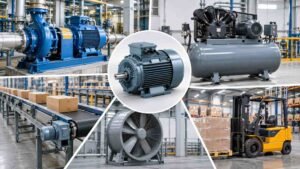
A motor may be required for:
- a pump
- compressor
- conveyor
- fan or blower
- material-handling equipment
- industrial machinery
- HVAC equipment
- processing equipment
- OEM machinery
- replacement of an existing motor
The actual applications will depend on the manufacturer’s product range, but the principle remains the same.
A person searching for an industrial motor for a new OEM machine is not at the same stage as a maintenance manager searching for a replacement motor. One may be planning a recurring procurement relationship; the other may need to restore production quickly.
The website, content and advertising should recognise that difference.
A useful commercial view
| Buyer situation | What the buyer is trying to solve | What the website should help with |
| OEM development | Finding a suitable motor supplier | Product capability, technical information, OEM enquiry |
| New equipment project | Selecting a motor for an application | Application information and specifications |
| Replacement | Finding a suitable replacement | Product identification and quick enquiry |
| Distributor sourcing | Finding products to supply | Product range and commercial discussion |
| Industrial procurement | Evaluating suppliers | Capability, documentation and quotation |
| Engineering/EPC requirement | Checking technical suitability | Technical resources and sales contact |
This changes how a manufacturer should approach Digital marketing for industrial motor manufacturers.
The objective is not to create one enormous page containing every keyword.
The objective is to make different commercial entry points available to the right buyers.
Start With the Search, Not the Marketing Channel
Before deciding whether the manufacturer needs more SEO, Google Ads, LinkedIn or AI automation, look at how potential customers are likely to arrive.
An OEM may search for a manufacturer.
A maintenance team may search for a product specification.
An engineer may search for an application-related solution.
A procurement professional may search for suppliers.
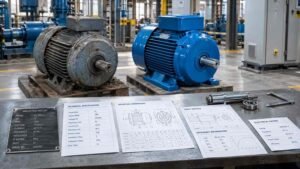
Someone replacing an existing unit may search using the information written on the motor nameplate.
These are different search behaviours.
That means the keyword strategy should be built around commercial situations, not simply a long list of phrases containing the word “motor.”
For example:
| Search direction | Likely commercial meaning |
| Industrial motor manufacturer | Supplier discovery |
| Three phase motor manufacturer | Product/supplier discovery |
| Industrial motor supplier India | Supplier comparison |
| Motor for industrial pump | Application requirement |
| Energy efficient industrial motor | Efficiency-focused requirement |
| Industrial motor replacement | Existing equipment problem |
| OEM motor supplier | Recurring equipment requirement |
| Industrial motor manufacturer for conveyor | Application-specific sourcing |
These are search themes rather than verified search-volume figures. Actual keyword prioritisation should be based on current keyword research, Search Console data and the manufacturer’s own sales history.
There is also a reason to avoid inventing search volumes or keyword-difficulty numbers in an article like this. Exact Indian search data for many industrial motor terms is not consistently available through public sources, and an unsupported “50,000 searches per month” claim adds little value.
The commercial intent behind the query is often more useful.
The First Opportunity: Get Discovered as a Manufacturer
The most obvious search category is also one of the most competitive conceptually:
Industrial motor manufacturer
A manufacturer needs a strong page that establishes what it actually makes and who it supplies.
That page should not be a collection of marketing statements such as:
“We are the leading manufacturer of high-quality industrial motors.”
It should demonstrate capability.
What product categories are available?
What power ranges are covered?
What applications are supported?
Does the company supply OEMs?
Does it handle bulk requirements?
What technical documentation is available?
Where does it manufacture?
What testing and quality processes can it substantiate?
What markets does it serve?
A prospective buyer should be able to understand the company without immediately having to call sales.
For SEO for industrial motor manufacturers, this manufacturer-level page becomes an important commercial asset because it establishes the broader topic while supporting more specific product and application pages.
The Second Opportunity: Sell the Application, Not Just the Motor
This is where the strategy becomes more interesting.
A buyer does not always wake up thinking:
“I need to purchase an industrial motor.”
They may think:
“We need a motor for this pump.”
Or:
“Our conveyor system needs a replacement.”
Or:
“We are developing a new machine and need a motor supplier.”
The application can therefore become the bridge between search intent and the product.
Consider a manufacturer supplying motors for pumping applications.
Instead of relying only on a generic product page, the website can have useful application content explaining:
- where the motor range is used
- relevant configurations
- technical considerations
- available ratings
- applicable operating conditions
- documentation
- how to discuss a project requirement
The same approach can be used for compressors, conveyors, fans, blowers, material-handling systems and other genuine applications.
This does not mean creating an SEO page for every imaginable application.
Thin pages such as:
“Industrial motors for textile machines”
“Industrial motors for food machines”
“Industrial motors for factory machines”
will not automatically create useful organic visibility.
The application page should exist because the manufacturer has real capability and useful information to provide.
That is what makes the content commercially defensible.
India Already Has Useful Evidence Around Motor Applications
This application-led approach is not simply a marketing theory.
Indian energy-efficiency resources demonstrate how motors are used across different industrial processes.
The Bureau of Energy Efficiency’s material on textile industries, for example, discusses induction motors used in applications such as air compressors, fans, blowers and pumps.
BEE’s industrial MSME resources also document energy-efficiency projects involving motors in different Indian clusters, including foundries, forging units, rice mills, ceramics and other manufacturing environments.
That gives motor manufacturers a useful content direction.
Instead of producing endless generic articles about motors, they can create commercially relevant content around the industries and equipment where their products actually operate.
For example, a manufacturer serving process industries could build useful pages around:
Motors for pumps
Motors for compressors
Motors for material handling
Motors for process equipment
Energy-efficient motor replacement
The exact subjects should follow the manufacturer’s actual capabilities.
The Third Opportunity: Replacement Demand Is Different
Replacement requirements deserve their own digital strategy because the buyer’s urgency is different.
Imagine a plant where an existing motor has stopped working.
The person responsible may already know:
- the motor brand
- model
- power
- voltage
- speed
- frame size
- mounting arrangement
- application
They may not be looking for an educational article explaining what an induction motor is.
They want to know:
Can you supply the right replacement?
This creates a very different landing-page opportunity.
A replacement page can explain what information the buyer should provide and offer a quick route to the sales team.
For example:
Need an industrial motor replacement?
Share the existing motor nameplate details, application, required quantity and location. Our team can review the requirement and advise on the next step.
The form could include an option to upload a photograph of the motor nameplate if the business is equipped to handle that information.
This is much closer to the buyer’s immediate need than forcing them through a generic product catalogue.
Why this matters commercially
Replacement enquiries can also reveal future opportunities.
A one-time replacement buyer may later need:
- additional motors
- spare units
- maintenance support
- motors for other equipment
- plant-wide replacement
- energy-efficiency upgrades
The first digital enquiry can therefore become the beginning of a larger commercial relationship.
The Fourth Opportunity: OEMs Can Change the Value of an Enquiry
An OEM requirement should not be treated like a normal retail-style product enquiry.
Suppose a machinery manufacturer needs 30 motors for a production run.
The immediate enquiry may represent more than one sale.
If the motor becomes part of the OEM’s equipment design, the manufacturer may receive recurring requirements as new machines are produced.
That changes what the website needs to communicate.
An OEM-focused section can discuss:
Product consistency
Technical documentation
Available configurations
Supply capability
Custom requirements where genuinely supported
Technical coordination
Bulk or recurring requirements
Enquiry and quotation process
The objective is not to promise capabilities the manufacturer does not have.
It is to make the existing capabilities easier for an OEM to evaluate.
This is also where Lead generation for industrial motor manufacturers becomes more sophisticated.
The objective is not simply:
“Get 100 enquiries.”
It could be:
“Generate 10 enquiries from companies that could become recurring OEM customers.”
Those are very different marketing objectives.
The Fifth Opportunity: Make Technical Information Work Harder
Industrial buyers do not expect a motor website to read like an e-commerce store.
They expect useful technical information.
BIS currently lists IS 12615 for energy-efficient three-phase squirrel-cage induction motors under its product-certification framework. BIS’s standards information also records IS 12615:2026 and references the related efficiency-class and performance specification.
BIS documentation for IS 12615 includes parameters such as mounting type, poles, efficiency class, degree of protection, insulation class, voltage and rated output.
BIS laboratory information also shows testing areas associated with the standard, including efficiency, temperature rise, vibration, noise, enclosure protection, overload and other performance-related tests.
For a manufacturer, this creates an important content opportunity.
Instead of simply saying:
“Our motors are efficient and reliable.”
the website can provide the appropriate technical evidence and documentation.
That makes the marketing stronger because the claims are connected to information the buyer can actually evaluate.
Don’t Turn Every Technical Page Into a Textbook
There is another problem at the opposite end.
Some manufacturers respond to the need for technical information by putting enormous blocks of engineering information on every page.
That does not necessarily improve conversion.
A product page needs to answer the questions that help the buyer determine:
Is this relevant to my requirement?
Does the manufacturer make what I need?
Can I get the required configuration?
Is there documentation available?
Who do I contact for a technical discussion or quotation?
The detailed engineering documentation can remain available for users who need it.
The main page should guide the visitor through the information rather than burying the enquiry opportunity underneath hundreds of specifications.
Efficiency Can Become a Commercial Content Theme
Energy efficiency is another area where a motor manufacturer’s content can become more commercially relevant.
BEE’s Indian MSME material contains multiple examples of energy-efficient motor projects. One documented project involved replacing an existing motor with an IE3 motor in a ceramic-unit ball mill, while BEE resources also include motor-efficiency projects across forging, foundry, rice-milling, dairy and other industrial clusters.
This gives manufacturers an opportunity to create useful content around questions such as:
When should an old industrial motor be replaced?
What information should be checked when comparing motor efficiency?
What should a plant consider before replacing a rewound motor?
How should an energy-efficient motor be evaluated for an existing application?
The content should avoid making universal savings claims because actual savings depend on the motor, load, operating hours, replacement conditions and application.
But the commercial topic is strong because it connects the motor with a measurable business concern: operating cost.
SEO Should Connect These Opportunities
This is where SEO services for industrial motor manufacturers should move beyond traditional keyword placement.
The website can have several connected layers:
Manufacturer layer
Who you are, what you manufacture and where you operate.
Product layer
The actual motor categories and configurations.
Application layer
Where those products are used.
Technical layer
Specifications, standards, efficiency and documentation.
Commercial layer
OEM requirements, replacement requests, bulk requirements and quotations.
Supporting content
Articles answering specific technical or purchasing questions.
This gives search engines a clearer understanding of the business while also giving buyers multiple routes into the website.
It is a much stronger architecture than creating 20 pages that all essentially say:
“We are a leading industrial motor manufacturer.”
Google Ads Should Follow the Same Commercial Logic
Paid search can then be built around these demand categories.
A manufacturer could have one group of campaigns around high-intent supplier searches and another around specific applications.
Replacement demand may require a different landing page from OEM enquiries.
That distinction matters because the conversion message should change.
Someone searching for a supplier
“Industrial Motor Manufacturer in India”
needs proof of manufacturing capability.
Someone searching for an application
“Motor for industrial pump”
needs application and product relevance.
Someone looking for replacement support
“Industrial motor replacement”
needs a fast and simple enquiry process.
Sending all three to the same homepage wastes some of the commercial value of the click.
This is why Digital marketing for industrial motor manufacturers should not treat Google Ads as an isolated advertising activity.
The advertisement, search term, landing page and enquiry process should work together.
A Better Way to Think About LinkedIn
LinkedIn does not have to compete with Google.
The two platforms can perform different jobs.
Google captures an existing requirement.
LinkedIn can help a manufacturer stay visible among companies that may create requirements in the future.
For example, an OEM engineering manager may not currently be searching for a motor supplier.
But if the manufacturer regularly publishes useful content about motor selection, OEM requirements, efficiency, applications and technical considerations, that company can become familiar with the brand before a requirement arises.
This also gives sales teams something useful to share.
Instead of sending:
“We are a leading motor manufacturer. Please let us know if you have any requirements.”
a salesperson can share a relevant technical article or application page and start a more meaningful conversation.
That is a much more natural use of LinkedIn for industrial B2B marketing.
What Happens After the Buyer Clicks “Enquire”?
This is where most digital marketing strategies become incomplete.
The marketing team may celebrate the conversion.
But what does the customer experience next?
If the form simply sends:
Name: Rahul
Phone: XXXXX
Message: Need motor
to a sales inbox, the sales team still has to discover what the buyer actually wants.
This is an opportunity for AI.
Turn a Basic Enquiry Into a Sales-Ready Conversation
Imagine a buyer sends a WhatsApp message:
“Need 20 motors for conveyor system.”
Instead of immediately sending a generic catalogue, an AI-assisted workflow could collect the information the company has decided is important.
For example:
AI: What is the required motor power?
Buyer: 15 kW.
AI: Is this for a new conveyor system or replacement?
Buyer: New system.
AI: What quantity is required and where will the motors be delivered?
Buyer: 20 units, Pune.
Now the sales team receives a much more useful starting point.
The AI has not selected a technically unsuitable motor.
It has not invented a specification.
It has simply collected the information required for the human team to continue the conversation.
That distinction is important.
AI Qualification Is About Prioritising Human Attention
Consider three enquiries arriving on the same day.
Enquiry 1:
“Send catalogue.”
Enquiry 2:
“Need 2 motors for replacement. Existing nameplate attached.”
Enquiry 3:
“We are an OEM producing industrial pumps and require 40 motors per month. Please discuss suitable options.”
All three deserve a response.
But they do not necessarily deserve the same sales workflow.
AI lead qualification can help collect additional context and route enquiries according to predefined business rules.
For example:
| Signal | Why sales may need it |
| Application | Helps identify relevant product area |
| Quantity | Indicates scale of requirement |
| Product requirement | Helps route enquiry |
| Customer type | OEM, end user, distributor etc. |
| Location | Helps determine commercial handling |
| Timeline | Indicates urgency |
| Technical information | Helps prepare for sales discussion |
The result is not “AI replacing sales.”
The result is sales receiving better context.
WhatsApp Can Become Part of the Lead Process
For Indian industrial businesses, WhatsApp can be particularly useful because customers and sales teams already use it extensively for business communication.
The opportunity is to connect WhatsApp with the broader enquiry workflow instead of treating it as a separate channel.
A potential process could include:
Website visitor → WhatsApp conversation → initial qualification → sales assignment → follow-up → CRM update
The precise workflow should depend on the client’s existing systems.
Adsthrive can incorporate AI Chat, WhatsApp automation, AI lead qualification and follow-up workflows into a customized setup rather than forcing the manufacturer to manage multiple disconnected automation products.
That is particularly relevant when enquiries arrive from several sources.
AI Calling Can Support the Follow-Up Gap
There is another point where manufacturers often lose opportunities.
The lead comes in.
Someone calls.
The prospect says they will check the requirement.
Then the follow-up gets delayed.
For a technically complex B2B purchase, one missed follow-up can mean the conversation moves to another supplier.
AI calling can support defined follow-up workflows where appropriate.
For example, after an enquiry or quotation, the system may be configured to:
- confirm that the enquiry was received
- request missing information
- remind a prospect about an agreed next step
- identify whether a callback is required
- pass a conversation to a sales representative
It should not be presented as a replacement for technical sales.
The purpose is to reduce the operational gap between lead received and human follow-up completed.
This Is Where Adsthrive Becomes More Than an SEO Agency
For an Industrial Motor Manufacturer, the biggest commercial opportunity is not necessarily choosing between SEO, Google Ads or AI.
It is connecting the pieces.
Adsthrive can build a customised setup combining:
SEO to improve visibility for relevant product, supplier and application searches.
AI SEO to develop content with stronger contextual coverage around products, applications and buyer questions.
Google Ads to capture high-intent searches where immediate visibility matters.
Lead generation to create campaigns focused on commercially relevant enquiries.
AI Chat and WhatsApp to handle initial conversations.
AI lead qualification to collect information before sales follow-up.
AI calling to support defined follow-up processes.
CRM and automation workflows to connect the information with the sales process where required.
The important word is customised.
A motor manufacturer does not need an identical system to a fastener manufacturer, electrical equipment company or industrial machinery company.
The products, applications, sales cycle and qualification questions are different.
The automation should reflect that.
The Real Measurement Is What Happens After the Lead
If a motor manufacturer receives 500 enquiries but only five are commercially useful, the lead-generation campaign has a problem.
If it receives 80 enquiries and 25 become quotations, that tells a very different story.
The reporting should therefore connect marketing activity with sales progression.
A useful commercial view is:
Search visibility
↓
Relevant website visit
↓
Product/application engagement
↓
Enquiry
↓
Qualified requirement
↓
Quotation
↓
Sales opportunity
The stages can be tracked in the CRM without turning the website into a giant funnel graphic.
The important metrics can include:
- qualified enquiries
- enquiries by product
- enquiries by application
- OEM enquiries
- replacement enquiries
- quotation requests
- cost per qualified enquiry
- response time
- enquiry-to-quotation progression
- repeat opportunities
- opportunity value
This allows the manufacturer to identify which parts of digital marketing are actually producing commercial value.
A Commercial Example: One Manufacturer, Three Different Buyers
Consider a hypothetical manufacturer with a range of three-phase industrial motors.
Buyer 1 — The OEM
A machinery manufacturer needs motors for a new equipment line.
It finds the company through an OEM-focused search page.
It reviews the motor range and technical information.
It submits a requirement for 40 units.
The enquiry is qualified and sent to technical sales.
This could become a recurring account.
Buyer 2 — The Plant
A manufacturing plant has an existing motor that needs replacement.
The maintenance team finds the manufacturer through a replacement-related search.
It uploads the motor nameplate details.
Sales reviews the requirement and responds.
This is a different landing page, a different conversation and potentially a different product requirement.
Buyer 3 — The Distributor
A distributor is looking for an additional motor range.
It finds the manufacturer through a supplier search.
Instead of being pushed through a consumer-style product journey, it reaches a commercial contact who can discuss range, supply and business requirements.
Three customers.
One manufacturer.
Three different digital journeys.
That is why a single generic marketing message is rarely enough.
Where an Industrial Motor Manufacturer Should Focus Its Content
A practical content portfolio can therefore look very different from the usual “write two blogs every week” approach.
Commercial pages
Manufacturer, products, applications, industries, OEM capability, replacement support and enquiry pages.
Technical content
Efficiency, motor selection, relevant specifications, operating considerations and documentation-related questions.
Application content
Pump, compressor, conveyor, fan, blower, material-handling and other genuine applications.
Buyer-focused content
OEM sourcing, replacement requirements, supplier evaluation and technical enquiry preparation.
Proof content
Manufacturing capability, testing, facilities, certifications and documented case studies where the company can substantiate them.
The objective is to make the website useful at multiple stages without publishing repetitive articles that all target the same phrase.
What a Strong Motor Website Should Make Possible
A prospective customer should be able to arrive from several different directions and still find a relevant route forward.
Someone searching for the manufacturer should find the company.
Someone searching for a product should find the product.
Someone searching for an application should find the application.
Someone evaluating technical suitability should find useful documentation.
Someone needing a replacement should find a quick route to sales.
An OEM should be able to understand how to discuss a recurring requirement.
And someone who is not ready to call immediately should still have a way to continue the conversation.
That is the real purpose of Digital marketing for industrial motor manufacturers.
It connects the manufacturer’s capabilities with the different ways buyers actually create demand.
Final Perspective
An industrial motor is a technical product, but the digital demand surrounding it is not one-dimensional.
The same manufacturer can be discovered by an OEM looking for a long-term supplier, a maintenance team searching for a replacement, a machinery company looking for application-specific motors or a distributor evaluating a new product range.
Those buyers should not all be forced through the same digital journey.
That is where SEO for industrial motor manufacturers can become commercially valuable.
The website can capture manufacturer and product searches. Application pages can reach buyers who begin with the equipment rather than the motor. Technical resources can help engineers evaluate suitability. Replacement pages can address urgent requirements. Google Ads can capture high-intent searches. LinkedIn can support relationships with OEM and industrial audiences.
And once the enquiry arrives, AI Chat, WhatsApp, qualification, calling and follow-up automation can help the sales team handle it more effectively.
The goal is not to manufacture more website traffic.
It is to manufacture more opportunities from the traffic that actually matters.
For an Industrial Motor Manufacturer, that means building a digital presence that does something a product catalogue cannot do on its own: connect the right buyer, the right application, the right product and the right sales conversation.
Frequently Asked Questions
How can SEO for industrial motor manufacturers generate better enquiries?
The strongest opportunity is to connect search intent with specific products, applications and commercial requirements. Instead of targeting only broad motor-related keywords, the website can cover supplier, product, application, OEM and replacement searches with appropriate landing pages.
Should an industrial motor manufacturer create pages for every application?
No. Pages should be created where the manufacturer has genuine capability and enough useful information to provide. Creating thin pages simply to target keywords can make the website repetitive without improving the buyer experience.
Why are application pages useful for motor manufacturers?
An application page connects the motor to the customer’s actual requirement. Someone looking for a motor for a pump or conveyor may be more likely to engage with a page that explains the relevant application than with a generic motor catalogue.
Can Google Ads generate industrial motor enquiries?
Yes. Google Ads can capture searches with commercial intent, particularly when campaigns are organised around relevant products, applications and supplier searches. The landing page and enquiry process need to match the search.
How can AI qualify motor enquiries?
AI can collect predefined information such as application, quantity, location, product requirement and timeline. This can give sales teams more context before they respond. Technical suitability and complex recommendations should remain subject to appropriate human review.
Is LinkedIn useful for industrial motor manufacturers?
LinkedIn can help manufacturers reach OEM, engineering, procurement and industrial decision-making audiences. It can also support sales outreach by giving sales teams useful technical and application content to share.
What should an industrial motor manufacturer measure from digital marketing?
The most useful measures extend beyond traffic and rankings. Qualified enquiries, quotation requests, enquiry quality, response time, opportunity progression and repeat business provide a stronger view of commercial performance.
What should a digital marketing agency provide to a motor manufacturer?
A suitable agency should be able to connect search visibility, content, paid advertising, lead generation and enquiry handling to the manufacturer’s actual sales process. The strategy should reflect the company’s products and customers rather than use the same template for every industrial business.
Turn More Motor Searches into Qualified B2B Opportunities
Your industrial motor business needs more than website traffic—it needs the right buyers reaching the right product and starting meaningful sales conversations. Adsthrive combines SEO, AI SEO, Google Ads, lead generation, AI Chat, WhatsApp automation, AI lead qualification and AI calling into a customized digital marketing system built around your sales process.
Get found by the right buyers. Generate better enquiries. Move more opportunities towards sales.
Talk to Adsthrive today.