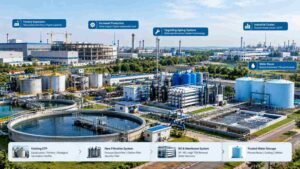
A textile unit expanding production may need an ETP upgrade. A pharmaceutical manufacturer may need treatment for a highly variable effluent stream. A chemical plant may be evaluating ZLD, while a food-processing facility may be looking for better organic-load management and water reuse. These are not the same sales opportunity, even though they all fall under Wastewater Treatment.
That distinction matters online. A company selling ETP, CETP, RO, ZLD, recycling, wastewater treatment equipment, EPC or O&M services can lose valuable enquiries if its digital presence presents everything as one generic “water treatment” offering. The commercial opportunity is to connect each industrial problem with the treatment capability that solves it—and then make that connection visible through Google, paid advertising, LinkedIn, social media and automated lead handling.
This is where SEO for wastewater treatment companies needs to go beyond ranking for broad phrases. The objective is to create visibility around the industries, treatment requirements and business situations that actually generate projects.
Wastewater treatment demand is created by industrial activity
The strongest opportunity for a wastewater treatment company is not necessarily a person searching for the phrase “wastewater treatment company.”
Demand is created when something changes inside an industrial operation.
A factory expands.
A new production line is commissioned.
An existing ETP stops delivering the required output.
An industry needs to reduce freshwater consumption.
A discharge requirement changes.
A plant wants to recycle treated water.
A common treatment facility needs additional capacity.
An old treatment system needs modernization.
Those events create commercial opportunities.
Indian regulatory and industry material also shows why this market cannot be treated as one generic category. CPCB documentation covers wastewater and effluent considerations across sectors such as pharmaceuticals, petrochemicals, dyes and dye intermediates, pesticides, fertilizers, oil refineries, paints and other chemical industries.
CPCB material on textile industries, for example, highlights the importance of understanding effluent characteristics, upgrading ETPs and increasing reuse and recycling of process water and treated effluent.
That gives a wastewater treatment company a much stronger commercial content opportunity:
Do not market only the treatment plant. Market the industrial situation that makes the treatment plant necessary.
Where the commercial opportunities actually come from
Before spending more on traffic, a wastewater treatment company should understand the different revenue situations inside its market.
| Commercial situation | Typical industrial need | Potential offering |
| New manufacturing project | New wastewater infrastructure | ETP, STP, RO, ZLD, complete plant |
| Production expansion | Existing capacity no longer sufficient | ETP expansion or upgrade |
| Poor treatment performance | Existing plant not achieving desired results | Retrofit, optimization, modernization |
| Water reuse initiative | Reduce freshwater dependence | RO, UF, recycling and recovery |
| High-TDS or difficult effluent | Advanced treatment requirement | RO, MEE, ATFD, ZLD |
| Industrial cluster | Shared wastewater infrastructure | CETP and common treatment systems |
| Plant maintenance | Operational reliability | O&M, AMC and service contracts |
| Compliance requirement | Treatment and monitoring | Treatment upgrade, monitoring and technical support |
This is more useful than building one broad “Wastewater Treatment Solutions” page and expecting it to generate every type of enquiry.
A company that handles ETP design, ZLD, wastewater recycling and O&M may actually have several different markets hiding inside one business.
That is where Digital marketing for wastewater treatment companies should begin.
Build your digital presence around revenue situations, not one service catalogue
A wastewater treatment website often follows the company’s internal structure:
- ETP
- STP
- RO
- ZLD
- MEE
- Filtration
- O&M
- Consultancy
That makes sense internally.
It does not always match how commercial demand is created.
An industrial manufacturer may not begin with “I need an MEE system.” The business problem may be that its existing process generates a high-TDS stream that is becoming difficult to manage.
A pharmaceutical manufacturer may not begin with “I need an ETP.” It may need a treatment system designed around changing effluent characteristics and production conditions.
A textile company may be concerned with colour, TDS, chemical loading, water recovery and production continuity.
The website therefore needs a second layer beyond the service catalogue.
Create pages around commercial situations
For example:
Existing ETP Upgrade
Explain:
- symptoms of an underperforming plant
- common causes
- capacity limitations
- treatment-stage improvements
- automation opportunities
- reuse possibilities
- technical information required for evaluation
Industrial Wastewater Recycling
Explain:
- where treated water can be reused
- treatment stages involved
- quality requirements
- recovery considerations
- suitable industrial applications
ZLD Solutions for High-TDS Effluent
Explain:
- where ZLD becomes relevant
- pretreatment
- membrane processes
- concentration
- evaporation
- crystallization
- recovery and reuse
These pages create more commercial entry points without creating meaningless keyword variations.
This is one of the most important areas for SEO services for wastewater treatment companies because the website begins matching business problems to solutions instead of simply repeating product names.
Treat each industrial sector as a different commercial market
The end industries using wastewater treatment should influence the content, landing pages and campaigns.
Textile and dyeing
Textile operations can generate wastewater containing colour, salts, chemicals and high dissolved solids. CPCB material specifically discusses the need for appropriate treatment, ETP upgrades and increased reuse and recycling in textile manufacturing.
A wastewater treatment company serving this market can create content around:
- textile ETP
- dyeing wastewater treatment
- textile wastewater recycling
- textile ZLD
- ETP modernization for textile plants
Pharmaceutical manufacturing
Pharmaceutical production can involve variable wastewater characteristics and complex treatment requirements.
Content should therefore focus on the actual engineering challenge:
pharmaceutical wastewater → treatment requirement → process configuration → compliance/reuse objective
Instead of another generic page titled “Best Wastewater Treatment Solutions.”
Food and beverage
Food processing creates a different treatment environment, often involving significant organic loading and production-related variability.
Commercial content can address:
- food processing wastewater treatment
- dairy wastewater treatment
- beverage industry ETP
- food industry water reuse
- wastewater treatment plant upgrades
Chemical manufacturing
Chemical industries can have very different wastewater characteristics depending on the process.
CPCB’s industrial pollution control framework includes multiple chemical-sector categories with specific wastewater discharge standards and pollution-control responsibilities.
This creates an opportunity for highly specific technical-commercial pages rather than broad chemical-industry claims.
Power and process industries
Water treatment requirements can extend beyond wastewater discharge to cooling, process water, boiler-related applications and reuse.
Government material on industrial wastewater recovery describes reuse of treated wastewater for industrial cooling and process applications, including examples involving UF and RO systems.
Industrial clusters
Small and medium industries do not always solve wastewater treatment independently.
CETPs provide a separate commercial market because multiple industrial units can use centralized treatment infrastructure. Government information has documented CETPs as a mechanism for treating effluent from medium and small industries within industrial clusters.
This is a completely different opportunity from selling an individual ETP.
Make the treatment technology explain the commercial outcome
Technical information is valuable—but only when it helps a potential customer understand the business decision.
A page explaining RO should not stop at:
“Reverse osmosis is a membrane-based separation process.”
That information is easy to find.
Instead, connect the technology to the situation:
Why would this industrial facility need RO after biological treatment?
When does RO become part of a wastewater reuse system?
What happens when high TDS makes conventional treatment insufficient?
Where does RO fit within a ZLD configuration?
The same approach applies to:
- UF
- MBR
- MBBR
- SBR
- MEE
- ATFD
- biological treatment
- chemical treatment
- sludge management
- water recovery
The commercial website should help a potential buyer understand why a technology may be relevant to their facility.
That makes the content more useful to both search engines and actual sales prospects.
Create a search map based on industrial demand
The goal is not to manufacture hundreds of pages simply because there are hundreds of keyword variations.
Instead, build a controlled search map around industry + problem + solution + commercial situation.
| Search type | Example search theme | Commercial opportunity |
| Core service | wastewater treatment company | Company-level enquiry |
| Industry | textile wastewater treatment | Industry-specific project |
| Application | pharmaceutical wastewater treatment | Sector-specific engineering enquiry |
| Problem | high TDS wastewater treatment | Advanced treatment requirement |
| Upgrade | ETP upgrade / ETP modernization | Existing plant opportunity |
| Reuse | industrial wastewater recycling | Water recovery project |
| Technology | industrial ZLD system | High-value treatment project |
| Cluster | CETP solutions | Industrial estate opportunity |
| Service | ETP operation and maintenance | Recurring service opportunity |
| Location | wastewater treatment company in [city] | Local project demand |
The table should be used as a planning framework—not as an excuse to create a page for every minor wording difference.
This is where SEO for wastewater treatment companies can become commercially stronger: every important search should lead to a page capable of answering the business question behind it.
Turn existing plants into a second revenue market
New plant projects are attractive, but an existing installed base can create another source of demand.
Consider an industrial facility that installed its ETP several years ago.
Production may have increased.
The wastewater profile may have changed.
The original plant may no longer have sufficient capacity.
Automation may be outdated.
The business may now want water reuse.
Operating costs may have increased.
The company may need a different treatment configuration.
That creates an upgrade and retrofit market.
A wastewater treatment company can build a dedicated digital acquisition path around this.
Content can answer questions such as:
- When should an ETP be upgraded?
- What causes an ETP to underperform?
- Can an existing ETP handle increased production?
- How can an existing treatment plant be modified for water reuse?
- When should biological treatment be upgraded?
- Can RO be added to an existing wastewater treatment system?
- What information is needed before an ETP retrofit is evaluated?
These are commercially useful topics because they speak to companies that already have wastewater infrastructure.
The prospect is not necessarily looking for a completely new plant.
They may already have one—and need someone to make it work better.
Use Google Ads where the project value justifies immediate visibility
SEO builds long-term visibility, but wastewater treatment projects can have high commercial value and long sales cycles.
That makes paid search useful for selected high-intent opportunities.
Instead of sending every advertisement to the homepage, create campaigns around distinct commercial requirements:
Campaign: ETP Projects
Landing page should answer:
- industries served
- treatment capacity
- treatment technologies
- engineering capability
- project scope
- technical information required
- enquiry option
Campaign: ZLD
The landing page should explain:
- industries where ZLD is relevant
- treatment stages
- water recovery objective
- advanced treatment capability
- technical evaluation process
Campaign: ETP Upgrade
The landing page should speak to existing plant owners rather than new-project buyers.
Campaign: Wastewater Recycling
The page should focus on treated-water reuse and industrial applications.
This is more effective than running one campaign around “water treatment company” and sending every visitor to the same page.
Digital marketing for wastewater treatment companies should use paid search selectively where a high-intent enquiry can justify the acquisition cost.
Make lead generation capable of understanding technical enquiries
A form saying:
Name
Phone
Email
Message
is often too weak for an industrial wastewater project.
A wastewater treatment enquiry can become much more useful when the form captures information such as:
- Industry
- Application
- Current treatment system
- Required capacity
- Approximate wastewater flow
- Existing ETP/plant
- Inlet water characteristics
- Desired output quality
- Reuse requirement
- Project type
- Location
- Expected project timeline
The exact fields should depend on the company’s sales process.
The objective is not to make the form unnecessarily long.
The objective is to collect the information that helps the sales or engineering team determine whether the enquiry is worth immediate attention.
This is where lead generation for wastewater treatment companies becomes different from ordinary lead generation.
A lead saying “Need ETP” is not equivalent to an enquiry that identifies the industry, flow requirement, existing plant and intended reuse.
What should happen after the enquiry?
This is where many industrial websites lose the value created by SEO and advertising.
Suppose a pharmaceutical company submits a technical enquiry.
What happens next?
If someone manually checks the form after several hours, the company has already created unnecessary delay.
An automated system can:
- Capture the enquiry.
- Identify the industry and application.
- Check whether key technical information is available.
- Ask for missing information through WhatsApp or chat.
- Categorise the enquiry.
- Notify the appropriate sales person.
- Trigger a follow-up sequence.
- Schedule a call where required.
- Update the CRM.
Adsthrive can connect these functions into a customised automation workflow rather than forcing the company to manage separate disconnected tools for every step.
This can include AI Chat, WhatsApp automation, AI lead qualification, AI calling, automated follow-up and CRM updates around the existing sales process.
LinkedIn should target the companies behind the opportunity
LinkedIn has a different job from Google.
Google captures active demand.
LinkedIn can help create demand and reach companies before the search happens.
For wastewater treatment companies, relevant audiences may include:
- Plant Heads
- EHS Managers
- Environmental Managers
- Utility Managers
- Project Managers
- Engineering Heads
- Operations Directors
- Factory Heads
- Sustainability teams
- EPC and engineering companies
The outreach should not simply say:
“We are a leading wastewater treatment company. Please contact us.”
A stronger approach is to build outreach around a specific industrial problem.
For example:
“We work with manufacturing facilities evaluating ETP upgrades when production expansion increases wastewater load. If your plant is reviewing treatment capacity or reuse requirements, we can help assess the existing configuration.”
That gives the recipient a reason to continue the conversation.
LinkedIn can also be used to distribute technical content such as:
- ETP upgrade checklists
- ZLD considerations
- wastewater reuse case studies
- treatment technology comparisons
- industry-specific compliance content
- plant modernization insights
Social media should demonstrate engineering capability
Social media does not have to generate every lead directly.
For a technical B2B company, its job can be to make the company look credible when a prospect checks the brand after finding it through Google or LinkedIn.
Useful content includes:
Project documentation
Show the treatment system, plant environment, equipment and application.
Before-and-after upgrades
Show what changed in an existing treatment plant.
Technical explainers
Explain why a particular treatment stage was required.
Industry-specific content
A textile ETP project should look different from a pharmaceutical wastewater project.
Water reuse examples
Show where treated water can be reused.
Operational content
O&M, monitoring, troubleshooting and plant performance content can demonstrate that the company understands the system beyond installation.
This turns social media into supporting evidence for the sales process rather than a calendar full of generic environmental posts.
AI Lead Qualification can separate projects from enquiries
Not every enquiry deserves the same response.
An AI lead qualification system can assess information such as:
- Industry
- Project type
- Capacity
- Current treatment system
- Requirement
- Location
- Timeline
- Technical completeness
For example:
| Enquiry | Possible classification |
| “Need ETP for new textile unit, 500 KLD” | High-priority project |
| “Need ETP upgrade for existing pharma plant” | High-priority technical enquiry |
| “Send brochure for wastewater treatment” | Nurture |
| “Looking for O&M for existing plant” | Service opportunity |
| “Need ZLD for high-TDS chemical wastewater” | Specialist project |
| “What is wastewater treatment?” | Early-stage information |
The qualification rules should be customized to the company’s actual sales criteria.
This is where AI can be commercially useful: not by replacing the sales team, but by reducing the time spent sorting enquiries and following up manually.
AI SEO gives technical content another layer
Traditional SEO can help a wastewater treatment company target established searches.
AI SEO can expand the content around related questions, applications and technical contexts.
For example, a single wastewater treatment topic can connect:
Industry
Textile
↓
Wastewater characteristic
High colour / TDS / chemical load
↓
Treatment requirement
ETP + advanced treatment
↓
Commercial requirement
Upgrade / recycling / ZLD
↓
Enquiry
Technical evaluation
The content should not artificially repeat these terms.
Instead, it should demonstrate enough technical and commercial context for search engines and potential customers to understand what the company actually does.
Adsthrive’s AI SEO services can be integrated with conventional SEO services so technical content, commercial pages and broader search visibility work together.
The website should behave like the first stage of your sales process
A good wastewater treatment website should answer important questions before a sales representative speaks to the prospect.
A visitor should be able to understand:
Do you serve my industry?
Do you handle my type of wastewater?
Do you provide the treatment technology I need?
Can you upgrade an existing plant?
Can you support water reuse or ZLD?
Do you provide O&M?
What information do you need from me?
What happens after I submit an enquiry?
If the website cannot answer these questions, additional traffic will not solve the underlying problem.
The website needs to reduce uncertainty.
That is especially important for industrial projects where the first enquiry may eventually develop into engineering discussions, site visits, technical evaluations and quotations.
Build content around evidence, not marketing claims
Wastewater treatment is an engineering-led purchase.
That makes evidence more valuable than generic statements such as:
“We provide innovative and sustainable wastewater solutions.”
Instead, demonstrate capability through:
- project applications
- industries served
- treatment capacity
- treatment processes
- before-and-after upgrades
- technical case studies
- equipment photographs
- process diagrams where appropriate
- water-reuse examples
- commissioning experience
- O&M capabilities
- downloadable technical documents
For example, a page about a textile wastewater project becomes much stronger when it explains the wastewater challenge, treatment configuration, capacity, recovery objective and implementation considerations.
The content itself becomes a sales asset.
Where Adsthrive fits into the commercial system
Adsthrive should not simply be positioned as another agency that will “increase website traffic.”
The stronger proposition is connecting the different parts of the acquisition and sales process.
For a wastewater treatment company, that can include:
- SEO for commercial and industry-specific searches
- AI SEO for broader contextual search visibility
- Lead generation campaigns
- Google Ads and landing-page optimisation
- LinkedIn outreach
- AI Chat
- WhatsApp automation
- AI lead qualification
- AI calling
- automated follow-up
- CRM updates
- appointment or consultation booking
The important part is that these functions can be designed around the company’s existing workflow.
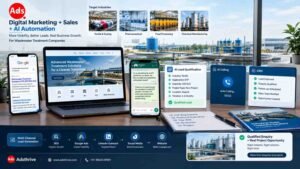
A wastewater treatment company selling a ₹X lakh or multi-stage industrial project does not need another disconnected marketing tool. It needs a system where traffic, enquiries, qualification and sales follow-up work together.
Adsthrive’s approach is to build that system around the client’s actual process.
What should you measure?
Traffic alone is not enough.
A commercially useful reporting system should connect marketing activity to sales outcomes.
Track:
| Metric | Why it matters |
| Organic visibility | Shows whether target searches are being captured |
| Qualified organic enquiries | Measures SEO’s commercial value |
| Google Ads enquiries | Shows paid acquisition performance |
| Cost per qualified lead | Better than cost per raw lead |
| Industry-wise enquiries | Shows which sectors create demand |
| Project-type enquiries | Identifies ETP, ZLD, upgrade, O&M etc. |
| Technical completeness | Shows lead quality |
| Lead-to-opportunity rate | Connects marketing to sales |
| Opportunity-to-quotation rate | Shows commercial progression |
| Enquiry-to-sale value | Measures actual business impact |
A wastewater treatment company may discover that one industry produces fewer enquiries but significantly more qualified opportunities.
That information should influence where the next marketing investment goes.
A practical seven-part growth model
Rather than treating digital marketing as seven disconnected channels, build the commercial system around these seven actions:
1. Identify the industrial revenue situations
Separate new projects, upgrades, reuse, ZLD, CETP, O&M and other opportunities.
2. Build sector-specific commercial content
Create useful pages around industries and their actual wastewater challenges.
3. Connect technology to applications
Explain where ETP, RO, UF, biological treatment, ZLD and recycling solutions fit.
4. Capture high-intent searches
Use SEO and Google Ads for searches that indicate genuine commercial requirements.
5. Turn technical information into better enquiries
Design landing pages and forms that collect information useful to engineering and sales teams.
6. Qualify and follow up automatically
Use AI Chat, WhatsApp, AI lead qualification and AI calling where they genuinely improve response speed and lead handling.
7. Measure opportunities, not just clicks
Connect marketing data with qualified leads, quotations and sales.
That is a much stronger model than publishing generic wastewater articles and waiting for enquiries.
Frequently Asked Questions
What does SEO for wastewater treatment companies involve?
It involves optimising a company’s website to appear for relevant searches around wastewater treatment services, industries, treatment technologies, plant upgrades, recycling, ZLD, O&M and related commercial requirements. The strongest approach connects search visibility with pages that can actually convert industrial visitors into technical enquiries.
Which industries need industrial wastewater treatment?
Industries such as textile and dyeing, pharmaceuticals, chemicals, food and beverage, manufacturing, power, engineering, tanneries, distilleries and industrial clusters can require wastewater treatment depending on their processes and discharge or reuse requirements. The exact treatment requirement varies by wastewater characteristics and the intended outcome.
Can SEO generate leads for ETP manufacturers?
Yes. SEO can attract companies searching for ETP projects, upgrades, industry-specific treatment solutions and related services. The website needs technically useful landing pages and a clear enquiry process rather than relying only on a generic ETP page.
Should wastewater treatment companies run Google Ads?
Google Ads can be useful for high-intent searches where a project has meaningful commercial value. Campaigns should be separated by opportunity—for example ETP projects, ZLD, wastewater recycling or ETP upgrades—and should direct visitors to relevant landing pages.
How can AI qualify wastewater treatment leads?
AI can collect and analyse information such as industry, application, capacity, project type, existing treatment system and timeline. It can then classify enquiries, request missing information, notify sales teams and trigger appropriate follow-up.
Is LinkedIn useful for wastewater treatment companies?
Yes. LinkedIn can help reach plant heads, engineering managers, EHS professionals, environmental managers, project teams, EPC companies and other relevant decision-makers. It is particularly useful for account-based outreach and distributing technical content.
How can wastewater treatment companies get more enquiries from their existing website?
Start by identifying which commercial situations the website currently fails to address. Build relevant landing pages, strengthen industry-specific content, improve enquiry forms, add project evidence and connect enquiries with faster qualification and follow-up.
What makes digital marketing successful for a wastewater treatment company?
The strongest results come when marketing is connected to the actual sales process. Search visibility, Google Ads, LinkedIn, social media, landing pages, lead generation and AI automation should ultimately help the company generate better-qualified opportunities and move them towards quotation and sales.
Turn Wastewater Treatment Demand Into Qualified B2B Opportunities
Your website should do more than explain wastewater treatment technologies. It should help the right industrial companies discover your capabilities, understand the relevance to their facility and submit enquiries that your sales team can actually act on.
Adsthrive combines SEO, AI SEO, Google Ads, lead generation, LinkedIn outreach, AI Chat, WhatsApp automation, AI lead qualification and AI calling into a customized digital marketing and automation system built around your sales workflow.
Reach the right industries. Generate better enquiries. Qualify opportunities faster.