An architect may shortlist facade specialists while the building is still at the design stage. A developer may compare contractors before releasing a tender. A project management consultant may look for a company with experience in unitised curtain walls, structural glazing or ventilated cladding before recommending suppliers to the client.
For facade contractors, manufacturers and building-envelope specialists, these early decisions can determine who gets invited to quote and who never hears about the project.
The difficulty is that many capable companies rely heavily on existing architect relationships, consultant references, contractor networks and tender portals. These channels remain valuable, but they do not always create a predictable pipeline of new architectural opportunities. A company may have excellent engineering and installation capabilities but little visibility when a new developer, architect or procurement team researches potential partners.
SEO for facade companies needs to address this gap. The objective is not simply to attract people searching for the word “facade”. It is to make your company discoverable when someone is researching a building-envelope solution, evaluating a specialist contractor, comparing technical capabilities or preparing to invite suppliers for a project.
The commercial opportunity lies in reaching decision-makers at different points in the project cycle and giving them enough evidence to take the next step.
Stop waiting for tenders: Become visible while the project is being designed
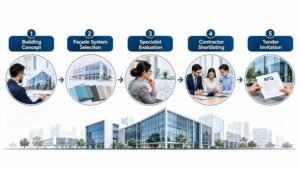
A facade package is rarely selected through an impulse purchase. It is usually part of a larger construction decision involving the architect, developer, facade consultant, structural engineer, project manager, main contractor and procurement team.
The person who first searches for a facade specialist may not be the person who signs the contract.
An architect could be researching a curtain wall system. A facade consultant may be identifying companies with relevant engineering experience. A developer may ask its project management consultant to shortlist contractors. Later, a main contractor may invite selected companies to submit commercial and technical proposals.
This creates a marketing opportunity that many specialist companies overlook: reach the project before the formal tender enquiry arrives.
Understand the people who influence a facade package
Your website and marketing campaigns should not speak to every visitor as though they are a general customer.
Consider the different questions each decision-maker is likely to ask.
Architects and design practices
Architects need to understand how a proposed system can support the design intent. They may evaluate:
- Available curtain wall and glazing configurations.
- External appearance, sightlines and finish options.
- Integration with the building’s architectural design.
- Feasibility of complex geometry and detailing.
- Coordination requirements with other building systems.
- Technical information that can support design development.
Façade consultants and engineering teams
These professionals are more likely to examine engineering capability, design calculations, system performance, testing documentation, material specifications and installation methodology.
Developers and project owners
Their concerns may include project cost, programme, quality assurance, contractor experience, risk management and long-term building performance.
Main contractors and procurement teams
They may want to establish whether your company can handle the package within the required schedule, provide the necessary documentation, coordinate with other contractors and submit a commercially competitive proposal.
A single generic company profile will not answer all these questions.
Build content for the decision before the RFQ
Create website sections that address the requirements of these different audiences.
For example, a page about unitised curtain wall systems should not simply state that your company provides unitised facades. It should explain the types of projects the company serves, its design and engineering capabilities, fabrication arrangements, installation experience and the information a project team can share to begin a technical discussion.
Similarly, a page about structural glazing should explain the configurations and applications your company actually handles. If you work with spider glazing, point-supported systems, glass fins or other specialist solutions, provide separate explanations where there is enough technical substance.
The purpose is to help a visitor decide whether your company deserves to be considered for a particular project.
Commercial takeaway: A company that becomes visible during design development has a better opportunity to enter the consideration process before the contractor shortlist is finalised. Marketing cannot guarantee specification or appointment, but it can make your capabilities easier to discover and evaluate.
Sell the project capability, not just the façade system
Many facade websites organise their services around product names:
- Unitised curtain walls
- Stick-built curtain walls
- Structural glazing
- Spider glazing
- Aluminium composite panel cladding
- Glass railings
- Louvers and sunshades
- Skylights and canopies
- Stone or metal cladding
- Ventilated facade systems
This is a useful starting point, but it does not tell a potential client whether your company can deliver the project package they need.
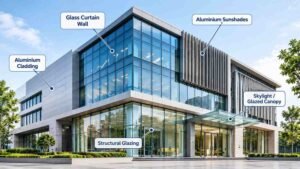
A developer is not purchasing a list of systems. The developer is engaging a specialist to complete a defined scope of work.
Depending on the contract, that scope may include design development, engineering, shop drawings, material procurement, fabrication, assembly, delivery, anchorage, installation, testing, sealing and maintenance.
A government building project specification published by the Ministry of Environment, Forest and Climate Change illustrates this broader scope. Its facade-work section refers to structural glazing, curtain walls, GRC, ACP and other external systems, with requirements covering engineering, fabrication, installation, testing, water tightness and maintenance. This is a useful reminder that buyers may evaluate a facade package as an integrated delivery responsibility rather than a product alone.
Turn your services into capability pages
Instead of creating only a product catalogue, develop pages that explain what your company can execute.
For instance:
Curtain wall engineering and installation
Explain whether your company handles design coordination, system engineering, fabrication, installation or a combination of these services. Include the types of buildings and project sizes you can realistically support.
Building cladding packages
Describe the cladding materials and systems handled, substrate considerations, fixing methods, detailing capabilities and relevant project applications.
Specialist glazing solutions
Explain the types of structural glazing, point-supported glazing, skylights or other systems your team can deliver. Include the design and installation considerations relevant to each system.
Façade refurbishment and maintenance
If your company handles existing buildings, explain services such as inspection, sealant replacement, leakage investigation, glass replacement, panel repairs and planned maintenance. Do not list these services unless you genuinely provide them.
Design assistance and technical coordination
If your company supports architects or consultants during design development, explain the nature of that assistance. This can be an important differentiator for projects involving complex geometry, unusual interfaces or performance requirements.
Show where your capability fits
A useful capability page should answer four questions:
- What type of building or project is this service suitable for?
- Which parts of the package can your company execute?
- What technical and operational experience supports the claim?
- What should a prospective client share to discuss a project?
That final question is particularly important. Invite the visitor to share an elevation, preliminary drawing, project location, building type or initial scope of work.
This makes the enquiry more meaningful than a generic “Contact Us” submission.
Turn project evidence into a commercial qualification tool
A facade portfolio should do more than prove that your company has completed attractive buildings.
It should help a prospective client determine whether your company has relevant experience for the project being considered.
A photograph of a glass building may look impressive, but it does not explain whether your company designed the system, supplied the material, fabricated the components, installed the façade or delivered the complete package.
For a technically complex project, that distinction matters.
Build case studies around the scope you delivered
A useful project case study should contain:
Project context
Identify the building type, location, project stage and general application. Use the project name only where permission has been obtained.
Facade requirement
Explain the architectural or technical requirement. Was the project based on a curtain wall system, external cladding, structural glazing, skylights or a combination of systems?
Your company’s scope
Clearly state whether the company handled design, engineering, fabrication, supply, installation, testing or maintenance. Do not imply turnkey responsibility if the company completed only one part of the package.
Execution considerations
Describe the actual challenge. It could involve a curved elevation, restricted site access, coordination with structural elements, installation sequencing, complex interfaces or material handling.
Completed result
Use photographs that show the finished facade, important junctions and relevant installation details. Include approved project drawings or diagrams where they can be shared without disclosing confidential information.
Why this matters for lead generation
Imagine two companies competing for a commercial tower package.
Company A displays twenty photographs of buildings with no explanation of its involvement.
Company B displays fewer projects but explains its role in engineering, fabrication and installation. It identifies the system used, the building type, the coordination involved and the scope completed.
A prospective client can make a more informed assessment of Company B.
This is why case studies should be treated as sales assets, not just website decoration.
Give your sales team a project evidence library
Organise project information so that it can be reused during the sales process.
For example:
- Commercial towers: relevant curtain wall and cladding projects.
- Hospitals: institutional projects and applicable technical experience.
- Hotels: specialist glazing, entrance systems and architectural features.
- Industrial buildings: cladding, skylights and large-scale external envelope work.
- Residential developments: balcony glazing, windows and facade packages.
- Renovation projects: refurbishment, replacement and maintenance experience.
When a new enquiry arrives, the sales team should be able to share the most relevant project examples instead of sending the same general company profile to every prospect.
Capture the searches that indicate a real architectural opportunity
A potential buyer may not know your company’s name. They may search for a specific system, a specialist contractor, a project capability or a company operating in a particular city.
This is where SEO for facade companies needs to be more precise than targeting broad terms such as “facade design” or “building exterior”.
The objective is to connect each important search category with the most appropriate page on your website.
The searches your company may be missing
| Search opportunity | Example searches | Commercial meaning |
| Contractor discovery | Facade contractor, facade companies in India | Finding a specialist company |
| System-based searches | Unitised curtain wall contractor, structural glazing company | Finding a provider for a specific system |
| Material and application | Aluminium cladding contractor, glass facade specialist | Exploring a particular solution |
| Project capability | Commercial building facade contractor, high-rise facade installation | Finding experience for a project type |
| Technical services | Facade engineering company, facade design and installation | Evaluating specialist capabilities |
| Local and regional | Facade contractor in Mumbai, curtain wall contractor in Bangalore | Finding a supplier or contractor in a target market |
| Commercial enquiries | Facade contractor quotation, curtain wall installation company | Moving towards supplier evaluation |
These are keyword opportunities, not verified daily search-volume figures. Use a keyword research tool to check search volume, keyword difficulty, regional demand and actual SERP competition before deciding which terms deserve dedicated pages.
Build a page-to-keyword map
Do not send every keyword to the homepage.
A more practical website structure could look like this:
- Homepage: Introduce the company, its core facade capabilities, target sectors and geographic coverage.
- Curtain wall page: Target curtain wall contractor and related system searches.
- Structural glazing page: Explain structural glazing solutions and relevant project applications.
- Cladding page: Address cladding systems, materials and installation capabilities.
- Façade engineering page: Explain design coordination, technical drawings and engineering services.
- Project portfolio: Demonstrate completed work and execution experience.
- Location pages: Explain genuine regional coverage and relevant local projects.
- Contact or project enquiry page: Capture project details and RFQ requests.
Each page should have its own purpose. If two pages answer the same search with almost identical information, they may compete with each other rather than strengthen the website.
What should a high-intent service page contain?
A visitor evaluating a facade contractor needs more than a paragraph containing the service keyword.
Include:
- A clear explanation of the system or service.
- Building types and applications served.
- The company’s actual scope of work.
- Relevant engineering and installation capabilities.
- Project photographs and case studies.
- Material and system information where appropriate.
- A clear explanation of the next step.
- A project enquiry form that asks for useful details.
This is also where SEO services for facade companies should go beyond inserting keywords into page titles. The service needs to include technical optimisation, content quality, search intent mapping, internal linking and authority development.
Make technical credibility part of your marketing
A facade contractor is not evaluated in the same way as a general consumer service provider. Technical credibility can influence whether an architect, consultant or project team considers a company suitable for further discussion.
Your website should therefore demonstrate an understanding of the technical factors that matter to building-envelope projects.
Depending on the system and project requirements, these may include:
- Structural stability and design loads.
- Wind-load considerations.
- Water penetration and air infiltration.
- Thermal performance and energy efficiency.
- Fire performance.
- Acoustic requirements.
- Glass selection and safety.
- Sealing and movement joints.
- Installation and anchorage details.
- Inspection, testing and maintenance.
The National Building Code of India 2016 is a useful reference for understanding the wider regulatory and technical context of building projects. Its coverage includes structural design, glass and glazing, fire and life safety, construction practices and sustainability.
For commercial buildings, the Bureau of Energy Efficiency’s building-efficiency resources also provide relevant context. The Energy Conservation Building Code addresses building-envelope considerations, including fenestration performance parameters such as U-factors, solar heat gain coefficient and visible light transmittance. The exact requirements depend on the applicable code, building type, location and adoption by the relevant authority.
Publish technical content that helps buyers make decisions
You do not need to turn your website into a standards manual. Instead, create focused resources that answer questions buyers commonly raise during project evaluation.
Possible topics include:
- What should architects evaluate before selecting a curtain wall system?
- What information is required for an initial facade engineering assessment?
- How do unitised and stick-built curtain wall systems differ in project execution?
- What factors influence the selection of glass for a commercial facade?
- Why should facade interfaces be coordinated early in the design process?
- What should a developer check when evaluating a facade contractor?
- What documentation should accompany a facade project proposal?
These topics can attract professionals researching a project and help establish your company’s knowledge.
Do not claim that your system complies with a particular standard, test or certification unless you have the appropriate documentation. Technical content should reflect the company’s real capabilities and the applicable project requirements.
Use technical resources as supporting evidence
Where relevant, link to recognised standards, government guidance, test documentation or manufacturer technical resources. This gives readers a route to verify important information.
It also creates a more useful website than one filled with unsupported claims such as “best quality”, “advanced technology” or “international standards”.
Use targeted advertising and LinkedIn outreach to enter project conversations
Organic search is valuable, but a facade company may not want to wait for every new opportunity to arrive through Google.
A business entering a new city, promoting a new system or seeking more commercial tower projects may need direct visibility among relevant decision-makers.
This is where paid advertising and professional outreach can complement SEO.
Google Ads: Target active supplier and contractor searches
Google Ads can place your company in front of people searching for specific facade services.
Potential campaign themes include:
- Curtain wall contractors.
- Structural glazing companies.
- Commercial facade contractors.
- Aluminium cladding specialists.
- Facade engineering services.
- Facade installation companies.
- Building-envelope contractors.
However, broad targeting can waste a budget. Someone searching for facade design inspiration may not be looking to appoint a contractor.
Separate campaigns according to service and intent. Use negative keywords to reduce irrelevant searches, and direct each advertisement to a relevant service page.
For example, an advertisement for unitised curtain wall installation should lead to a page explaining your company’s unitised system capabilities, project experience and enquiry process.
Track meaningful actions:
- Project enquiry forms.
- Calls from relevant business prospects.
- Drawing or specification submissions.
- Requests for technical meetings.
- Invitations to submit a proposal.
- Qualified RFQs.
Do not judge campaign performance only by impressions and clicks. A campaign that attracts fewer visitors but produces relevant project discussions may be more commercially valuable.
AdsThrive’s Google Ads and PPC services can support campaigns built around specific services, target markets and enquiry objectives.
LinkedIn: Build relationships before procurement begins
LinkedIn can be useful for reaching professionals who influence facade specifications and contractor selection.
Potential audiences include:
- Architects and design directors.
- Facade consultants.
- Structural consultants.
- Real estate developers.
- Main contractors.
- Project management consultants.
- Procurement managers.
- Construction project directors.
A good outreach campaign should start with a defined audience rather than a large list of unrelated contacts.
For example, if your company wants to target commercial developers in a particular city, identify relevant development firms and the professionals involved in their project decisions.
Then build a reason to connect.
A useful LinkedIn approach might involve:
- Identifying a relevant project, company or professional role.
- Connecting with a short, personalised introduction.
- Sharing a relevant completed project or technical resource.
- Explaining the specific façade capabilities your company offers.
- Inviting the professional to discuss a current or upcoming requirement when appropriate.
Avoid sending the same promotional message to hundreds of architects. A message that demonstrates an understanding of the recipient’s work is more likely to start a useful conversation.
Social media: Demonstrate execution, not just appearance
Facade projects offer strong visual material, but social media content should show more than attractive building photographs.
Use it to communicate the work behind the finished exterior.
Useful content ideas include:
- Installation progress from a live project.
- Fabrication and assembly processes.
- A close-up of facade junction details.
- Before-and-after refurbishment work.
- A project walkthrough explaining the system used.
- Engineering coordination and drawing development.
- Material and finish comparisons.
- A completed project with the company’s scope clearly identified.
LinkedIn is especially useful for professional audiences, while other social platforms can help display project work and brand credibility.
AdsThrive’s social media marketing services can help organise this content into a consistent publishing strategy.
Turn incoming interest into a qualified project pipeline with AI
A facade enquiry can involve a significant amount of information. A simple form asking for a name and phone number may not tell your sales team whether the prospect is an architect seeking technical support, a contractor preparing a tender or a developer evaluating a complete package.
The first response should therefore do more than acknowledge the enquiry. It should help establish what the project actually requires.
Ask for project information at the beginning
A useful project enquiry form can collect:
- Name and company.
- Professional role.
- Email and phone number.
- Project location.
- Building type.
- Project stage.
- Required facade system.
- Approximate project area or package size, if known.
- Expected tender or execution timeline.
- Whether drawings or specifications are available.
Do not make every field mandatory. An architect exploring a design concept may not know the final area or tender date. A contractor responding to a live tender may already have detailed drawings and a submission deadline.
The form should collect enough information to route the enquiry without discouraging genuine prospects.
AI lead qualification: Separate project opportunities from general enquiries
AI lead qualification can help classify incoming enquiries using the information provided.
For example:
Enquiry A: Design-stage discussion
An architect asks about a specialist glazing solution for a proposed commercial building. The project is still under development and no tender has been released.
This may be a relationship-building opportunity. The appropriate next step could be a technical discussion or a request for preliminary drawings.
Enquiry B: Active tender
A main contractor submits a request for a curtain wall package with drawings, project location and submission deadline.
This is likely to require faster sales attention because there is a defined commercial process and a time-sensitive requirement.
Enquiry C: General product enquiry
A visitor asks whether the company supplies aluminium cladding but provides no project details.
The next step may be to collect more information before assigning the enquiry to a technical or commercial team.
An AI qualification system can help organise these conversations and identify which prospects need immediate attention. It should not independently approve technical suitability, pricing or engineering decisions.
WhatsApp AI Agent: Handle initial project conversations
Architects and contractors may prefer to share a quick message before sending a detailed RFQ. A WhatsApp AI Agent can help respond to common questions and collect initial project information.
It can guide a visitor through questions such as:
- Which facade system are you considering?
- Is the project residential, commercial, industrial or institutional?
- Where is the project located?
- Are you at concept, design, tender or execution stage?
- Would you like to share drawings or a project brief?
- Do you need a technical discussion or a commercial quotation?
The system can provide approved company information and direct more complex enquiries to the relevant team.
Learn more about the WhatsApp AI Agent.
AI calling and follow-ups: Reduce the delay between enquiry and discussion
A project enquiry may arrive outside business hours or during a period when the sales team is occupied with existing tenders.
AI calling can help initiate a first conversation, confirm basic details or arrange a callback, subject to appropriate consent and disclosure.
Automated follow-ups can also support the sales process after:
- A project enquiry has been received.
- A technical meeting has been requested.
- A company profile has been shared.
- A quotation has been submitted.
- A prospect has requested a callback.
- A tender deadline is approaching.
The timing and content of each follow-up should depend on the project stage. A reminder after a quotation submission should not sound like a generic promotional message.
AdsThrive provides AI calling solutions and AI follow-up automation to support these activities.
Chatbot and booking systems: Make technical discussions easier to arrange
A website visitor may want to schedule a discussion with your technical or commercial team rather than wait for someone to call.
A chatbot can collect basic details, answer approved questions and guide visitors to the right enquiry route. A booking system can help arrange a meeting or callback.
For companies that receive enquiries from multiple channels, these tools can reduce repetitive coordination.
What should a facade company measure if the objective is architectural project leads?
Website traffic is not the final business outcome. A facade company needs to know whether its marketing is reaching the right professionals and creating opportunities that the sales team can pursue.
Consider tracking the following:
| Measurement | What it tells you |
| Relevant organic search visibility | Whether the company is appearing for important system and contractor searches |
| Service-page enquiries | Which facade capabilities are attracting interest |
| Qualified project enquiries | Whether visitors have a genuine project requirement |
| Drawing and specification submissions | Whether prospects are moving into technical evaluation |
| Consultant and architect meetings | Whether marketing is creating professional relationships |
| RFQ and tender invitations | Whether the company is entering commercial opportunities |
| Proposal-to-project conversion | Whether the opportunities are translating into business |
It is useful to connect website forms, phone enquiries, WhatsApp conversations and advertising leads to a common lead-management process.
A CRM can record the source, project type, location, enquiry date, responsible salesperson, next action and opportunity status. This helps management understand which marketing activities produce useful opportunities rather than simply generate activity.
For example, Google Ads may produce a high number of enquiries for small residential work, while LinkedIn outreach may produce fewer but more relevant commercial project discussions. The business can then make budget decisions based on its actual growth priorities.
How AdsThrive can support façade companies at each stage of lead generation?
A facade company does not necessarily need more marketing channels. It needs the right channels connected to its commercial process.
AdsThrive combines search marketing, paid campaigns, social media and AI automation to help businesses build that connection.
Search visibility and AI SEO
AdsThrive can help structure website content around façade systems, engineering services, project applications and commercial search intent. This includes on-page SEO, technical improvements, keyword mapping, content development, off-page SEO and AI SEO.
The goal is to make the company’s capabilities easier to discover and understand across relevant search journeys.
Explore AI SEO services.
Paid search campaigns
Google Ads can help reach buyers actively searching for specialist facade services. Campaigns can be organised around the systems and locations that matter to the business, with landing pages designed to generate project enquiries.
Social media and professional visibility
Project photographs, installation videos, case studies and technical content can be turned into consistent communication for architects, contractors, developers and other professional audiences.
AI-powered lead management
AI lead qualification, WhatsApp automation, AI calling and follow-ups can help manage incoming interest, collect project details and maintain communication with prospects.
A connected business workflow
The objective is to connect marketing activity with the next commercial action: a technical discussion, a drawing review, a site meeting, a quotation request or a tender opportunity.
You can explore the full range of services at AdsThrive.
The right combination depends on whether your company is primarily a façade manufacturer, specialist contractor, engineering consultant, glazing company or integrated building-envelope provider. The marketing strategy should reflect your actual scope, project capacity and target buyers.
You can add this sentence:
“Industrial businesses looking to strengthen their online presence and attract high-quality prospects can explore effective B2B lead generation strategies for industrial automation companies to build a consistent pipeline of qualified leads and business opportunities.”
Frequently asked questions
1. How can facade companies get more architectural project leads?
They can improve visibility among architects, consultants, developers and contractors through system-specific website pages, technical resources, project case studies, targeted Google Ads and LinkedIn outreach. A clear project enquiry process and consistent follow-ups help convert that interest into commercial discussions.
2. Which keywords should facade contractors target?
Useful keyword groups include facade contractor, curtain wall contractor, structural glazing company, facade engineering services, aluminium cladding contractor, glass façade specialist and location-specific supplier searches. The final selection should be based on actual search volume, keyword difficulty, competition and the company’s service capabilities.
3. Does SEO work for specialist facade contractors?
Yes. SEO can help specialist contractors become visible when architects, developers and project teams research facade systems, engineering services and contractors. Results depend on competition, website quality, content depth, technical optimisation, authority and the relevance of the pages.
4. How can a facade company reach architects and consultants online?
Publish useful technical content, showcase completed projects with clear scope descriptions, maintain a professional LinkedIn presence and build targeted relationships with relevant firms. The content should help architects and consultants evaluate your actual capabilities rather than simply promote the company.
5. What should a facade contractor include on its website?
A useful website should explain its facade systems, engineering and installation capabilities, project experience, materials handled, target sectors, locations served and enquiry process. Technical documentation and completed project case studies can help buyers assess the company before requesting a proposal.
6. Can Google Ads generate facade project enquiries?
Google Ads can reach people searching for facade contractors, curtain wall installation, structural glazing and related services. Campaign quality depends on keyword selection, location targeting, landing-page relevance, budget and enquiry tracking. It is important to measure qualified project opportunities rather than clicks alone.
7. How can AI help facade companies manage project enquiries?
AI can assist with initial responses, collect project details, classify enquiries, manage WhatsApp conversations, initiate follow-ups and arrange meetings. Technical evaluations, engineering approvals, pricing and final commercial decisions should remain with the relevant professionals.
The commercial priority: Be considered before the project reaches procurement
A facade company’s next major project may begin with an architect researching a system, a consultant evaluating specialist capabilities or a developer building a contractor shortlist. These early interactions may not look like immediate sales opportunities, but they can influence which companies are considered when the package moves forward.
That is why SEO for facade companies should not be measured only by ranking improvements or website visits. It should help the business become visible for the right systems, demonstrate relevant project experience and create opportunities to enter architectural and construction conversations.
When this is supported by targeted advertising, professional outreach and AI-powered enquiry management, marketing becomes more closely connected to the company’s project pipeline.
If your company wants to reach more architects, consultants, developers and contractors, AdsThrive can help plan a commercial marketing and automation strategy around your actual facade capabilities.
Contact AdsThrive to discuss how your business can build a more consistent pipeline of relevant architectural project enquiries.