A food processing plant may need water with consistent quality for production. A textile unit may be dealing with colour, suspended solids or process-water requirements. A boiler operator may need to manage feedwater quality, while a pharmaceutical facility may have tightly defined water specifications. These businesses do not necessarily begin their supplier search by typing “water treatment equipment manufacturer”. They often start with the water problem, the process affected or the equipment they need to replace.
That difference matters commercially. A manufacturer may have the right filtration systems, reverse osmosis equipment, softeners, membrane systems, dosing equipment or industrial water treatment solutions, yet still miss potential customers because its website only lists product names.
The opportunity is to make the equipment discoverable through the problems it solves, the industries it serves and the technical information buyers need before requesting a quotation.
Digital marketing for water treatment equipment manufacturers should therefore connect three things: the buyer’s water requirement, the manufacturer’s actual equipment capabilities and a clear route to a qualified sales enquiry. SEO, Google Ads, LinkedIn, social media and AI-powered lead management can work together to create that connection.
This article examines how manufacturers can capture demand for individual equipment categories, reach industrial buyers, improve enquiry quality and use Adsthrive’s digital marketing and automation capabilities to support commercial growth.
The Market Does Not Search by Your Product Catalogue Alone
A manufacturer’s internal product catalogue is organised around what the company makes. A buyer’s search is often organised around what the buyer needs to fix, produce or maintain.
For example, a company might sell industrial RO plants, but a buyer may search for equipment to reduce dissolved solids in process water. A manufacturer may supply water softening systems, while a boiler operator may be researching scaling and feedwater treatment. A filtration equipment manufacturer may offer multiple filter configurations, but a factory may search for a filtration solution for a particular production process.
The product and the search are related, but they are not always expressed in the same language.
This creates a visibility gap.
| What the manufacturer sells | What the potential buyer may be trying to solve | Useful content or landing page |
| Industrial RO plant | High dissolved solids or a specific process-water requirement | Industrial RO applications and system specifications |
| Water softening plant | Hardness-related scaling concerns | Industrial water softener applications |
| Ultrafiltration system | Removal of suspended particles or particular contaminants | UF system applications and process information |
| Demineralisation plant | Low-mineral water requirements for a defined process | DM plant applications and technical details |
| Pressure sand filter | Suspended solids and preliminary filtration requirements | Industrial filtration equipment page |
| Activated carbon filter | Specific taste, odour or organic-compound treatment requirements, where applicable | Activated carbon filtration applications |
| Dosing system | Controlled chemical addition within a treatment process | Chemical dosing equipment and integration information |
| Membrane filtration equipment | Separation requirements and membrane-based treatment applications | Membrane equipment and operating considerations |
These examples must be matched to the actual products and treatment capabilities of the manufacturer. Not every technology is suitable for every water source or application.
The commercial lesson is simple: a company should not expect one broad product page to capture every relevant search. It needs a clear relationship between the equipment it manufactures, the applications it serves and the questions that potential buyers ask.
First, Decide Which Equipment Categories Deserve More Visibility
Not every product deserves the same marketing budget. Some equipment categories may generate a high number of enquiries but produce low-value opportunities. Others may attract fewer enquiries but lead to larger industrial orders or repeat business.
Before creating campaigns, examine the commercial value of the product portfolio.
A manufacturer can divide its catalogue into three groups:
Core revenue equipment: Products that contribute significantly to current sales and have a clear market. These deserve strong product pages, search visibility and paid campaign support.
Growth equipment: Products the company wants to sell more frequently, enter new industries with or expand into new geographical markets. These may need dedicated landing pages and targeted outreach.
Supporting equipment and components: Filters, housings, vessels, accessories, replacement parts or related systems that may support repeat purchases, cross-selling or service enquiries.
This classification helps prevent a common marketing mistake: spending the same amount of effort on every product simply because each appears in the catalogue.
For example, if industrial RO systems are a major revenue category, the manufacturer should have a strong commercial page for that product, relevant application pages and a route for buyers to submit water and capacity requirements. If membrane housings are a growth category, the business may need product-specific technical content and a different enquiry form.
The marketing team should also ask the sales team which products are difficult to explain, which enquiries are frequently lost and which applications produce the best commercial opportunities. That information is more useful than choosing campaign topics solely because a keyword tool suggests a phrase has search demand.
Six Commercial Strategies for Water Treatment Equipment Manufacturers
1. Turn the Product Catalogue Into a Searchable Equipment Architecture
A catalogue is useful for existing customers and sales teams, but it is not automatically a good website structure. Buyers should be able to find the exact equipment they need without navigating through an entire company profile.
A manufacturer selling multiple categories should consider organising its website into a clear hierarchy.
For example:
- Industrial water treatment systems
- Industrial RO plants
- Ultrafiltration systems
- Demineralisation plants
- Water softeners
- Filtration equipment
- Pressure sand filters
- Activated carbon filters
- Cartridge filtration systems
- Other filter configurations actually supplied
- Process and treatment equipment
- Chemical dosing systems
- Membrane equipment
- Clarifiers or other process equipment, where manufactured
- Applications
- Food and beverage
- Pharmaceuticals
- Textiles
- Power and utilities
- Chemical processing
- Other sectors served by the company
This is an example of a website architecture, not a recommendation to create pages for products the business does not manufacture.

Each important product page should explain what the equipment is intended to do, where it is used, what information is required to assess a requirement and what makes the manufacturer’s offering relevant.
A strong product page should answer questions such as:
- What does the equipment treat or process?
- What applications is it designed for?
- What capacity or configuration options are available?
- Which operating conditions affect selection?
- What technical information can the manufacturer provide?
- Does the company offer design, fabrication, installation or commissioning?
- Are maintenance, replacement parts or after-sales support available?
- What should a buyer submit to receive a useful quotation?
Include actual product photographs, drawings or diagrams where permitted. If the manufacturer has approved technical specifications, make them accessible. Do not publish generic specifications copied from another supplier or claim a capacity range that the company cannot deliver.
A useful page should also have a relevant call to action. “Send Your Water Requirement”, “Request Equipment Details” or “Discuss an Industrial Application” can be more meaningful than a generic button repeated across the entire website.
For a company that wants to improve its organic visibility, SEO for water treatment equipment manufacturers should begin with this product architecture. It gives search engines and buyers a clearer understanding of the company’s equipment range.
Related internal resource: SEO services by Adsthrive.
2. Create Application Pages That Connect Equipment With Industrial Use
A product page explains the equipment. An application page explains why a particular industry may need it.
These two page types serve different search intentions and should support each other.
Consider an industrial RO manufacturer. A product page can explain the system’s available configurations and specifications. An application page can discuss the water requirements that may arise in food processing, pharmaceuticals, manufacturing or other relevant sectors. It should explain the application accurately without promising that one RO configuration will suit every facility.
The same approach can work for softeners, filtration systems, demineralisation equipment and other products.
A practical application page can include:
- The type of water requirement or process involved.
- The operational concern the equipment may address.
- The relevant equipment category offered by the manufacturer.
- Important selection factors, such as feedwater characteristics, required output quality and operating conditions.
- Available technical support and services.
- A route for the buyer to discuss the specific requirement.
This creates a more useful connection between product discovery and commercial intent.
For example, a textile manufacturer researching water treatment may be interested in process-water consistency, while a power facility may be concerned about the requirements of its boiler or cooling-water systems. These are different applications and should not be forced into one generic page.
Do not create dozens of near-identical industry pages by replacing one industry name with another. Each page should contain information relevant to that sector. If the company has no experience or suitable offering for an application, it should not imply otherwise.
Application pages also give the sales team material to share with prospects. A salesperson can send a relevant page to a food processing company instead of asking the prospect to read the entire product catalogue.
This is particularly valuable for manufacturers with a wide product range: one well-developed product page can support several genuinely useful application pages, while each application page links back to the equipment that addresses the requirement.
3. Use Technical Proof to Reduce the Gap Between Interest and Enquiry
Water treatment equipment is not always purchased through a quick online decision. A buyer may need to review specifications, operating conditions, test information, materials, performance data and compatibility with an existing process.
A website that only says “high-quality equipment” gives the buyer very little to evaluate.
Manufacturers should make approved technical evidence part of their marketing.
Depending on the product, useful information may include:
- Equipment drawings and dimensions.
- Available materials of construction.
- Flow rates and capacity ranges.
- Operating pressure and temperature limits.
- Membrane or filter details, where relevant.
- Feedwater requirements and limitations.
- Utility and power requirements.
- Maintenance and replacement considerations.
- Installation and commissioning scope.
- Testing and inspection information.
- Applicable standards or certifications, where genuinely held or relevant.
The level of detail should reflect what the company can responsibly publish. Some information may be shared only after an enquiry, particularly when designs are customised or client-specific.
Technical content should also explain the limits of the equipment. For example, a filtration system cannot be marketed as removing every dissolved contaminant if that is not what the system is designed to do. Similarly, a manufacturer should not imply that every RO system meets every drinking-water or industrial process specification.
Indian standards and regulatory references can strengthen technical content when used accurately. The Bureau of Indian Standards provides a Know Your Standard portal through which users can search standards and access related information. For example, IS 4343:2023 concerns the code of practice for treatment of water for high-pressure boilers. It is a specific reference, not a blanket certification for all water treatment equipment.
For applicable RO-based point-of-use drinking-water systems, BIS has also published IS 16240:2023. Its scope should not be confused with industrial RO plant specifications.
A manufacturer can use relevant technical resources to create educational content, product documentation and sales material. The purpose is to help buyers understand the offering and assess whether a discussion is worthwhile.
This is where SEO services for water treatment equipment manufacturers should go beyond metadata and keyword placement. Technical pages should be structured so that the right buyer can discover the information, understand it and take the next step.
4. Capture High-Intent Searches With Google Ads and Product-Specific Landing Pages
Organic rankings take time to build. Google Ads can help a manufacturer reach buyers who are already searching for a particular product or supplier.
However, broad campaigns can waste budget when the company’s equipment range covers several unrelated categories.
A better approach is to divide paid campaigns by product family and commercial intention.
For example:
| Campaign group | Search themes to test | Suitable landing page |
| Industrial RO | Industrial RO plant manufacturer, industrial RO system supplier | Industrial RO product page |
| Water softening | Industrial water softener, water softening plant manufacturer | Water softener page |
| Filtration | Industrial filtration equipment, pressure sand filter manufacturer | Relevant filtration page |
| Demineralisation | DM plant manufacturer, demineralisation plant supplier | DM plant page |
| Ultrafiltration | Industrial UF system, ultrafiltration equipment supplier | UF product page |
| Replacement and service | Filter replacement, membrane replacement or maintenance terms, if offered | Relevant service page |
The search terms should be checked before campaigns are launched. A phrase may look commercially relevant but still attract students, job seekers, household buyers or people looking for a different type of equipment.
Use negative keywords where appropriate and review the actual search-term report regularly.
The advertisement should be specific about what the company supplies. If the business manufactures industrial RO systems, the advertisement should not make it sound like a household purifier seller. If the company supplies equipment but does not provide installation, do not advertise installation as an included service.
A strong landing page should match the advertisement. It should show the relevant equipment, key specifications, applications, genuine project evidence and an enquiry route. Avoid sending every campaign to the homepage.
The form should collect enough information to help the sales team respond:
- Name and company.
- Business email or phone number.
- Equipment or application of interest.
- Project or plant location.
- Required capacity, if known.
- Feedwater source or relevant water information, if available.
- New installation, replacement or expansion.
- Expected purchase or project timeline.
Not every visitor will know the technical details. Make it possible to submit an enquiry even when some information is unavailable.
Google Ads should be evaluated through qualified enquiries, technical discussions, quotation requests and sales opportunities. A low cost per click is not proof that a campaign is producing business.
For further campaign guidance, see Adsthrive’s Google Ads optimisation article.
5. Use LinkedIn and Social Media to Reach Buyers Before They Search
Search advertising reaches people who are actively looking. LinkedIn and social media can help manufacturers reach industrial audiences who may have a relevant requirement but have not started searching for a supplier.
The target audience depends on the equipment.
For industrial process-water equipment, relevant contacts may include plant heads, utility managers, production managers, maintenance heads, project engineers, purchase managers, consultants and EPC contractors. For certain product categories, distributors and system integrators may also be important.
LinkedIn outreach should be built around the manufacturer’s actual market.
Start by identifying the industries the company serves and the job roles likely to influence equipment selection. Then research relevant companies and create a manageable prospect list.
A useful outreach approach includes:
- A short introduction that explains the manufacturer’s actual equipment category.
- A relevant reason for contacting the person or organisation.
- A link to a product or application page that matches the prospect’s industry.
- An invitation to discuss a specific requirement rather than a generic sales pitch.
- A sensible follow-up, without repeatedly messaging people who do not respond.
For example, a manufacturer of industrial filtration equipment could contact a plant or maintenance professional with a short introduction to its filtration range and ask whether the organisation is reviewing any filtration requirements. The message should not assume that the recipient has a current problem.
Social media has a different role. It gives manufacturers a place to demonstrate their equipment, manufacturing capability and application knowledge.
Useful posts include:
- A close-up of a finished equipment assembly with a brief explanation of its purpose.
- A manufacturing or quality-inspection photograph.
- A product comparison that explains the difference between two equipment categories.
- A short technical explanation of a common selection factor.
- A project photograph with the client’s permission.
- A video showing a genuine operating or testing process.
- An explanation of maintenance considerations for a particular equipment category.
Avoid posting only festival greetings, generic sustainability slogans and product photographs without context. These may maintain activity, but they do little to help a technical buyer evaluate the manufacturer.
A single well-documented product or project can be adapted into a website case study, a LinkedIn post, a short video and a sales presentation. This creates consistency without publishing the same caption repeatedly.
6. Connect Every Enquiry to AI Lead Qualification and Sales Follow-Up
A manufacturer can invest in SEO, paid advertising and outreach, but the commercial result still depends on what happens after a prospect makes contact.
Water treatment equipment enquiries can be technically varied. One person may request an industrial RO plant, another may need a softener, and another may be enquiring about replacement membranes or a filtration system. A salesperson needs enough context to identify the requirement and route it correctly.
An AI-assisted enquiry process can help collect that initial information.
For example, a website chatbot or WhatsApp assistant can ask:
- Which equipment are you interested in?
- What industry or application is it for?
- Is this a new installation, replacement or expansion?
- What is the required flow rate or capacity, if known?
- What is the source of the water?
- Is a water analysis report available?
- Where is the project located?
- When do you expect to make a decision?
The answers can be organised and sent to the appropriate salesperson. A technical team can then review the details and ask for additional information where needed.
AI should not independently prescribe a treatment process or guarantee water quality based on incomplete answers. Water analysis, process conditions, technical calculations and final equipment selection require appropriate technical review.
A connected automation setup can also help with:
Immediate acknowledgement: The prospect receives confirmation that the enquiry has been received.
Enquiry categorisation: The system identifies whether the enquiry concerns RO, filtration, softening, membranes, DM equipment or another category the business handles.
Lead routing: The enquiry reaches the relevant product or regional sales team.
AI calling: Where the prospect has consented and the workflow is appropriate, an AI calling system can help initiate contact, confirm basic details or schedule a discussion.
WhatsApp and email follow-up: Approved messages can share product information, request missing details or remind the prospect about an agreed next step.
CRM updates: Contact information, enquiry source, product interest and follow-up status can be recorded in one place.
Consultation booking: Prospects can be directed to an available salesperson or technical representative for a discussion.
This is especially useful when enquiries arrive through multiple channels. Without a connected process, a website form may sit in an inbox, a WhatsApp enquiry may remain on an employee’s phone and an advertisement lead may not reach the correct salesperson.
AI lead qualification helps organise the first stage of the conversation. It does not replace the salesperson or engineer who evaluates the actual requirement.
Adsthrive’s AI chatbot agent, AI calling solution and lead generation services can be considered as part of a connected enquiry process, depending on the manufacturer’s needs.
The Search Opportunities Manufacturers May Be Missing
A manufacturer may rank for its company name and a broad product term while missing searches for individual equipment types, industrial applications and replacement requirements.
The table below shows search themes worth investigating. These are examples of possible queries, not measured daily search counts or claims about search volume.
| Search category | Example searches | Commercial opportunity |
| Manufacturer searches | Water treatment equipment manufacturer, industrial water treatment equipment supplier | Reach buyers comparing suppliers |
| Product searches | Industrial RO plant, industrial water softener, DM plant manufacturer | Promote individual equipment categories |
| Application searches | Water treatment system for food processing, process water treatment for pharmaceutical plants | Reach buyers by industry |
| Component searches | Membrane housing manufacturer, industrial filter housing supplier | Capture component-level demand |
| Problem-related searches | Industrial water hardness treatment, high TDS water treatment system | Connect a water problem with a relevant solution |
| Replacement searches | RO membrane replacement, industrial filter replacement | Capture repeat and service-related demand, where offered |
| Agency searches | SEO services for water treatment equipment manufacturers, digital marketing agency for water treatment equipment manufacturers | Reach manufacturers actively looking for marketing support |
Search Console can show which queries already generate impressions and clicks. Keyword research tools can help identify additional terms and estimate their relative competition. The company should then compare those terms with its product range and sales priorities.
Do not create pages for every phrase in the table. Group closely related searches around one useful page and create separate pages only when the search intent or product offering is meaningfully different.
What Should a Manufacturer Measure Beyond Website Traffic?
A manufacturer needs to know whether marketing is attracting buyers who can actually purchase its equipment.
A campaign may generate many enquiries from household consumers when the company sells industrial systems. Another may attract requests for products outside the manufacturer’s range. These enquiries increase lead counts but do not necessarily improve revenue.
Use a reporting structure that connects marketing activity to sales outcomes.
| Measurement area | What to review |
| Search visibility | Impressions and clicks for relevant product and application searches |
| Product-page performance | Visits, engagement and enquiry actions on important equipment pages |
| Paid campaign quality | Search terms, conversion rate and cost per qualified enquiry |
| Lead relevance | Product fit, industry, location and project requirement |
| Sales response | Time to first contact and completion of agreed follow-up |
| Technical progression | Requests for water analysis, technical discussions or site assessments |
| Commercial progression | Quotations, negotiations, orders and revenue |
| Repeat business | Replacement equipment, spares, service or additional system requirements, where relevant |
Marketing and sales should review these results together. If the marketing team reports 100 leads but sales says most are irrelevant, the problem needs to be investigated at the campaign and qualification levels.
If industrial RO enquiries are strong but filtration enquiries are weak, the company may need to improve the filtration page, adjust the campaign or reconsider the target market. If leads are relevant but do not progress, the sales team may need better technical information, faster response or a clearer quotation process.
This feedback should influence future content and campaign decisions. The goal is to invest more in the channels and product categories that create meaningful commercial opportunities.
How Adsthrive Supports Manufacturers Looking for More Qualified Enquiries
A water treatment equipment manufacturer may already have a website, product catalogue and sales team, but still struggle to generate a consistent flow of relevant enquiries. In some cases, the problem is poor search visibility. In others, the website does not explain the product range clearly, advertising reaches the wrong audience or incoming leads are not followed up properly.
Adsthrive approaches this as a connected marketing and lead-management requirement rather than treating every channel as an isolated activity.
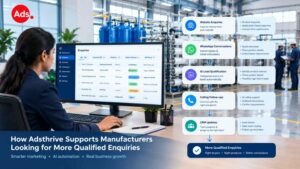
Depending on the manufacturer’s objectives, the work can include:
- SEO: Improve the visibility of product, application and service pages for relevant commercial searches.
- AI SEO: Strengthen content and search visibility so the business can communicate its expertise across evolving search experiences.
- Google Ads: Reach buyers actively looking for specific equipment categories and applications.
- Lead generation: Build campaign and landing-page routes that encourage relevant prospects to submit their requirements.
- LinkedIn outreach: Support targeted communication with industrial companies and relevant decision-makers.
- AI chatbot and WhatsApp: Collect initial enquiry information and provide a convenient route to contact the business.
- AI calling: Support agreed follow-up and appointment workflows.
- AI lead qualification: Categorise enquiries and help sales teams prioritise them.
- CRM and booking automation: Keep enquiry records and next steps organised.
The important point is that manufacturers should not have to manage a disconnected collection of tools for chat, calling, WhatsApp, lead qualification, booking and CRM updates if a more integrated workflow can meet their needs.
Adsthrive can customize an all-in-one AI automation approach around the manufacturer’s existing sales process. A business that already receives good enquiries may need stronger follow-up automation, while a company with limited visibility may need SEO and paid campaigns before automation becomes a priority.
Explore Adsthrive’s AI SEO services, AI chatbot solution, AI calling solution and lead generation services to understand the available capabilities.
The right starting point is to review the manufacturer’s product portfolio, target industries, existing enquiry sources and sales follow-up process. That makes it possible to prioritise the improvements that have the strongest commercial relevance.
Frequently Asked Questions
1. How can water treatment equipment manufacturers generate more leads?
Manufacturers can generate leads through product-specific SEO, application pages, Google Ads, LinkedIn outreach, technical content and targeted lead-generation campaigns. A clear enquiry form and timely follow-up help turn interest into a sales conversation. The marketing approach should reflect the equipment categories and industries the manufacturer actually serves.
2. Why is SEO important for water treatment equipment manufacturers?
SEO helps manufacturers appear when buyers search for equipment, suppliers, applications and treatment solutions. Separate, useful pages for industrial RO systems, filtration equipment, softeners, DM plants and other products can help attract more relevant visitors. Search visibility should be measured by qualified enquiries and sales opportunities, not rankings alone.
3. Which keywords should water treatment equipment manufacturers target?
Keyword selection should reflect the product range and buyer intent. Relevant themes may include industrial water treatment equipment manufacturer, industrial RO plant supplier, water softening equipment, filtration system manufacturer, DM plant supplier and industry-specific water treatment applications. Use keyword research and Search Console data to prioritise terms instead of assuming every phrase has equal demand.
4. Are Google Ads effective for industrial water treatment equipment?
Google Ads can reach buyers actively searching for specific equipment or suppliers. Separate campaigns by product category, use relevant landing pages and exclude unrelated search terms. Measure the number and quality of enquiries, quotation opportunities and resulting sales rather than relying only on click volume.
5. How can LinkedIn generate B2B enquiries for water treatment equipment manufacturers?
LinkedIn can help manufacturers connect with plant managers, utility managers, production heads, maintenance teams, procurement professionals, consultants and EPC companies. Targeted outreach supported by relevant product information and project evidence can create business conversations with organisations that may need the equipment.
6. How can AI help manage water treatment equipment enquiries?
AI can acknowledge incoming enquiries, collect preliminary information, categorise product requirements, route leads to sales teams and support agreed follow-up. It can help identify whether a prospect is enquiring about RO, filtration, softening or another product category. Final technical evaluation and equipment selection should remain with qualified personnel.
7. What should a water treatment equipment manufacturer’s website include?
The website should clearly explain its equipment categories, applications, available specifications, materials, technical capabilities, project experience and services. It should also provide product photographs, relevant technical documents, clear contact options and enquiry forms that collect useful project information.
8. How do I choose a digital marketing agency for water treatment equipment manufacturers?
Look for an agency that understands industrial B2B marketing and can connect product-level SEO, paid campaigns, lead generation and sales follow-up. It should understand the difference between industrial and household water treatment searches, report on enquiry quality and avoid unsupported ranking or lead guarantees.
Final Word: Market the Equipment Through the Requirement It Meets
A manufacturer should not expect a single company-profile page or broad product catalogue to generate every type of enquiry. Buyers research equipment through different routes: a product name, a water quality concern, an industrial application, a replacement requirement or a supplier search.
The strongest digital presence connects those routes to the manufacturer’s actual capabilities. Product pages explain the equipment, application pages make the relevance clear, technical information supports evaluation, and targeted campaigns bring suitable buyers to the right destination.
For water treatment equipment manufacturers, the commercial objective is not simply to generate more website traffic. It is to attract businesses with relevant water treatment requirements, collect enough information to understand those requirements and help the sales team move the conversation forward.
A combination of SEO for water treatment equipment manufacturers, paid advertising, LinkedIn outreach and connected AI automation can support that process when each activity is tied to a clear commercial goal.
To discuss SEO, lead generation or customised AI automation for your manufacturing business, contact Adsthrive.