An industrial RO plant is rarely purchased simply because a company wants a water purification machine. A food-processing unit may need consistent process water. A pharmaceutical facility may require water that meets a defined quality specification. A textile manufacturer may be dealing with high-TDS water, while a boiler operator may need suitable feedwater preparation to protect equipment from scaling and operational problems.
For an industrial RO manufacturer, the commercial opportunity lies in understanding these different requirements and demonstrating how its equipment addresses them. Buyers are not comparing only membrane count or litres-per-hour capacity. They also want to understand water recovery, operating costs, pretreatment requirements, maintenance, installation and the manufacturer’s ability to support the system after commissioning.
This creates a specific marketing challenge: how can industrial RO companies attract businesses with genuine water-treatment requirements rather than collect enquiries from people looking for domestic purifiers, low-cost equipment or unrelated services?
A focused approach to SEO for industrial RO companies, Google Ads, technical content, LinkedIn outreach and AI-enabled lead management can help manufacturers reach buyers with actual project requirements. The opportunity becomes stronger when marketing explains the commercial value of the plant and the sales team can identify whether an enquiry is technically and commercially suitable.
This article takes a commercial approach to industrial RO marketing. Instead of repeating a generic list of digital marketing tactics, it examines how manufacturers can communicate operating value, reach different industrial applications, compete for project enquiries, support technical evaluation and improve the way leads move towards a quotation.
Why industrial RO manufacturers need to sell more than plant capacity
A buyer searching for an industrial RO plant may see several manufacturers offering apparently similar equipment. Many product pages highlight capacity, membrane type, construction material, automation and price. These specifications matter, but they rarely tell the complete commercial story.
Consider two manufacturers offering a 5,000 LPH industrial RO system.
One presents a basic product listing with a few equipment photographs and a contact number. The other explains the applications, feedwater conditions, pretreatment arrangement, recovery considerations, operating requirements, installation support and maintenance options. It also gives the buyer a way to share a water analysis report and request a technical discussion.
Both may manufacture capable equipment, but the second manufacturer gives a prospective customer more information to evaluate the solution.
Industrial RO projects involve more than an equipment purchase. A buyer may need to coordinate with production, utilities, maintenance, quality, engineering and procurement teams. The final decision can depend on whether the proposed system fits the site’s water conditions and operating requirements.
The questions buyers need answered before requesting a quotation
An industrial RO manufacturer’s website and sales material should help buyers understand questions such as:
- What type of feedwater can the proposed system handle?
- What treated-water quality is required for the stated application?
- What pretreatment may be necessary?
- What capacity is suitable for the facility’s actual demand?
- What factors influence water recovery and reject-water generation?
- What are the expected operating and maintenance requirements?
- Does the manufacturer provide installation, commissioning and after-sales support?
- Can the system be expanded or integrated with existing treatment equipment?
The manufacturer may not be able to answer every question accurately without a water analysis, site details and technical discussion. That is precisely why the website should encourage a useful technical enquiry rather than promise a standard solution for every application.
For manufacturers already investing in SEO services for industrial businesses, this distinction is important. Search visibility should lead buyers to information that helps them evaluate the supplier, not simply to another page repeating the product name.
The commercial opportunity is bigger than the industrial RO product search
A manufacturer that targets only “industrial RO plant manufacturer” is competing for a relatively narrow part of the buying process. Potential customers may begin with a capacity requirement, a water-quality problem, a production expansion, a water-reuse project or a need to replace an existing treatment system.
Each situation creates a different commercial conversation.
For example, a facility expanding production may need a higher water-treatment capacity. A plant experiencing inconsistent water quality may be investigating its existing treatment arrangement. A company planning water reuse may be assessing whether additional treatment stages are technically and economically suitable.
These businesses may eventually require an industrial RO system, but they will not necessarily use the same search terms.
The manufacturer’s marketing should therefore connect the equipment with the business situations it can genuinely serve.
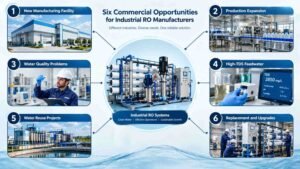
Where industrial RO demand can originate
| Business situation | What the company may be evaluating | Marketing opportunity |
| New manufacturing facility | Water-treatment capacity for a new site | Reach project and engineering searches |
| Production expansion | Additional treated-water capacity | Promote capacity planning and custom systems |
| Existing water-quality problem | Treatment performance and water quality | Publish application and troubleshooting content |
| High-TDS feedwater | Whether RO is suitable for the source water | Explain feedwater assessment and system selection |
| Water-reuse project | Treatment stages and reuse requirements | Explain RO’s role in a broader treatment arrangement |
| Replacement of an ageing plant | Efficiency, maintenance and system suitability | Promote replacement and upgrade discussions |
| New utility requirement | Water for boilers, cooling or other utilities | Build relevant application pages |
These are potential demand situations, not claims that every facility will need RO. System suitability depends on the source water, required treated-water quality, process conditions and the complete treatment arrangement.
The Central Pollution Control Board’s Water and Wastewater Analysis explains that RO performance and product-water quality depend on feedwater characteristics, membrane selection and appropriate pretreatment. Manufacturers can use this technical context to create more useful educational content instead of presenting RO as a universal answer to every water problem.
Six commercial opportunities industrial RO manufacturers should build their marketing around
1. Win enquiries from businesses facing a specific water-quality problem
A business may not begin its search with the phrase “industrial RO plant manufacturer”. It may start with a problem: high TDS in borewell water, inconsistent process-water quality, scaling in equipment or a requirement for lower-conductivity water.
These searches can bring manufacturers into consideration before the buyer has finalised the equipment specification.
For example:
- A food-processing facility may be investigating water quality for production and cleaning requirements.
- A textile unit may need to address dissolved solids in its process-water supply.
- A manufacturing plant may be evaluating alternatives to its existing water source.
- A boiler operator may need a treatment arrangement that forms part of its feedwater preparation.
- A facility using groundwater may be assessing whether an RO system is appropriate for its source-water conditions.
These are not identical projects. Feedwater characteristics, required permeate quality, pretreatment, operating hours and applicable process requirements can vary significantly.
Create pages around the problem, not just the machine
An industrial RO manufacturer can develop useful website pages around the water-quality challenges it is equipped to address. Examples include:
- Industrial RO systems for high-TDS water
- RO systems for process-water applications
- Industrial RO plants for borewell water
- RO systems for boiler-feedwater pretreatment
- Industrial RO solutions for food and beverage facilities
- RO systems for water reuse and recovery projects
Each page should explain the relevant application, the role of RO, the information required for system selection and the manufacturer’s actual capabilities.
Do not make unsupported claims such as guaranteeing a particular TDS reduction for every source-water condition. Results depend on feedwater composition, membrane selection, system design, pretreatment and operating conditions.
A useful page should also include a clear enquiry action, such as Share Your Water Analysis, Discuss Your Plant Requirement or Request a Technical Consultation.
This is where SEO services for industrial RO companies can create commercial value. Rather than targeting only broad product terms, SEO can help a manufacturer appear for relevant problem-led searches and direct visitors to pages that explain the appropriate application.
Give technical searches a commercial next step
A visitor reading about high-TDS water may still be researching. The page should not force an immediate quotation request if the visitor does not yet have the information required.
Offer useful next steps:
- Download a technical checklist for initial RO system evaluation.
- Submit available feedwater test results.
- Request a discussion with the technical team.
- View relevant industrial RO product ranges.
- Read a related article explaining pretreatment requirements.
This approach gives visitors a reason to continue interacting with the manufacturer. It also helps the business distinguish between early-stage research and an active project enquiry.
For a broader view of how manufacturers can connect search visibility with commercial enquiries, see Adsthrive’s article on digital marketing for industrial machinery manufacturers.
2. Make capacity and application information easy to compare
Industrial RO buyers often have an initial capacity requirement. They may search for a 500 LPH, 1,000 LPH, 5,000 LPH or larger system. However, capacity alone does not determine whether a plant is suitable.
A manufacturer that lists capacities without explaining the conditions behind system selection may receive enquiries that are difficult to convert. A better product presentation helps buyers understand the system range and the information needed before a technical proposal can be prepared.
Turn the product catalogue into a commercial specification resource
Organise product pages so that a buyer can quickly identify the system range and understand its intended use.
| Product information | What the buyer needs to understand |
| Plant capacity | Nominal output and the operating conditions associated with it |
| Feedwater source | Whether the system is designed for the stated source-water conditions |
| Feedwater quality | TDS, hardness, silica, iron, turbidity and other relevant parameters, as applicable |
| Pretreatment | Whether filtration, softening, chemical dosing or other treatment stages may be needed |
| Membrane arrangement | The proposed membrane configuration and its role in the system |
| Recovery | Design considerations and factors that affect recovery |
| Automation | Available controls, instrumentation and monitoring |
| Installation | Site requirements, utilities and commissioning support |
| Maintenance | Consumables, service requirements and support arrangements |
The table is not a substitute for a technical proposal. It helps a potential buyer understand the information that influences a proposal.
Manufacturers should also make their actual differentiators visible. If the business provides customised skids, specific automation options, energy-conscious designs, service support or integration with pretreatment systems, those details should be explained with evidence.
Create product pages for meaningful differences
A single page listing every capacity and application can become difficult to navigate. Consider dedicated pages for major product ranges or applications where the manufacturer has sufficient technical information and genuine experience.
For example, a manufacturer might have separate pages for:
- Compact industrial RO systems
- High-capacity industrial RO plants
- Custom-engineered RO systems
- RO systems for process-water applications
- RO plants integrated with pretreatment equipment
Avoid creating dozens of nearly identical pages by changing only the capacity or location. Each page should offer meaningful information that helps a buyer assess a different product or application.
This also creates more relevant destinations for Google Ads campaigns and internal links. If the manufacturer also offers related industrial treatment systems, a contextual link to its industrial equipment marketing can support readers researching equipment-related marketing opportunities.
Show the difference between a standard plant and a customised project
Some buyers may require a standard capacity system, while others may need a customised arrangement based on feedwater quality, site constraints, operating hours or integration with existing equipment.
The website should make it clear which solutions are available off the shelf and which require technical evaluation.
A simple comparison can help:
| Requirement | Standard system enquiry | Custom project enquiry |
| Capacity | Selected from an available range | Determined through project evaluation |
| Feedwater | Within stated design parameters | Requires detailed water analysis |
| Installation | Standard installation scope | May require site-specific planning |
| Integration | Defined connections | May involve existing ETP, filtration or utility systems |
| Proposal | Product and configuration details | Technical review and project-specific proposal |
This information can reduce confusion and prevent buyers from assuming that every project can be quoted using a standard price list.
3. Turn technical proof into a reason to shortlist the manufacturer
Industrial buyers need confidence before they invite a manufacturer to quote. Product descriptions alone may not establish whether a supplier understands the application or can deliver the required installation.
Technical proof can help close that information gap.
A manufacturer should make its engineering knowledge visible through material that sales teams can also use during discussions.
What should an industrial RO manufacturer publish?
Project case studies
A useful case study explains the customer’s broad application, the initial water-treatment requirement, the challenges considered, the system supplied and the scope of the manufacturer’s work. Share only details that the customer has authorised.
A strong case study might describe how a manufacturer designed an RO system for a facility with a particular feedwater condition and production requirement. It should explain the design considerations without disclosing confidential plant information.
Water analysis and system selection guidance
Explain why a water analysis is important before selecting an RO system. Discuss relevant parameters and how they can influence pretreatment, membrane selection and system design.
Technical articles
Useful subjects include:
- Why pretreatment matters in industrial RO systems
- How feedwater quality affects RO membrane performance
- What influences recovery in an industrial RO plant?
- What should buyers check before selecting an RO capacity?
- How should industrial RO systems be maintained?
- What information is needed for an RO plant quotation?
Installation and service information
If the manufacturer provides installation, commissioning, operator guidance or annual maintenance support, explain what those services include. Avoid vague claims such as “complete support” without describing the actual scope.
Explain the operating implications without making unrealistic promises
An industrial buyer may be interested in the plant’s purchase price, but the total cost of operating the system also matters.
Depending on the design and application, operating considerations may include:
- Energy consumption
- Membrane replacement
- Pretreatment chemicals
- Filter cartridge replacement
- Cleaning requirements
- Reject-water management
- Routine maintenance
- Operator training
- Service availability
Manufacturers should explain the factors that influence these costs instead of promising universal savings.
For example, a page can explain that feedwater quality, operating pressure, recovery, system configuration and maintenance practices influence operating performance. It can then invite the buyer to discuss the specific site conditions.
The CPCB’s technical manual on water and wastewater analysis is a useful reference for explaining why water analysis and appropriate treatment selection matter. Use such references to support educational content, while making it clear that the manufacturer’s own system design and performance claims must be supported by its technical documentation.
Make proof useful to sales
A technical article should not end as an isolated traffic page. Link it to a relevant product page, project example or consultation form.
For instance, an article explaining pretreatment requirements can direct readers to the manufacturer’s industrial RO solutions and invite them to share a water analysis report.
A project case study can link to a relevant product category and a page explaining installation or commissioning support.
This gives the visitor a logical next step and gives the sales team a more informed starting point.
For manufacturers looking to improve organic visibility, Digital marketing for industrial RO companies should connect technical credibility with commercial action. The objective is not to publish technical content merely to increase the number of blog posts. It is to make the manufacturer’s expertise easier to evaluate.
4. Use Google Ads to capture projects with immediate purchase intent
SEO can build visibility over time, but manufacturers may also want enquiries from buyers who are actively evaluating suppliers. Google Ads can help reach these searches when campaigns are organised around the right product, application and commercial intent.
A campaign targeting only “RO plant” may attract domestic purifier enquiries, small commercial requirements, spare-parts searches and unrelated research. Industrial RO manufacturers need to separate those searches from the terms that are more likely to lead to a B2B project.
Separate campaigns by buying requirement
A practical campaign structure could include:
| Campaign theme | Example search terms | Suitable landing page |
| Manufacturer intent | Industrial RO plant manufacturer, industrial RO system supplier | Manufacturer and capability page |
| Capacity intent | 1,000 LPH industrial RO plant, 5,000 LPH RO system | Relevant capacity or product page |
| Application intent | Industrial RO for process water, RO system for boiler-feedwater pretreatment | Application-specific page |
| Custom project intent | Custom industrial reverse osmosis plant, industrial RO plant design | Custom engineering page |
| Service intent | Industrial RO plant maintenance, RO plant AMC service | Service page, if offered |
These are examples for keyword planning, not verified daily search-volume terms. Actual campaign keywords should be selected using the manufacturer’s target geography, search data, conversion history and commercial priorities.
Build negative keyword lists
Negative keywords help reduce irrelevant clicks. Depending on the manufacturer’s offering and target market, the team may need to exclude searches related to:
- Domestic RO purifiers
- Household water filters
- Small countertop purifiers
- Free RO plant diagrams
- RO repair jobs or employment
- Unrelated consumer products
- Spare parts, if the campaign is intended only for complete plant projects
Do not exclude every service or component term automatically. If the manufacturer also sells membranes, pumps, consumables or maintenance services, those may deserve separate campaigns.
Give every campaign a relevant landing page
A visitor searching for a 5,000 LPH industrial RO plant should not be sent to a generic homepage with no clear product information.
The landing page should show the relevant system, key specifications, application information, technical proof and an enquiry option. A buyer should be able to request a quotation or submit project details without searching through the website.
Track more than the cost per click
A campaign can generate inexpensive clicks without generating commercially relevant enquiries. The manufacturer should measure:
- Enquiry form submissions
- Phone calls from campaign traffic
- WhatsApp enquiries
- Qualified industrial project enquiries
- Technical consultation requests
- Quotation opportunities
- Cost per qualified enquiry
If a campaign generates many domestic purifier enquiries, the problem may be the search terms, ad copy or landing page. If the traffic is relevant but visitors do not enquire, the landing page may not provide enough technical information or a clear next step.
Adsthrive’s guide to Google Ads optimisation can be used as a supporting resource when reviewing campaign structure, targeting and performance.
5. Reach project decision-makers before the supplier shortlist is finalised
Industrial RO purchases may involve several people. A plant head may identify the production requirement, a utility engineer may review water conditions, a consultant may prepare the technical specification, and procurement may compare supplier quotations.
LinkedIn outreach can help manufacturers build visibility among relevant business contacts rather than relying entirely on people searching for a supplier at that moment.
Make LinkedIn outreach specific to the application
A generic message saying “We are leading industrial RO plant manufacturers. Contact us for the best price” gives a buyer little reason to respond.
A more useful approach is to share information connected to the recipient’s industry or operational requirement.
For example:
- A food-processing company may be interested in process-water quality and treatment reliability.
- A pharmaceutical facility may need to understand how its water-treatment requirements relate to applicable quality standards and validation expectations.
- A textile manufacturer may be assessing water quality, treatment cost and reuse opportunities.
- An engineering consultant may need product specifications, technical documentation and supplier capability information.
The manufacturer should avoid assuming that every company in an industry needs an RO plant. Outreach should be based on relevant business context and a credible reason to make contact.
Use content to support outreach
LinkedIn works better when the company has useful material to share. A manufacturer can publish:
- Short technical explanations from its engineering team
- Project photographs with customer permission
- Product demonstrations
- Installation and commissioning updates
- Maintenance guidance
- Application-specific case studies
- Explanations of common RO selection mistakes
The sales team can then use these resources in relevant conversations.
Social media has a supporting role as well. LinkedIn is useful for professional visibility and direct B2B engagement, while other social channels can showcase equipment, factory capability, project execution and company credibility.
A short video showing an RO skid, its major components and the manufacturer’s assembly process may be more useful than a generic promotional graphic. A project photograph accompanied by a clear explanation of the application can also give prospective buyers a better understanding of the manufacturer’s work.
Build a contact list around relevant business roles
Depending on the project and company size, relevant contacts may include:
- Plant heads
- Utility managers
- Maintenance managers
- Engineering managers
- Project managers
- Procurement managers
- Technical consultants
- Environmental and water-treatment specialists
Do not send the same message to every role. An engineering manager may be interested in system configuration, while procurement may need supplier details, commercial scope and delivery information.
The aim is to create recognition and start relevant conversations—not to send large volumes of generic connection requests.
6. Convert incoming interest into technically qualified sales opportunities
A manufacturer may receive enquiries through its website, Google Ads, LinkedIn, WhatsApp, telephone calls and referral networks. The challenge is not only collecting these enquiries. It is identifying which ones deserve immediate sales attention and what information is still missing.
An industrial RO enquiry is more useful when it contains enough information for an initial technical and commercial assessment.
Collect the information that helps evaluate an RO project
| Information | Why it matters |
| Company and industry | Helps identify the application |
| Required capacity | Provides an initial indication of plant size |
| Feedwater source | Helps understand the starting water condition |
| Water analysis report | Supports technical evaluation |
| Required treated-water quality | Defines the intended output |
| Operating hours | Helps understand demand and usage |
| Project location | Supports logistics and service planning |
| Project stage | Indicates whether the requirement is exploratory or active |
| Installation timeline | Helps assess urgency |
| Contact role | Helps identify the person coordinating the requirement |
Not every visitor will have all these details. The form should not become so long that it discourages genuine enquiries. A practical approach is to collect essential contact and project information first, then request technical documents during follow-up.
Use progressive enquiry forms
A long form asking for every technical detail may discourage potential customers who are still evaluating suppliers. A shorter first-stage form can collect the information necessary to begin a conversation.
For example:
First-stage enquiry
- Name
- Company
- Business email or phone number
- Required capacity, if known
- Application or industry
- Project location
Technical follow-up
- Feedwater source
- Available water analysis
- Required permeate quality
- Operating hours
- Existing treatment arrangement
- Installation requirements
This makes the initial enquiry easier while still allowing the technical team to collect the information needed for a proposal.
Use AI-assisted qualification to organise enquiries
AI lead qualification can help categorise incoming enquiries based on the information submitted. For example, an enquiry may be tagged by product interest, capacity, application, project stage or missing technical details.
The system can help identify:
- Enquiries with a stated capacity and water analysis report
- Buyers who have a project timeline
- Businesses that need a technical consultation
- Enquiries that require additional information
- Requests for products or services the manufacturer does not offer
- Existing customers seeking maintenance or support
AI should support the sales team, not make final engineering decisions. A qualified lead is not automatically a technically feasible project. Engineers must review the water conditions and application before confirming system suitability.
Connect WhatsApp, calling and CRM follow-up
When a buyer submits an enquiry, a connected follow-up process can acknowledge the request, ask for missing information and route the lead to the appropriate sales representative.
For example:
- A prospect submits an enquiry for an industrial RO plant.
- The system records the source, product interest and contact details.
- An automated WhatsApp response acknowledges the enquiry and requests relevant technical information.
- AI-assisted qualification organises the lead based on the available details.
- A calling workflow or sales representative follows up with the prospect.
- The CRM records the discussion, next action and follow-up date.
- The technical team reviews the requirement when sufficient information is available.
This reduces the risk of enquiries being lost between different channels. It also gives managers a clearer view of which leads have been contacted, which require technical review and which are ready for a quotation discussion.
Manufacturers can explore how AI chatbot agents support initial enquiry handling and how AI calling solutions can support follow-up conversations. The workflow should be designed around the manufacturer’s actual sales process and the questions its team needs answered.
A commercial consideration many RO manufacturers overlook: the cost of an unsuitable enquiry
Not every enquiry is a potential sale. Some buyers may be looking for a domestic purifier, a low-capacity commercial unit, a replacement membrane or a service that the manufacturer does not provide.
Other enquiries may be from businesses that need a different treatment technology or a more extensive treatment arrangement.
When all these enquiries are counted equally, marketing reports can look positive while the sales team spends time filtering unsuitable requests.
Separate lead volume from lead suitability
A manufacturer can classify enquiries into practical categories:
| Enquiry category | Example | Suggested action |
| Active project | Buyer has a defined capacity and installation timeline | Prioritise sales and technical follow-up |
| Technical evaluation | Buyer has a water-quality issue but needs guidance | Arrange an initial technical discussion |
| Early research | Buyer is comparing options without a confirmed project | Share relevant educational resources |
| Service requirement | Existing customer needs maintenance or support | Route to the service team |
| Outside offering | Request is unrelated to the manufacturer’s products | Close or redirect appropriately |
| Incomplete enquiry | Contact details are available but project information is missing | Follow up for essential details |
This classification makes reporting more useful. It also helps the marketing team understand which channels produce relevant opportunities.
For example, a Google Ads campaign may generate fewer leads than a broad social campaign but deliver a higher proportion of active industrial projects. That distinction should influence budget decisions.
How industrial RO manufacturers can market water recovery and reuse responsibly
Water recovery and reuse can be a relevant commercial subject for manufacturers serving industrial facilities. Some businesses evaluate treatment systems as part of a wider water-management project, particularly where freshwater availability, wastewater handling or process-water requirements influence operating decisions.
However, manufacturers should avoid presenting RO as a standalone answer to every reuse requirement. A complete project may involve primary treatment, biological treatment, filtration, ultrafiltration, chemical treatment, RO and concentrate management, depending on the feedwater and intended reuse.
The Central Pollution Control Board’s Guidelines for Reuse of Treated Wastewater discuss different industrial reuse applications and treatment considerations. This is a useful background for manufacturers developing content around industrial water reuse.
Create a dedicated commercial page for reuse applications
If the manufacturer has genuine experience supplying RO systems for reuse projects, it can develop a page explaining:
- The type of feedwater or treated effluent considered
- The role of RO within the overall treatment arrangement
- The pretreatment stages that may be required
- The intended reuse application
- How reject or concentrate streams are addressed within the project scope
- The information needed for a preliminary assessment
Avoid publishing a generic claim such as “RO provides 90% water recovery” unless the figure is supported by the specific system design and operating conditions. Recovery varies with feedwater quality, membrane configuration, scaling potential, system design and operating practice.
The page should encourage a technical assessment rather than imply that a single recovery figure applies to all industrial projects.
How to improve the website’s conversion potential
A manufacturer can attract relevant traffic and still lose enquiries if the website makes it difficult to evaluate the company or contact its team.
The conversion experience should be reviewed from the perspective of a busy plant manager, engineer or procurement professional.
Check the important product-page elements
| Website element | What should be checked |
| Product heading | Does it clearly identify the industrial RO system? |
| Product photographs | Are they actual equipment images wherever possible? |
| Capacity details | Are available capacities and conditions explained? |
| Application information | Can buyers identify relevant industrial uses? |
| Technical specifications | Is sufficient information available for initial evaluation? |
| Project proof | Are there genuine installations or case studies? |
| Service information | Is installation and maintenance support explained? |
| Enquiry form | Is it easy to submit a project requirement? |
| Contact options | Are phone, email and WhatsApp details easy to find? |
| Mobile experience | Can visitors read specifications and submit enquiries on a phone? |
Use calls to action that match the buyer’s stage
Not every visitor is ready to request a quotation. A manufacturer can use different calls to action based on the page and search intent.
| Visitor requirement | Suitable call to action |
| Comparing manufacturers | View Product Range |
| Evaluating a capacity | Request Product Details |
| Investigating water quality | Share Water Analysis |
| Planning a new project | Discuss Your Requirement |
| Ready for procurement | Request a Quotation |
| Existing customer | Contact Service Team |
The wording should accurately reflect what happens after the visitor submits the form. If the company cannot provide an immediate technical assessment, do not promise one.
Make contact details and response expectations clear
Industrial buyers may contact more than one supplier. If the manufacturer does not acknowledge an enquiry or explain the next step, the prospect may continue with another supplier.
The website can set clear expectations, such as when the sales team generally responds, what information is useful to share and whether a technical document can be attached.
This is a simple improvement, but it can make the difference between a form submission that receives attention and one that remains unnoticed.
Search opportunities industrial RO companies may be overlooking
Manufacturers often focus on broad phrases such as “industrial RO plant” and “RO plant manufacturer”. Those searches matter, but they are only part of the opportunity. Buyers may also search by capacity, water condition, application, technical problem or service requirement.
The following table provides keyword themes to investigate in Google Search Console and keyword research tools. It does not represent verified daily search volumes.
| Search theme | Example searches | Commercial opportunity |
| Manufacturer searches | Industrial RO plant manufacturer, industrial RO system supplier | Reach buyers comparing manufacturers |
| Capacity searches | 5000 LPH RO plant, 10000 LPH industrial RO system | Attract buyers with an initial capacity requirement |
| Water-quality searches | RO plant for high-TDS water, industrial RO for borewell water | Reach businesses investigating a specific water condition |
| Application searches | RO plant for process water, industrial RO for food industry | Connect the product with an industrial use case |
| Customisation searches | Custom industrial RO plant, automatic industrial RO system | Reach buyers with specific project requirements |
| Technical searches | Industrial RO plant recovery, RO pretreatment system | Build visibility with buyers researching system selection |
| Service searches | Industrial RO plant AMC, RO membrane maintenance service | Generate service enquiries, where those services are offered |
The next step is to check which of these themes already generate impressions and clicks for the business. Google Search Console can reveal queries where the website receives impressions but does not attract enough clicks. Those pages may need better titles, clearer application information or a stronger commercial call to action.
A keyword should not be added to a page simply because it contains the phrase “industrial RO”. The content must answer the searcher’s actual requirement.
How to measure whether marketing is generating better industrial RO opportunities
Traffic alone does not show whether marketing is producing business opportunities. An industrial RO manufacturer should connect its marketing reports with the sales process.
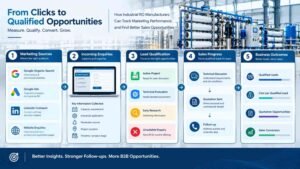
The following measures can help:
| Measurement | What it reveals |
| Relevant organic enquiries | Whether SEO attracts the intended audience |
| Product-page conversion rate | Whether product information encourages action |
| Qualified enquiry rate | Whether incoming leads match the business offering |
| Cost per qualified lead | Whether paid campaigns attract commercially relevant prospects |
| Technical consultation requests | Whether buyers are progressing beyond initial research |
| Quotation opportunities | Whether marketing contributes to active sales discussions |
| Lead-to-quotation rate | Whether enquiry quality is improving |
| Lead source and revenue | Which channels contribute to commercial outcomes |
For example, if Google Ads produces 40 enquiries but only two are relevant industrial projects, the campaign may need changes to its keywords, targeting, landing page or qualification process. If SEO produces fewer enquiries but a higher proportion of quotation opportunities, that channel may be contributing more value than the raw lead count suggests.
Marketing and sales should review these figures together. Sales feedback can reveal whether enquiries are relevant, whether the website sets accurate expectations and what information buyers repeatedly request.
Use CRM data to improve marketing decisions
A CRM can help the manufacturer understand what happens after a lead enters the business.
Useful records include:
- Original source of the enquiry
- Product or capacity requested
- Industry and application
- Lead qualification status
- Date of first response
- Technical information received
- Quotation status
- Reason for losing an opportunity
- Follow-up activity
- Final sales outcome, where available
Over time, this information can reveal patterns. For example, a manufacturer may find that enquiries for a particular capacity range are more likely to become quotations, or that a certain application requires more technical discussion before procurement begins.
These insights can inform SEO content, paid campaign targeting and website improvements.
How Adsthrive supports industrial RO companies looking for more B2B leads
Industrial RO manufacturers need marketing that understands the difference between a domestic purifier enquiry and a genuine industrial water-treatment project. They also need a process that connects visibility with sales follow-up.
Adsthrive works with businesses on digital marketing and AI-enabled automation, with solutions shaped around the company’s products, sales process and operational requirements.
For industrial RO companies, this can include:
SEO and AI SEO
Improve website visibility for relevant manufacturer, product, capacity and application searches. The work can include technical SEO, product-page improvements, content planning and search visibility for commercial keywords.
Explore Adsthrive’s SEO services and AI SEO services.
Google Ads and lead generation
Build campaigns around industrial RO plant requirements, relevant capacities and application-specific searches. Campaigns can be structured to reduce irrelevant traffic and direct potential buyers to suitable landing pages.
Learn more about lead generation services.
AI chatbot and WhatsApp automation
Respond to website enquiries, collect initial project details and guide prospects towards the next step. An AI chatbot can help answer routine questions and capture information for the sales team. See Adsthrive’s AI chatbot agent.
AI calling and follow-up
Support timely follow-ups, initial conversations and appointment coordination. AI calling can help manage repetitive outreach, while sales representatives handle technical discussions and commercial negotiations. Explore the AI calling solution.
AI lead qualification and CRM coordination
Organise enquiries using details such as product interest, capacity, application, project stage and follow-up status. The exact workflow can be designed around the manufacturer’s existing CRM and sales process.
The advantage of a connected approach is that manufacturers do not have to treat every activity as a separate tool or disconnected process. Depending on the business requirement, Adsthrive can bring website enquiries, WhatsApp communication, AI qualification, calling follow-ups and CRM updates into a coordinated workflow.
The objective is straightforward: help the manufacturer attract relevant prospects, identify genuine requirements and give its sales team a clearer route to the next commercial conversation.
To discuss a customised approach, visit Adsthrive or contact the team.
Frequently asked questions
1. How can industrial RO companies generate more B2B leads?
Industrial RO companies can generate B2B leads through SEO, Google Ads, application-specific landing pages, technical case studies, LinkedIn outreach and targeted lead-generation campaigns. A clear enquiry process and timely follow-up help convert initial interest into sales opportunities.
2. Which keywords should industrial RO manufacturers target?
Manufacturers should target commercial searches such as industrial RO plant manufacturer, industrial RO system supplier, industrial reverse osmosis plant, capacity-specific RO searches and application-related terms. They can also build relevant content around water-quality problems and technical requirements they are equipped to address.
3. Is SEO useful for industrial RO companies?
Yes. SEO can help manufacturers appear when businesses search for industrial RO plants, suppliers, capacities, applications and technical information. Effective SEO for industrial RO companies should connect relevant searches to useful product pages, technical resources and enquiry options.
4. Should industrial RO manufacturers use Google Ads?
Google Ads can help manufacturers reach businesses actively searching for industrial RO systems and suppliers. Campaigns should separate industrial requirements from domestic purifier searches, use relevant landing pages and measure qualified enquiries rather than clicks alone.
5. What information should an industrial RO enquiry form collect?
An enquiry form can request company name, contact details, industry, required capacity, feedwater source, project location and project timeline. It can also allow buyers to upload a water analysis report. The form should remain easy to complete, with further technical information collected during follow-up.
6. How can AI help qualify industrial RO leads?
AI can organise enquiries by product interest, capacity, application, project stage and missing information. It can support initial responses and follow-up coordination. However, technical feasibility and final system recommendations should be reviewed by qualified engineering personnel.
7. How long does SEO take to generate enquiries for industrial RO manufacturers?
SEO does not have a fixed time frame. Results depend on the website’s current condition, competition, content quality, technical performance, target geography and search demand. Manufacturers should monitor relevant impressions, rankings, enquiries and quotation opportunities over time.
8. What should manufacturers look for in a digital marketing agency?
An agency should understand industrial B2B buying requirements, product-led search intent, technical website content, Google Ads targeting and lead qualification. It should also report on qualified enquiries and sales opportunities rather than relying only on traffic and impressions.
Conclusion: Make the industrial RO solution easier to evaluate and easier to enquire about
Industrial RO companies do not need to compete only through plant capacity, product photographs or price claims. They need to make it easier for a prospective buyer to understand the application, assess the manufacturer’s technical capability and start a meaningful project discussion.
A combination of SEO, Google Ads, technical proof, LinkedIn outreach and lead qualification can help manufacturers reach businesses with relevant water-treatment requirements. When those activities are connected to a reliable follow-up process, marketing becomes more useful to the sales team.
For manufacturers investing in SEO for industrial RO companies, the priority should be to attract the right industrial requirement, communicate the value of the proposed solution and create a clear path from the first search to a qualified sales conversation.