A food processing machinery company can have excellent equipment, experienced engineers, strong manufacturing capabilities and years of industry expertise – and still lose potential buyers before its sales team ever speaks to them.
Why?
Because the buying process has changed.
A food manufacturer looking for a new processing line may first search Google, compare manufacturers, read technical specifications, watch machine videos, explore applications, ask AI-powered search tools for recommendations, compare suppliers and only then submit an enquiry.
By the time a salesperson receives the enquiry, the buyer may already have shortlisted two or three competitors.
For machinery manufacturers, this means marketing can no longer be limited to having a website, attending exhibitions or relying on referrals.
The real opportunity is to build a system that helps your company get discovered, understood, trusted, contacted and followed up with.
And in 2026, that system needs to go beyond traditional SEO.
Google’s AI Overviews and AI Mode are changing how users discover and explore information, while Google continues to emphasize that established SEO practices remain important for visibility in these AI-powered search experiences. The bigger shift is toward useful, original and context-rich information rather than content created simply to target individual keywords.
For food processing machinery companies, that means connecting AISEO, content, Google Ads, LinkedIn, lead generation, conversion optimization and AI automation into one commercially focused strategy.
Why Do Food Processing Machinery Companies Need Digital Marketing in 2026?
The food processing industry has a large and increasingly sophisticated machinery requirement.
According to India’s Ministry of Food Processing Industries, the country has a substantial food-processing ecosystem and faces a demand-supply gap in food processing plants and machinery. The ministry’s sector profile also highlights the need for efficient and advanced processing capabilities and stronger domestic machinery manufacturing capabilities.
That creates opportunities for machinery manufacturers and suppliers.
But opportunity does not automatically become sales.
A potential customer may be looking for:
- Food processing machinery
- Food processing equipment
- Packaging machinery
- Filling machines
- Dairy processing equipment
- Food grinding machinery
- Processing lines
- Automated food processing equipment
- Custom food processing machinery
- Food processing equipment suppliers
And they may search for these requirements long before they contact a manufacturer.
Your buyer is researching before your salesperson knows about them
A typical machinery purchase can involve several people:
Production Manager → Plant Head → Engineering Team → Procurement → Finance → Management
Each person may ask different questions.
The production manager may care about capacity.
The engineering team may care about specifications.
Procurement may compare suppliers and pricing.
Management may look at ROI and production efficiency.
That is why a machinery company’s digital presence needs to answer more than:
“Who are we?”
It needs to answer:
“Can your equipment solve my production requirement?”
The Biggest Digital Marketing Loophole: Getting the Lead Is Not the End
Many food processing machinery companies have some form of online marketing.
They may have:
- A website
- Google Business Profile
- Social media
- Search rankings
- Google Ads
- Product brochures
- Trade-show campaigns
- Contact forms
But there can still be a major gap between marketing activity and revenue.
Where does that gap happen?
The company isn’t visible for the right searches.
A manufacturer may rank for its own brand name but remain invisible when a buyer searches for a specific machine or application.
The website describes products but doesn’t answer buying questions.
A visitor sees a machine photograph and a few specifications but still doesn’t know whether it suits their application.
Paid campaigns generate clicks without enough commercial context.
A buyer clicks an advertisement and lands on a generic homepage.
Social media creates awareness but doesn’t create a clear path to enquiry.
There may be plenty of posts but no structured conversion journey.
Leads are generated but not qualified quickly.
Sales teams receive enquiries without knowing which ones are urgent, relevant or ready to buy.
Follow-ups are delayed.
A prospect submits an enquiry today but receives a response tomorrow — while another supplier responds within minutes.
This is where modern digital marketing needs to evolve.
The goal isn’t simply:
More traffic → More forms
The goal is:
Relevant visibility → Buyer confidence → Enquiry → Qualification → Follow-up → Sales opportunity
What Searches Are Food Processing Machinery Companies Missing?
The opportunity is much larger than one generic keyword.
Potential buyers search across products, applications, problems, industries and purchase intent.
| Search Type | Example Search | Buyer Intent |
| Product | Food processing machinery | High |
| Product-specific | Automatic filling machine | High |
| Application | Dairy processing equipment | High |
| Industry | Bakery processing machinery | High |
| Problem | How to automate food packaging | Medium-High |
| Purchase | Food processing machine price | Very High |
| Supplier | Food processing equipment manufacturer | Very High |
| Location | Food processing machinery manufacturer in India | High |
| Customization | Custom food processing equipment | Very High |
| Comparison | Automatic vs semi-automatic packaging machine | Medium-High |
| Capacity | 1000 kg/hour processing machine | Very High |
| Export | Food processing machinery exporters | High |
The important point is that different searches represent different stages of the buying journey.
A person searching:
“What is food processing automation?”
may still be researching.
Someone searching:
“Automatic food packaging machine manufacturer”
may already be looking for suppliers.
Your digital strategy should therefore capture both — while giving more commercial attention to searches closer to purchase.
7 Digital Marketing Strategies That Can Generate More Leads and Sales
1. Build AISEO Around Buyer Context, Not Just Keywords
Traditional SEO often starts with:
Keyword → Page → Optimization → Ranking
That approach is becoming too narrow for modern search.
In 2026, food processing machinery companies need to build context around their expertise.
Google’s current guidance for generative AI search emphasizes creating unique, useful, non-commodity content while continuing to follow SEO fundamentals.
So instead of creating one page targeting:
Food processing machinery
build a connected information ecosystem around:
Machine → Application → Industry → Capacity → Problem → Solution
For example, suppose a company manufactures automated packaging machinery.
Its content should not stop at a product page.
It can create supporting content around:
- Automatic packaging for snack manufacturers
- Packaging machine capacity guide
- Automatic vs semi-automatic packaging
- How to reduce manual packaging operations
- Packaging machine maintenance
- Packaging automation ROI
- How to select packaging equipment
- Common packaging problems and solutions
This creates a much stronger topical context.
What should AISEO content include?
- Original technical information
- Real product specifications
- Application knowledge
- Industry terminology
- Buyer questions
- Case studies
- Comparisons
- Technical FAQs
- Images and videos
- Authoritative references
- Internal connections between related pages
AI can help research, structure and scale content.
But the company’s actual engineering knowledge needs to remain at the centre.
A useful workflow is:
Research → AI-assisted drafting → Industry expertise → Technical validation → Optimization → Publish → Measure
That is very different from producing hundreds of generic AI articles.
For a manufacturer, the objective is to become a useful source of information that can be discovered through traditional search as well as AI-powered search experiences.
This is where SEO for food processing machinery companies needs to evolve from keyword targeting into contextual authority.
2. Turn Product Pages Into Sales Pages
One of the easiest ways to improve digital lead generation is to improve the pages where buyers actually make decisions.
A machinery product page should not function like a digital brochure.
It should help the buyer decide:
“Is this machine suitable for my requirements?”
A strong machinery page should explain:
| Buyer Question | What the Page Should Show |
| What does it do? | Machine overview |
| What can it process? | Applications |
| How much can it process? | Capacity |
| Where is it used? | Industries |
| Can it be customized? | Configuration options |
| How automated is it? | Automation details |
| What is it made from? | Materials |
| How does it operate? | Demonstration/video |
| What happens after purchase? | Installation & support |
| How do I proceed? | Quote/consultation CTA |
Replace generic CTAs
Instead of only:
Contact Us
test more specific actions:
- Request a Quote
- Get Machine Specifications
- Discuss Your Requirement
- Talk to an Engineer
- Request Pricing
- Book a Technical Consultation
- Send Your Production Requirement
A buyer requesting a quotation is different from someone simply browsing.
Your CTA should reflect that.
This also creates better information for the sales team.
For example:
Machine: Automatic Filling Machine
Application: Liquid Food
Capacity: 2,000 units/hour
Location: Maharashtra
Timeline: 3 months
That is already a much more useful sales opportunity than:
“Please contact me.”
3. Create Content Around Problems That Trigger a Purchase
Most machinery companies create content around their products.
The better strategy is to create content around the problems that make buyers look for those products.
Compare:
Generic
“Benefits of Food Processing Machinery”
with:
Buyer-focused
“How to Choose Food Processing Machinery Based on Production Capacity”
Or:
Generic
“Food Packaging Machines”
with:
Buyer-focused
“Automatic vs Semi-Automatic Packaging Machines: Which Is Better for Your Production Line?”
Or:
Generic
“Food Processing Automation”
with:
“How Can Food Manufacturers Reduce Manual Processing Without Rebuilding the Entire Production Line?”
The second approach gives the content a commercial purpose.
Build content around:
Problems
- Labour dependency
- Production bottlenecks
- Inconsistent output
- Packaging delays
- Manual handling
- Capacity limitations
Buying questions
- Which machine should I choose?
- What capacity do I need?
- What level of automation makes sense?
- Can the machine be customized?
- What maintenance is required?
Commercial questions
- What affects machine pricing?
- What should I include in an RFQ?
- How do I compare machinery suppliers?
- What should I check before purchasing?
Then connect those articles to relevant product pages.
The content should lead naturally toward:
Learn → Compare → Evaluate → Enquire
This makes content marketing a lead-generation asset rather than a publishing exercise.
4. Use Google Ads to Capture Buyers Already Looking for a Supplier
SEO and AISEO build long-term visibility.
Google Ads can capture demand that already exists today.
This is particularly useful for high-intent searches.
Focus campaigns around:
Product intent
- Food processing machinery manufacturer
- Packaging machinery manufacturer
- Filling machine supplier
Application intent
- Dairy processing equipment
- Food packaging equipment
- Spice processing machinery
Purchase intent
- Food processing machinery price
- Food processing machine quotation
- Food processing equipment supplier
But there is one important rule:
Don’t send every ad to the homepage.
If someone searches:
Automatic filling machine manufacturer
send them to the relevant filling-machine landing page.
That page should immediately show:
- Machine capability
- Capacity
- Applications
- Images/video
- Technical information
- Benefits
- Trust signals
- Enquiry CTA
Then connect the enquiry to lead qualification.
A practical acquisition process
High-intent search
↓
Relevant landing page
↓
Technical information + proof
↓
Request Quote / Talk to Engineer
↓
Lead qualification
↓
Sales follow-up
This is where SEO services for food processing machinery companies and paid search should work together rather than operating as completely separate activities.
5. Use LinkedIn to Reach the Companies That Actually Buy Machinery
Food processing machinery is a B2B sale.
Your audience isn’t simply “people interested in food.”
It can include:
- Plant Heads
- Production Managers
- Procurement Managers
- Engineering Heads
- Operations Managers
- Factory Owners
- Directors
- Project Managers
Instead of posting generic promotional content every day, build a targeted account strategy.
Step 1: Identify target companies
For example:
- Dairy manufacturers
- Snack manufacturers
- Beverage manufacturers
- Bakery manufacturers
- Spice manufacturers
- Food packaging companies
Step 2: Identify decision-makers
Find the people responsible for:
- Procurement
- Production
- Engineering
- Operations
- Plant management
Step 3: Create problem-led content
Examples:
“5 things plant managers should check before upgrading packaging machinery.”
“When will semi-automatic equipment become a production bottleneck?”
“What should procurement teams include in a machinery RFQ?”
Step 4: Start relevant conversations
Don’t begin with:
“We are a leading manufacturer. Would you like our catalogue?”
Instead:
“Are you currently running this packaging process manually, semi-automatically or through a fully automated line?”
That opens a business conversation.
LinkedIn then becomes more than a branding channel.
It becomes a B2B prospecting and relationship-building channel.
6. Build Lead Generation Around the Information Buyers Actually Want
A simple contact form is not enough.
A machinery buyer may not be ready to call immediately.
Give them different ways to start a conversation.
High-intent CTAs
- Request a Quote
- Get Pricing
- Talk to an Engineer
- Send Your Requirement
Lower-friction CTAs
- Download Product Brochure
- Get Technical Specifications
- Request Machine Catalogue
- Book a Consultation
Then collect useful information.
Recommended enquiry fields
- Name
- Company
- Industry
- Machine required
- Application
- Required capacity
- Location
- Purchase timeline
- Phone
Now marketing can provide sales with more than a name and phone number.
It can provide context.
Create lead priority
| Lead Type | Example | Action |
| Hot | Specific machine + capacity + quotation request | Immediate sales call |
| Warm | Clear requirement but still comparing | Sales follow-up |
| Research | Looking for information | Nurture |
| Low-fit | Doesn’t match products/applications | Lower priority |
This makes lead generation for food processing machinery companies more useful because the objective becomes qualified sales opportunities rather than a higher number of forms.
7. Use AI Automation to Stop Good Leads From Going Cold
This is where the biggest 2026 opportunity appears.
Imagine your marketing generates:
100 enquiries
But the sales team cannot immediately call all 100.
Some leads arrive:
- After business hours
- During weekends
- While salespeople are travelling
- During exhibitions
- When sales teams are handling existing customers
A delayed response can create a serious opportunity gap.
This is where AI automation can support the sales process.
AI Chatbot for Website Visitors
A visitor asks:
“Do you manufacture automatic packaging machines?”
Instead of waiting for someone to reply, an AI chatbot can:
- Answer basic questions
- Understand the visitor’s requirement
- Ask qualifying questions
- Capture contact details
- Share relevant information
- Hand the conversation to a human
Adsthrive’s AI Chatbot Agent is designed around website conversations, lead capture, knowledge-base connections and human handoff.
AI Lead Qualification
The system can ask:
What machine are you looking for?
What product are you processing?
What production capacity do you require?
Where is your facility located?
When are you planning to purchase?
The answers can help categorize the opportunity before it reaches the salesperson.
Adsthrive’s AI approach also includes lead scoring and automated qualification as practical applications of AI in marketing.
AI Calling
Suppose a company has received 500 enquiries over the last six months.
How many of those leads were actually followed up?
Instead of allowing old enquiries to disappear into a spreadsheet, AI calling can help reconnect with prospects.
For example:
“You previously enquired about food processing equipment. Are you still planning to upgrade or purchase machinery?”
If the prospect is interested:
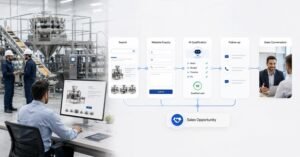
AI → identifies requirement → qualifies → books meeting → sales takes over
Adsthrive’s AI Calling Solution supports outbound calling, real-time conversation, qualification, meeting booking and integrations with business systems.
AI Follow-Ups
Not every machinery buyer purchases immediately.
A prospect may say:
“We are planning the expansion next quarter.”
Instead of losing that lead:
AI follow-up → relevant reminder → re-engagement → sales conversation
This is particularly useful for machinery because the buying cycle can involve technical evaluation, budgeting, approvals and production planning.
A Practical Digital-to-Sales System for Machinery Companies
Instead of creating multiple complicated funnels, keep the process simple:
Google / AI Search / LinkedIn / Ads
↓
Relevant Product or Content Page
↓
Quote / Consultation / Requirement
↓
AI Qualification + Follow-Up
↓
Qualified Sales Opportunity
The human sales team remains responsible for the important technical and commercial conversation.
AI handles the repetitive work around it.
How Digital Marketing and AI Automation Work Together
The strongest strategy isn’t about selecting one channel.
Each channel solves a different problem.
| Business Problem | Practical Solution | Expected Role |
| Buyers can’t find you | SEO + AISEO | Search visibility |
| AI/search doesn’t understand your expertise | Context-rich content | Topical authority |
| Buyers need technical information | Product/application pages | Build confidence |
| Immediate demand exists | Google Ads | Capture intent |
| Procurement teams are hard to reach | LinkedIn + targeted outreach | B2B awareness |
| Website visitors don’t enquire | CRO + stronger CTAs | Conversion |
| Too many poor-quality enquiries | AI lead qualification | Prioritization |
| Visitors need instant answers | AI chatbot | Faster response |
| Leads aren’t followed up | AI follow-ups | Lead nurturing |
| Old leads are forgotten | AI calling | Lead reactivation |
| Multiple disconnected tools | Customized AI automation | One connected system |
This is the important shift:
Marketing shouldn’t end when someone submits a form.
The marketing system should help move that person toward a meaningful sales conversation.
What Should Food Processing Machinery Companies Measure?
If the goal is sales, measuring traffic alone is not enough.
Search visibility
- Relevant organic impressions
- Product keyword visibility
- AI/search visibility
- Non-branded traffic
- Application-page visibility
Lead generation
- Quote requests
- Technical enquiries
- Calls
- WhatsApp enquiries
- Consultation bookings
Lead quality
- Qualified leads
- RFQs
- Sales meetings
- High-intent enquiries
Sales performance
- Opportunities created
- Quotations generated
- Conversion rate
- Pipeline value
- Revenue from marketing-generated leads
AI automation
- Response time
- Leads qualified
- Follow-ups completed
- Meetings booked
- Old leads reactivated
The important metric is not:
“How many people visited our website?”
It is:
“How many relevant buyers entered our sales pipeline, and how many moved forward?”
How Adsthrive Can Help Food Processing Machinery Companies
A digital marketing strategy for machinery manufacturers should not be built by simply selecting a package of unrelated services.
The starting questions should be:
- What do you manufacture?
- Who buys it?
- What problems do they have?
- What do they search for?
- Where are competitors visible?
- What happens after someone visits your website?
- How quickly are enquiries handled?
- How are qualified opportunities separated from general enquiries?
Adsthrive can connect these stages through digital marketing, AISEO, performance marketing, lead generation, conversion optimization and AI automation. Its current service ecosystem includes AI SEO, performance marketing, lead generation and several AI-powered customer and sales automation capabilities.
AISEO and Search Visibility
Build content around the machines, applications, industries and problems your buyers actually search for.
Explore Adsthrive AI SEO Services
Google Ads and Performance Marketing
Capture high-intent searches and direct them toward relevant product or application pages.
Explore Adsthrive Performance Marketing
Lead Generation
Build campaigns around the right industries, decision-makers, locations and commercial intent.
Explore Adsthrive Lead Generation
AI Chatbot
Allow website visitors to ask questions, receive immediate answers and submit their requirements.
Explore Adsthrive AI Chatbot Agent
AI Lead Qualification
Identify which enquiries deserve immediate sales attention.
AI Calling
Use AI voice agents for outbound calling, lead qualification, appointment booking and follow-up.
Explore Adsthrive AI Calling Solution
AI Follow-Ups
Keep prospects engaged when the buying decision takes weeks or months.
Why an All-in-One AI Automation System Can Make More Sense
One of the problems businesses face in 2026 is the growing number of AI tools.
There is one tool for:
- Chatbots
- Another for WhatsApp
- Another for calling
- Another for CRM automation
- Another for lead scoring
- Another for follow-ups
- Another for appointment booking
Now the business has six different subscriptions, six dashboards and several disconnected workflows.
That’s not always automation.
Sometimes it’s simply more software to manage.
The better approach is to start with the business workflow.
For example:
Lead arrives
→ AI responds
→ Requirement is collected
→ Lead is qualified
→ CRM is updated
→ Sales team is notified
→ Follow-up happens
→ Meeting is booked
→ Sales takes over
Instead of asking:
“Which AI tool should we buy?”
ask:
“What part of our sales process needs to be automated?”
Adsthrive can build and customize AI automation around that requirement rather than forcing a business to use a collection of disconnected tools.
Its current AI ecosystem includes lead qualification, WhatsApp AI, AI follow-ups, AI chatbot, AI calling and AI booking systems.
That means a food processing machinery company can explore a system based on its own:
- Sales process
- Products
- Qualification questions
- CRM
- Website
- Communication channels
- Follow-up process
- Sales-team handoff
The goal is not to automate everything.
The goal is to automate the repetitive parts that slow down lead handling, while keeping human salespeople involved where technical knowledge, negotiation and relationship-building matter.
Why Choose Adsthrive for Food Processing Machinery Marketing?
Choosing a digital marketing agency for food processing machinery companies should not be about finding an agency that simply promises more traffic.
The agency needs to understand the complete path:
Buyer Search → Content → Website → Enquiry → Qualification → Follow-Up → Sales
Adsthrive can combine digital marketing with AI automation across that journey.
Search and AISEO
Help potential buyers discover your business through relevant search and context-rich content.
Performance Marketing
Capture immediate commercial demand through Google Ads and other performance campaigns.
B2B Lead Generation
Reach relevant industries, companies and decision-makers.
Conversion Optimization
Improve the website experience so relevant visitors have a clear reason to enquire.
AI Qualification
Separate high-intent prospects from general enquiries.
AI Chatbot
Give website visitors immediate assistance.
AI Calling
Automate appropriate outbound and follow-up conversations.
AI Follow-Ups
Reduce the number of prospects lost because nobody followed up at the right time.
Customized AI Automation
Instead of making your team run around multiple tools, Adsthrive can design an AI automation system around your actual requirements and workflow.
That is the bigger opportunity in 2026.
Not simply:
“Let’s use AI.”
But:
“Let’s identify where our business is losing time, leads and sales — and build automation around those gaps.”
Frequently Asked Questions
1. Does SEO still work for food processing machinery companies in 2026?
Yes. SEO remains important, but the strategy needs to go beyond individual keywords. Google says SEO fundamentals continue to support visibility in AI-powered search experiences, while useful, original and context-rich content is increasingly important.
2. What is AISEO for food processing machinery companies?
AISEO can be understood as optimizing a company’s content and digital presence for modern search experiences where AI systems help users discover and summarize information. For machinery companies, this means creating strong context around products, applications, industries, technical expertise and buyer questions.
3. How can food processing machinery companies generate more qualified leads?
Combine product-focused search visibility, high-intent Google Ads, technical content, conversion-focused landing pages, LinkedIn outreach and structured lead qualification. The goal should be qualified enquiries rather than simply increasing website traffic.
4. Should machinery manufacturers invest in Google Ads?
Google Ads can be valuable for capturing high-intent searches while organic visibility develops. Campaigns should be closely matched to specific machinery categories and landing pages rather than sending every visitor to the homepage.
5. Can LinkedIn generate leads for food processing machinery manufacturers?
Yes. LinkedIn can help manufacturers reach plant heads, procurement managers, engineering teams, operations managers and business owners. The strongest approach combines targeted account selection with useful, problem-focused content and relevant outreach.
6. Can AI qualify food processing machinery enquiries?
Yes. AI can ask predefined qualification questions, collect information such as machine requirements and capacity, identify intent and route suitable prospects to the sales team. Human teams should remain involved when technical evaluation or negotiation is required.
7. Can AI calling help recover old machinery leads?
Yes. Businesses with older enquiry databases can use AI calling to reconnect with prospects, identify whether the requirement is still active and route interested prospects to sales.
8. Do food processing machinery companies need multiple AI tools?
Not necessarily. Using many separate tools can create disconnected workflows. A better approach can be to identify the specific business problems that need automation and build a connected system around those requirements.
Final Thoughts
Food processing machinery companies don’t have a shortage of things they can market.
They have machines, engineering capabilities, applications, technical knowledge, production experience and customer projects.
The challenge is turning those assets into a digital system that reaches buyers before competitors do.
In 2026, that means thinking beyond traditional search rankings.
- Build contextual content that helps your company appear across modern search experiences.
- Create product pages that answer real purchasing questions.
- Use Google Ads to capture buyers with immediate intent.
- Use LinkedIn to reach the people involved in machinery decisions.
- Create conversion paths that make enquiries easy.
Then fix the part many marketing strategies ignore:
What happens after the lead arrives?
- AI can help answer that.
- A website chatbot can respond.
- AI can qualify the requirement.
- AI calling can follow up.
- Automation can update workflows.
- AI can help reactivate old enquiries.
And your sales team can focus on the conversations that actually require human expertise.
The objective of SEO for food processing machinery companies should therefore not simply be higher rankings.
It should be better visibility that creates better commercial opportunities.
And the objective of digital marketing should not end with generating an enquiry.
It should help move the right enquiry toward a sales opportunity.
Build the system around your business — not around a collection of tools.
Adsthrive can combine AISEO, performance marketing, lead generation, conversion optimization and customized AI automation so your team doesn’t have to keep running between multiple disconnected platforms.
One strategy. One connected system. AI automation built around your needs.