A pharmaceutical machinery manufacturer can have technically strong products, experienced engineers and years of industry expertise and still struggle to generate the right enquiries. The problem is often not a lack of demand. It is that potential buyers cannot find the right information, do not understand the manufacturer’s capabilities quickly enough, or submit enquiries without enough information for the sales team to act on them. SEO for pharma machinery manufacturers in 2026 therefore needs to go beyond ranking product keywords. It needs to connect content, AI search visibility, paid campaigns, buyer-intent signals, automation and lead qualification into one continuous system.
The goal should not be 100 enquiries from people who are simply curious.
The goal should be 20 enquiries from pharmaceutical companies, procurement teams, plant managers and technical decision-makers who have an actual machinery requirement.
That changes the entire digital marketing strategy.
The Real Problem: More Leads Don’t Always Mean Better Leads
Imagine a pharmaceutical machinery manufacturer receives 50 enquiries in a month.
At first, 50 looks like a successful result.
But after the sales team checks them:
- 10 are students or researchers.
- 7 are looking for machinery the company does not manufacture.
- 6 are distributors with no active projects.
- 5 are from countries the company does not serve.
- 8 have provided almost no technical requirement.
- 5 are only looking for general information.
- 9 appear to have genuine commercial potential.
The company did not actually generate 50 sales opportunities.
It generated 9 potentially valuable opportunities.
This is why the question should not be:
“How can we generate more leads?”
It should be:
“How can we consistently attract, identify and prioritise buyers who have a genuine requirement for our machinery?”
That distinction is becoming more important in 2026 because industrial buyers increasingly research suppliers independently before speaking to sales. They compare capabilities, specifications and technical information online, while AI-assisted search is becoming another part of supplier discovery.
For pharma machinery manufacturers, this creates an opportunity.
Your website, content, search visibility and automation can do much of the early education and qualification before a salesperson gets involved.
What Has Changed for Pharma Machinery Marketing in 2026?
Pharmaceutical machinery is not an impulse purchase.
A potential buyer may be evaluating:
- Production capacity
- Machine configuration
- Automation level
- Product compatibility
- Material of construction
- GMP requirements
- Validation requirements
- Documentation
- Installation
- Maintenance
- Service support
- Supplier experience
- Customisation
- Delivery timelines
- Total project requirements
Multiple people can also influence the decision.
- A production manager may care about output.
- An engineering team may care about specifications.
- Procurement may compare suppliers and commercial terms.
- A plant head may evaluate operational suitability.
- Quality and validation teams may examine documentation.
- Management may ultimately approve the investment.
That means your digital marketing cannot be built around one generic message.
It needs to answer the different questions that arise throughout the buying process.
And this is where the biggest change of 2026 becomes important.
Buyers Are Researching Before They Contact You
A manufacturer may previously have relied heavily on sales representatives, exhibitions, distributors and referrals.
Those channels still matter.
But today’s buyer can independently search:
“Tablet compression machine manufacturer”
Then:
“High-speed tablet press capacity”
Then:
“Tablet press GMP requirements”
Then:
“Tablet compression machine manufacturer India”
Then:
“Tablet press machine price”
Then:
“Best tablet press for high-volume production”
By the time that buyer fills out your enquiry form, they may already know what type of machine they want and may already be comparing three or four suppliers.
Your digital presence needs to support that research.
This is why content, SEO, AI search visibility and conversion optimization need to work together rather than operate as separate marketing activities.
Turn Your Website Into a Digital Sales Engineer
The first major opportunity is your website.
Many machinery websites function like online brochures.
They show:
Machine Name → Short Description → Image → Contact Us
That may be enough for someone who already knows the company.
It is not enough for a buyer who is comparing suppliers.
A stronger product page should answer the questions a technical buyer would normally ask your sales or engineering team.
For example, a tablet compression machine page could explain:
- What the machine is designed for
- Suitable applications
- Production capacity
- Machine speed
- Tablet size range
- Number of stations
- Material of construction
- Automation features
- Control system
- Changeover requirements
- Cleaning considerations
- Available configurations
- Utilities required
- Safety features
- Documentation available
- Installation support
- Service support
- Frequently asked technical questions
The purpose is not to publish technical information simply because “Google likes long pages.”
The purpose is to remove uncertainty.
A technically detailed website can allow the buyer to answer several questions before contacting sales.
That can improve the quality of the eventual enquiry.
For pharmaceutical equipment, documentation can be particularly important. Depending on the project and specification, buyers may evaluate material certificates, drawings, manuals, validation documentation, FAT/SAT support and DQ/IQ/OQ/PQ-related requirements.
Therefore, technical information can itself become a lead-generation asset.
Make Content Your 24/7 Sales Team
Content should be one of the biggest investments in the digital strategy.
But that does not mean publishing generic blogs every week.
A pharma machinery manufacturer should create content around the questions buyers actually ask.
For example:
Product questions
- What is a rotary tablet press?
- How does a capsule filling machine work?
- What is a blister packing machine?
- What is the difference between automatic and semi-automatic equipment?
Selection questions
- How do I select a tablet compression machine?
- What tablet press capacity do I need?
- Which machine is suitable for high-volume production?
Technical questions
- What factors affect tablet compression speed?
- How does machine automation affect production?
- What specifications should be checked before purchasing pharmaceutical machinery?
Compliance questions
- What documentation should be requested from a pharmaceutical equipment manufacturer?
- What should buyers check before machine validation?
- What information is required for equipment qualification?
Commercial questions
- What affects pharmaceutical machinery cost?
- What should be included in a machinery quotation?
- How should manufacturers compare machinery suppliers?
This creates a content network, rather than a collection of unrelated blogs.
The manufacturer becomes useful at multiple stages of the buying process.
And that matters because technical manufacturing content can have a significant advantage: it can address highly specific questions that general marketing websites often ignore. Current manufacturing SEO guidance is increasingly focused on detailed product specifications, technical content, applications, certifications and buyer questions rather than thin catalogue pages.
Build Content for AI Search as Well as Traditional Search
In 2026, SEO cannot stop at:
“How do we rank on Google?”
The better question is:
“Can search engines and AI systems understand what we manufacture, who we serve and why a buyer should consider us?”
AI-assisted search is changing how buyers discover information. Instead of searching ten pages manually, a buyer can ask an AI system a broader question such as:
“Which pharmaceutical machinery manufacturers offer high-capacity tablet compression equipment?”
Or:
“What should I check before selecting a pharmaceutical packaging machine supplier?”
That means manufacturers need content that clearly communicates facts about:
- Products
- Applications
- Industries
- Technical capabilities
- Certifications
- Locations
- Experience
- Services
- Documentation
- Customer projects
- Frequently asked questions
The objective is not to create artificial content for AI.
It is to make your real expertise easier for search engines, AI systems and human buyers to understand.
This is an important part of modern SEO for pharma machinery manufacturers.
The content should be accurate, specific and supported by real company information. Current 2026 manufacturing guidance also highlights the importance of accurate, extractable technical information because self-directed buyers increasingly rely on what they find online before contacting suppliers.
Stop Targeting Only High-Volume Keywords
A common mistake is choosing keywords simply because they have search volume.
For a machinery manufacturer, a keyword with 1,000 searches may be less valuable than one with 30 highly relevant searches.
Consider the difference.
Broad search
“pharmaceutical equipment”
This could represent students, researchers, consultants, manufacturers, job seekers or buyers.
High-intent search
“tablet compression machine manufacturer”
This tells you much more.
Even stronger intent
“tablet compression machine manufacturer India”
Now you have:
Product + supplier intent + geography
Technical commercial intent
“high speed tablet press for pharmaceutical production”
Now you have:
Product + application + requirement
The strategy should therefore classify searches according to buying signals, not just search volume.
| Search Type | Example | Potential Signal |
| General | Pharmaceutical machinery | Early research |
| Product | Tablet compression machine | Product interest |
| Supplier | Tablet press manufacturer | Supplier research |
| Location | Tablet press manufacturer India | Commercial + geographic intent |
| Specification | Tablet press production capacity | Technical evaluation |
| Problem | Machine for increasing tablet production | Solution research |
| Comparison | Rotary tablet press vs single punch | Evaluation |
| Commercial | Tablet press machine price | Purchase consideration |
| RFQ | Tablet compression machine quotation | Strong commercial intent |
This is where SEO services for pharma machinery manufacturers should focus: not simply increasing traffic, but increasing visibility for searches that can contribute to commercial opportunities.
From Search to Qualified Enquiry
The first funnel should be simple.
Discovery to Enquiry
Search / AI Search / Google Ads / LinkedIn
↓
Relevant technical content
↓
Product or application page
↓
Proof + specifications + documentation
↓
RFQ / Consultation / Enquiry
The important part is the transition.
Someone searching for a technical solution should not be forced through:
Homepage → About Us → Products → Contact
Instead, the path should be direct.
For example:
“tablet compression machine manufacturer”
↓
Tablet Compression Machine
↓
Specifications + applications + technical information
↓
Case study / documentation / machine video
↓
Request a Quote
This is where content and conversion optimization become connected.
Use Google Ads for Immediate High-Intent Demand
SEO can take time to build.
Google Ads can capture commercial searches while organic visibility is developing.
But the campaign should not be built around broad keywords.
A campaign could be divided by machinery category:
Campaign 1
Tablet Compression Machines
Campaign 2
Capsule Filling Machines
Campaign 3
Blister Packaging Machines
Campaign 4
Granulation Equipment
Campaign 5
Other Pharmaceutical Machinery
Each campaign should ideally lead to a relevant landing page.
A person searching:
“capsule filling machine manufacturer”
should not arrive on the company’s generic homepage.
They should land on a page that immediately communicates:
- Machine capability
- Applications
- Technical specifications
- Available models
- Images/video
- Manufacturer information
- Service/support
- Enquiry option
Paid search should also use negative keywords and search-term analysis to reduce irrelevant traffic.
This is an important part of Digital marketing for pharma machinery manufacturers because the objective isn’t simply to buy clicks.
It is to buy access to relevant commercial intent.
Use LinkedIn to Reach the Accounts Google Cannot Find for You
Google captures existing demand.
LinkedIn can help create or influence demand within target accounts.
Instead of measuring LinkedIn only by likes and followers, identify the companies that could actually purchase your equipment.
Potential target accounts could include:
- Pharmaceutical manufacturers
- Contract manufacturing organisations
- CDMOs
- Formulation manufacturers
- API manufacturers
- Pharmaceutical packaging companies
- Nutraceutical manufacturers
- Large production facilities
- Equipment distributors
Then identify relevant decision-makers:
- Procurement Managers
- Purchase Heads
- Plant Heads
- Engineering Heads
- Production Managers
- Project Managers
- Technical Directors
The content shown to these audiences should also change.
Engineering audience
Technical specifications and machine capabilities.
Production audience
Capacity, efficiency and process improvements.
Procurement audience
Supplier capability, documentation and commercial information.
Management audience
Investment value, productivity and business outcomes.
This makes LinkedIn part of the account strategy rather than simply another social media channel.
Use Buyer-Intent Signals to Understand Who Is Serious
This is where digital marketing becomes much more intelligent.
Suppose someone visits your website.

They:
- Read a product page.
- Open the technical specifications.
- Download a brochure.
- Read a machine-selection article.
- Visit the enquiry page.
- Return two days later.
- Submit an enquiry.
That visitor is sending significantly stronger signals than someone who only visited your homepage.
A modern marketing system can track relevant behaviour such as:
- Product pages viewed
- Technical document downloads
- Repeat visits
- Enquiry form activity
- Campaign source
- Geography
- Content engagement
- Email engagement
- Requested machine
- Project stage
These signals can then help sales prioritise follow-up.
The latest manufacturing lead-generation thinking increasingly emphasises buyer-intent signals, coordinated channels, CRM attribution and responsible AI-assisted research rather than isolated lead-generation tactics.
Use AI to Qualify Enquiries Before They Reach Sales
Getting an enquiry is only the beginning.
The next question is:
“Is this enquiry worth immediate sales attention?”
AI can assist with the first layer of qualification.
For example, when an enquiry arrives, the system can identify:
- Company
- Industry
- Location
- Job role
- Machine requested
- Application
- Production requirement
- Timeline
- Project stage
- Requirement completeness
Then assign an initial category.
High Priority
Specific machine + genuine company + defined requirement + active project.
Nurture
Relevant company but project is still being researched.
Research
General information request without clear buying intent.
Unqualified
Irrelevant industry, student enquiry, job enquiry or unrelated requirement.
AI should not replace the technical sales team.
It should reduce the repetitive work of reading and categorising every enquiry so the sales team can spend more time on genuine opportunities.
Don’t Lose a Good Lead Because the Buyer Isn’t Ready Today
One of the biggest problems in industrial marketing is timing.
A buyer might research machinery today but purchase six months later.
If the manufacturer simply sends:
“Thank you for contacting us.”
and waits, the opportunity can disappear.
Instead, relevant leads can enter an automated nurture sequence.
For example:
Initial enquiry
→ Requirement confirmation
After technical evaluation
→ Relevant machine information
Later
→ Technical guide
Later
→ Relevant case study
Later
→ Product update or application information
When intent increases
→ Sales consultation
The content should be based on the buyer’s actual requirement rather than sending the same newsletter to everyone.
This is where marketing automation becomes particularly useful for lead generation for pharma machinery manufacturers.
From Enquiry to Sales Opportunity
The second funnel is focused on what happens after the form is submitted.
Enquiry to Sales Opportunity
Enquiry
↓
AI-assisted qualification
↓
Lead score
↓
CRM
↓
Automated nurture or sales assignment
↓
Technical discussion
↓
Quotation / RFQ
↓
Sales opportunity
This creates a much stronger connection between marketing and sales.
Marketing is no longer responsible only for generating forms.
It becomes responsible for helping create sales-ready opportunities.
Keep SEO, Content, Ads, AI and Automation in One Connected System
This is where many manufacturers face another problem.
They may have:
- One agency for SEO
- Another person writing content
- A separate Google Ads account
- LinkedIn handled internally
- Leads arriving by email
- Sales information stored in spreadsheets
- Another CRM
- Manual follow-up
- No connection between marketing and sales data
The result?
Lots of activity, but no single picture of the buyer.
A better approach is to connect these activities through a central marketing automation/CRM environment.
For example:
SEO
→ brings the visitor
Content
→ educates the visitor
Google Ads
→ captures active demand
→ reaches target accounts
Website
→ captures the enquiry
AI
→ helps classify the enquiry
CRM
→ stores the buyer information
Automation
→ triggers follow-up
Analytics
→ shows which channels generate qualified opportunities
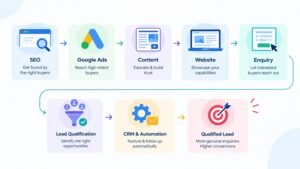
This is where Adsthrive can help pharma machinery manufacturers bring these activities into one connected software or automation system for the business, instead of making the marketing team manage disconnected tools.
The exact software stack can depend on the manufacturer’s existing CRM, website and automation requirements. The important part is having one connected system of record where marketing activity, enquiries, qualification and follow-up can work together.
That can make the entire process easier to monitor and optimize.
What Adsthrive Can Solve for Pharma Machinery Lead Generation
The role of a digital marketing agency should not be limited to:
“We will improve your rankings.”
For a pharmaceutical machinery manufacturer, the problems are usually connected.
Problem: Buyers cannot find your machinery
Adsthrive solution:
Search strategy, technical SEO, product-page optimisation and AI-search-focused content.
Problem: Website traffic does not convert
Adsthrive solution:
Conversion-focused product pages, landing pages, enquiry forms and stronger calls to action.
Problem: Content does not attract genuine buyers
Adsthrive solution:
Buyer-intent content based on machine, application, technical and commercial searches.
Problem: Google Ads generates irrelevant enquiries
Adsthrive solution:
Intent-based campaign structures, search-term analysis, negative keywords and dedicated landing pages.
Problem: LinkedIn generates engagement but not opportunities
Adsthrive solution:
Target-account research, decision-maker targeting and content designed around actual buyer roles.
Problem: Sales receives poorly qualified enquiries
Adsthrive solution:
Lead forms, qualification fields, AI-assisted lead scoring and CRM workflows.
Problem: Old leads are forgotten
Adsthrive solution:
Automated lead nurturing and follow-up workflows.
Problem: Marketing and sales work with different information
Adsthrive solution:
A connected CRM and marketing automation setup.
Problem: Management cannot identify what generates revenue
Adsthrive solution:
Campaign, enquiry, qualification and conversion reporting.
This is the difference between hiring a digital marketing agency for pharma machinery manufacturers simply to generate traffic and working with a partner to build a complete digital enquiry system.
What Should Pharma Machinery Manufacturers Measure?
If the marketing team only reports:
- Website visitors
- Impressions
- Clicks
- Followers
- Number of leads
the company still may not know whether marketing is producing business.
The more useful metrics are:
| Metric | What It Tells You |
| Organic product-page traffic | Whether buyers are finding specific machinery |
| High-intent keyword visibility | Whether commercial searches are being captured |
| Product-page conversion rate | Whether visitors become enquiries |
| Qualified enquiry rate | Whether lead quality is improving |
| Cost per qualified enquiry | Whether paid campaigns are efficient |
| Marketing-qualified leads | Whether marketing is creating relevant demand |
| Sales-qualified leads | Whether sales sees genuine opportunity |
| Lead-to-quotation rate | Whether enquiries have commercial value |
| Quotation-to-order rate | Whether opportunities convert |
| Revenue by channel | Which marketing activity contributes to business |
| Revenue by machine category | Which products attract demand |
| Response time | How quickly genuine buyers receive attention |
The ultimate question should be:
Which marketing activities generate qualified enquiries that become revenue?
Not:
“Which campaign generated the most clicks?”
A Practical 2026 Strategy for Pharma Machinery Manufacturers
A manufacturer does not need to implement everything overnight.
A practical approach can start with the foundation.
Phase 1: Understand the Demand
Identify:
- Machinery categories
- Applications
- Target countries
- Target industries
- Buyer roles
- Commercial keywords
- Technical searches
- Competitors
- Existing content gaps
Phase 2: Build the Digital Knowledge Base
Develop:
- Product pages
- Application pages
- Technical guides
- Comparison content
- FAQs
- Case studies
- Machine videos
- Specification content
- Documentation resources
Phase 3: Capture Existing Demand
Launch:
- SEO
- Google Ads
- Product-specific landing pages
- Conversion tracking
- Search-term analysis
Phase 4: Create Targeted Demand
Use:
- Account-based campaigns
- Technical content distribution
- Remarketing
- Email nurture
Phase 5: Qualify and Automate
Connect:
- Enquiry forms
- CRM
- AI-assisted qualification
- Lead scoring
- Notifications
- Follow-up
- Nurture workflows
Phase 6: Optimise From Real Sales Data
Review:
- Which machines receive enquiries?
- Which keywords produce qualified buyers?
- Which countries convert?
- Which campaigns generate quotations?
- Which content influences enquiries?
- Which leads become customers?
Then feed those insights back into SEO, content and advertising.
That creates a continuous improvement cycle rather than a marketing campaign that starts and stops.
Why This Approach Works Better Than Chasing More Leads
The strongest digital strategy for a pharmaceutical machinery manufacturer is not necessarily the one that creates the biggest number of form submissions.
It is the one that reduces wasted enquiries while making genuine buyers easier to find.
A manufacturer should aim to create a system where:
The right buyer finds the right machine.
The website answers the buyer’s technical questions.
The content establishes expertise.
AI-search visibility increases the chances of being discovered during research.
Google Ads captures active commercial demand.
LinkedIn reaches target accounts.
The website captures the requirement.
AI helps identify intent.
The CRM stores the opportunity.
Automation keeps the conversation moving.
Sales receives better-qualified opportunities.
And the data tells marketing what to improve next.
That is a far more sustainable model for SEO for pharma machinery manufacturers than relying on one channel.
Final Takeaway: Build an Enquiry System, Not Just a Marketing Campaign
Pharmaceutical machinery manufacturers do not need to become content publishers or technology companies.
They need a digital system that reflects how their buyers actually research and purchase equipment in 2026.
The most valuable shift is from:
More traffic → More leads
to:
Better visibility → Better content → Better buyer signals → Better qualification → Better enquiries → Better sales opportunities
Content becomes the knowledge layer.
SEO and AI search make that knowledge discoverable.
Google Ads captures immediate demand.
LinkedIn reaches target accounts.
Automation keeps prospects engaged.
AI helps qualify repetitive information.
CRM keeps the entire process connected.
And sales remains responsible for the technical conversation, quotation and final commercial decision.
Adsthrive can help bring these components together for pharma machinery manufacturers — from SEO services for pharma machinery manufacturers and technical content to Google Ads, digital campaigns, AI-assisted qualification, CRM and marketing automation — so the business can manage the entire lead-generation process through one connected software or tool environment rather than relying on multiple disconnected systems.
The objective is simple:
Not more enquiries for the sake of numbers.
More enquiries from buyers who actually need your machinery.
And when the system continues attracting, educating, qualifying and nurturing those buyers every day, digital marketing becomes more than a campaign.
It becomes an always-on source of qualified opportunities.
FAQs
- How can pharmaceutical machinery manufacturers generate more qualified enquiries?
By combining technical SEO, buyer-focused content, Google Ads, LinkedIn marketing, conversion-focused product pages, lead qualification, CRM and marketing automation. - What keywords should pharma machinery manufacturers target for SEO?
Manufacturers should focus on high-intent keywords such as tablet compression machine manufacturer, capsule filling machine manufacturer, pharmaceutical machinery manufacturer India, and specification- or application-based searches. - How can a pharmaceutical machinery website improve lead quality?
Detailed product specifications, applications, documentation, FAQs, technical resources and qualification-focused enquiry forms can help attract serious buyers and reduce irrelevant enquiries. - Can Google Ads help pharmaceutical machinery manufacturers generate enquiries?
Yes. Google Ads can capture existing commercial demand when campaigns target high-intent machinery keywords and direct users to relevant product-specific landing pages. - How can AI help qualify pharmaceutical machinery enquiries?
AI can assist in identifying details such as the company, machine required, application, production requirement, location, timeline and project stage, helping sales teams prioritise promising enquiries.
Turn Your Pharma Machinery Website Into a Lead Engine
If your website attracts visitors but not enough relevant RFQs, Adsthrive can help you reach the right buyers, capture enquiries and qualify leads more effectively.
We combine SEO, Google Ads, LinkedIn marketing, content, AI qualification, CRM integration and automation into one connected lead-generation system.
Generate Better Pharma Machinery Enquiries
Turn your website into more than a product catalogue. Build a system that attracts qualified buyers, understands their requirements and supports your sales team.
Talk to Adsthrive about generating more relevant enquiries and better-qualified RFQs.
Adsthrive — From Search Visibility to Qualified Enquiries.