A paver block manufacturer may produce several shapes, colours, thicknesses and concrete grades, yet still miss enquiries from contractors searching for a specific paving solution. A landscape contractor may need decorative blocks for a resort pathway. A warehouse developer may be comparing heavy-duty paving for vehicle movement. A municipal contractor may need products that match a project specification, delivery schedule and approved technical requirements.
These buyers are not looking for exactly the same product, even when they all search for Paver Blocks.
The commercial opportunity is to make your product range easy to discover, compare and enquire about. SEO for paver block manufacturers should therefore connect product information with real applications, buyer requirements and supply locations – not simply bring visitors to a homepage. The same principle should guide Google Ads, LinkedIn outreach, social media and automated enquiry handling.
This article explains how manufacturers can turn product-level visibility into better enquiries, reduce wasted advertising spend and create a more consistent route from a buyer’s first search to a quotation.
The real marketing problem: buyers search for a project solution, not just a paver
A manufacturer might organise its catalogue around product names: zigzag pavers, I-shape pavers, rectangular blocks, grass pavers, coloured pavers or designer finishes. That is useful for an existing customer who already knows what to order. It is not always how a new buyer begins searching.
A contractor may start with the surface they need to complete. A procurement manager may search by load requirement. A dealer may want a manufacturer who can supply repeat quantities across a particular region. An architect may be comparing finishes and patterns before specifying a product.
This creates a gap between the way manufacturers present their catalogue and the way buyers discover suppliers.
Consider these different buying situations:
- A residential contractor needs pavers for a driveway and wants to compare colours, patterns and delivery costs.
- A warehouse project team needs a suitable paving product for an area used by loaded vehicles.
- A landscaping company needs decorative finishes for an outdoor public space.
- A civil contractor is preparing a quotation and needs product details, technical documents and supply confirmation.
- A building-material dealer wants a dependable manufacturer, a wholesale price structure and clarity on dispatch capacity.
If all these visitors arrive on one generic page saying “We manufacture high-quality paver blocks”, the website makes them do too much work. They have to call, explain the project and wait for basic product information.
A better marketing system anticipates those questions. It helps a buyer reach the relevant product or application page, understand what information the manufacturer can provide and submit a useful enquiry.
That is the commercial purpose of SEO, paid advertising and lead automation for this industry.
Start with the product specification buyers need to verify
Paver block marketing has an advantage that many manufacturers overlook: technical details can become useful search content and strong sales evidence.
The Indian Standard IS 15658:2021 covers concrete paving blocks. The Bureau of Indian Standards product manual provides a reference for the standard and its certification framework. Manufacturers should use the applicable standard and their own verified test records when presenting product claims; a marketing page should never imply certification or test compliance that the business does not hold.
The product information buyers may need includes:
- Product shape and pattern
- Length, width and thickness
- Concrete grade and relevant performance information
- Colour and surface finish
- Intended application and traffic category
- Available complementary pieces and edge solutions, where applicable
- Minimum order quantity and supply capacity
- Manufacturing and dispatch location
- Technical data sheets and test documentation
- Installation guidance or access to a laying partner
These details should be checked against the manufacturer’s actual products and project requirements. Do not copy generic grade, strength or thickness claims from another supplier’s website.
Turn technical information into a sales advantage
A product page should not be a photograph gallery with a short description. It should help a buyer decide whether the product is worth discussing with the sales team.
For example, a page for heavy-duty interlocking pavers can explain the applications the manufacturer serves, list available product specifications, show actual product photographs and provide a route to request a project quotation. A page for decorative pavers can show patterns, colours, finishes and completed outdoor applications.
The BIS compendium on paving products also identifies related Indian Standards, including IS 16777:2019 for the laying of interlocking concrete block pavements. This gives manufacturers an authoritative reference point when preparing educational material about product selection and installation.
A useful technical page does two jobs: it answers the buyer’s first questions and gives the sales team a better-informed enquiry.
The searches your website may be missing
A manufacturer who targets only “paver block manufacturers” may miss searches from people who already know the application, shape, specification or location they need. The following are examples of search themes to investigate in Search Console and keyword research tools. They are not claimed search-volume figures.
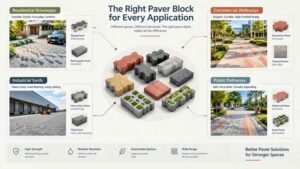
| Search category | Example buyer searches | What the manufacturer should offer |
| Supplier discovery | paver block manufacturer, concrete paver block supplier | Clear manufacturer profile, location and product range |
| Product type | interlocking paver blocks, zigzag paver blocks, I-shape pavers | Separate product pages with photographs and specifications |
| Application | paver blocks for parking areas, industrial flooring pavers, driveway pavers | Application-specific pages and relevant project examples |
| Technical requirement | 80 mm paver blocks, M40 concrete pavers, heavy-duty pavers | Verified dimensions, grades and technical documents |
| Design and finish | coloured paver blocks, designer pavers, textured concrete pavers | Finish galleries, colour options and sample enquiry |
| Commercial purchase | paver blocks bulk order, wholesale paver block supplier | Bulk enquiry form, capacity and dispatch information |
| Local supply | paver block supplier in [city], paver block factory near [location] | Genuine service-area and location information |
| Project procurement | paver blocks for warehouse, pavers for commercial campus | Project enquiry route and specification support |
The opportunity is not to create a separate page for every possible phrase. It is to identify meaningful product groups and buyer needs, then build pages that provide genuinely different information.
For instance, “interlocking paver blocks” and “zigzag paver blocks” may belong on one well-developed product page if the manufacturer offers that product family. “Heavy-duty pavers for industrial yards” may deserve a separate application page if the company has relevant products, evidence and project experience.
This is where SEO for paver block manufacturers becomes a product-discovery strategy rather than a list of repeated keywords.
Build a website that behaves like a product selection desk
A buyer should not need to speak to a salesperson to discover whether your company manufactures the product they are looking for. Your website should provide enough information to make the first contact specific.
Instead of forcing every visitor through a single “Contact Us” page, create clear routes based on what they want to do.
Give each product family a useful destination
A practical website structure could include:
- Interlocking paver blocks
- Zigzag and I-shape pavers
- Rectangular and square pavers
- Decorative and coloured pavers
- Heavy-duty paving products
- Grass pavers or permeable paving products, if manufactured
- Kerb stones and complementary precast products, if part of the range
Each page should have original descriptions, real product images and relevant technical details. If two products differ only by a minor variation, do not create thin pages that repeat the same copy.
Add application pages where the buying requirement changes
Product pages explain what you manufacture. Application pages explain where and why a buyer may consider the product.
Examples include:
- Pavers for residential driveways and pathways
- Paving for commercial parking areas
- Pavers for industrial yards and loading areas
- Decorative paving for resorts, campuses and public spaces
- Paving solutions for contractors and infrastructure projects
The application page should explain the relevant selection factors without making engineering decisions on behalf of the buyer. Actual pavement performance depends on more than the surface block: design, sub-base, bedding, drainage, installation and expected traffic all matter.
The page should invite the prospect to share the project details so your technical or sales team can recommend a suitable product.
Make the enquiry form collect useful information
A form that asks only for a name and phone number may generate contacts, but it does not help the team understand the opportunity.
For paver block enquiries, consider asking for:
| Field | Why it helps |
| Buyer type | Contractor, dealer, builder, architect or project owner |
| Product required | Helps route the enquiry to the right product range |
| Application | Driveway, parking, industrial yard, pathway or other use |
| Approximate quantity | Helps distinguish sample requests from bulk requirements |
| Required dimensions or thickness | Gives the sales team a starting specification |
| Delivery location | Helps assess transport and supply feasibility |
| Project stage | Planning, tendering, active construction or repeat purchase |
| Expected purchase timeline | Helps prioritise follow-up |
Keep the form manageable. Make detailed technical fields optional where the buyer may not know the answer. The objective is to start a useful conversation, not make a first-time visitor complete a tender document.
A focused website and landing-page strategy can support this process. AdsThrive’s website and digital growth services can be considered alongside SEO when the website needs stronger product presentation and clearer enquiry paths.
Make location and delivery part of the marketing strategy
Paver blocks are heavy construction products. Buyers may compare manufacturers not only on product price but also on transport distance, unloading arrangements, delivery timing, quantity and the feasibility of supplying a project location.
This makes local and regional search visibility commercially important.
A manufacturer serving a defined radius should clearly communicate:
- Factory or dispatch location
- Cities and districts regularly served
- Whether bulk delivery is available
- Whether transport is arranged by the manufacturer or buyer
- Typical order and dispatch process, where confirmed
- Whether the business supplies dealers, contractors or direct projects
Do not create dozens of near-identical city pages by changing only the place name. Build a location page only when there is a real service area, distribution arrangement, project history or useful local information to support it.
Google Business Profile can also help buyers verify the manufacturer’s location, contact details, photographs and business presence. Keep the business name, address, phone number and website consistent across relevant listings.
For a manufacturer with multiple plants or sales offices, each location should have accurate information. A sales office should not be presented as a factory, and a distributor should not be represented as a company-owned branch.
“Explore how AAC block manufacturers can attract more potential buyers, generate quality leads, and grow their business through effective online marketing strategies.”
Six commercial strategies that connect visibility to enquiries
The right marketing mix depends on the manufacturer’s product range, serviceable geography, sales capacity and average order value. These six strategies can be combined rather than treated as disconnected activities.
1. Use SEO to capture product, application and supplier demand
A broad manufacturer keyword is useful, but it is only one part of the search opportunity.
A stronger plan maps search intent to the right page:
| Buyer intent | Recommended page |
| Wants a manufacturer | Main manufacturer page |
| Comparing product shapes | Product category page |
| Needs a specific application | Application page |
| Checking specifications | Technical product page or downloadable document |
| Looking for a nearby supplier | Genuine location or service-area page |
| Ready to buy in bulk | Bulk supply or project enquiry page |
The content should answer the questions that influence supplier selection. A contractor may want to know which shapes are available, whether matching kerbs can be supplied and how quickly the manufacturer can respond. A dealer may be more concerned about wholesale arrangements, consistent availability and repeat orders.
Do not make every page repeat the same paragraph about quality and durability. Give each page a distinct purpose and evidence.
AdsThrive’s AI SEO services can support this work through intent-focused content, technical optimisation and structured information that helps search systems understand a manufacturer’s products and capabilities. The objective is to improve discovery across traditional search and AI-assisted research—not to promise a particular ranking position.
For manufacturers investing in SEO services for paver block manufacturers, the work should be judged by relevant search visibility, qualified visits, enquiry quality and opportunities created, not just by the number of keywords reported as ranking.
2. Use Google Ads when the buyer is already looking for a supplier
SEO takes time to build. Google Ads can provide visibility for selected high-intent searches while organic pages are being developed.
The mistake is to run one campaign for every product and send all clicks to the homepage.
A better campaign structure separates commercial needs:
Campaign A: Manufacturer and supplier searches
Target searches such as paver block manufacturer, concrete paver supplier and bulk paver block supplier. The landing page should introduce the company, product range, supply area and enquiry route.
Campaign B: Product-specific searches
Use separate ad groups for products the business actually manufactures, such as interlocking pavers, zigzag blocks or decorative pavers. Send each ad to the matching product page.
Campaign C: Application-specific searches
Build campaigns around relevant applications, such as commercial paving, parking areas or industrial yards—only where the manufacturer has products suitable for those requirements.
Campaign D: Local and regional demand
Target locations the business can realistically supply. A low-cost click from a distant area is not valuable if transport makes the order commercially unviable.
Ads should qualify the click before it reaches the website. If the company sells only in bulk, say so. If a product is available only in selected sizes, make that clear. This may reduce irrelevant enquiries and improve the sales team’s time allocation.
AdsThrive’s Google Ads and PPC services and PPC campaign management can be aligned with landing pages, conversion tracking and enquiry quality. Campaign reviews should consider search terms, location, product interest, form submissions and actual sales outcomes.
3. Use LinkedIn to reach project decision-makers before the tender stage
Not every commercial opportunity begins with a Google search. A developer may appoint a consultant before selecting materials. A contractor may be preparing for a project months before procurement begins. A dealer may be considering an additional supplier before the next buying cycle.
LinkedIn can help manufacturers identify and approach relevant businesses and professionals.
Potential audiences include:
- Civil contractors
- Infrastructure contractors
- Real estate developers
- Procurement and purchase managers
- Landscape architects
- Project consultants
- Facility and industrial project managers
- Building-material distributors
The outreach should be specific. A generic message saying “We are leading paver block manufacturers, contact us” gives the recipient little reason to respond.
A better first message could be:
Hello [Name], we manufacture concrete paving products for residential, commercial and industrial applications. I noticed your work in [relevant project segment]. If you are reviewing paving suppliers for upcoming projects, I can share our product range and technical details for consideration.
The follow-up should offer something useful: a catalogue, product specification sheet, project photographs or a short discussion about the required application.
LinkedIn is not a substitute for a product-ready website. Direct prospects to the relevant page rather than making them search through a generic homepage.
4. Make social media demonstrate the product instead of repeating promotional claims
Paver blocks are visual products. Shape, colour, pattern, finish and installation can be understood much faster through real photographs and short videos than through generic promotional graphics.
A useful social content plan can show:
- Different paver shapes arranged side by side
- Close-up views of surface texture and colour
- Product thickness and dimensions with a scale reference
- Palletising, storage and dispatch preparation
- Before-and-after project photographs, with permission
- Completed driveways, pathways and parking areas
- Product selection comparisons for different applications
- Quality checks and testing processes
- Dealer or contractor supply updates
- New moulds, product launches and production improvements
A short video showing how a particular pattern looks after installation can help a buyer visualise the finished surface. A carousel comparing product shapes can help dealers and contractors understand the range.
Avoid posting performance claims that cannot be supported. If a photograph shows a completed project, identify the application accurately and obtain permission where required.
Social media can also support paid retargeting. Someone who viewed a product page but did not enquire may later see a relevant product demonstration or project image. The message should bring them back to the appropriate page rather than repeatedly showing a generic brand advertisement.
5. Build lead-generation campaigns around a real buying action
A lead-generation campaign needs a clear reason for a prospect to share their details.
For paver block manufacturers, useful offers include:
- Request a bulk supply quotation
- Download the product catalogue
- Request product specifications
- Discuss an upcoming paving project
- Enquire about dealer or distributor opportunities
- Request colour and pattern information
- Arrange a product or sample discussion, if available
Each offer should have its own landing page or focused form. A dealer enquiry should not ask exactly the same questions as a project procurement enquiry.
For example, a bulk project form can request product type, estimated quantity, delivery location and purchase timeline. A dealer form can ask for business location, current product categories and expected monthly requirement.
This is where Digital marketing for paver block manufacturers should be measured by the commercial value of the leads generated. A campaign producing 100 contacts is not automatically better than one producing 20 enquiries from contractors and dealers who can actually purchase.
AdsThrive can connect campaign planning, landing pages and lead-generation activity so that the acquisition message and enquiry process support the same commercial objective.
6. Use AI lead qualification to prevent valuable enquiries from going cold
A paver block enquiry may arrive while the sales team is on a site visit, speaking with a dealer or handling an existing quotation. If the prospect receives no acknowledgement, they may contact another supplier.
AI-assisted enquiry handling can help with the first response and information collection.
A website chatbot can ask what product the visitor needs and whether the requirement is for a project, dealership or personal property. A WhatsApp AI agent can continue the conversation and collect details such as quantity, location and timeline. AI lead qualification can organise the information and help identify enquiries that need immediate human attention.
For example:
Incoming enquiry: “Need paver blocks for a warehouse project.”
Initial qualification:
- What is the project location?
- Is the requirement for a new warehouse or an existing facility?
- What quantity is estimated?
- Do you have a specified thickness or grade?
- What is the expected purchase date?
- Would you like a quotation or a technical discussion?
The system should not independently approve a technical specification. It should capture the buyer’s stated requirements and route technical decisions to the appropriate person.
AdsThrive’s AI lead qualification and AI chatbot agent can support the initial enquiry stage. A WhatsApp AI agent can provide another communication route for prospects who prefer messaging.
Follow-up matters just as much as the first response. A buyer may be waiting for project approval, comparing quotations or finalising quantities. Automated reminders can help the team reconnect without relying entirely on manual tracking. AdsThrive’s AI follow-up solution and AI calling solution can support appropriate follow-up workflows, while sales staff handle negotiation, technical clarification and commercial commitments.
What should happen after a lead arrives?
The lead process should be designed around the way paver block sales actually progress. A contact form submission is only the beginning.
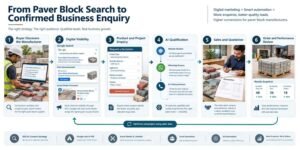
| Enquiry stage | What needs to happen | Useful system support |
| New enquiry | Acknowledge the request and capture the source | Website form, chatbot or WhatsApp |
| Requirement capture | Record product, application, quantity and location | AI-assisted qualification |
| Feasibility check | Confirm product availability and supply capability | Sales or operations team |
| Technical review | Check specifications and project suitability | Technical team |
| Quotation | Prepare price, transport and delivery details | Sales/quotation process |
| Follow-up | Check buyer response and project status | AI reminders, WhatsApp or calling |
| Order confirmation | Record order details and next steps | CRM and sales workflow |
| Future opportunity | Track repeat demand and related products | CRM follow-up |
This is also where a connected CRM process becomes valuable. If the same buyer calls, fills out a form and sends a WhatsApp message, the team should be able to recognise that these interactions belong to one opportunity.
A central record can show the product requested, project location, quantity, quotation status, last contact and next follow-up date. This reduces duplicate calls and makes it easier for management to understand which campaigns are producing real business.
For suitable prospects, automated booking can also help arrange a discussion with sales. The purpose is not to automate every conversation; it is to remove avoidable delays between interest and a useful human response.
Use technical resources as trust-building content
Paver block buyers may want to verify product performance and installation requirements before selecting a supplier. A manufacturer can support that decision with accurate documents and useful explanations.
Potential website resources include:
- Product data sheets
- Test reports and certification details, where applicable
- Available sizes, grades and finishes
- Guidance on selecting products for different applications
- Installation and laying references
- Maintenance information
- Project photographs and case studies
- Frequently asked technical questions
The Bureau of Indian Standards lists IS 15658:2021 for concrete paving blocks and related paving standards in its product resources. Its laboratory information system also provides information on testing laboratories and testing scopes for IS 15658. Manufacturers can use these official references to understand the standards and testing ecosystem, while ensuring that any claims about their own products are supported by their documentation. See the BIS laboratory information for IS 15658.
For projects involving interlocking concrete block pavements, the relevant laying guidance should also be considered. The Indian Railways RDSO document on precast interlocking paver blocks provides a useful example of how paving products appear in infrastructure specifications. It is a draft document and should not be presented as a current universal procurement rule.
A resource section can improve buyer confidence while creating useful search destinations. It also gives salespeople a link to share when a prospect asks a technical question.
How to choose a digital marketing partner for a paver block business
A marketing agency should understand that a paver block enquiry is influenced by product fit, quantity, project stage, supply location and commercial feasibility. The agency does not need to replace the manufacturer’s technical team, but it should know how to translate product knowledge into clear online information and lead-generation campaigns.
Before choosing a partner, ask how it will handle the following:
Product and application mapping: Will the agency understand the difference between decorative pavers, interlocking blocks and products intended for heavier-use applications?
Search intent: Will it separate supplier searches from product, application, specification and local searches?
Landing-page quality: Will campaigns direct buyers to relevant pages, or will every advertisement lead to the homepage?
Lead qualification: Will the enquiry form capture enough information to help the sales team assess the opportunity?
Reporting: Will reports show qualified enquiries, quotation requests and sales progression, rather than only impressions and clicks?
Automation: Can the agency help connect chatbot, WhatsApp, calling, follow-ups and CRM workflows where they make operational sense?
A Digital marketing agency for paver block manufacturers should be able to explain how each activity supports a measurable business objective. It should also be clear about what depends on the manufacturer’s own response time, pricing, product availability, documentation and delivery capability.
AdsThrive brings SEO, AI SEO, Google Ads, social media, lead generation and AI-powered enquiry workflows into one digital growth approach. Its AI SEO services can support discovery, while paid campaigns and lead automation can help connect interested buyers with the sales process. The right mix should be planned around the manufacturer’s market and operational capacity—not a fixed package of unrelated activities.
What should a manufacturer measure every month?
A marketing report should answer a business question: are the right buyers finding the company, and are those enquiries moving towards orders?
Track a manageable set of measures:
| Measurement | What it tells the business |
| Organic clicks by product page | Which products are attracting search interest |
| Search queries and landing pages | What buyers are looking for before contacting you |
| Enquiry conversion rate | Whether visitors are taking the next step |
| Qualified enquiry count | How many contacts match the company’s target market |
| Enquiry by product and application | Which product categories attract demand |
| Enquiry by location | Where commercially serviceable demand exists |
| Cost per qualified enquiry | Whether paid campaigns are attracting relevant prospects |
| Quotation rate | How many qualified enquiries become quotations |
| Order conversion rate | How many quotations become orders |
| Repeat and dealer enquiries | Whether marketing supports longer-term accounts |
Do not judge a campaign only by the lowest cost per lead. A low-cost enquiry from a location the company cannot serve may have little value. A higher-cost enquiry for a large project may be commercially stronger, provided the product and delivery requirements are feasible.
Marketing and sales should review lead outcomes together. Sales can identify irrelevant search terms, missing product information and recurring buyer questions. Marketing can use that feedback to improve landing pages, campaign targeting and content.
This feedback loop is especially important for SEO for paver block manufacturers because search performance should be connected to the products and applications that actually generate business.
Frequently asked questions
1. How can paver block manufacturers get more enquiries online?
Build product and application pages, target supplier and project searches, use Google Ads for high-intent demand, publish real product and project content, and make it easy to request a quotation. Capture quantity, product requirement and delivery location so the sales team can assess the enquiry.
2. Which keywords should paver block manufacturers target?
Target a mix of manufacturer, supplier, product type, shape, application, thickness, grade, bulk order and location searches. The exact keyword plan should reflect the products manufactured and the regions the company can serve. Validate search demand using Search Console and a keyword research platform rather than assuming every phrase has the same value.
3. Are Google Ads useful for paver block manufacturers?
Yes, when campaigns focus on products, applications and locations the manufacturer can serve. Separate campaigns by search intent, use relevant landing pages and track qualified enquiries rather than clicks alone.
4. What information should a paver block enquiry form collect?
At minimum, collect the buyer’s contact details, product required, project or application type, approximate quantity and delivery location. Ask for thickness, grade or other technical specifications when the buyer knows them, but do not make every technical field compulsory.
5. How can manufacturers reach contractors and dealers on LinkedIn?
Identify relevant contractors, developers, procurement professionals and building-material distributors. Use personalised outreach connected to a specific product range or project need. Offer a catalogue or technical information and direct the prospect to a relevant product page.
6. Can AI help manage paver block enquiries?
AI can acknowledge enquiries, ask initial questions, collect project details, organise lead information and support follow-ups through website chat, WhatsApp or calling workflows. Technical suitability, pricing decisions and final commitments should remain with the manufacturer’s responsible team.
7. How long does SEO take to generate enquiries?
There is no guaranteed timeline. Results depend on the website’s current condition, competition, location, product range, content quality and the demand for targeted searches. Paid campaigns can provide earlier visibility while organic search improvements develop, but both should be measured by lead relevance and commercial outcomes.
8. Should a paver block manufacturer create separate pages for every city?
Only where the company genuinely serves that location and can provide useful, distinct information. A genuine regional page can explain delivery coverage, local projects or supply arrangements. Replacing a city name across duplicate pages without real local value is not a sound strategy.
Turn product visibility into a stronger enquiry pipeline
A paver block manufacturer does not need to attract every person searching for paving products. It needs to reach buyers whose applications, product requirements, quantities and locations match the company’s manufacturing and supply capabilities.
That means presenting the product range clearly, making technical information accessible, building pages around real buying situations and using paid campaigns to reach demand that is commercially relevant. LinkedIn and social media can build familiarity with contractors, developers and dealers. AI-assisted qualification and follow-up can help the sales team respond while an opportunity is still active.
A focused SEO for paver block manufacturers strategy should connect those activities to one outcome: more relevant enquiries that have a realistic path to quotation and order.
AdsThrive can help bring SEO, AI SEO, Google Ads, social media, lead generation and AI enquiry automation into a coordinated digital growth plan. If your website attracts visitors but does not generate enough useful project or dealer enquiries, review the gaps in your product pages, campaign targeting and response process with the AdsThrive team.