

A commercial buyer rarely searches for a fire Protection safety supplier simply because they want a product catalogue. The search usually starts with a requirement: a new building, a factory expansion, a fire pump replacement, a sprinkler installation, a hydrant system, an alarm requirement, a compliance-related project or a complete fire protection package.
That distinction matters.
A company can have an excellent range of fire pumps, extinguishers, hydrant systems, sprinkler equipment, fire alarm systems and accessories yet still miss valuable enquiries if buyers cannot find the right product page, understand the company’s capability or move quickly from research to a sales conversation.
For Fire Protection businesses, the commercial opportunity is therefore not simply to increase website traffic. It is to build a system that connects product discovery, technical information, paid search, professional outreach, enquiry capture and sales follow-up.
This article explains how SEO for fire protection companies can become one part of a wider commercial acquisition system, supported by Google Ads, social media, LinkedIn outreach, lead generation and AI-powered enquiry management.
The real problem is not visibility. It is the gap between visibility and a project enquiry.
Consider how a procurement manager, consultant or contractor might research a new project.
They may search for:
- Fire pump suppliers
- Fire hydrant system manufacturers
- Fire sprinkler equipment suppliers
- Fire alarm system manufacturers
- Fire fighting equipment for commercial buildings
- Fire protection systems for factories
- Fire pump replacement
- Fire safety equipment suppliers near a project location
- Fire protection system installation companies
- Fire equipment for warehouses
These searches do not all represent the same buying stage.
Someone searching for a product specification may be researching.
Someone searching for a manufacturer may be shortlisting suppliers.
Someone requesting a quotation may already have an active project.
Someone looking for replacement equipment may have an immediate requirement.
The marketing system needs to recognise these differences.
The National Building Code of India 2016 includes dedicated provisions covering fire prevention, life safety and fire protection. BIS also notes that the code is used by builders, developers, contractors, building professionals, manufacturers and suppliers involved in construction and building services.
That means a fire equipment company’s digital presence has to communicate more than product availability. It needs to make the company’s capabilities understandable to the people involved in actual building and infrastructure projects.
What should a commercial marketing system actually generate?
The target should not be “more leads” in isolation.
A better objective is:
Relevant search → Relevant product or solution → Technical confidence → Enquiry → Qualification → Sales conversation → Project opportunity
For example, imagine a contractor searching for a fire pump system for a commercial building.
If the search result sends the buyer to a generic homepage, the buyer still has to determine:
- Whether the company supplies the required pump
- Whether it handles commercial projects
- Whether the product is suitable for the application
- Whether technical information is available
- Whether the company serves the project location
- How to request a quotation
Every unnecessary step creates friction.
A focused landing page can instead present the relevant product category, supporting information, applications, project evidence and a clear enquiry option.
That is where SEO services for fire protection companies need to move beyond basic keyword placement.
The work should connect search intent with the commercial journey.
Build the website around how buyers actually specify Fire Protection systems
One of the biggest mistakes in industrial and construction marketing is organising the website around the company’s internal catalogue instead of the buyer’s decision process.
A fire protection business may internally divide products into pumps, valves, extinguishers, hydrants and alarms.
The buyer may think differently.
They may think:
“I need a complete fire protection system for a warehouse.”
Or:
“I need to replace the existing fire pump.”
Or:
“We need fire hydrant equipment for a commercial project.”
Or:
“Our consultant has specified a particular fire alarm arrangement.”
The website should therefore have several layers.
Product pages
These explain individual products and equipment categories.
Examples:
- Fire pumps
- Fire hydrant systems
- Sprinkler systems
- Fire alarm systems
- Fire extinguishers
- Hose reels
- Valves and accessories
Application pages
These explain where the solutions are used.
Examples:
- Commercial buildings
- Industrial facilities
- Warehouses
- Hospitals
- Hotels
- Shopping centres
- Educational institutions
- Data centres
Project-oriented pages
These can address commercial requirements such as:
- New installation
- Replacement
- System upgrade
- Project supply
- Annual maintenance
- Large-volume requirements
- Consultant-specified equipment
This structure gives search engines more context while giving buyers clearer routes into the business.
AdsThrive’s AI SEO Services can support this approach by building content around search intent, topical relevance, structured information and internal linking rather than treating every page as an isolated keyword target.
Make Google Ads work at the product and project level
Organic search is valuable, but it does not need to carry the entire acquisition strategy.
Some searches are highly commercial and deserve immediate paid visibility.
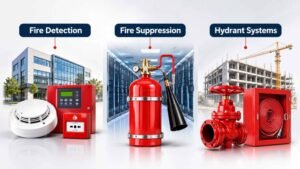
For example, a campaign could separately target searches around:
- Fire pump suppliers
- Fire hydrant equipment
- Fire sprinkler systems
- Fire alarm systems
- Industrial fire protection
- Commercial fire safety equipment
- Fire protection project suppliers
The landing page should match the search.
A person searching for fire pumps should not automatically land on a generic fire equipment homepage.
They should reach a page that explains the relevant product category and gives them a clear next action.
AdsThrive’s Google Ads PPC service specifically describes search campaigns, conversion tracking, A/B testing and high-intent search capture as components of its paid advertising approach.
The important part: measure enquiries, not clicks alone
A campaign can produce traffic without producing useful business.
For a fire equipment company, better conversion events could include:
- RFQ submission
- Project enquiry
- Product enquiry
- Technical consultation
- Phone call
- WhatsApp conversation
- Catalogue request
- Site discussion
- Distributor enquiry
The commercial question is not:
“How many clicks did the campaign generate?”
It is:
“Which campaigns generated enquiries that sales could actually pursue?”
Separate product demand from project demand
This is one of the most useful distinctions for a company selling fire safety equipment.
A person searching for a single extinguisher is different from a contractor looking for a complete system for a 100,000-square-foot commercial project.
The marketing system should not treat them identically.
A simple commercial search map
| Search type | Possible buyer intent | Useful destination |
| Product search | Product research or purchase | Product page |
| Manufacturer search | Supplier evaluation | Manufacturer/company page |
| Application search | Solution research | Application page |
| Project search | Active requirement | Project enquiry page |
| Replacement search | Existing-system requirement | Replacement/service page |
| Location search | Local supplier evaluation | Location/service page |
This also affects Google Ads.
A campaign for “fire pump supplier” can use different messaging and landing pages from a campaign around “fire protection system for warehouse.”
The same principle applies to organic search.
A useful Digital marketing for fire protection companies strategy should therefore map products, applications, industries and project requirements instead of creating one broad campaign around “fire safety.”
Turn technical credibility into a marketing asset
Fire protection is not a category where visual appeal alone closes the sale.
A commercial buyer may need confidence around specifications, standards, applications, installation requirements, documentation and project suitability.
BIS’s current fire-safety resources show how Indian fire-safety requirements are supported by a range of standards covering areas such as extinguishers, sprinklers, fire detection, hydrants and related systems.
That gives manufacturers and suppliers a valuable content opportunity.
Instead of publishing generic blogs such as “Why fire safety is important,” create useful technical resources around genuine buyer questions.
Examples:
Product questions
- How do commercial fire pumps work?
- What information is needed before selecting fire protection equipment?
- What should a buyer check when replacing fire safety equipment?
- What documentation should accompany a project enquiry?
Application questions
- What fire protection considerations apply to warehouses?
- What systems are commonly considered for commercial buildings?
- What information does a contractor need before requesting a quotation?
Procurement questions
- What should be included in a fire equipment RFQ?
- How can contractors compare suppliers?
- What information should be shared with a manufacturer before quotation?
These resources can attract buyers earlier in the decision process and then guide them toward commercial pages.
Use LinkedIn and social media as proof, not decoration
Fire equipment companies often have genuinely useful material but use only a fraction of it online.
A completed installation can become a project post.
A product test can become technical content.
A new manufacturing capability can become a LinkedIn update.
A project challenge can become an educational post.
A product comparison can become a visual explanation.
This is far more valuable than posting generic festival greetings or repetitive product photographs every week.
For example, a manufacturer could publish:
Project: Commercial building fire pump installation
Requirement: New fire protection infrastructure
Scope: Pump assembly, piping and associated equipment
Challenge: Integration with existing building services
Outcome: Completed installation
The post does not need to reveal confidential client information.
Its purpose is to show that the company understands real project environments.
AdsThrive’s Social Media Marketing service describes audience targeting, content creation, paid campaigns and conversion-focused social strategies.
LinkedIn can then be used more selectively for professional outreach to:
- Architects
- MEP consultants
- EPC companies
- Contractors
- Procurement teams
- Facility managers
- Developers
- Industrial project teams
- Fire consultants
The objective is not to send the same sales message to everyone.
The objective is to start relevant business conversations.
Build lead generation around the information sales actually needs
A generic contact form often produces leads like:
Name: Raj
Phone: XXXXX
Message: Need quotation.
That is technically a lead.
But it is not a useful project brief.
A better enquiry journey can collect the information required for the next sales step without turning the form into a long questionnaire.
Depending on the product, useful fields may include:
- Product category
- Project type
- Application
- Project location
- Approximate quantity
- New installation or replacement
- Required timeline
- Technical specification availability
- Company name
- Contact details
For larger projects, buyers could also be given the option to upload drawings, BOQs or technical documents.
The form should be designed around what the sales team actually needs.
It should not collect information simply because a marketer thinks it might be useful.
Add AI where the sales process is repetitive
The biggest opportunity for AI is often not replacing the salesperson.
It is removing repetitive work before the salesperson needs to get involved.
Imagine a visitor arrives through Google Ads at 9:30 PM.
They want information about a fire pump.
Instead of seeing only a contact form, an AI chatbot can begin the conversation.
It might ask:
- Which type of fire protection requirement do you have?
- Is this for a new project or replacement?
- What type of property is involved?
- Where is the project located?
- Do you have a specification or BOQ?
- Would you like a quotation or technical discussion?
The system can then capture the conversation.
AdsThrive’s AI ChatBot Agent is designed around website conversations, query resolution and lead capture.
For buyers who prefer WhatsApp, the conversation can continue there through an AI WhatsApp Agent, which can support automated replies, lead capture, routing and approved information sharing.
AI should support the sales team, not make engineering decisions
This distinction is important.
AI can collect:
- Product requirement
- Application
- Location
- Quantity
- Timeline
- Project type
- Contact information
But technical suitability, system design, compliance interpretation, engineering approval and commercial negotiation should remain with the appropriate professionals.
What information can AI use to organise incoming enquiries?
| Information | Why it matters |
| Product required | Routes enquiry to the right category |
| Project type | Helps distinguish project opportunities |
| Application | Adds commercial and technical context |
| Location | Helps determine service coverage |
| Quantity | Indicates potential scale |
| Timeline | Helps identify urgency |
| Specification/BOQ | Provides sales or technical context |
| Buyer type | Helps determine the appropriate sales path |
AdsThrive’s AI Lead Qualification is designed to capture leads, analyse information, score intent and route opportunities to sales.
For a company receiving enquiries from several product categories, this can make the first stage of sales management more organised.
Where should the marketing budget go?
There is no single channel that should receive every rupee.
The right mix depends on the company’s products, geography, project size, sales cycle and existing digital visibility.
A practical allocation can be based on commercial purpose.
| Channel | Primary role | Best suited for |
| SEO | Build long-term organic discovery | Product, application and supplier searches |
| Google Ads | Capture immediate search demand | High-intent commercial searches |
| Reach professional audiences | Consultants, contractors and procurement | |
| Social media | Build visibility and proof | Projects, products and technical content |
| Lead generation | Create focused enquiry campaigns | Specific products or project categories |
| AI automation | Improve response and qualification | Incoming enquiries and follow-up |
The important point is that these channels should not operate as separate marketing projects.
- A Google Ads campaign can send traffic to a product page.
- The product page can offer AI chat or WhatsApp.
- The conversation can collect requirements.
- AI qualification can organise the enquiry.
- The sales team can receive the information.
- Follow-up automation can then keep the conversation moving.
That is a connected commercial system.
- Prevent good enquiries from disappearing after the first conversation
Generating an enquiry is only one part of the problem.
Fire protection projects may involve:
- Consultant approval
- Technical discussions
- BOQ preparation
- Vendor comparison
- Budget approval
- Site coordination
- Tender timelines
- Procurement approval
- Revised specifications
A buyer who enquires today may not purchase tomorrow.
That does not mean the opportunity is dead.
This is where follow-up needs to become part of the marketing system.
For example:
Day 0: Enquiry received
Day 0: Requirement confirmed
Day 1: Sales discussion
After quotation: Follow-up
After technical review: Clarification
Before project decision: Re-engagement
The messages should depend on the buyer’s actual stage.
A prospect waiting for a technical quotation should not receive the same generic message as someone who only downloaded a catalogue.
AdsThrive’s AI Follow-ups & Reminder supports automated follow-up sequences, reminders and reactivation workflows.
For prospects who need a phone conversation, AdsThrive’s AI Calling Solution can support configured outbound calls, qualification, follow-up and appointment-related workflows.
The purpose is simple: reduce the number of genuine opportunities that disappear because the next action was forgotten.
Make the sales handoff measurable
A marketing campaign should not end when the form is submitted.
The sales process should tell marketing what happened next.
For example:
Search → Visit → Enquiry → Qualified → Quotation → Opportunity → Won/Lost
This creates a feedback loop.
Suppose Google Ads produces 50 enquiries.
After sales review:
- 20 are relevant
- 10 are outside the service area
- 8 are low-value product enquiries
- 7 are genuine project opportunities
- 5 need more information
That is far more useful than reporting “50 leads generated.”
Over time, this data can improve:
- Keyword selection
- Ad copy
- Landing pages
- Lead forms
- Qualification questions
- Geographic targeting
- Content topics
- Sales follow-up
This is where Lead generation for fire protection companies becomes a commercial discipline rather than simply a campaign metric.
What searches could a Fire Protection business be missing every day?
The opportunity is usually broader than the obvious product keyword.
A company may already rank for one major product term while missing searches around applications, replacements, project requirements and buyer language.
| Search opportunity | Example search | Commercial potential |
| Product | Fire pump supplier | High |
| Application | Fire protection for warehouse | High |
| Project | Commercial fire protection system | High |
| Replacement | Fire pump replacement | High |
| Supplier | Fire safety equipment manufacturer | High |
| Technical | Fire hydrant system requirements | Medium to high |
| Location | Fire protection equipment supplier in [city] | High |
| Procurement | Fire equipment quotation | Very high |
The exact search volume and competition should be validated through keyword research for the company’s target geography and product range.
The objective is not to create hundreds of pages simply because a keyword exists.
Each page should have a real purpose.
Commercial buyers and project consultants may evaluate fire protection products against applicable building and fire-safety requirements. Manufacturers should make relevant technical documentation available and understand the requirements outlined in the National Building Code of India
What makes a good digital strategy different from a generic marketing package?
A company selling engineered fire equipment does not necessarily need the same marketing system as a consumer business.
The strategy needs to reflect:
- Product complexity
- Project value
- Sales cycle
- Target industries
- Consultant influence
- Contractor relationships
- Geographic coverage
- Product availability
- Technical documentation
- Procurement process
That is why a Digital marketing agency for fire protection companies should be evaluated on more than its ability to produce social media posts or rank a few keywords.
Ask whether the agency can connect:
- Technical SEO
- Product and application content
- Google Ads
- Landing pages
- LinkedIn outreach
- Social media
- Lead generation
- AI chatbot
- WhatsApp automation
- AI lead qualification
- AI calling
- Follow-up automation
- Booking
- CRM and sales reporting
The value comes from connecting these activities around one commercial objective.
How AdsThrive can connect marketing activity with the sales process
AdsThrive’s approach can be structured around the complete path rather than treating each service as an isolated campaign.
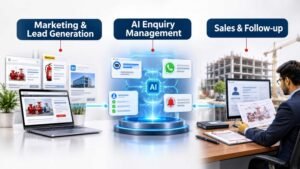
Search visibility
Product, application, industry and commercial search opportunities can be addressed through SEO and AI SEO.
The SEO and digital growth services can form the organic acquisition layer.
Paid demand
Google Ads can capture active searches where immediate visibility matters.
The campaign can direct prospects to relevant product or project pages rather than sending every click to the homepage.
Professional outreach
LinkedIn and social media can support account-level visibility among consultants, contractors, procurement professionals and project stakeholders.
Enquiry capture
Landing pages, forms, website chat and WhatsApp can give prospects different ways to start a conversation.
AI qualification
Incoming enquiries can be organised according to predefined business criteria.
AI calling
Suitable prospects can be contacted for initial qualification, confirmation or appointment-related workflows.
Follow-up
Automated reminders can help keep quotations, callbacks and longer project conversations active.
Booking
When a prospect is ready for a technical or commercial discussion, AI Booking Systems can help coordinate appointments and reduce scheduling friction.
This creates a system such as:
Search / Ads / LinkedIn → Relevant Page → Enquiry → AI Conversation → Qualification → Follow-up → Sales Discussion → Quotation
The exact workflow should be customized to the company’s products and sales process.
The commercial advantage of combining SEO, Ads and AI
- SEO is useful for building ongoing discovery.
- Paid advertising is useful when the business wants immediate visibility for selected searches.
- LinkedIn can help reach specific professional audiences.
- Social media can provide proof and visibility.
- Lead-generation campaigns can create focused acquisition opportunities.
- AI can improve what happens after someone responds.
None of these needs to operate independently.
For example, a buyer could discover a fire pump page through organic search, start a website conversation, move to WhatsApp, provide project details, receive an initial qualification response and then be routed to a salesperson.
Another buyer might click a Google Ad for fire hydrant equipment, submit a quotation request and receive an AI-assisted follow-up.
A third prospect might be identified through LinkedIn outreach and directed toward a project-specific landing page.
The system can accommodate different buyer journeys without forcing every prospect through exactly the same route.
A practical 90-day starting plan
A fire equipment company does not have to rebuild everything at once.
A phased approach is often more practical.
First 30 days: Fix the commercial foundation
Focus on:
- Product and application page audit
- Search intent research
- Conversion-path review
- Google Ads account review
- Lead-form improvement
- Tracking setup
- Existing enquiry analysis
The objective is to understand where current opportunities are being lost.
Days 31–60: Build acquisition opportunities
Develop:
- Priority product pages
- Application-focused content
- Search campaigns
- LinkedIn outreach
- Project-focused social content
- Conversion-focused landing pages
- Lead-generation campaigns
The objective is to increase relevant discovery and enquiry opportunities.
Days 61–90: Connect AI and follow-up
Introduce appropriate automation:
- AI chatbot
- WhatsApp AI
- AI lead qualification
- AI calling
- Automated follow-ups
- Booking
- CRM routing
The objective is to reduce the delay between enquiry and sales action.
This phased approach also makes performance easier to evaluate because the company can identify which changes are actually improving the commercial pipeline.
To create a successful PPC campaign, it is essential to set clear objectives, target the right audience, conduct effective keyword research, and follow these proven tips and tricks for running a successful Google Ads campaign.
Frequently Asked Questions
1. How can fire protection companies get more commercial enquiries?
Focus on product-specific SEO, Google Ads, project-focused landing pages, LinkedIn outreach and faster enquiry handling. The website should make it easy for buyers to request quotations or technical discussions.
2. Is SEO useful for fire protection equipment companies?
Yes. SEO can help the company appear for product, application, supplier, project and technical searches. The strongest strategy connects those searches to useful pages and clear enquiry options.
3. Should fire equipment companies use Google Ads?
Yes, particularly for high-intent searches where immediate visibility is valuable. Campaigns should be separated by product or commercial intent rather than sending every visitor to one generic page.
4. Can AI qualify fire protection enquiries?
Yes. AI can collect information such as product requirement, project type, location, quantity and timeline. Technical suitability and engineering decisions should remain with qualified professionals.
5. Can WhatsApp help generate B2B fire equipment leads?
Yes. WhatsApp can provide a low-friction way for prospects to ask questions, share requirements and continue conversations. An AI agent can support initial responses and information collection.
6. How can LinkedIn help fire protection companies?
LinkedIn can help companies reach architects, consultants, contractors, procurement teams and facility professionals through targeted content and outreach.
7. What should a fire equipment website include?
It should clearly explain products, applications, industries served, technical information, project capabilities, service areas and the easiest ways to request a quotation or consultation.
8. Should marketing teams measure leads or sales opportunities?
Both should be measured, but qualified opportunities are more useful for commercial decision-making than raw lead volume. Marketing should ideally know which enquiries progress into quotations and projects.
Build a commercial enquiry system, not just a marketing presence
A fire protection company can have strong products, experienced engineers and the capability to handle large projects, but those strengths do not automatically create online enquiries.
The buyer has to discover the company.
The relevant product or solution has to be easy to understand.
The website needs to provide enough information to support evaluation.
The enquiry process needs to be simple.
Sales needs enough context to respond intelligently.
And prospects who are not ready immediately need an organised follow-up path.
That is the real opportunity behind SEO for fire protection companies.
The goal is not to publish hundreds of pages or chase every possible keyword. It is to build visibility around genuine commercial demand and connect that demand to a sales process that can handle it.
A strong strategy can combine organic search, Google Ads, LinkedIn outreach, social media, landing pages, lead generation, AI chat, WhatsApp, AI qualification, AI calling, follow-up automation and booking.
When those components work together, digital marketing stops being a collection of activities and becomes part of the company’s business-development process.
Turn Fire Protection Searches Into Commercial Opportunities
If your company wants more than website traffic, AdsThrive can help build a connected acquisition and enquiry-management system around your products, target industries and sales process.
From SEO and Google Ads to LinkedIn, lead generation, AI chatbot, WhatsApp automation, AI lead qualification, AI calling, follow-ups and booking systems, the objective is to move the right prospects from discovery toward a meaningful sales conversation.


