For roofing sheet manufacturers, an enquiry is rarely just a request for a price. A buyer may need a particular profile, base-metal thickness, coating, colour, sheet length or insulation arrangement – and the final purchase can depend on roof area, structural design, project location and delivery schedule. A contractor sourcing sheets for an industrial shed has different requirements from a dealer replenishing stock or a farmer roofing an agricultural building.
That is why a website listing only “colour-coated roofing sheets” or “GI roofing sheets” can miss valuable opportunities. SEO for roofing sheet manufacturers needs to make product differences, applications, supply capabilities and quotation routes easy to find. Marketing must also help the sales team identify whether an enquiry fits the manufacturer’s actual products and service area.
The commercial objective is not simply to increase website traffic. It is to generate more relevant enquiries from builders, fabricators, contractors, dealers, architects and industrial project buyers—and help those enquiries move towards quotations and orders.
The hidden reason roofing sheet enquiries fail to convert
A roofing sheet manufacturer may receive dozens of calls and website enquiries, but the sales team can still struggle to prepare quotations. The problem is often the information available at the first contact.
Consider a typical message:
“Need roofing sheets for a factory. Please share price.”
The sales team cannot prepare a meaningful quotation from this alone. It needs to understand the product type, profile, thickness, coating, colour, sheet length, quantity, delivery location and project timeline. Some of these details may be specified by the consultant or project engineer; others may need to be confirmed during a technical discussion.
Now compare it with a more complete enquiry:
“We are sourcing pre-painted trapezoidal roofing sheets for a warehouse project near Pune. The approximate roof area is 18,000 sq. ft. We have a specified profile and thickness in the project document. Please confirm whether you can supply the required colour and sheet lengths, and share your quotation.”
The second enquiry gives the manufacturer a starting point. The team can check product fit, ask for the drawing or specification, evaluate supply feasibility and move towards a quotation.
This difference should influence the entire marketing process.
A manufacturer should not only ask, “How do we get more people to contact us?” It should also ask:
- Are we attracting buyers looking for products we actually manufacture?
- Can visitors understand the difference between our sheet categories?
- Do our pages explain the specifications buyers need to confirm?
- Can a contractor submit a project requirement without making several calls?
- Does the sales team receive enough information to prioritise enquiries?
- Are we following up with buyers who are still comparing suppliers?
The answer is a marketing system built around enquiry readiness. The website attracts the right searches, product pages explain the offer, campaigns reach selected buyer groups, and automation helps collect missing information.
What are roofing sheet buyers actually searching for?
A manufacturer who targets only “roofing sheet manufacturer” may overlook buyers searching by material, coating, profile, application or project requirement.
These are representative search patterns worth checking in Search Console and keyword research tools. They are not verified search-volume rankings.
| Search intent | Example searches | Useful page or content |
| Supplier discovery | roofing sheet manufacturer, roofing sheet supplier India | Manufacturer profile and supply capabilities |
| Material-based | GI roofing sheets, PPGI roofing sheets, PPGL roofing sheets | Separate material and product-category pages |
| Profile-based | trapezoidal roofing sheets, corrugated roofing sheets, standing seam roofing | Profile-specific product pages |
| Coating and finish | colour coated roofing sheets, aluminium zinc roofing sheets | Coating details, finish options and product documentation |
| Dimension and specification | roofing sheet thickness, roofing sheet width, roofing sheet length | Technical specification and enquiry support |
| Application-based | industrial shed roofing sheets, warehouse roofing sheets, factory roofing sheets | Project and application pages |
| Commercial buying | roofing sheets bulk price, wholesale roofing sheet supplier | Bulk enquiry and dealer information |
| Local procurement | roofing sheet manufacturer in Pune, roofing sheet supplier near me | Genuine location and service-area pages |
| Accessories | roofing sheet ridge cap, flashing, roofing screws | Accessories and compatible components pages |
| Insulated roofing | PUF roofing panels, insulated roof panels | Separate insulated product pages, if manufactured |
The table reveals an important content opportunity: buyers may already know what they need, but the website may not have a page that directly answers their search.
For example, a manufacturer producing trapezoidal profiles should not expect a general “Products” page to do all the work. A dedicated page can show profile photographs, available dimensions, material options, coating details, compatible accessories and a quotation route.
The same applies to GI, PPGI and PPGL products. They should be described accurately and separately wherever their properties, standards or intended buying requirements differ.
Make the product catalogue answer the questions a procurement team will ask
A digital catalogue should do more than display attractive roofing installations. It should help a buyer shortlist the right product and prepare a useful enquiry.
Organise products by material, profile and finish
The manufacturer’s actual product range should determine the website structure. Depending on the business, this may include:
- Galvanized iron or GI roofing sheets
- Pre-painted galvanized steel sheets
- Pre-painted galvalume or aluminium-zinc coated products, where manufactured
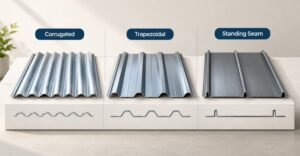
- Corrugated roofing sheets
- Trapezoidal roofing sheets
- Standing seam profiles
- Roofing sheets in different colours and finishes
- Insulated roofing panels or PUF panels, if offered
- Ridge caps, flashings, gutters and other accessories, if supplied
Avoid creating pages for product categories the business does not manufacture or supply. A page should represent a real capability, not merely a keyword opportunity.
Explain specifications without turning the page into a technical manual
The buyer should be able to find the key information quickly. Depending on the product, useful details may include:
| Product information | Why the buyer needs it |
| Base material | Helps identify the product category |
| Nominal thickness or BMT | Supports specification comparison |
| Coating type and coating mass | Helps buyers evaluate the specified finish |
| Profile shape and dimensions | Helps match the product to the project requirement |
| Sheet length and effective cover width | Supports quantity and layout planning |
| Colour and paint system | Helps confirm the required appearance and finish |
| Available grades | Helps establish whether the product meets the project specification |
| Accessories | Helps buyers understand the complete supply scope |
| Manufacturing and dispatch location | Helps assess supply feasibility |
| Technical documents | Supports procurement and consultant review |
The manufacturer should publish only verified specifications. Terms such as BMT and total coated thickness should not be treated as interchangeable. If the business supplies different coating systems or thickness options, explain them accurately and provide the relevant product documentation.
For galvanized plain and corrugated steel sheets, the relevant Indian reference is IS 277:2018. The BIS summary of IS 277 discusses requirements including base steel properties, zinc coating, dimensional tolerances, corrugation characteristics, finish and product quality. This can help manufacturers understand why technical information matters to buyers. It should not be used to claim that a particular product is certified unless the manufacturer holds the applicable certification.
For continuously pre-painted galvanized steel sheets, BIS lists IS 14246:2024. Its product manual covers testing and requirements associated with the base steel, metallic coating, organic coating, dry film thickness and profiles. Manufacturers can refer to the BIS product manual for IS 14246 when reviewing what technical information may be relevant to their product documentation.
Make drawings and specification uploads possible
Some buyers will not know every technical term. They may have a roof layout, BOQ, consultant specification or project drawing instead.
Give them an option to upload a document with their enquiry. The sales team can then review the information and request clarification where necessary.
A useful product page can offer two clear routes:
Know your requirement? Request a quotation by entering the product details.
Working from a project document? Upload the BOQ, drawing or specification for review.
This small change can make the website more useful to project procurement teams and reduce the back-and-forth involved in collecting basic information.
Build the website around the questions that happen before a quotation
A roofing sheet buyer may move through several questions before contacting a manufacturer:
- Does this manufacturer supply the material and profile I need?
- Are the available thicknesses and coatings suitable for my specification?
- Can the company supply the required sheet length and quantity?
- Does it serve my project location?
- Can it provide accessories and related components?
- How do I share the BOQ or request a quotation?
The website should answer these questions in a logical order.
Give each major product group its own landing page
A strong product page should contain:
- A clear product name and short explanation
- Real photographs of the actual product
- Profile or cross-section visuals where useful
- Available material and coating options
- Verified dimensions and specification details
- Typical applications, described accurately
- Related accessories
- Downloadable product information, if available
- A visible quotation or document-upload option
A page for pre-painted roofing sheets should not simply duplicate a GI sheet page with a few words changed. Explain the differences relevant to the products actually supplied.
Add project-focused pages where there is a genuine difference
Manufacturers may serve several project categories:
- Industrial sheds and manufacturing facilities
- Warehouses and logistics buildings
- Commercial buildings
- Agricultural buildings
- Workshops and fabrication projects
- Institutional or infrastructure buildings
These pages should explain the manufacturer’s relevant supply experience and product capabilities. They should not make unsupported claims about structural suitability. Roof design, load calculations, drainage, wind conditions and fixing arrangements must be evaluated by qualified professionals against the project requirements.
For instance, the Ministry of Home Affairs’ published building specification includes a roofing section that identifies a particular PPGL trapezoidal sheet specification alongside thickness, steel grade, coating and fixing details. It is an example of how a project document can combine several requirements rather than specify only a generic sheet name. Refer to the MHA roofing specification document as an example—not as a universal specification for every roofing project.
Improve the quotation journey
A product page should not make every visitor navigate to the contact page and start from scratch.
Useful calls to action include:
- Request a bulk quotation
- Upload project BOQ
- Share your roofing specification
- Ask about available profiles
- Enquire about dealer supply
- Request a product catalogue
- Discuss a custom sheet requirement
A quotation form can capture the information needed for the first sales review without overwhelming the visitor.
Six practical ways to generate more roofing sheet enquiries
1. Capture searches from buyers who already know the product they need
This is the foundation of SEO for roofing sheet manufacturers. The objective is to appear when a buyer searches for a product, profile, coating or supplier—not merely when someone searches for the broad industry term.
Start with the products that have the strongest commercial value and supply capability. Map each important search group to a relevant page.
For example:
| Product or requirement | Suggested search focus | Recommended destination |
| GI corrugated sheets | GI corrugated roofing sheet manufacturer | GI corrugated product page |
| Colour-coated products | colour coated roofing sheet supplier | Pre-painted product page |
| Trapezoidal profile | trapezoidal roofing sheet manufacturer | Profile-specific page |
| Industrial projects | roofing sheets for industrial sheds | Industrial application page |
| Dealer purchase | wholesale roofing sheet supplier | Dealer or bulk supply page |
| Accessories | roofing ridge cap manufacturer | Accessories page |
Build supporting content around genuine buyer questions: how to compare coating types, what information is needed for a quotation, how to calculate approximate sheet coverage, or what details a contractor should confirm before ordering.
Do not publish engineering calculations as final design advice. A simple explainer can help a buyer understand what information is needed, while directing structural and installation decisions to the project engineer.
For businesses investing in SEO services for roofing sheet manufacturers, the work should cover product architecture, technical content, search visibility, local discoverability and conversion tracking. AdsThrive’s AI SEO services can support this through search-intent mapping, content optimisation and improvements that help search engines and AI-assisted discovery systems interpret the manufacturer’s capabilities.
The result should be measured through relevant product-page traffic, quotation requests, document uploads and qualified enquiries—not a ranking screenshot alone.
2. Use Google Ads to reach buyers with immediate procurement needs
Organic visibility is valuable, but a manufacturer may need enquiries while SEO improvements are developing. Google Ads can put the business in front of people actively searching for a supplier or a particular roofing product.
The campaign structure should reflect commercial intent.
Supplier searches: Target phrases around roofing sheet manufacturers, suppliers and bulk purchasing.
Product searches: Create separate groups for GI, pre-painted, corrugated and trapezoidal products, depending on the catalogue.
Project searches: Target industrial shed roofing, warehouse roofing and other relevant applications where the manufacturer can meet the requirement.
Regional searches: Focus on locations the company can supply profitably.
Avoid broad campaigns that spend money on unrelated searches such as roofing repair, installation jobs, DIY instructions or residential roof replacement if the manufacturer is focused on wholesale supply.
Use negative keywords where appropriate and review actual search terms frequently. A click is not a business opportunity if the visitor wants a repair contractor while the advertiser sells roofing sheets in bulk.
AdsThrive’s Google Ads and PPC services can connect search campaigns with product-specific landing pages, enquiry tracking and conversion optimisation. Its PPC campaign management can support ongoing review of targeting, search terms, budgets and lead quality.
A useful campaign report should show:
- Which product attracted the enquiry
- Which search term triggered the ad
- Which location generated the contact
- Whether the visitor requested a quotation or catalogue
- Whether the sales team considered the enquiry relevant
- Whether a quotation or order followed
This makes budget decisions more meaningful than optimising for clicks alone.
3. Reach contractors, fabricators and project teams through LinkedIn
A large roofing requirement may be discussed long before a purchase order is released. Contractors, project consultants, procurement managers and industrial developers may shortlist suppliers during the planning or tendering stage.
LinkedIn gives manufacturers a way to identify these business audiences and begin relevant conversations.
Potential target groups include:
- Industrial shed contractors
- Steel structure fabricators
- Warehouse developers
- Roofing installation companies
- Civil contractors
- Infrastructure project procurement teams
- Architects and project consultants
- Building material distributors
- Industrial facility managers
The outreach should reflect the recipient’s work. A fabricator may be interested in profile availability and repeat supply. A contractor may need product documentation and quotation support. A dealer may want to understand wholesale arrangements and dispatch coverage.
A practical first message could read:
“Hello [Name], we manufacture and supply roofing sheet products for industrial, commercial and related building applications. If your team is sourcing GI or pre-painted roofing sheets for upcoming projects, I can share our available profiles and product specifications for review.”
Do not send the same promotional message to hundreds of unrelated profiles. Build a list based on relevant companies, roles and project segments. Follow up with useful material such as a catalogue, profile details or a project-specific discussion.
The manufacturer’s LinkedIn page should also show real product photographs, factory capabilities, product updates and completed supply references where permission is available.
4. Use social media to show evidence that a catalogue cannot communicate
Roofing sheets are easier to evaluate when buyers can see the profile, finish, colour, surface and installation context. Social media should therefore demonstrate the product rather than repeat “best quality at competitive prices” in every post.
A useful content programme could include:
Product demonstrations
- Close-up footage of corrugated and trapezoidal profiles
- Side-by-side views of different colours and finishes
- Videos explaining available sheet lengths or profile options
- Product handling and packaging demonstrations
Manufacturing evidence
- Coil handling and profiling processes
- Quality inspection activities
- Measurement and thickness checks
- Protective film and packing procedures
- Dispatch preparation
Project and application content
- Industrial shed roofing projects
- Warehouse and commercial building applications
- Before-and-after project views, where authorised
- Accessories and finishing details
- Customer testimonials with permission
Buyer education
- What details to share when requesting a quotation
- Differences between product categories
- Questions to ask before placing a bulk order
- How to prepare a roofing sheet BOQ
- Why project specifications should be checked before ordering
Short videos can be repurposed across Instagram, Facebook, YouTube Shorts and LinkedIn, while longer technical demonstrations can be hosted on YouTube and embedded on product pages.
Social content can also support retargeting. A visitor who viewed a product page but did not enquire may later see a relevant profile demonstration or catalogue offer. Keep the follow-up message connected to the product they explored rather than showing a generic company advertisement.
5. Design lead-generation offers around the buyer’s next decision
A buyer may not be ready to request a quotation on the first visit. Some are comparing suppliers, preparing a BOQ or checking whether a manufacturer can supply a particular profile.
Give each buyer a clear next step:
| Buyer stage | Useful offer |
| Exploring suppliers | Download product catalogue |
| Comparing products | Request profile and specification details |
| Preparing a project | Upload BOQ or roofing drawing |
| Checking availability | Enquire about quantity and delivery |
| Buying in bulk | Request project quotation |
| Looking for a supplier partner | Apply for dealer or distributor discussion |
This approach helps the manufacturer collect leads at different stages without treating every contact as an immediate sales opportunity.
A campaign for catalogue downloads should not be judged in the same way as a bulk quotation campaign. The first may create early-stage prospects; the second should attract buyers with a clearer purchase requirement.
Lead generation for roofing sheet manufacturers should therefore distinguish between product enquiries, project RFQs, dealer applications and general information requests. The follow-up content and sales priority should reflect that difference.
AdsThrive can help coordinate the landing page, campaign message, enquiry form and lead capture process so the buyer receives a consistent experience from the first click to the first sales conversation.
6. Use AI to turn incomplete enquiries into sales-ready conversations
The first enquiry may arrive outside business hours, during a factory visit or while the sales team is handling another customer. A slow response can give a competing supplier the opportunity to engage first.
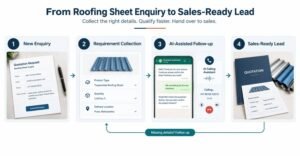
AI-assisted communication can help acknowledge the enquiry and collect missing information.
A website chatbot can ask which product the buyer needs. A WhatsApp AI agent can collect the project location, estimated quantity and expected timeline. An AI calling assistant can contact a prospect who requested a callback or confirm basic details before routing the enquiry to sales.
A useful qualification conversation could collect:
- Company name and buyer role
- Product category
- Profile or sheet type
- Required thickness or specification, if known
- Colour or coating preference
- Approximate quantity or roof area
- Sheet length or drawing availability
- Delivery location
- Expected purchase date
- Whether a BOQ or technical document is available
The AI system should record what the buyer says, not invent missing specifications. If the buyer does not know the required coating or thickness, the enquiry should be marked for technical clarification rather than automatically assigned a product.
AdsThrive’s AI chatbot agent, WhatsApp AI agent and AI lead qualification can support these early conversations. The objective is to make sure a lead is acknowledged, basic information is collected and the correct person receives the enquiry.
A practical lead-scoring model for roofing sheet manufacturers
Not every enquiry should receive the same priority. A dealer asking for a recurring monthly supply and a student asking for a product price may both submit a form, but they represent very different commercial opportunities.
A simple lead classification model can help the sales team organise its work.
| Lead category | Typical enquiry signals | Recommended action |
| Project-ready | Product identified, quantity or roof area known, location and timeline provided | Prioritise quotation review |
| Specification pending | Genuine project, but technical details or BOQ are missing | Request documents or arrange a technical discussion |
| Dealer opportunity | Business details, target market and repeat supply interest | Route to channel sales |
| Early research | Product comparison or catalogue request without a confirmed project | Share relevant information and nurture |
| Out of scope | Product, quantity, location or application outside business capability | Respond appropriately and close or refer |
This classification should be adapted to the manufacturer’s sales process. It is not a substitute for checking credit, technical suitability, stock or delivery capacity.
Connect follow-ups to the buyer’s stage
A single “Following up on your enquiry” message is not useful for every prospect.
A project-ready buyer may need a quotation update. A buyer waiting for an internal approval may need a reminder after an agreed period. A dealer prospect may need information about the product range and supply terms. Someone who downloaded a catalogue may benefit from a message asking which profile they are evaluating.
AdsThrive’s AI follow-up solution can support scheduled, context-based follow-ups. Its AI calling solution can assist with appropriate outbound calls, reminders and callback requests. Human sales staff should handle price negotiation, technical clarifications and commitments.
For companies that schedule product discussions or dealer calls, AI booking systems can help coordinate appointments without lengthy back-and-forth communication.
Make marketing and sales share the same definition of a good lead
One of the most common reporting mistakes is treating every form submission as a successful lead. Marketing may report a high number of conversions while sales says that most contacts are irrelevant.
The gap usually comes from different definitions.
Marketing may count:
- Catalogue downloads
- Contact form submissions
- WhatsApp conversations
- Phone calls
- Callback requests
Sales may count only:
- Valid business contacts
- Relevant product requirements
- Serviceable project locations
- Enquiries with realistic quantities
- Opportunities that can progress to a quotation
Both sets of numbers are useful, but they should not be combined into one headline figure.
Agree on a shared definition of a qualified enquiry. For example, a qualified lead may need a genuine buyer identity, a product the manufacturer supplies, a location the business can serve and a project or purchase requirement worth pursuing.
Then connect campaign reporting to the sales outcome.
| Metric | Business question answered |
| Organic traffic by product page | Which products are being discovered? |
| Paid search enquiries | Which campaigns attract active buyers? |
| Cost per qualified lead | How much does it cost to reach a relevant prospect? |
| Specification-complete enquiries | Are forms and qualifications improving lead quality? |
| Quote requests | Which channels create real commercial discussions? |
| Quotations issued | Are enquiries progressing through sales? |
| Order conversion | Which sources contribute to revenue? |
| Enquiry response time | Are prospects receiving timely attention? |
| Dealer enquiries | Is marketing helping expand distribution? |
| Repeat enquiries | Are existing relationships returning through digital channels? |
A monthly review should include marketing and sales representatives. Sales can explain why leads were rejected or delayed. Marketing can use those reasons to refine search terms, landing pages, forms and targeting.
This is how SEO for roofing sheet manufacturers can become part of a measurable sales process rather than a standalone ranking exercise.
What should manufacturers ask before hiring a marketing agency?
A Digital marketing agency for roofing sheet manufacturers should understand the difference between attracting general roofing interest and generating enquiries for the manufacturer’s actual product range.
Before choosing a partner, ask how it will approach these areas:
Product understanding: Will the team understand your GI, pre-painted, corrugated, trapezoidal or other product categories? Can it translate your verified specifications into useful product pages?
Search strategy: Will it map supplier, product, profile, coating, application and location searches separately?
Campaign relevance: Will Google Ads exclude unrelated repair, installation or employment searches if those are not part of your business?
Enquiry quality: Will forms collect enough information to help sales assess the requirement without creating unnecessary friction?
B2B outreach: Can the team identify relevant contractors, fabricators, developers and dealers rather than relying on generic social media activity?
Automation: Can chatbot, WhatsApp, calling and follow-up workflows be connected to the enquiry process?
Reporting: Will the agency report qualified enquiries, quotations and sales outcomes – not just impressions and clicks?
AdsThrive combines SEO, AI SEO, paid advertising, lead generation and AI-powered communication workflows. The AdsThrive outlines its digital marketing and automation capabilities. The right engagement should begin with an understanding of the manufacturer’s products, target regions, order profile and sales process – not a standard package applied to every business.
“For more insights on improving lead generation and attracting qualified enquiries, explore our guide on how environmental engineering companies can generate more enquiries.”
Frequently asked questions
1. How can roofing sheet manufacturers generate more leads online?
Create product-specific pages, target supplier and specification searches, run Google Ads for relevant high-intent terms, use LinkedIn to reach contractors and procurement teams, and make quotation requests easy. AI-assisted qualification and follow-ups can help the sales team respond and organise enquiries.
2. Which keywords should roofing sheet manufacturers target?
Start with manufacturer and supplier searches, then expand into product categories such as GI, PPGI, PPGL, corrugated and trapezoidal sheets. Add profile, coating, thickness, application, bulk purchase and regional searches based on the actual products and locations the company serves.
3. Are Google Ads suitable for roofing sheet manufacturers?
Yes. Google Ads can reach buyers actively searching for roofing products or suppliers. Separate campaigns by product and intent, use relevant landing pages, target serviceable locations and track qualified enquiries rather than clicks alone.
4. What information should a roofing sheet quotation form collect?
Collect the buyer’s contact and company details, product type, approximate quantity or roof area, project location and expected timeline. Allow the buyer to share the BOQ, drawing or specification. Make technical fields optional if the buyer may not know the answers.
5. How can manufacturers reach roofing contractors and dealers?
Use LinkedIn to identify contractors, steel structure fabricators, roofing installers, project procurement professionals and building-material distributors. Share relevant product information and follow up with a specific business discussion rather than generic promotional messages.
6. Can AI qualify roofing sheet enquiries?
Yes. AI can collect initial details such as product type, profile, quantity, location, timeline and document availability. It can categorise enquiries and route them to sales. Product suitability and technical decisions should be reviewed by qualified staff.
7. How can a manufacturer reduce irrelevant leads from Google Ads?
Use product-specific campaigns, location targeting, negative keywords and clear ad copy. State whether the business handles bulk orders, dealer supply or project enquiries. Review search terms and sales feedback regularly.
8. How long does SEO take to generate roofing sheet enquiries?
There is no guaranteed timeline. Results depend on competition, website quality, product-page coverage, location, search demand and the quality of the content. Paid search can provide visibility while organic improvements develop, but both channels should be evaluated by qualified enquiries and sales progression.
Turn more product searches into quotation opportunities
Roofing sheet manufacturers do not need to attract every visitor interested in roofing. They need to reach people whose product requirements, project locations, quantities and timelines match the business’s capabilities.
That requires more than a broad product page and a phone number. Buyers need clear product categories, verified technical details, relevant application information and an easy way to share a project requirement. Marketing campaigns must reach the right contractors, fabricators, dealers and procurement teams. Enquiry automation should help collect missing details and keep the conversation moving without replacing technical or commercial judgement.
A focused SEO for roofing sheet manufacturers strategy connects product discovery with the quotation process. When SEO, Google Ads, LinkedIn outreach, social media and AI-assisted follow-ups work towards the same sales objective, the manufacturer can build a more organised pipeline of relevant opportunities.
If your website receives visits but too few useful enquiries – or your sales team spends too much time chasing incomplete requirements – AdsThrive can help review your search visibility, campaigns and enquiry workflow. Explore the AdsThrive to discuss a digital growth plan built around your roofing products and target buyers.