Environmental engineering firms often have the technical capability to design sewage treatment plants, develop effluent treatment systems, conduct environmental impact assessments, provide pollution-control solutions and execute water-management projects. Yet a prospective industrial client may shortlist another consultant simply because that company is easier to find, explains its capabilities more clearly or responds to an enquiry faster.
The commercial challenge is not just generating website visits. It is reaching the right project owner, industrial operator, infrastructure consultant, EPC contractor or procurement team—and giving them enough information to start a serious discussion.
A company offering EIA consultancy needs a different enquiry strategy from a firm designing an STP or supplying air-pollution-control systems. Their buyers, project values, decision timelines and search behaviour are different. SEO for environmental engineering companies must account for those differences while connecting visibility to measurable business opportunities.
This article looks at enquiry generation from a commercial perspective: which services should be marketed, how to identify buyers with active project requirements, where paid campaigns and LinkedIn fit, and how Adsthrive’s SEO, advertising and AI-enabled lead-management capabilities can support the process.
The commercial opportunity: sell the project outcome, not just the engineering service
Environmental engineering is a broad market. A company may work across regulatory consulting, treatment infrastructure, industrial pollution control, environmental monitoring, waste management or sustainability projects. A buyer rarely approaches all these services with the same requirement.
Consider the different commercial situations:
- A manufacturing plant needs an effluent treatment plant upgrade because its existing system cannot consistently meet discharge requirements.
- A real estate developer needs environmental consultancy and documentation before progressing with a proposed development.
- A municipality or infrastructure contractor is exploring sewage treatment capacity and project execution.
- An industrial facility needs air-pollution-control equipment or an emissions-monitoring solution.
- A company wants a water-reuse system to reduce freshwater consumption and operating costs.
- An EPC contractor is looking for an environmental engineering partner for a larger project.
These are not interchangeable enquiries. Each represents a different service requirement, buyer role, technical discussion and potential contract.
The commercial opportunity is to make each capability discoverable and easy to evaluate. A visitor looking for an ETP consultant should not have to navigate a generic page that talks equally about environmental audits, solid waste, air quality and water treatment. The page should explain the relevant service, project experience, technical scope and next step.
This is where a focused approach to digital marketing for environmental engineering companies becomes commercially useful. It connects a company’s actual project capabilities with the buyers who need them.
What does a qualified enquiry look like?
A website form submission is not automatically a sales opportunity. A useful enquiry should contain enough information for the sales or technical team to understand whether the requirement matches the company’s capabilities.
| Enquiry detail | Why it matters commercially |
| Organisation and industry | Helps identify the type of buyer and application |
| Project location | Helps assess service coverage, site visits and project conditions |
| Requirement or problem | Identifies the service or engineering solution needed |
| Project stage | Distinguishes early research from active procurement |
| Capacity or project scale | Helps estimate technical and commercial fit |
| Expected timeline | Indicates urgency and potential sales priority |
| Contact role | Shows whether the person is an influencer, consultant or decision-maker |
For example, a request for an ETP quotation from an operating manufacturing plant is different from a student asking for information about effluent treatment. Both may use similar words in a search, but they should not receive the same sales priority.
The goal of lead generation for environmental engineering companies should therefore be to improve the relevance and usefulness of enquiries—not simply increase the number of form submissions.
Where environmental engineering companies may be losing project enquiries
Before increasing advertising budgets or publishing more blogs, examine where potential buyers are being lost.
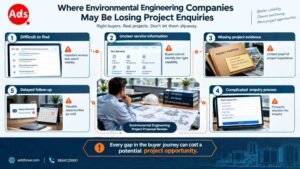
1. Several services are hidden under one generic page
A company may provide EIA consultancy, environmental audits, wastewater treatment, STP design, ETP operations, air-pollution control and solid-waste management. If all these capabilities appear on one broad services page, search engines and buyers may struggle to understand the company’s depth in each area.
A buyer searching for an industrial wastewater treatment consultant needs a focused page. A developer looking for environmental clearance consultancy needs a different explanation, even if the same company provides both services.
2. Technical expertise is not translated into commercial proof
Engineering teams understand design parameters, treatment processes, compliance requirements, plant capacity and operational constraints. Prospective clients, however, also want to know whether the firm has handled comparable projects.
A service page should make it easy to find:
- The type of facility or project handled.
- The engineering scope offered.
- Relevant treatment or control technologies.
- Industries and applications served.
- Project photographs, diagrams or case studies where permission is available.
- Certifications, registrations and professional credentials where applicable.
- The information required to request a consultation or proposal.
Do not publish confidential client information or claim regulatory approvals that the company does not hold. Use verifiable project evidence.
3. Advertising attracts enquiries outside the service scope
Broad keywords such as “environmental services” or “environmental engineering” may attract students, job seekers, researchers, general consumers and businesses with unrelated requirements.
Paid campaigns need tighter keyword selection, negative keywords, audience targeting and landing pages that reflect the actual service being promoted.
4. Enquiries are not followed up consistently
An engineering prospect may need a technical discussion, site assessment, document review or internal approval before requesting a proposal. If the company responds once and then stops following up, a potentially valuable opportunity can go cold.
Marketing and sales need a shared process for recording, assigning and following up on enquiries.
The buyer searches your marketing should be built around
Environmental engineering buyers may search by the problem they need to solve, the service they want to procure, the technology they are considering or the industry in which they operate.
The following are illustrative keyword opportunities, not verified daily search volumes. Use Google Keyword Planner, Search Console and actual enquiry data to validate demand for the company’s target locations and services.
| Search opportunity | Example buyer search | Likely commercial intent |
| Environmental consultancy | Environmental engineering consultant in India | High |
| Environmental assessment | EIA consultancy for industrial projects | High |
| Wastewater projects | Industrial wastewater treatment plant consultant | High |
| Effluent treatment | ETP design and installation company | High |
| Sewage infrastructure | STP design and construction company | High |
| Air pollution control | Industrial air pollution control system supplier | High |
| Environmental compliance | Environmental compliance consultant for factories | Medium to high |
| Water reuse | Industrial wastewater recycling system | High |
| Environmental monitoring | Ambient air quality monitoring services | High |
| Solid waste solutions | Industrial waste management consultant | High |
A company should not attempt to rank one page for every phrase. Each keyword group should be mapped to the service page that can best answer the search.
For instance, “EIA consultancy for industrial projects” belongs on a page explaining assessment scope, project categories, documentation and consultancy support. It should not be forced into a generic wastewater treatment page.
This intent-based mapping is a central part of SEO for environmental engineering companies: the search phrase, landing page, proof and enquiry action should all match.
Six commercial strategies to generate better enquiries
The following strategies are deliberately organised around business decisions and revenue opportunities rather than a standard sequence of SEO tasks.
1. Prioritise services by contract potential before investing in visibility
Not every service deserves the same marketing budget. Some services may generate frequent small assignments, while others may lead to larger engineering contracts with longer decision cycles.
Start by reviewing the company’s actual revenue mix and delivery capacity. Identify the services that are commercially attractive, operationally deliverable and supported by evidence of past work.
A simple prioritisation exercise can help:
| Service line | Commercial questions to assess | Marketing priority |
| ETP/STP design and execution | Typical project size, target industries, geographic coverage and execution capacity | High if the company has delivery capability |
| EIA and environmental consultancy | Project categories, consultant credentials, documentation scope and regulatory experience | High where expertise is established |
| Air-pollution-control solutions | Equipment or system range, industries served and installation capability | High for firms with a defined offering |
| Environmental monitoring | Available services, instruments, reporting scope and recurring demand | Depends on operational capacity |
| Solid and hazardous waste management | Waste categories, authorisations, treatment capability and service territory | High where compliance and operations are supported |
| Water reuse and recycling | Applications, treatment capacity, operating economics and project references | High for industrial water-focused firms |
This is not a universal ranking. A consultancy specialising in EIA may have a stronger business case for promoting assessment services than for marketing treatment-plant execution. A wastewater EPC firm may choose to prioritise industrial ETP and STP projects.
Turn commercial priorities into website priorities
For each selected service, document:
- The buyer and industry being targeted.
- The business problem that creates demand.
- The service scope the company can genuinely deliver.
- The proof that supports the company’s credibility.
- The location or market the company can serve.
- The next commercial action the visitor should take.
The result is a website that supports the sales strategy instead of simply listing every service the company has ever offered.
Adsthrive’s SEO services can support this commercial planning through search-focused website optimisation and content development. The important starting point is to identify which services deserve visibility and which enquiries the business actually wants.
2. Build project-specific pages that help buyers assess your capability
A buyer considering an environmental engineering partner is not only looking for a service name. They need to understand whether the company can handle the technical and operational requirements of their project.
A strong service page should answer the questions a buyer would normally ask during an initial sales conversation.
What should an ETP or STP service page explain?
A useful page could include:
- The industries and facilities served.
- Whether the company offers consultancy, design, supply, installation, commissioning or operations and maintenance.
- The treatment technologies the company works with.
- The type of wastewater or sewage applications handled.
- Relevant capacity ranges, where verified.
- Project photographs and documented experience.
- Site assessment and proposal process.
- A clear way to request a technical discussion.
The same principle applies to other services.
An environmental impact assessment page should explain the company’s actual assessment and consultancy scope, project experience and documentation support. An air-pollution-control page should describe the relevant systems, applications and industries. An environmental monitoring page should specify what is monitored, how the service is delivered and what the client receives.
Create pages around actual buyer applications
A company may need separate pages for:
- Industrial effluent treatment.
- Municipal sewage treatment.
- Wastewater recycling and reuse.
- Environmental impact assessment consultancy.
- Environmental audits and compliance support.
- Industrial air-pollution-control systems.
- Environmental monitoring and testing.
- Solid and hazardous waste management.
Only create a page when there is enough unique information to make it useful. Thin pages that simply replace one location or industry name with another can create a poor user experience and add little search value.
For firms that need to improve the website experience as well as its search visibility, Adsthrive also provides website design and development. A service page should be easy to navigate, quick to load and structured to support enquiries from desktop and mobile visitors.
3. Use regulatory and project knowledge as commercial content
Environmental engineering is closely connected to regulations, technical standards, project approvals and public infrastructure requirements. This creates a content opportunity that generic service descriptions cannot easily replicate.
For example, the Central Pollution Control Board publishes technical information and guidelines relating to industrial pollution control, wastewater and environmental management. Its material can help a company identify the technical questions that industrial clients may need to understand. See the CPCB’s official information and technical resources.
The commercial value is not to rewrite government documents. It is to explain how the company’s legitimate services relate to a buyer’s project requirements.
Turn technical knowledge into useful buyer resources
Consider developing content such as:
For industrial wastewater projects
- What information should a factory prepare before requesting an ETP proposal?
- Which operating details affect wastewater treatment system selection?
- What should a buyer compare when evaluating an ETP upgrade?
- What information is needed to assess treated-water reuse opportunities?
For environmental consultancy
- What project information is typically needed at the start of an EIA assignment?
- What should a developer clarify before appointing an environmental consultant?
- How should a business organise environmental documentation for a project review?
For pollution-control systems
- What should an industrial facility assess before selecting an air-pollution-control system?
- Which operating conditions should be discussed during a technical consultation?
- What should be included in a monitoring and maintenance scope?
These topics help a prospective client understand the work involved and give the company an opportunity to demonstrate its expertise.
Use authoritative sources responsibly
The CPCB’s guidance on reuse of treated wastewater discusses reuse applications and the considerations involved in using treated sewage water for non-potable purposes. An engineering firm working in water reuse can use this as a starting point for an original article explaining the project information clients should evaluate.
Similarly, the Ministry of Jal Shakti’s Namami Gange programme updates provide context on public water and sewerage infrastructure initiatives. Firms targeting municipal and infrastructure opportunities can publish project-focused commentary that explains their own capabilities without implying that they are associated with a government programme.
A useful article should distinguish between:
- What a regulation or official source says.
- What the engineering company offers.
- What depends on the project’s location, category or approval process.
- What the prospective client should confirm with the relevant authority or qualified professional.
This approach creates more trustworthy content and gives buyers a reason to contact the company for a project-specific discussion.
4. Run Google Ads around active project requirements, not broad environmental terms
SEO can build long-term visibility, but an engineering company may also need enquiries while organic pages are being developed. Google Ads can help capture searches from businesses actively looking for a consultant, system provider or project partner.
The campaign should be divided by commercial service rather than sending every click to the homepage.
Example campaign structure
| Campaign group | Search themes | Recommended landing page |
| ETP projects | Industrial ETP design, ETP installation company, effluent treatment consultant | Industrial ETP service page |
| STP projects | STP design company, sewage treatment plant contractor | STP project page |
| EIA consultancy | EIA consultant, environmental impact assessment services | EIA consultancy page |
| Air pollution control | Industrial dust collection, air pollution control equipment | Air-pollution-control page |
| Water reuse | Industrial wastewater recycling, water reuse system | Water reuse page |
Reduce irrelevant paid clicks
A campaign should be reviewed for searches that do not match the company’s services. Depending on the business, negative keyword candidates may include terms such as jobs, salary, internship, course, training, notes, project report or DIY.
These should be reviewed against actual search-term reports rather than applied blindly. A company that sells environmental training or prepares academic project reports would need a different exclusion list.
Also separate searches for consultancy from searches for equipment supply or turnkey execution. A company that only offers EIA consultancy should not pay for traffic looking for an STP construction contractor unless it genuinely provides that service.
Measure commercial outcomes
Do not judge a campaign only by clicks or form submissions. Track:
- Calls and completed enquiry forms.
- Service requested.
- Project location.
- Qualified versus unqualified enquiries.
- Technical meetings booked.
- Proposals submitted.
- Opportunities won or lost.
- Cost per qualified opportunity.
Adsthrive offers lead generation services and performance marketing capabilities that can be aligned with these goals. Campaign structure, landing-page relevance and lead tracking should work together so the business can see which services are producing meaningful opportunities.
5. Use LinkedIn to reach the people who influence engineering contracts
Not every environmental engineering project begins with a Google search. A plant head may be reviewing treatment performance, an EPC contractor may be looking for a specialist partner, or a consultant may be preparing a project team before a formal tender is published.
LinkedIn can help a company reach these audiences before they submit a website enquiry.
Which decision-makers should the company target?
Depending on the service and project type, relevant audiences may include:
- Plant heads and factory managers.
- EHS and environmental managers.
- Project directors and project managers.
- EPC and infrastructure company leaders.
- Procurement and purchase managers.
- Consultants and engineering partners.
- Developers and industrial estate operators.
- Sustainability and compliance professionals.
A campaign should not target every person with “environment” in their job title. The audience needs to reflect the service being promoted.
For example, an ETP upgrade campaign may focus on plant heads, EHS managers and project teams in selected manufacturing sectors. An EIA consultancy campaign may be more relevant to project developers, infrastructure consultants and organisations planning new facilities.
What should environmental engineering companies publish?
LinkedIn content should make technical expertise visible without turning every post into a sales advertisement.
Useful content formats include:
Project capability posts: Explain the engineering scope of a completed project, with permission to share relevant details.
Technical explainers: Discuss what affects the selection of a treatment process, monitoring approach or pollution-control solution.
Project-readiness checklists: Share the information a client should prepare before requesting a technical proposal.
Industry-specific updates: Explain how a regulatory development or infrastructure project may affect a particular type of business, while directing readers to the official source.
Leadership perspectives: Have technical directors or senior consultants explain common project challenges and the questions clients should ask before appointing a service provider.
Build outreach around a relevant business reason
A useful LinkedIn message should not begin with a generic claim that the company provides the best environmental solutions. It should establish why the conversation may be relevant.
For example:
We work with industrial wastewater and treatment projects. I noticed your organisation operates manufacturing facilities, so I wanted to connect and share a short checklist of the operating information that is useful when reviewing an ETP upgrade.
This is more appropriate than sending an unsolicited quotation request to every person in a target industry.
Adsthrive’s social media and performance marketing capabilities can help coordinate content, audience targeting and remarketing. Its main digital marketing services include social media, paid campaigns and lead-generation support that can be adapted to a company’s target sectors and project goals.
6. Make every enquiry easier to qualify, assign and follow up
A potential client may submit a form after reviewing a service page, clicking a Google advertisement or responding to a LinkedIn campaign. The next step determines whether the enquiry becomes a real sales conversation.
Environmental engineering enquiries often require more context than a basic name, phone number and message. A useful form should collect enough information to help the team respond intelligently without making the first interaction unnecessarily difficult.
Design enquiry forms around the service
An ETP or STP enquiry form might ask for:
- Company name and industry.
- Project location.
- New plant, expansion, upgrade or operation requirement.
- Approximate treatment capacity, if known.
- Type of wastewater or sewage.
- Current project stage.
- Expected timeline.
- Contact details.
An EIA consultancy form may need a different set of fields:
- Project type and location.
- Project stage.
- Proposed capacity or project size, if available.
- Consultancy or documentation requirement.
- Whether the prospect has existing project documents.
- Preferred consultation time.
Do not make every field compulsory. A person at an early planning stage may not know the final capacity or technical specifications. Give them a way to request an initial discussion.
Use AI to organise incoming enquiries
AI-enabled lead qualification can help organise information received through website forms, chat, WhatsApp and calls. For example, an incoming enquiry can be classified by:
- Service requested: EIA, ETP, STP, monitoring or pollution control.
- Industry: manufacturing, infrastructure, real estate or another sector.
- Project stage: research, feasibility, tendering, procurement or execution.
- Location and service coverage.
- Urgency and requested next action.
The AI system should not decide technical feasibility or promise regulatory outcomes. Its role is to collect, summarise and route information so the appropriate person can review it.
Adsthrive’s AI Chatbot Agent can support website conversations and information capture. Its AI Calling Solution can support voice-based engagement and follow-up workflows. These capabilities are most useful when they are connected to a clear sales process and human review.
What should happen after a prospect submits an enquiry?
A practical handover process could look like this:
- The enquiry is recorded with its source and requested service.
- The system checks whether essential contact and project details are available.
- The enquiry is assigned to the relevant service or sales representative.
- The prospect receives an acknowledgement and a clear next step.
- The responsible team reviews technical fit and contacts the prospect.
- The CRM records the discussion, proposal status and next follow-up date.
A fast acknowledgement is useful, but it should not replace a meaningful technical response. An automated message cannot assess the design requirements of an ETP or confirm whether a project is eligible for a particular approval. Those decisions belong to qualified professionals.
What Adsthrive can bring together for environmental engineering businesses
An environmental engineering company may already have a website, a social media presence and an advertising account. The problem is often that these activities are managed separately.
SEO may bring visitors to a service page, but the page may not explain the company’s project experience. Google Ads may generate form submissions, but the sales team may not know which campaign produced a qualified opportunity. LinkedIn may create conversations, but there may be no consistent follow-up process.
Adsthrive’s value proposition is the ability to connect visibility, acquisition, enquiry capture and follow-up through a combination of digital marketing and AI-enabled services.
Search visibility for commercially valuable services
Adsthrive’s AI SEO services and SEO capabilities can support search visibility through website optimisation, content and search-focused improvements. For environmental engineering firms, the work should begin with the actual services and buyer searches—not a generic list of environmental keywords.
The priority should be to make important service pages discoverable and useful, improve how the website communicates technical expertise and connect relevant searches to appropriate enquiry actions.
Paid campaigns for immediate demand capture
Google Ads and other paid campaigns can help promote selected services while organic visibility develops. Campaigns can be organised around EIA consultancy, wastewater treatment, pollution control, environmental monitoring or other services the company is equipped to deliver.
Adsthrive’s performance marketing offering can support paid campaign execution, with landing pages and conversion tracking aligned to the business objective. The media budget and campaign targets should be set after reviewing service value, competition, geography and the company’s ability to handle new projects.
Website experiences that turn interest into enquiries
A service page should help a buyer understand the scope, assess credibility and take the next step. Adsthrive’s website design and development services can support the creation or improvement of pages and landing experiences that serve this purpose.
For example, a company promoting ETP consultancy could use a dedicated page with its project scope, relevant industries, technical process, project evidence and a short enquiry form. A separate page for EIA consultancy would answer a different set of questions.
Lead capture and follow-up through AI
Adsthrive’s AI capabilities can support the period after a visitor shows interest. A chatbot can capture initial project details, AI calling can support follow-up workflows, and AI-assisted qualification can help route enquiries to the appropriate team.
These systems should be configured around the company’s service categories and sales responsibilities. A general chatbot that cannot distinguish between an EIA enquiry and an industrial wastewater project will collect information without necessarily improving lead quality.
A measurable route from marketing spend to business opportunities
The reporting process should connect marketing activity to commercial outcomes. Adsthrive’s lead generation service can be considered as part of a wider acquisition plan, with the business defining what counts as a qualified lead before campaigns begin.
A practical monthly report should distinguish:
| Measurement | What the management team learns |
| Organic enquiries by service | Which service pages attract potential clients |
| Paid enquiries by campaign | Which advertising groups produce responses |
| Qualified enquiry rate | Whether incoming prospects match the target business |
| Technical meetings | Whether enquiries progress to meaningful discussions |
| Proposals submitted | Whether marketing is contributing to the sales pipeline |
| Won projects | Which sources eventually contribute to revenue |
| Cost per qualified opportunity | Whether acquisition spending is commercially sustainable |
This makes it easier to decide whether to expand a campaign, improve a landing page, change the audience or pause a low-quality source.
How to evaluate a digital marketing agency before assigning the work
Choosing a partner should not come down to a promise of first-page rankings or a fixed number of leads. Environmental engineering is a technical B2B category, and the agency must understand how to communicate services without making unsupported engineering or compliance claims.
A company considering a digital marketing agency for environmental engineering companies should assess the following:
- Industry understanding: Can the agency distinguish between EIA consultancy, ETP execution, STP projects, monitoring and pollution-control services?
- Keyword intent: Does it separate commercial searches from educational, employment and academic searches?
- Website structure: Can it explain how service pages, application pages and supporting content will be organised?
- Advertising discipline: Does it plan keyword exclusions, landing pages and conversion tracking?
- Lead quality: Does it ask what makes an enquiry commercially useful to the sales team?
- Reporting: Can it report qualified enquiries, proposals and sales progress rather than only traffic and rankings?
- AI governance: Does it keep technical decisions and regulatory advice under appropriate human review?
- Content quality: Can technical content be reviewed by the company’s own engineering or compliance specialists?
Ask the agency to explain how it would market one actual service from your portfolio. A useful proposal should identify the target buyer, search intent, page requirements, campaign approach and enquiry information needed. It should not rely on a generic package that treats every environmental engineering firm in the same way.
For a discussion about your website and acquisition requirements, Contact Adsthrive Today.
A further opportunity: capture projects before the formal enquiry stage
Environmental engineering projects can involve feasibility work, preliminary assessments, consultant appointments, tender preparation, technical evaluation and procurement. If a company only markets itself to people searching for an immediate quotation, it may miss prospects who are still identifying a suitable partner.
This does not mean every early-stage visitor should be treated as a sales-ready lead. It means the website should provide appropriate ways for different prospects to engage.
Create useful entry points for different project stages
| Prospect’s current stage | Useful website resource | Appropriate next action |
| Exploring a solution | Service overview and application guide | Request an initial discussion |
| Comparing engineering firms | Project experience and capability profile | Discuss project suitability |
| Preparing a project | Technical information checklist | Request a consultation |
| Evaluating proposals | Scope of work and service process | Submit project details |
| Ready to appoint a partner | Enquiry or quotation form | Speak with the sales team |
For example, a prospect researching an industrial wastewater reuse project may not be ready to request a quotation. A page explaining the information required for an initial assessment can encourage a conversation without demanding complete engineering specifications immediately.
Develop content for the industries the company wants to serve
Environmental engineering services are relevant to several sectors, but their requirements differ. A manufacturing plant may be concerned with effluent characteristics and treatment operations, while a real estate developer may need project-related environmental consultancy.
The company can create genuinely useful industry pages when it has relevant experience and enough information to explain the application.
Potential sectors include:
- Pharmaceuticals and chemicals.
- Food processing and beverage manufacturing.
- Textiles and dyeing.
- Automotive and engineering industries.
- Real estate and infrastructure development.
- Municipal and public utilities.
- Power and energy facilities.
- Industrial parks and manufacturing clusters.
Each page should explain the relevant environmental challenge, the services the company provides, its project experience and the next step for a prospective client. Avoid publishing near-identical pages that differ only by industry name.
The same principle applies to location targeting. A company serving multiple states or countries should prioritise areas where it can genuinely deliver consultancy, site visits, installation or project execution. Location pages should contain useful local service information rather than repeated city names inserted for rankings.
How to measure whether marketing is generating commercially useful enquiries
A monthly increase in traffic does not automatically mean the business is growing. Management should be able to trace the movement from marketing activity to sales conversations and project opportunities.
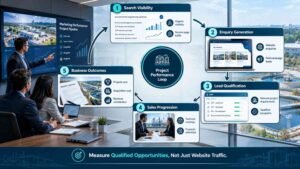
For SEO for environmental engineering companies, the measurement plan should include both search performance and commercial progress.
Review performance at three levels
Visibility: Are the relevant service pages appearing for the searches the company wants to target? Are impressions and clicks increasing for ETP, STP, EIA, environmental monitoring or other priority services?
Enquiry quality: Are visitors submitting project-related enquiries? Are they from the industries, locations and project categories the company serves?
Sales contribution: Are qualified enquiries becoming technical discussions, site assessments, proposals and awarded projects?
A simple review sheet can include:
| KPI | Review question |
| Priority keyword visibility | Are the right service searches improving? |
| Service-page enquiries | Which capabilities are generating interest? |
| Cost per enquiry | How much is being spent to acquire a response? |
| Cost per qualified lead | What does it cost to attract a suitable prospect? |
| Meeting-to-proposal rate | Are initial discussions progressing? |
| Proposal-to-project rate | Are opportunities converting into contracts? |
| Lead response time | How quickly does the team contact prospects? |
The company should also compare performance by service line. If EIA consultancy generates many enquiries but few proposals, the issue may be the audience, project fit or service positioning. If an ETP campaign generates fewer enquiries but a stronger proposal rate, it may deserve a larger share of the budget.
Use Google Analytics, Search Console, advertising reports and CRM records together. This helps distinguish a search visibility problem from a landing-page problem or a sales follow-up problem.
Frequently asked questions
1. How can environmental engineering companies generate more enquiries?
They can improve service-page visibility, target commercial searches, run Google Ads for priority services, use LinkedIn to reach relevant decision-makers and make website enquiries easier to submit. Enquiry qualification and consistent follow-up help turn responses into project opportunities.
2. Why is SEO important for environmental engineering firms?
SEO helps prospective clients discover a firm’s services when they search for environmental consultancy, EIA support, wastewater treatment, pollution-control systems or related engineering requirements. It also gives the company an opportunity to demonstrate its technical scope and project experience before a buyer makes contact.
3. Which keywords should environmental engineering companies target?
Keyword selection should reflect the services actually offered. Examples include environmental engineering consultant, EIA consultancy, industrial wastewater treatment company, ETP design and installation, STP construction company, air-pollution-control systems and environmental monitoring services. Validate the phrases using keyword tools and actual search data before prioritising them.
4. Can Google Ads generate leads for environmental engineering projects?
Yes. Google Ads can target buyers searching for specific consultancy or engineering services. Separate campaigns and landing pages should be used for different offerings, with negative keywords and conversion tracking to reduce irrelevant enquiries and evaluate lead quality.
5. How can LinkedIn help environmental engineering companies find clients?
LinkedIn can help firms connect with plant heads, EHS managers, project directors, EPC contractors, procurement teams and infrastructure consultants. Technical insights, project experience and relevant outreach can support business conversations before a formal requirement is published.
6. What information should an environmental engineering enquiry form collect?
It should collect the organisation’s name, contact details, project location, service requirement, industry, project stage and expected timeline. For treatment projects, capacity and wastewater details can also be requested when available. Keep the form short enough that prospects can complete it.
7. How can AI help qualify environmental engineering leads?
AI can collect initial project information, categorise enquiries by service, identify missing details, summarise conversations and route prospects to the appropriate team. Technical feasibility, compliance interpretation and engineering recommendations should remain subject to qualified human review.
8. How long does SEO take to generate enquiries for environmental engineering companies?
There is no guaranteed timeline. Results depend on the website’s existing authority, technical condition, competition, target locations, content quality and search demand. Paid campaigns may produce responses sooner, while organic visibility generally requires sustained work and monitoring.
Generate more relevant project enquiries with Adsthrive
Environmental engineering companies do not need more disconnected marketing activities. They need a commercial approach that connects the services they can deliver with the organisations looking for those capabilities.
A company promoting EIA consultancy needs to reach project developers and organisations planning new facilities. An industrial wastewater specialist needs to reach businesses reviewing treatment capacity, compliance requirements or water reuse. An air-pollution-control provider needs to reach facilities evaluating emissions-control requirements.
Adsthrive can support this growth through SEO, AI SEO, Google Ads, social media marketing, LinkedIn-oriented campaigns, website development, lead generation and AI-powered enquiry handling.
The work should begin with the company’s commercial priorities: which services have the strongest project potential, which buyers should be reached, what evidence supports the company’s expertise and what information sales teams need before pursuing an opportunity.
From there, SEO and advertising can attract relevant prospects, landing pages can explain the offering, and AI-enabled chat and calling solutions can support enquiry capture and follow-up. The sales team remains responsible for evaluating technical suitability and progressing project discussions.
If your company wants to improve its search visibility, generate better project enquiries and connect marketing activity with sales outcomes, speak with Adsthrive about a growth plan built around your environmental engineering services.