A machine tool manufacturer can have advanced equipment, experienced engineers, strong production capabilities and years of industry expertise – and still miss potential customers before the sales team gets a chance to speak with them.
The reason is simple: the buyer may already be searching online.
A production manager looking for a new machining centre may compare manufacturers on Google. An engineering team may research machine specifications and applications. A procurement manager may shortlist suppliers before requesting quotations. A plant head may investigate automation options before approaching a manufacturer.
Machine tools are also not a simple product purchase. Buyers often evaluate machine type, workpiece capacity, accuracy, spindle performance, automation, tooling, application suitability, service support and total value before making a decision. The Indian Machine Tool Manufacturers’ Association describes machine tools as critical to manufacturing and notes their role as the “mother machines” of industry.
That creates an important marketing opportunity.
Manufacturers do not simply need more website visitors. They need to be visible when relevant buyers are researching machines, applications, capabilities and suppliers—and then give those buyers enough information to take the next step.
SEO for machine tool manufacturers is one part of that process, but sustainable growth requires more than rankings. SEO, Google Ads, technical content, LinkedIn, conversion optimisation, lead generation and AI-powered qualification can work together to create a stronger path from search to sales enquiry.
This guide explains how that system can work.
Why Is Digital Marketing Different for Machine Tool Manufacturers?
Machine tool marketing has a different buying cycle from consumer products or low-value B2B services.
A buyer rarely sees an advertisement for a CNC machining centre and immediately purchases it.
The process may look more like:
Requirement → Research → Technical evaluation → Supplier comparison → Enquiry → Technical discussion → Quotation → Demonstration/trial → Negotiation → Purchase
Several people can influence that process.
| Buyer or Influencer | What they may evaluate |
| Production Manager | Productivity, throughput and machine capability |
| Manufacturing Engineer | Technical specifications and application suitability |
| Procurement Manager | Supplier, pricing, delivery and commercial terms |
| Plant Head | Capacity, efficiency and operational impact |
| Engineering Head | Accuracy, automation and integration |
| Business Owner/Director | Investment value, scalability and ROI |
This means your website cannot simply say:
“We are a leading machine tool manufacturer.”
It needs to answer the questions that arise during the buying process.
- Can the machine handle the required application?
- What materials can it process?
- What is the working capacity?
- What level of accuracy can it achieve?
- What industries use it?
- Can it be automated?
- Can the machine be customized?
- What technical support is available?
- How can the buyer request a quotation?
A digital strategy that answers these questions has a better chance of supporting the sales process.
What Are Machine Tool Buyers Actually Searching For?
One of the biggest opportunities for manufacturers is understanding that buyers do not always search using the manufacturer’s terminology.
A company may describe its product internally as a “high-speed vertical machining centre.”
The buyer may search:
- CNC machining centre manufacturer
- vertical machining centre supplier
- CNC machine for automotive components
- high precision machining centre
- 5-axis CNC machine manufacturer
- CNC machine for high-volume production
- machining centre for aluminium components
- CNC machine manufacturer in India
The search behaviour is broader than the product catalogue.
This is why keyword research should begin with the buyer’s requirement, not simply a list of machine names.
What Search Opportunities Could Machine Tool Manufacturers Be Missing?
A useful starting point is to divide searches into different commercial categories.
| Search category | Example search | Intent |
| Product | CNC turning machine manufacturer | Commercial |
| Machine type | Vertical machining centre manufacturer | Commercial |
| Application | CNC machine for automotive components | Commercial |
| Industry | Machine tools for aerospace manufacturing | Commercial |
| Capability | High precision CNC machining centre | Commercial |
| Specification | CNC machine with high spindle speed | High commercial |
| Problem | Machine for high-volume component production | Problem + commercial |
| Supplier | Machine tool supplier in India | Commercial |
| Location | CNC machine manufacturer Bangalore | Commercial |
| Research | How to choose a CNC machining centre | Informational |
| Comparison | VMC vs HMC for production | Research |
| Purchase | CNC machine quotation | High commercial |
The opportunity is not necessarily to rank for every search.
It is to identify the searches that correspond to your actual products, applications, markets and ideal customers.
Build Search Visibility Around Machines, Applications and Industries
The first strategy is to stop treating SEO as a single-keyword exercise.
A machine manufacturer’s website should create clear connections between:
Machine → Capability → Application → Industry → Buyer requirement
For example, suppose a company manufactures vertical machining centres.
Instead of having one page titled:
Vertical Machining Centres
the website could build supporting relevance around:
- Vertical machining centre manufacturer
- VMC machine supplier
- VMC for automotive components
- VMC for precision engineering
- VMC for high-volume production
- VMC machining applications
- VMC machine specifications
- How to select a VMC
- VMC automation solutions
This creates more opportunities to match different stages of buyer research.
Product searches
These are often closer to commercial intent.
Examples:
- CNC turning machine manufacturer
- VMC manufacturer
- HMC machine supplier
- 5-axis machining centre manufacturer
Application searches
These connect machines to real manufacturing requirements.
Examples:
- CNC machine for automotive components
- CNC machining centre for aerospace parts
- CNC machine for die and mould manufacturing
Industry searches
These allow manufacturers to reach specific sectors.
Examples:
- Machine tools for automotive industry
- Machine tools for aerospace manufacturing
- CNC machines for precision engineering
Problem-based searches
These capture buyers who know the manufacturing problem but may not yet know the exact solution.
Examples:
- Machine for increasing production capacity
- CNC machine for reducing machining time
- Machine for high-precision component production
This approach makes SEO for machine tool manufacturers more commercially useful because the strategy is connected to actual purchasing requirements rather than simply generating generic traffic.
Turn Product Pages Into Technical Buying Resources
A product page should do more than display a machine photograph and a list of specifications.
For an expensive technical purchase, the buyer needs enough information to determine whether the machine deserves further consideration.
A strong product page can include:
Machine overview
Explain what the machine does and the type of production requirement it is designed for.
Technical specifications
Provide useful information such as:
- Working range
- Table size
- Spindle specifications
- Axis travel
- Accuracy
- Repeatability
- Maximum workpiece dimensions
- Tool capacity
- Automation options
Only include specifications that are accurate and relevant to the actual product.
Applications
Explain what the machine can be used for.
For example:
- Automotive components
- Aerospace components
- Die and mould
- Precision engineering
- General engineering
- Medical components
Industries served
Show where the machine fits commercially.
Videos and demonstrations
A buyer can understand machine movement, automation and production capability more easily through demonstrations than through text alone.
Technical downloads
Brochures, specifications, manuals and application documents can support deeper evaluation.
Proof
Where available, include:
- Customer applications
- Case studies
- Certifications
- Quality systems
- Installation examples
- Production results
Clear enquiry options
Instead of using only:
Contact Us
consider:
- Request a Quote
- Discuss Your Requirement
- Request Machine Specifications
- Talk to a Technical Expert
- Schedule a Demonstration
The goal is to help the buyer move from:
Understand → Evaluate → Trust → Enquire
3. Create Content Around the Questions Engineers and Procurement Teams Ask
Machine tool manufacturers have an advantage that many industries struggle to create: technical knowledge.
Your engineers already know the questions customers ask.
Marketing can turn those questions into useful search content.
For example:
Machine selection
- How do you choose a CNC machining centre?
- What factors should you consider when selecting a CNC machine?
- What is the difference between VMC and HMC?
- When should a manufacturer consider a 5-axis machine?
Production
- How can CNC automation improve production?
- What affects CNC machining accuracy?
- How can manufacturers reduce machining cycle time?
- What machine capabilities matter for high-volume production?
Applications
- Which CNC machines are suitable for aerospace components?
- What type of CNC machine is suitable for automotive parts?
- How are machining centres used in die and mould manufacturing?
Investment
- What should manufacturers consider before purchasing a CNC machine?
- How should businesses evaluate CNC machine ROI?
- What factors influence the total cost of machine ownership?
This content can attract buyers earlier in the research process.
It also gives the manufacturer an opportunity to demonstrate engineering expertise before a salesperson enters the conversation.
Use Google Ads to Capture High-Intent Machine Searches
SEO is useful for building long-term visibility, but manufacturers may also have immediate demand they want to capture.
This is where Google Ads can complement organic search.
For example, a manufacturer could create campaigns around high-intent searches such as:
- CNC machine manufacturer
- CNC turning machine supplier
- VMC machine manufacturer
- 5-axis CNC machine supplier
- CNC machine quotation
- machining centre manufacturer
The important point is search intent.
A campaign targeting:
What is CNC machining?
has a different commercial value from:
CNC machining centre manufacturer
The second search is much closer to supplier discovery.
Send paid traffic to relevant pages
If someone searches for a specific machine, sending them to the homepage creates unnecessary friction.
A stronger journey is:
Google Search
↓
Relevant Advertisement
↓
Specific Machine Page
↓
Specifications + Applications + Proof
↓
Request Quote / Technical Discussion
This is where paid advertising and SEO should support the same website architecture.
Google Ads can capture immediate demand while organic search builds visibility over time.
Use LinkedIn to Reach the People Behind the Purchase
Machine tools are sold to businesses, not anonymous internet traffic.
LinkedIn can therefore play an important role in reaching:
- Plant Heads
- Production Managers
- Procurement Managers
- Engineering Heads
- Operations Managers
- Manufacturing Engineers
- Business Owners
- Directors
- OEM decision-makers
But simply posting a machine photograph every day is unlikely to create a strong B2B acquisition strategy.
The content should demonstrate useful expertise.
Content ideas
Technical
“5 factors to evaluate before selecting a new machining centre.”
Production
“How automation can reduce repetitive machine-handling tasks.”
Procurement
“What should be included in an RFQ for a CNC machine?”
Application
“Choosing the right machining solution for high-volume automotive components.”
Proof
“Inside a recent machine installation.”
Engineering
“What machine accuracy actually means for component production.”
LinkedIn can also support account-based outreach.
Instead of sending hundreds of generic messages, identify target companies, identify relevant decision-makers and start conversations around genuine manufacturing requirements.
That makes LinkedIn outreach more useful as a business-development channel.
Build Lead Generation Around Qualified Enquiries
Traffic is not the final objective.
A machine tool manufacturer needs commercially useful enquiries.
This is where lead generation for machine tool manufacturers should connect marketing activity with the sales process.
A basic contact form may ask:
- Name
- Phone
- Message
That may not give sales enough information.
A more useful enquiry could ask:
- Company name
- Industry
- Machine required
- Application
- Production requirement
- Location
- Expected purchase timeline
- Additional technical requirement
The exact fields should depend on the business.
For example, an RFQ for a machining centre may require completely different information from an enquiry for a grinding machine.
The objective is not to create a long form.
The objective is to capture the information that helps sales determine whether the enquiry is relevant.
What Does a High-Quality Machine Tool Lead Look Like?
Consider two enquiries.
Enquiry A
“Need CNC machine. Send price.”
There is very little context.
Enquiry B
“We are an automotive component manufacturer expanding our production line. We are evaluating a VMC for high-volume component production and need information on working capacity, spindle specifications, automation options and delivery timeline.”
The second enquiry provides much more commercial context.
The sales team knows:
- Industry
- Project type
- Machine category
- Application
- Purchase stage
- Technical questions
- Potential next step
This is why successful lead generation for machine tool manufacturers should focus on the quality and relevance of opportunities rather than simply increasing form submissions.
Add AI Lead Qualification Before Every Enquiry Reaches Sales
AI can support the lead-generation process without replacing technical salespeople.
A machine tool website can use AI-powered systems to collect initial information from prospects.
For example, an AI assistant could ask:
- What type of machine are you looking for?
- What application will it be used for?
- Which industry are you in?
- What production volume are you targeting?
- Do you already have a machine specification?
- When are you planning to purchase?
The responses can then help categorise leads.
| Lead category | Possible action |
| Immediate requirement | Notify sales immediately |
| Strong technical fit | Assign to technical sales |
| Early-stage research | Add to nurturing |
| Distributor enquiry | Route to business development |
| Poor product fit | Lower priority |
| General enquiry | Automated response |
AI should not make the final technical or commercial decision.
Its role is to collect information, identify intent and reduce repetitive qualification work.
This becomes especially useful when advertising campaigns begin generating larger enquiry volumes.
How Do SEO, Ads, LinkedIn and AI Work Together?
The biggest mistake is treating every digital channel as a separate activity.
A better system connects them.
| Buyer stage | Channel | Purpose |
| Awareness | Build industry visibility | |
| Research | SEO | Capture information searches |
| Product discovery | SEO + Google Ads | Capture commercial searches |
| Evaluation | Website + content | Answer technical questions |
| Consideration | Case studies + proof | Build confidence |
| Enquiry | Landing pages | Generate action |
| Qualification | AI | Understand requirements |
| Follow-up | CRM + automation | Maintain momentum |
| Sales | Human team | Technical/commercial discussion |
This gives manufacturers a clearer path:
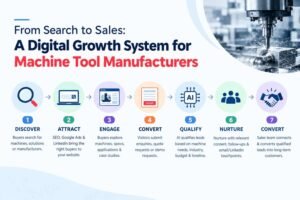
Search → Website → Evaluation → Enquiry → Qualification → Sales
The objective is not to force every buyer through the same funnel.
A procurement manager who is ready for a quotation needs a different experience from an engineer who is still researching machine options.
What Should SEO Services for Machine Tool Manufacturers Include?
A manufacturer evaluating SEO services for machine tool manufacturers should look beyond basic keyword placement.
A useful programme should include several layers.
Technical SEO
This can include:
- Website architecture
- Crawlability
- Indexing
- Page speed
- Mobile performance
- XML sitemap
- Canonicalisation
- Structured data
- Internal linking
Product SEO
Optimise important machine and product pages around genuine commercial searches.
Application SEO
Create pages around the manufacturing applications where the machines are used.
Industry SEO
Build relevant content for industries served by the manufacturer.
Technical content
Answer genuine questions from engineers, procurement teams and production managers.
Authority building
Strengthen the website’s credibility through useful resources, relevant references, case studies and industry expertise.
Conversion optimisation
Make it easier for qualified visitors to request quotations, specifications, demonstrations or technical discussions.
The important connection is:
Search visibility → Relevant visitor → Technical confidence → Enquiry
Not simply:
Keyword → Ranking
What Should Digital Marketing for Machine Tool Manufacturers Look Like Over 6 Months?
A realistic strategy should be phased instead of attempting everything simultaneously.
Month 1: Understand the market
Start with:
- Product analysis
- Competitor research
- Search-intent research
- Website audit
- Existing traffic analysis
- Conversion audit
- Lead-source analysis
The objective is to identify where potential buyers are currently being lost.
Months 2–3: Fix the search foundation
Prioritise:
- Product pages
- Machine categories
- Application pages
- Technical content
- Internal linking
- Technical SEO
- Conversion paths
Months 3–4: Capture high-intent demand
Introduce or improve:
- Google Ads
- Product-specific landing pages
- Remarketing
- Lead forms
- Quote requests
Months 4–6: Expand B2B demand generation
Add:
- LinkedIn content
- LinkedIn outreach
- Industry campaigns
- Case studies
- Lead magnets
- AI lead qualification
- Automated follow-up
The exact timeline depends on the website, market, competition, products and available search demand.
How Should Machine Tool Manufacturers Measure Digital Marketing ROI?
Traffic alone does not tell you whether marketing is working.
A manufacturer should look further down the sales pipeline.
Search metrics
- Commercial keyword visibility
- Organic product-page traffic
- Application-page traffic
- Non-branded search visibility
Conversion metrics
- Quote requests
- Technical enquiries
- Demo requests
- Calls
- Form submissions
Lead metrics
- Qualified lead rate
- Cost per lead
- Cost per qualified lead
- Lead-source performance
Sales metrics
- Sales opportunities
- Quotations generated
- Opportunity value
- Closed deals
- Revenue influenced by marketing
A useful measurement chain is:
Search visibility
↓
Relevant traffic
↓
Enquiry
↓
Qualified lead
↓
Sales opportunity
↓
Revenue
The further marketing reporting moves toward this chain, the more useful it becomes for management.
What Are the Biggest Digital Marketing Mistakes Machine Tool Manufacturers Make?
1. Targeting only their company name
Existing customers already know the brand.
New buyers may search by product, application or problem.
2. Putting every machine on one page
Important products deserve their own search and conversion opportunities.
3. Treating technical specifications as enough
Specifications matter, but buyers also need applications, proof, support information and context.
4. Publishing generic manufacturing blogs
A post about “the importance of digital transformation” may generate little commercial value if the actual buyer is searching for a specific machine.
Content should connect to real manufacturing questions.
5. Sending Google Ads traffic to the homepage
A specific search deserves a specific destination.
6. Measuring leads without measuring quality
100 irrelevant enquiries can be less valuable than 10 well-qualified opportunities.
7. Ignoring follow-up
A valuable enquiry can lose momentum if nobody responds quickly.
AI-powered qualification and follow-up can help reduce this gap.
When Should You Work With a Digital Marketing Agency for Machine Tool Manufacturers?
A manufacturer may benefit from specialist support when:
- Important machine searches are dominated by competitors.
- Product pages receive little organic visibility.
- Website traffic is not producing enough enquiries.
- Marketing depends heavily on referrals and exhibitions.
- Google Ads produces irrelevant leads.
- The business wants to enter a new geographic market.
- The sales team has inconsistent lead flow.
- Marketing data and sales data are disconnected.
- The company wants to introduce AI-powered qualification and automation.
Choosing a digital marketing agency for machine tool manufacturers should not be based only on promises of rankings or traffic.
Ask whether the agency understands:
- Industrial buyer behaviour
- Technical products
- B2B search intent
- Product-led SEO
- Lead generation
- Google Ads
- LinkedIn marketing
- Conversion optimisation
- CRM and automation
- AI-powered lead qualification
The agency should be able to connect marketing activity with the actual sales process.
Where AI Fits Into the Future of Manufacturing Marketing
AI is becoming relevant not only inside factories but also around the commercial side of manufacturing.
NIST’s 2026 roadmap describes AI and machine learning as increasingly important in smart manufacturing, including applications involving industrial data, robotics, digital twins, optimisation and autonomous systems.
For marketing and sales teams, the practical opportunity is different.
AI can help with:
- Lead qualification
- Website conversations
- Customer FAQs
- Lead scoring
- Follow-up
- Data analysis
- Content research
- Search-intent analysis
- Campaign optimisation
The principle should remain simple:
Use AI to reduce repetitive work and improve response speed, while keeping technical and commercial decisions with qualified people.
How Adsthrive Can Help Machine Tool Manufacturers Build a Digital Growth System
The right strategy for a machine tool manufacturer should not begin with:
“Which marketing package should we sell?”
It should begin with:
Where are potential buyers being lost?
If buyers cannot find the company for relevant searches, SEO and AI SEO become priorities.
If high-intent searches exist but competitors are capturing the clicks, Google Ads can help create immediate visibility.
If the website receives visitors but generates few enquiries, conversion optimization may be the problem.
If LinkedIn visibility is weak, targeted B2B content and outreach can create additional opportunities.
If sales receives too many low-quality enquiries, AI-powered lead qualification can help filter and prioritise them.
Adsthrive can bring these capabilities together rather than treating each service as an isolated campaign.
Search Visibility
Adsthrive’s AI SEO Services focus on conversational content, structured information, topical authority and search visibility across evolving AI-driven search environments.
For machine tool manufacturers, that approach can be adapted around:
- Machines
- Applications
- Industries
- Technical questions
- Commercial searches
- Buyer intent
SEO
Adsthrive’s SEO services cover technical, on-page and off-page optimisation, content and search visibility.
For a machine tool manufacturer, the focus should be on the searches that can realistically contribute to commercial opportunities.
Performance Marketing
Google Ads and other paid channels can help capture high-intent demand while organic visibility develops. Adsthrive’s broader performance marketing offering includes Google Ads, social advertising, LinkedIn Ads and remarketing.
Lead Generation
Adsthrive’s lead generation services can support the transition from digital visibility to actual enquiries.
For machine tool manufacturers, that means focusing on relevant RFQs, technical discussions, quotation requests and qualified business opportunities rather than simply maximising form submissions.
AI-Powered Lead Qualification
Adsthrive also works with AI-based lead qualification and automation. AI can help identify high-intent enquiries, collect initial requirements and route opportunities to the appropriate sales team.
The resulting system can look like:
Google / AI Search / LinkedIn / Ads
↓
Relevant Machine or Application Page
↓
Technical Information + Proof
↓
Quote / Consultation / Enquiry
↓
AI Qualification
↓
Sales Follow-up
↓
Qualified Opportunity
This is the difference between simply having a digital presence and building a digital acquisition system.
Frequently Asked Questions
How can SEO help machine tool manufacturers generate leads?
SEO can help manufacturers become visible when buyers search for machines, applications, capabilities, suppliers and technical information. The strongest strategy connects those searches to relevant product and application pages with clear enquiry paths.
What keywords should machine tool manufacturers target?
They should target a mix of product, machine type, application, industry, capability, specification, location and problem-based searches. The exact keyword set should be based on the manufacturer’s products and target markets rather than a generic manufacturing keyword list.
How long does SEO for machine tool manufacturers take?
SEO is a long-term strategy. Results depend on competition, website authority, technical health, content quality, search demand and the starting position of the website. High-intent paid campaigns can be used alongside SEO when immediate visibility is required.
Is Google Ads better than SEO for machine tool manufacturers?
Neither is universally better. Google Ads can provide immediate visibility for high-intent searches, while SEO can build long-term organic visibility. Using both can help capture buyers at different stages.
How can machine tool manufacturers generate more enquiries?
Start by improving visibility for commercial searches, create dedicated product and application pages, use strong enquiry CTAs, run targeted paid campaigns and make forms easier to complete. AI qualification can then help sales prioritise relevant opportunities.
Is LinkedIn useful for machine tool manufacturers?
Yes, particularly for reaching decision-makers involved in production, procurement, engineering and operations. LinkedIn becomes more valuable when content and outreach are built around specific industries, applications and manufacturing problems.
Should machine tool manufacturers use AI for lead qualification?
AI can be useful for collecting initial requirements, identifying intent, scoring enquiries and routing leads. It should support—not replace—the technical and commercial judgement of the sales team.
Final Takeaway: Build a Digital Sales System Around the Machine Buyer
Machine tool manufacturers already have something valuable to market: engineering capability.
The challenge is making that capability visible to the right buyer at the right moment.
A manufacturer can build that visibility by connecting:
Product-focused SEO
→ Technical content
→ Google Ads
→ B2B outreach
→ Conversion-focused product pages
→ Lead generation
→ AI qualification
→ Sales follow-up
The goal is not to generate traffic for the sake of traffic.
It is to help the right manufacturer, procurement manager, engineer or plant head discover the right machine, understand its capabilities and take the next step toward a commercial conversation.
That is the real opportunity behind Digital marketing for machine tool manufacturers.
And for companies competing in increasingly digital B2B buying environments, SEO for machine tool manufacturers should be treated as part of a wider acquisition strategy—not as a standalone ranking exercise.
Ready to Turn More Machine Searches Into Qualified Enquiries?
If your machines are technically strong but your online visibility is not generating enough business opportunities, it may be time to rethink the digital journey.
Adsthrive can help machine tool manufacturers combine SEO, AI SEO, Google Ads, performance marketing, LinkedIn marketing, lead generation, conversion optimisation and AI-powered automation into a strategy built around measurable business outcomes.
“Get found by the right buyers. Generate better enquiries. Qualify opportunities faster. Build a stronger digital sales pipeline.”