An industrial waste management contract is rarely won because a company simply offers waste collection. A manufacturing plant may need a partner to handle spent solvents, chemical containers, used oil, metal scrap, contaminated packaging, process sludge, electronic waste or several waste streams across multiple facilities. Before appointing a vendor, its purchase, EHS, production and finance teams may need to understand the provider’s capabilities, service coverage, documentation process, collection frequency and commercial terms.
That creates a specific marketing challenge: industrial waste management companies must prove that they can handle the customer’s actual waste requirements before the customer is ready to request a quotation. A website that only lists collection, recycling and disposal services leaves too many commercial questions unanswered.
A well-planned digital presence can help your company reach manufacturers with active waste-management requirements, demonstrate operational suitability and create a stronger pipeline of commercial enquiries. This article looks at growth from the perspective of winning and retaining industrial accounts – not simply increasing website traffic. It covers how SEO, paid advertising, LinkedIn, social media, lead generation and AI-enabled follow-up can work together to bring better opportunities to your sales team.
The commercial opportunity is bigger than a waste collection enquiry
Industrial waste management is not one uniform service. A company handling recyclable metal waste may have a different sales process from a provider specialising in hazardous waste collection, industrial sludge treatment or electronic waste recovery.
Even within one manufacturing facility, several requirements can exist at the same time:
- Regular collection of production waste.
- Safe handling and authorised disposal of specific waste streams.
- Recovery or recycling of reusable materials.
- Scheduled removal of sludge, used oil or process residues.
- Documentation and reporting requirements.
- Waste audits and recommendations for improving segregation.
- Multi-location waste-management arrangements.
- Emergency or one-time removal requirements.
Each requirement can lead to a different commercial conversation. A facility manager may be looking for a regular collection arrangement, while an EHS manager may be evaluating a provider’s handling process and documentation. A procurement team may be comparing quotations, and a sustainability team may be looking for better recovery or recycling options.
This is why a single generic service page is unlikely to communicate the full value of an industrial waste management business.
The commercial objective should be to make your company discoverable for the right waste stream, credible to the people responsible for appointing vendors and easy to contact when a facility has a requirement.
A digital marketing agency for industrial waste management companies should understand this difference. Generating a large number of form submissions is not enough if those enquiries come from households, students, job seekers or businesses outside your service area.
The focus needs to be on commercial fit.
What should digital marketing actually generate for an industrial waste company?
Before choosing channels, decide what a successful enquiry means to your business. For one company, it may be a recurring industrial waste collection contract. For another, it may be a high-value hazardous waste disposal project, a recycling partnership or a multi-site service agreement.
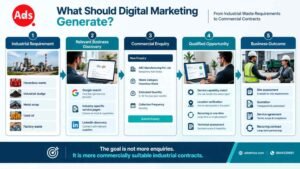
A useful lead is one that has a realistic possibility of becoming revenue.
| Enquiry type | What the prospect may need | Commercial value to evaluate |
| Recurring industrial collection | Scheduled collection from a factory or industrial facility | Contract frequency and duration |
| Hazardous waste management | Handling, transportation, treatment or disposal support | Waste type, compliance requirements and service capability |
| Industrial recycling | Recovery of metal, plastic, packaging or other recyclable materials | Material volume and recovery economics |
| Sludge and residue management | Periodic removal or treatment of process waste | Quantity, treatment requirements and frequency |
| E-waste management | Collection and authorised processing of electronic waste | Material category, quantity and service scope |
| Multi-location contract | Waste services across several plants or warehouses | Number of locations and operational coverage |
| Waste audit or assessment | Review of current waste handling and recovery practices | Potential for a wider service engagement |
Your marketing campaigns should be designed around these commercial outcomes. A campaign that generates 40 enquiries for a low-value one-time collection may be less useful than one that produces five qualified discussions with manufacturers seeking annual service arrangements.
That distinction should influence your website content, keyword selection, advertising budget and lead qualification process.
SEO for industrial waste management companies: become visible at the point of vendor selection
A manufacturer searching for a waste management partner may not begin with the broad phrase “industrial waste management company”. The search may be more specific: a particular waste category, treatment requirement, industrial location, collection service or recycling arrangement.
This creates an opportunity for SEO for industrial waste management companies to capture different stages of commercial intent.
A search for “industrial waste disposal services” may indicate that a facility is comparing providers. A search for “used oil collection from factories” can reveal a more specific operational requirement. A search for a hazardous waste service in a particular industrial area may signal a need for a provider with suitable coverage.
Your website needs to answer these searches with useful, service-specific pages rather than repeating the same paragraph across multiple URLs.
Build pages around the waste streams you can genuinely handle
Start by listing the waste categories your company is equipped and authorised to manage. Do not create pages for every possible waste type simply to increase the number of indexed URLs.
Depending on your actual capabilities, relevant service pages may cover:
- Hazardous industrial waste management.
- Non-hazardous industrial waste collection.
- Industrial solid waste management.
- Chemical waste handling and disposal.
- Used oil collection and management.
- Industrial sludge management.
- Metal and plastic waste recycling.
- Electronic waste collection and processing.
- Industrial packaging waste recovery.
- Waste segregation and management support.
Each page should explain what the service includes, the type of facilities it supports, how the service is delivered and what information is needed to assess a requirement.
For example, a page about industrial sludge management should not stop at saying that your company collects sludge. It should explain the types of industrial operations you serve, whether the service involves collection or further treatment, the information required to assess a job and the geographical areas covered.
Where regulatory permissions or authorisations apply, describe your actual status accurately. Do not use generic claims such as “fully certified” without identifying what the claim means and ensuring that the supporting documentation is current.
For regulatory context, the Central Pollution Control Board (CPCB) is an important official reference point for pollution-control information and applicable waste-management resources in India. Your website should direct prospects to relevant official information where appropriate, while clearly distinguishing your own services from regulatory guidance.
Make your location coverage commercially useful
Industrial waste management is often operationally dependent on geography. A provider may serve selected industrial estates, manufacturing clusters or cities rather than every location in a state.
Your website should make that coverage clear.
Instead of publishing dozens of nearly identical city pages, build a location structure that explains:
- Which industrial areas you serve.
- Which waste categories you handle in each area.
- Whether a regular collection is available.
- Whether transportation is included.
- Whether services are available for individual facilities or multiple sites.
- How a prospective customer can confirm service availability.
A useful location page should contain genuine local information. If your team operates in an industrial cluster, explain the types of facilities served and the services available there. Do not create a page for a city where you cannot actually provide the service.
This is also where local SEO can support commercial enquiries. A properly maintained Google Business Profile, accurate contact details and consistent business information can help prospects verify that your company operates in the region they need.
For a wider understanding of how search visibility can support industrial businesses, see Adsthrive’s SEO services.
Capture searches that indicate an immediate requirement
The following are examples of search opportunities worth researching and mapping to relevant service pages. They are not verified daily search counts.
| Search theme | Example search | Likely intent | Recommended destination |
| Service provider | Industrial waste management company | Compare providers | Main industrial waste service page |
| Hazardous waste | Hazardous waste disposal services | Find a suitable handler | Hazardous waste service page |
| Waste stream | Industrial sludge disposal | Solve a specific waste issue | Sludge management page |
| Collection requirement | Factory waste collection services | Arrange collection | Collection service page |
| Recycling | Industrial metal waste recycling company | Find a recovery partner | Industrial recycling page |
| Local requirement | Industrial waste management in Pune | Find a regional provider | Relevant location page |
| Vendor evaluation | Industrial waste management services for factories | Assess commercial suitability | Industrial services overview |
| Compliance-related research | Industrial hazardous waste handling requirements | Understand obligations | Informational resource with official references |
The purpose of keyword research is not to collect the largest possible list. It is to identify searches that your business can answer with a genuine service and a credible commercial proposition.
Use informational content to support—not replace—service pages
Industrial waste buyers may research handling processes, segregation, waste classification, recycling possibilities and regulatory responsibilities before contacting a service provider.
Useful supporting content could include:
- What information should a factory prepare before appointing a waste management vendor?
- How can a manufacturing facility improve waste segregation?
- What should an industrial waste collection agreement specify?
- How should a business evaluate an industrial recycling partner?
- What details affect the cost of industrial waste collection?
- What records should a facility discuss with its authorised waste-management provider?
These articles can attract earlier-stage visitors and direct them to relevant service pages. They should not be written as substitutes for technical, regulatory or legal advice.
This is one of the practical roles of SEO services for industrial waste management companies: connecting a prospect’s research to the specific service your business can provide.
Turn your website into a vendor evaluation resource
A procurement manager does not necessarily contact the first company appearing on Google. The website may be one of several sources used to decide whether a provider deserves a conversation.
The prospect is likely to look for evidence that your company can handle the requirement. If that evidence is missing, even a strong search ranking may fail to generate a useful enquiry.
Think of your website as a digital vendor evaluation file. It should make it easy for a buyer to understand your operating capabilities without needing several introductory calls.
Show what happens after a customer contacts you
Many industrial service websites explain what they do but provide little information about how an engagement begins.
A prospect may want to know whether your team first reviews the waste category, requests photographs or documentation, arranges a site visit, assesses the quantity or prepares a quotation.
You do not need to publish confidential operating procedures. A simple explanation of your enquiry process can reduce uncertainty.
For example:
- The customer shares the facility location and waste category.
- Your team reviews the available details and identifies missing information.
- A technical or operations representative assesses the requirement where necessary.
- The company confirms the proposed scope and commercial terms.
- Collection or other agreed services are scheduled after the necessary checks and approvals.
Adapt this process to your actual operations. Do not promise site inspections, response times or services that your team cannot consistently deliver.
Publish the information that helps buyers compare providers
Consider including the following on relevant service pages:
| Information to display | Why a commercial buyer needs it |
| Waste categories handled | Helps establish service fit |
| Industries served | Shows relevant operational experience |
| Service locations | Confirms geographical coverage |
| Collection arrangements | Helps assess operational suitability |
| Treatment or recovery capabilities | Explains what happens to the material |
| Relevant authorisations and documentation | Supports vendor due diligence |
| Facility and equipment information | Provides operational context |
| Contact for commercial enquiries | Makes the next step clear |
Use genuine photographs of your facilities, vehicles, equipment, processes and team where suitable. If you have completed projects that can be publicly discussed, explain the type of waste, the customer’s operational requirement and the service delivered. Remove confidential customer details unless permission has been granted.
A short, factual case study can be more persuasive than several generic statements about being a trusted or leading provider.
Make the enquiry form collect useful information
A form asking only for a name, phone number and message may generate contacts, but it does not give your sales team enough information to assess the opportunity.
For industrial waste enquiries, consider collecting:
- Company name.
- Contact person and designation.
- Facility location.
- Waste category.
- Approximate quantity or volume, if known.
- One-time or recurring requirement.
- Preferred contact method.
- Additional information or file attachment, where relevant.
Keep the form manageable. A prospect should not have to complete a lengthy technical questionnaire before your team has even reviewed the requirement.
The form should collect enough information for an initial conversation, with more detailed checks handled by the appropriate team later.
This is also where lead generation services can support a more structured enquiry process by connecting landing pages, campaign sources and lead capture.
Six commercial growth strategies for industrial waste management businesses
SEO creates long-term search visibility, but it is not the only source of business. Industrial waste companies can also reach prospects through targeted advertising, professional networks, social media and structured follow-up.
The following strategies are designed around different commercial situations rather than treating every channel as another way to collect form submissions.
1. Build campaigns around the value of the waste stream
Not every waste-management enquiry has the same commercial value. The quantity, frequency, location, processing requirements and operational complexity can all affect whether a project is worth pursuing.
Your marketing team should work with operations and sales to identify the services the business wants to grow.
For example, a company may want to increase:
- Recurring waste collection contracts from manufacturing facilities.
- Industrial recycling partnerships with predictable material volumes.
- Hazardous waste management projects within its authorised service scope.
- Multi-location agreements with industrial groups.
- Waste-management arrangements for warehouses and logistics facilities.
Once the priority is clear, create separate campaign messages and landing pages.
A campaign targeting factories that need regular waste collection should not send every visitor to a broad homepage. The landing page should explain the collection service, coverage, accepted waste categories and the information needed to request an assessment.
Likewise, a campaign for industrial recycling should explain the materials handled, the recovery process and the commercial details required to evaluate a partnership.
This makes the advertising message more relevant and gives your sales team a clearer idea of what the prospect wants.
2. Use Google Ads to capture requirements that cannot wait for SEO
SEO is valuable for building visibility over time. However, a company entering a new region or promoting a recently expanded service may need enquiries before organic rankings improve.
Google Ads can place your business in front of people actively searching for the relevant service.
For industrial waste management companies, campaigns can be organised around distinct service categories, such as:
- Industrial waste collection.
- Hazardous waste management.
- Industrial sludge disposal.
- Industrial recycling services.
- Used oil collection.
- E-waste management.
- Location-specific industrial waste services.
The campaign should be built around the services you genuinely offer. Avoid bidding broadly on every phrase containing “waste management” because searches may include municipal collection, household garbage, jobs, government information and unrelated requirements.
A practical Google Ads structure
| Campaign component | What to configure |
| Service grouping | Separate campaigns or ad groups for priority services |
| Location targeting | Industrial areas and regions actually served |
| Search terms | Commercial and service-specific queries |
| Negative keywords | Irrelevant searches such as jobs, salary, household and free disposal, where appropriate |
| Landing page | A page matching the advertised service |
| Conversion tracking | Calls, forms and qualified enquiry events |
| Lead review | Record whether the enquiry matches your service and location |
Do not judge campaign performance only by cost per form submission. Track how many enquiries become site assessments, quotations and contracts.
If the average value of a recurring contract is significantly higher than a one-time job, your bidding and budget decisions should reflect that difference.
Adsthrive’s Google Ads optimisation guide provides additional context on campaign optimisation. The important point for this industry is to connect advertising data with actual sales outcomes.
3. Use LinkedIn to reach the people who influence vendor appointments
Some industrial waste contracts are not awarded after a single Google search. A company may already have an existing provider, but its operations or EHS team could be reviewing alternatives because of service issues, expansion, cost changes or a new waste stream.
LinkedIn can help your sales and marketing teams reach relevant professionals before an active enquiry appears.
Potential audiences include:
- EHS managers.
- Plant and factory managers.
- Facility managers.
- Procurement managers.
- Operations heads.
- Sustainability managers.
- Administration and infrastructure leaders.
- Directors responsible for industrial operations.
The aim should not be to send the same sales message to hundreds of contacts. Build a focused account list based on industry, facility location, company size and likely service requirement.
A practical outreach sequence could look like this:
First interaction: Follow the company and engage with a relevant business update.
Second interaction: Share a useful resource about industrial waste segregation, vendor evaluation or collection planning.
Third interaction: Introduce the relevant service and ask whether the company has a requirement that falls within your operational coverage.
Further follow-up: Continue only when there is a relevant business reason to do so.
For example, a provider specialising in industrial sludge management could focus on manufacturing facilities where process sludge is a recurring operational issue. Its outreach should discuss that service rather than promoting every waste-management offering at once.
LinkedIn can also be used for paid campaigns. Sponsored content and lead-generation campaigns can target selected professional audiences, but the audience size, budget and expected lead volume should be evaluated before investing.
The most useful outcome is not the number of connection requests sent. It is the number of relevant companies that enter a genuine commercial discussion.
4. Use social media to demonstrate operating capability
Social media may not be the first place a procurement manager looks for an industrial waste vendor, but it can influence how credible a company appears after the prospect discovers it elsewhere.
A buyer may visit your LinkedIn or other social profiles to understand whether the business is active, what services it provides and whether its operations appear relevant.
For this industry, social content should demonstrate actual work rather than rely on generic environmental messages.
Useful content themes include:
| Content theme | Example post |
| Operational capability | A short video explaining how your team handles a particular collection process |
| Waste segregation | Common segregation mistakes observed at industrial facilities |
| Recycling and recovery | An explanation of how a specific material stream is evaluated for recovery |
| Equipment and infrastructure | A genuine look at relevant vehicles, storage arrangements or processing equipment |
| Project updates | A permitted, non-confidential summary of a completed industrial assignment |
| Team expertise | An introduction to the people responsible for operations, safety or customer coordination |
| Industry education | A practical explanation of information a factory should prepare before requesting a quotation |
Avoid publishing customer site photographs, waste manifests, facility details or sensitive operational information without permission.
Social media can also support remarketing. A visitor who has viewed your hazardous waste service page may later see an educational post about the service, keeping your company familiar while the prospect evaluates providers.
For a commercial business, the objective is to make your expertise visible and support the buyer’s decision—not to chase likes and followers without a connection to enquiries.
5. Create a lead-generation programme for recurring industrial accounts
A company seeking a recurring industrial waste contract may need more than an advertisement. It may need a reason to share its requirement, a simple way to request an assessment and confidence that the provider understands its operational situation.
This is where lead generation should extend beyond basic forms.
Consider creating a commercial offer such as:
- Request an industrial waste service assessment.
- Discuss recurring factory waste collection.
- Request a quotation for a specific waste category.
- Explore industrial recycling arrangements.
- Discuss waste management across multiple facilities.
The offer should match the service your team can actually deliver.
A landing page for recurring collection, for example, can explain the type of facilities served, service coverage, waste categories accepted, collection arrangements and details required to prepare a quotation.
A landing page for industrial recycling may need to ask about material type, estimated volume, location and collection frequency.
You can also use downloadable resources, such as a vendor evaluation checklist or a factory waste information sheet, to attract prospects who are researching before making an appointment.
However, do not confuse a download with a qualified lead. A person downloading a checklist may not have an active requirement. Lead scoring and follow-up should distinguish research interest from a genuine buying opportunity.
Adsthrive’s AI chatbot agent can be considered as part of a website enquiry experience, helping visitors find relevant information and move towards an appropriate contact action.
6. Use AI lead qualification and connected follow-up to reduce missed opportunities
A marketing campaign can generate a suitable enquiry and still fail commercially if nobody responds promptly or the information is not passed to the right person.
This is especially relevant when a company receives enquiries for multiple waste categories, locations and service types.
An AI-enabled lead qualification process can help organise the first stage of communication.
For example, after a prospect submits a form, an automated system can ask for missing details such as:
- Which type of industrial waste needs to be managed?
- Where is the facility located?
- Is the requirement one-time or recurring?
- What is the approximate quantity?
- Is the prospect requesting collection, recycling, treatment or another service?
- When does the customer expect the service to begin?
The system can then classify the enquiry based on the information supplied and route it to the relevant sales or operations contact.
A lead involving a service outside your authorised scope should not be presented to the sales team as a qualified opportunity. It should be flagged for review or politely redirected, depending on your business process.
Where automation can support the process
| Automation feature | Practical use |
| Website chatbot | Collect initial service and location details |
| WhatsApp automation | Acknowledge enquiries and request missing information |
| AI calling | Support permitted follow-up or appointment coordination |
| Lead qualification | Categorise enquiries by waste stream, location and requirement |
| CRM integration | Store the source, contact details and enquiry status |
| Automated reminders | Alert the sales team about pending follow-ups |
| Reporting | Identify which campaigns produce suitable commercial opportunities |
Adsthrive offers AI calling solutions and AI chatbot services that can form part of a connected enquiry and follow-up process.
The objective is not to replace technical discussions with automation. Questions about waste classification, authorisations, treatment suitability, safety or final commercial scope should be reviewed by appropriately qualified people.
AI should help organise and route the conversation—not make unsupported compliance decisions.
How should an industrial waste management company measure marketing performance?
A marketing report that only shows impressions, clicks, followers and website sessions does not tell management whether the business is acquiring better customers.
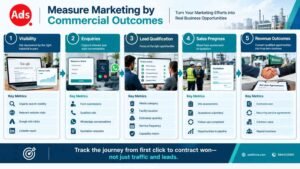
For industrial waste management companies, performance should be measured through the movement from first contact to commercial opportunity.
A useful reporting structure includes four levels.
| Measurement stage | Metrics to monitor | Business question |
| Visibility | Search impressions, rankings, relevant website visits | Are potential customers finding the business? |
| Enquiry | Calls, forms, WhatsApp conversations and quotation requests | Are visitors contacting the company? |
| Qualification | Relevant waste category, service location, quantity and frequency | Are the enquiries commercially suitable? |
| Sales outcome | Site assessments, quotations, contracts and repeat business | Is marketing contributing to revenue? |
Track the service category behind each enquiry
A lead for industrial sludge management should not be grouped with an enquiry for metal recycling if the two services have different margins, operating requirements and sales processes.
Record the service category and campaign source for every lead. Over time, this will help management identify which services attract the strongest commercial opportunities.
Separate one-time work from recurring contracts
A one-time collection job and a recurring facility agreement may have very different revenue potential.
Your reporting should distinguish:
- One-time service enquiries.
- Regular collection requirements.
- Annual or long-term contracts.
- Multi-location opportunities.
- Recycling partnerships.
- Project-based waste-management requirements.
This allows the marketing budget to be evaluated against the type of business the company wants to acquire.
Review lead quality with the sales and operations teams
Marketing should not be responsible for judging lead quality in isolation. Sales and operations teams can provide important feedback.
For example:
- Was the waste category within the company’s capabilities?
- Was the location serviceable?
- Was the customer asking for a one-time or recurring arrangement?
- Did the enquiry progress to a technical assessment?
- Was a quotation submitted?
- Why was the opportunity lost?
These answers can improve keyword targeting, landing-page information and lead qualification rules.
A campaign that generates fewer enquiries but a higher proportion of suitable quotations may deserve more investment than a campaign producing a large volume of irrelevant contacts.
Why Adsthrive should be part of the growth conversation
Industrial waste management companies often need several marketing activities to work together. SEO can bring service-related searches to the website, Google Ads can capture immediate demand, LinkedIn can help reach selected business accounts, and social media can provide additional proof of operational capability.
But these channels can become disconnected if enquiries are not tracked, follow-ups are inconsistent or campaign data is not connected to the sales process.
Adsthrive can support this requirement through a combination of digital marketing and AI-enabled customer communication.
SEO and AI SEO for long-term visibility
Adsthrive can help improve website visibility through keyword research, technical SEO, service-page optimisation and industry-relevant content. The focus should be on the services and locations that the company can genuinely support.
Its AI SEO services can be considered alongside conventional SEO to strengthen how relevant business information is organised and presented for search discovery.
Paid advertising for immediate commercial demand
Google Ads and other paid campaigns can be structured around priority waste-management services and target locations. Campaigns should use relevant landing pages and conversion tracking so the business can identify which advertisements are generating suitable enquiries.
Lead generation across relevant channels
Adsthrive’s lead generation services can support the process of attracting and capturing business enquiries through targeted campaigns and conversion-focused experiences.
AI-powered communication and follow-up
Website chatbots, WhatsApp workflows, AI calling and connected CRM processes can help collect initial information, acknowledge enquiries and remind the responsible team about pending conversations.
The value lies in connecting these capabilities around the company’s actual workflow. A business handling several waste categories should not have to manage every enquiry through a disconnected tool or a manually maintained spreadsheet.
Adsthrive’s role is to help build a connected marketing and enquiry-management system around the business—not simply run advertisements and report the number of clicks.
To discuss SEO, paid campaigns, lead generation or AI automation for your business, visit Adsthrive or contact the team.
Frequently asked questions
1. How can industrial waste management companies get more B2B enquiries?
They can improve visibility for specific waste-management services, create dedicated pages for the waste categories they handle, run targeted Google Ads, reach industrial decision-makers through LinkedIn and use clear enquiry forms. Lead qualification should identify the waste type, facility location and service requirement before the opportunity is passed to sales.
2. Why is SEO important for industrial waste management companies?
SEO helps a company appear when manufacturers and other organisations search for waste collection, hazardous waste handling, industrial recycling and related services. Service-specific pages can attract more relevant visitors than a website that only targets broad waste-management terms.
3. What keywords should an industrial waste management company target?
Keyword selection should reflect the company’s actual services. Examples include industrial waste management services, hazardous waste disposal, industrial sludge management, factory waste collection, industrial recycling services and location-specific service searches. The final keyword list should be validated using search data, competition and business priorities.
4. Can Google Ads generate leads for industrial waste management services?
Yes. Google Ads can reach people actively searching for a relevant service. Campaigns should be separated by service category and location, use suitable landing pages and exclude irrelevant searches. The company should measure qualified enquiries and quotations rather than relying only on clicks or form submissions.
5. How can LinkedIn help an industrial waste management company?
LinkedIn can help businesses connect with EHS managers, procurement professionals, plant managers, facility heads and sustainability teams. Companies can use targeted outreach, educational content and paid campaigns to introduce relevant services to selected industrial accounts.
6. What information should an industrial waste enquiry form collect?
A useful initial form can request the company name, contact details, facility location, waste category, approximate quantity, collection frequency and type of service required. The form should remain short enough to complete easily, with detailed technical information collected later by the appropriate team.
7. How can AI help industrial waste management companies manage enquiries?
AI can assist with initial information collection, enquiry categorisation, follow-up reminders and routing leads to the relevant team. It can help organise the sales process, but technical, regulatory and safety-related decisions should remain with qualified personnel.
8. How long does SEO take to generate enquiries for an industrial waste management company?
There is no fixed timeline. Results depend on the website’s current condition, competition, service locations, content quality and the demand for the targeted services. Paid campaigns can provide earlier visibility, while SEO is generally a longer-term investment that requires ongoing optimisation.
Build a pipeline around the industrial services you want to sell
An industrial waste management company does not need more enquiries at any cost. It needs opportunities that match its service capabilities, operating locations and commercial priorities.
That means marketing should begin with the waste streams the business wants to handle, the facilities it wants to serve and the type of contracts it wants to win. SEO can make those services easier to discover. Paid advertising can capture immediate requirements. LinkedIn can open conversations with industrial decision-makers. Social media can demonstrate operating capability. Lead-generation campaigns can create clear routes to enquiry, while AI-enabled follow-up can help ensure that suitable prospects do not get overlooked.
For companies looking to grow beyond referrals and inconsistent inbound enquiries, SEO for industrial waste management companies should be treated as part of a wider commercial acquisition plan. The strongest approach connects visibility with proof, lead qualification and a sales process capable of turning the right enquiry into a long-term customer.