A fire door manufacturer may have a technically capable product range, tested door assemblies, manufacturing facilities and experience supplying commercial projects. Yet, potential buyers may still struggle to find the company when they search for fire-rated doors, certified doorsets, project-specific specifications or reliable manufacturers.
The reason is often not a lack of demand. It is a gap between how buyers search for fire safety products and how manufacturers present their capabilities online.
Architects, fire consultants, contractors, developers, project procurement teams and distributors do not all search for the same thing. Some need a manufacturer for an upcoming project. Others need technical documentation, a particular fire-resistance classification, a specific door configuration or a supplier who can support a larger order.
Fire door manufacturers need a marketing system that connects technical credibility with project discovery and enquiry handling. This requires more than ranking for a general product keyword. It means making the right capabilities visible, helping buyers evaluate the manufacturer and giving them a direct route to discuss their project.
This is where SEO, Google Ads, LinkedIn outreach, lead generation and AI-powered enquiry management can work together.
The Real Commercial Opportunity Is Hidden in the Project Specification
A fire door is rarely selected as an isolated decorative product. It is usually part of a wider building safety and construction requirement.
A commercial building project may involve several door locations, different opening dimensions, specific fire-resistance requirements, different configurations and associated hardware. The manufacturer may need to coordinate with contractors, consultants, architects and procurement teams before a purchase decision is made.
That creates an important marketing opportunity.
A buyer may not initially search for a particular manufacturer. They may search for:
- Fire-rated steel doors for a commercial building.
- Fire doors for hospitals or educational institutions.
- Fire-rated doorsets for staircases and corridors.
- Fire-rated sliding doors for industrial premises.
- Fire door manufacturers with relevant testing documentation.
- Fire-rated doors with specific hardware configurations.
- Bulk fire door suppliers for construction projects.
If a manufacturer’s website only has a generic page titled Fire Doors, it may fail to address these different requirements.
The solution is not to create hundreds of nearly identical pages. It is to organise the manufacturer’s genuine capabilities into useful commercial information that helps the right buyer move forward.
For manufacturers, this is the foundation of SEO for fire door manufacturers: connecting product capabilities, technical information, project applications and buyer intent.
Why technical credibility matters in this market
Fire safety products are evaluated differently from ordinary building materials. A procurement team may need to verify the applicable classification, testing information, door construction, hardware and documentation before considering a supplier.
For Indian manufacturers, the relevant technical framework deserves particular attention. The Bureau of Indian Standards lists IS 3614:2021 – Fire Doors and Doorsets — Specification, including the first revision and associated amendment information. Manufacturers should refer to the applicable current standard and licensing requirements when presenting product claims.
This is not merely a compliance matter. It is also a content opportunity. A website that explains its actual tested configurations, available documentation and product limitations gives buyers more useful information than one that relies on broad claims such as “high-quality fire doors”.
Six Marketing Strategies That Can Help Fire Door Manufacturers Win More Projects
Instead of treating marketing as a collection of disconnected activities, manufacturers should approach it as a way to become discoverable, evaluable and contactable during a project’s buying process.

The following six strategies address different commercial gaps.
1. Turn Your Product Range into a Project-Specific Digital Catalogue
A standard product catalogue is designed to show what a company manufactures. A project-focused website must also help buyers understand where those products may fit.
These are two different objectives.
Imagine a contractor working on a hospital project. The contractor may be coordinating several requirements, including doors for staircases, service areas, electrical rooms and other designated locations.
The person searching online may not know the manufacturer’s complete product range. They may begin with a specific application or requirement.
If every product is grouped under one general Fire Door page, the buyer must do extra work to determine whether the company can supply what is needed.
A more useful website structure connects products with their relevant applications.
How should the website organise its product information?
The structure should reflect the manufacturer’s actual product range. Depending on its capabilities, the website could organise information around:
| Website section | Information buyers need |
| Fire-rated steel doors | Construction, available configurations and relevant documentation |
| Wooden fire doors | Material, design options and applicable product information |
| Fire-rated sliding doors | Application, opening arrangement and product limitations |
| Fire-rated rolling shutters | Suitable project applications and technical details |
| Fire-rated doorsets | Door leaf, frame, hardware and assembly information |
| Vision-panel options | Available configurations and applicable testing details |
| Project applications | Relevant commercial, healthcare, industrial and institutional uses |
These sections should only be created where the manufacturer genuinely offers the relevant products.
Build pages around the buyer’s next question
A buyer looking for a steel fire door may want to know whether the manufacturer offers the required configuration.
A project consultant may want to understand the documentation available for evaluation.
A contractor may need a quick way to request pricing for multiple openings.
Each page should answer the questions relevant to that visitor.
For example, a strong product page can include:
- A clear description of the product.
- Available door configurations.
- Applicable fire-resistance classifications.
- Relevant testing or certification information.
- Associated frame and hardware details.
- Product photographs and drawings, where available.
- A project enquiry or quotation option.
This is more commercially useful than filling the page with repeated phrases about quality and durability.
Manufacturers looking to build this structure can use AdsThrive’s SEO and AI SEO services to develop a search strategy around genuine product capabilities, application-related searches and buyer questions.
The objective is to make each important product category a useful entry point for a potential project enquiry.
2. Make Technical Documentation Part of Your Lead-Generation Strategy
For many industrial products, a buyer can make an initial decision based on price, appearance or general product information.
Fire-rated doors require a more careful evaluation.
A project team may need to check whether the offered door assembly is appropriate for the required application and whether the manufacturer can provide relevant supporting information.
This makes technical documentation an important part of the digital buying experience.
What should manufacturers make accessible online?
Depending on what is available and permitted for publication, manufacturers can organise:
- Product data sheets.
- Technical drawings.
- Available door configurations.
- Relevant testing documentation.
- Applicable certification details.
- Hardware information.
- Installation and maintenance guidance.
- Product photographs.
- Project references.
- Contact information for technical enquiries.
The website should not publish unsupported claims or imply that one test result automatically covers every possible door design.
BIS documentation for IS 3614 explains that product characteristics such as door type, classification, latch condition, opening size, infill material, configuration and vision-panel arrangements can affect testing and licensing coverage.
This makes accurate product information particularly important.
Use technical resources to create meaningful enquiries
Instead of offering only a generic contact form, manufacturers can create useful enquiry options.
For example:
Request a project-specific product discussion
A form can ask for:
- Project type.
- Required door category.
- Approximate quantity.
- Required fire-resistance classification, if known.
- Project location.
- Expected procurement timeline.
- Drawing or specification upload, if supported.
The visitor does not need to know every technical detail before submitting the form. The purpose is to collect enough information for the sales or technical team to begin the conversation.
A visitor who downloads a product document may also have a different level of purchase intent from someone requesting a quotation. These actions can be recorded separately.
This gives the manufacturer a better understanding of which pages and resources are creating commercial interest.
Do not make technical downloads unnecessarily difficult
A common website mistake is requiring a long registration form before a visitor can access basic product information.
That can discourage architects, consultants and contractors who are still evaluating potential suppliers.
A better approach is to make essential product information easy to access and use optional enquiry forms for visitors who want further assistance.
This creates a natural transition from technical research to a sales conversation.
3. Capture Project Searches Before Competitors Receive the Enquiry
A manufacturer can have a strong sales team and still miss potential customers if its website does not appear for relevant searches.
The important distinction is between general informational searches and commercial searches.
Someone searching for the meaning of a fire-resistance rating may be conducting early research. Someone searching for a fire door manufacturer, supplier or project quotation may be closer to selecting a vendor.
Both can matter, but the website should not treat them identically.
What searches can fire door manufacturers be missing?
| Search type | Example searches | Commercial opportunity |
| Manufacturer searches | Fire door manufacturers in India, fire-rated door manufacturer | Direct supplier enquiries |
| Product searches | Steel fire doors, wooden fire-rated doors | Product-specific enquiries |
| Project searches | Fire doors for commercial buildings, hospital fire doors | Project-related requirements |
| Configuration searches | Fire-rated sliding doors, fire-rated double-leaf doors | Specific product requirements |
| Supplier searches | Fire door supplier for contractors, bulk fire door supplier | Procurement and bulk orders |
| Documentation searches | IS 3614 fire door manufacturer, fire door testing documentation | Technical evaluation |
These are examples of search themes, not claims about individual daily search volumes. Actual demand should be checked using Google Search Console, Google Keyword Planner and relevant keyword research tools before finalising page targets.
What should the SEO strategy prioritise?
For SEO for fire door manufacturers, the most useful approach is to connect three types of content:
Commercial pages
These target buyers looking for manufacturers, suppliers, product categories and project quotations.
Product and application pages
These help buyers identify the relevant product and understand where it may be used.
Supporting technical content
These answer genuine questions about product configurations, documentation, testing, installation and evaluation.
The primary keyword should be integrated naturally into the page title, opening content, suitable headings and relevant body sections. Supporting terms should appear where they match the subject.
There is no need to force every keyword into every page. That can make the website repetitive and weaken the distinction between pages.
How should manufacturers evaluate SEO performance?
Do not judge the strategy only by ranking improvements.
Review:
- Organic visits to commercial product pages.
- Search queries that generate relevant impressions.
- Enquiry submissions from product pages.
- Technical document downloads.
- Calls and WhatsApp enquiries.
- Enquiries by product category.
- Quotation requests.
- Qualified project opportunities.
This helps identify whether SEO is attracting people who may actually purchase the products.
4. Use Google Ads to Reach Buyers with Immediate Project Requirements
SEO is useful for building long-term search visibility. However, a manufacturer may also want to reach buyers who are actively searching for suppliers now.
This is where Google Ads can complement organic search.
A campaign can target selected commercial searches and send users to a relevant product or project landing page.
But the campaign structure matters.
Why a single Google Ads campaign may not be enough
Consider three different searches:
- Fire door manufacturer.
- Fire-rated sliding door supplier.
- Fire doors for hospital projects.
All three are related, but the buyer’s requirement is not identical.
If every visitor lands on the same homepage, the manufacturer is asking them to find the relevant product themselves.
Instead, advertising campaigns can be organised around actual product categories and commercial intent.
| Campaign focus | Landing page focus | Suggested enquiry action |
| Fire door manufacturer | Manufacturing capability and product range | Request a company profile or quotation |
| Steel fire doors | Steel door configurations and product information | Discuss product requirements |
| Fire-rated sliding doors | Sliding-door applications and available configurations | Request project assistance |
| Bulk project supply | Project and supply capabilities | Submit project details |
What should the landing page contain?
A campaign landing page should quickly establish:
- What the company manufactures.
- Which product category is relevant.
- What supporting information is available.
- What project or supply requirements it can discuss.
- How the buyer can contact the team.
Google Ads should also use negative keywords and search-term reviews to reduce irrelevant clicks.
For example, a manufacturer targeting commercial project enquiries may want to exclude unrelated searches for jobs, DIY repairs or free drawings, depending on its business model.
AdsThrive’s Google Ads and PPC services can help manufacturers plan campaigns around commercial search intent, relevant landing pages and enquiry conversion.
What should be measured?
A low cost per form submission does not automatically mean a successful campaign.
A better report should distinguish between:
- General enquiries.
- Product enquiries.
- Bulk supply enquiries.
- Project-related enquiries.
- Technical questions.
- Qualified opportunities.
The sales team should also provide feedback on the relevance of incoming enquiries. That information can guide future targeting and campaign optimisation.
5. Use LinkedIn and Social Media to Reach Project Decision-Makers
Not every project opportunity begins with a Google search.
A developer may be planning a building. An architect may be preparing specifications. A contractor may be preparing a tender submission. A procurement manager may be identifying potential suppliers before a formal requirement is published.
These people may not be actively searching for a manufacturer at that moment.
This creates a role for LinkedIn and social media.
Which audiences should manufacturers focus on?
Depending on the company’s target market, relevant audiences may include:
- Architects.
- Fire safety consultants.
- MEP consultants.
- Project management consultants.
- Civil contractors.
- Main contractors.
- Real estate developers.
- Hospital project teams.
- Industrial project procurement teams.
- Building material distributors.
The objective should not be to send generic promotional messages to everyone.
A manufacturer should identify which professional groups are most relevant to its product range and project capabilities.
What should a fire door manufacturer publish?
A useful social media strategy can demonstrate product knowledge and manufacturing capability.
Examples include:
Manufacturing and quality content
Show production processes, material handling, assembly, quality checks and relevant manufacturing facilities.
Product explanation
Explain differences between available door types, configurations and applications without making unsupported performance claims.
Technical awareness
Share useful information about documentation, testing, product identification and the importance of evaluating the complete doorset.
Project content
Show completed installations or project references where the company has permission to share them.
Procurement guidance
Publish practical checklists that help contractors and consultants prepare a fire door requirement before requesting quotations.
How can LinkedIn outreach generate opportunities?
A LinkedIn outreach campaign can focus on a carefully selected list of relevant companies and professionals.
For example:
- Identify commercial construction companies working on relevant project types.
- Find appropriate procurement, project or technical contacts.
- Review the company’s project focus and potential product relevance.
- Connect with a personalized message.
- Share a relevant product or capability resource.
- Follow up professionally where there is genuine interest.
The message should explain why the manufacturer may be relevant to the recipient’s work.
Avoid sending the same promotional message repeatedly. It can damage the brand’s credibility and produce poor engagement.
A coordinated social media marketing strategy can help manufacturers maintain a consistent presence while LinkedIn outreach supports more targeted business conversations.
6. Connect Enquiry Generation with AI Qualification and Sales Follow-Up
Generating an enquiry is only one part of the commercial process.
The manufacturer still needs to understand what the buyer wants, identify whether the requirement matches its product range and make sure the right person follows up.
This is where many businesses lose opportunities.
A project enquiry may arrive through a website form, a Google Ads campaign, WhatsApp, LinkedIn or a telephone call. If each channel is handled separately, the sales team may have to manually collect information and coordinate responses.
An AI-supported enquiry workflow can reduce this administrative burden.
What information should AI collect?
For a fire door manufacturer, the qualification process could be configured to collect:
| Qualification field | Why it matters |
| Customer or company type | Helps identify contractor, consultant, developer, distributor or end user |
| Project type | Provides context about the building requirement |
| Door category | Identifies the product area |
| Required quantity | Helps assess order scale |
| Fire-resistance requirement | Records the buyer’s stated requirement |
| Project location | Helps the team understand where the requirement is based |
| Project stage | Helps distinguish early planning from active procurement |
| Timeline | Indicates when the buyer expects a response |
| Drawings or documents | Provides additional context where the customer can share them |
AI should collect and organise the information. It should not independently certify a product’s suitability, interpret complex fire-safety requirements as an engineer or replace technical verification.
How an AI qualification workflow can work
From enquiry to organised sales opportunity
- Enquiry received
Website form, Google Ads, WhatsApp, LinkedIn or telephone. - AI collects initial details
Product category, project type, quantity, location and timeline. - Enquiry is organised
Project enquiry, bulk supply enquiry, technical query or general enquiry. - Sales team receives the context
The relevant team reviews the requirement and decides the next step. - Follow-up is initiated
A human or configured automated workflow supports the next conversation.
How AdsThrive can help automate the process
AdsThrive’s approach can connect marketing activity with enquiry handling instead of treating lead generation and follow-up as unrelated services.
For example:
- AI Lead Qualification can help collect and organise incoming project details.
- WhatsApp AI Agent can support initial conversations and information collection.
- AI Calling Solution can support configured calling and follow-up workflows.
- AI Follow-Ups can help businesses manage follow-up communication.
- AI Chatbot Agent can provide an additional channel for website visitors to ask questions.
The workflow can also be connected with CRM updates and other business processes where supported.
For a manufacturer receiving enquiries from several campaigns, this can make it easier to identify which opportunities need attention and reduce the risk of enquiries being overlooked.
The Website Should Help Buyers Request a Quote Without Guesswork
Even a well-designed website can lose enquiries if its contact process is difficult.
A buyer may have already reviewed the product range, checked the available information and decided to contact the manufacturer. At this point, the website should not create unnecessary steps.
For project-driven products, a generic contact form may not collect enough information.
At the same time, a very long form can discourage visitors.
The best option is a short first-stage form with an opportunity to provide more details later.
A practical project enquiry form
A fire door manufacturer could consider fields such as:
- Name.
- Company.
- Business email or telephone number.
- Product category.
- Project location.
- Approximate quantity.
- Brief project requirement.
Optional fields could allow the visitor to share drawings or specifications.
The form should also make it clear what happens after submission. For example, the manufacturer may state that its sales team will review the details and contact the buyer to discuss the requirement.
Create different conversion options for different visitors
Not every website visitor is ready to request a quotation.
A manufacturer can provide several relevant actions:
| Visitor requirement | Suitable action |
| Wants product information | View or download product details |
| Has a technical question | Contact the technical team |
| Has an active project | Submit a project enquiry |
| Needs bulk supply | Request a commercial discussion |
| Wants to speak immediately | Call or WhatsApp the company |
This approach gives visitors a clear next step without forcing every person into the same form.
A well-organised AI booking system may also be useful where the manufacturer wants to let prospects schedule an initial discussion with the relevant team.
How Should Manufacturers Evaluate Whether Their Marketing Is Working?
A manufacturer may receive more website visitors after launching a marketing campaign. That is useful, but it does not prove that the business is receiving more project opportunities.
The reporting needs to connect marketing activity with the sales process.
Consider the difference between these two reports:
Basic report: 2,000 website visits, 100 form submissions and 50 WhatsApp conversations.
Commercial report: 100 enquiries received, 35 relevant product enquiries, 18 project requirements, 12 quotation discussions and 4 opportunities progressing through the sales pipeline.
The second report provides more useful information for business decisions.
Metrics worth tracking
| Metric | What it tells the manufacturer |
| Organic commercial traffic | Whether search visibility is attracting relevant visitors |
| Product-page enquiries | Which products are generating interest |
| Cost per qualified enquiry | How much marketing spends to attract relevant opportunities |
| Project enquiries | Whether campaigns are attracting project-related demand |
| Quotation requests | Whether prospects are moving towards commercial evaluation |
| Lead response time | How quickly the business responds |
| Enquiry-to-quotation rate | Whether incoming requirements are progressing |
| Opportunity value | The potential commercial value of the pipeline |
Manufacturers should review these metrics by channel and product category.
For example, Google Ads may generate immediate enquiries for one product category, while SEO may bring more visitors to technical pages. LinkedIn may contribute to conversations with contractors and consultants that take longer to convert.
Each channel should be evaluated according to its role rather than judged by the same short-term metric.
How AdsThrive Can Build a Connected Marketing and Enquiry System for Fire Door Manufacturers
A fire door manufacturer does not need separate, disconnected marketing activities that produce reports but do not help the sales team.
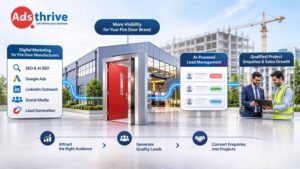
The strategy should connect the company’s product capabilities with the right audiences, search opportunities and enquiry-handling process.
AdsThrive can help build this through a combination of SEO, AI SEO, Google Ads, social media, lead generation and AI automation.
| Business challenge | AdsThrive solution |
| Buyers cannot find relevant product pages | SEO and AI SEO |
| Product categories lack search visibility | Product-focused SEO strategy |
| Need immediate reach for high-intent searches | Google Ads and PPC |
| Architects and contractors are unfamiliar with the company | Social media and LinkedIn-focused outreach |
| Website visitors are not submitting enquiries | Conversion-focused landing pages |
| Enquiries arrive without sufficient details | AI Lead Qualification |
| Website visitors need initial assistance | AI Chatbot Agent |
| WhatsApp conversations need structured handling | WhatsApp AI Agent |
| Leads need timely follow-up | AI Calling and AI Follow-Ups |
| Sales teams need organised lead information | CRM and workflow automation |
Why a customised approach matters
A manufacturer specialising in steel fire-rated doors may have a different target market from a company focused on wooden doorsets or fire-rated shutters.
One business may primarily work with contractors and developers. Another may receive enquiries from distributors, institutional buyers or project consultants.
The marketing strategy should reflect those differences.
For example, a manufacturer targeting large commercial projects may need:
- Product and application-specific SEO pages.
- Google Ads targeting relevant supplier searches.
- LinkedIn outreach to project and procurement professionals.
- Project enquiry forms with quantity and location fields.
- AI qualification for incoming requirements.
- Follow-up workflows connected to the sales team.
A distributor-focused business may need a different campaign and enquiry process.
AdsThrive can customize the combination of services according to the manufacturer’s product range, target market, sales process and existing technology.
Explore AdsThrive to understand how its digital marketing and AI automation services can support business growth.
What Should a Fire Door Manufacturer Prepare Before Hiring a Digital Marketing Agency?
Before starting a marketing engagement, a manufacturer should organise the information that will help the agency build a relevant strategy.
A useful starting checklist includes:
- Complete product catalogue.
- Available product categories and configurations.
- Applicable standards and certification details.
- Testing documentation that can be shared.
- Manufacturing facility photographs.
- Product images and technical drawings.
- Target industries and project categories.
- Preferred geographic markets.
- Existing customer segments.
- Sales contact details and response process.
- Existing website and advertising performance data.
The agency should also understand which products the company wants to prioritise.
For example, if the manufacturer wants to generate enquiries for a particular category, the marketing plan should allocate suitable landing pages, keyword targets and campaign budgets to that priority.
A strategy built without understanding the actual product range can attract enquiries that the manufacturer cannot fulfil.
This is why selecting a digital marketing agency for fire door manufacturers should involve more than comparing service lists or monthly packages. The agency should understand how the company sells, what buyers evaluate and what makes an enquiry commercially relevant.
For acoustic panel manufacturers looking to attract more B2B customers, improve online visibility, and generate quality leads, explore this guide on Digital Marketing for Acoustic Panel Manufacturers.
Frequently Asked Questions
1. How can fire door manufacturers generate more project enquiries?
Manufacturers can improve project enquiries by building product-specific website pages, publishing accurate technical information, targeting commercial search terms, running Google Ads, reaching architects and contractors through LinkedIn and simplifying project enquiry forms. AI qualification and follow-up can help organise incoming opportunities.
2. Why is SEO important for fire door manufacturers?
SEO helps manufacturers appear when architects, contractors, developers, consultants and procurement teams search for relevant products or suppliers. It can also help potential buyers find product configurations, technical information and company capabilities before contacting the sales team.
3. What keywords should fire door manufacturers target?
Useful keyword groups include fire door manufacturer, fire-rated door supplier, steel fire door manufacturer, wooden fire door manufacturer, fire-rated sliding door supplier and bulk fire door supplier. The final keyword list should reflect actual products, target locations and search demand.
4. Can Google Ads generate enquiries for fire-rated doors?
Yes. Google Ads can target buyers searching for manufacturers, suppliers and specific product categories. Campaigns should use relevant landing pages, appropriate location targeting, negative keywords and conversion tracking to improve enquiry relevance.
5. How can LinkedIn help fire door manufacturers?
LinkedIn can help manufacturers connect with architects, consultants, contractors, developers and procurement professionals. Sharing relevant product information, manufacturing capabilities and technical resources can support brand visibility and create opportunities for targeted business conversations.
6. Can AI help qualify fire door enquiries?
Yes. AI can collect initial details such as product category, project type, quantity, location and timeline. It can organise enquiries for the sales team and support follow-up. Technical suitability and compliance decisions should remain with qualified professionals.
7. What should a fire door manufacturer’s website include?
A useful website should include product categories, available configurations, relevant technical information, applicable documentation, manufacturing capabilities, project references where available and clear contact options. It should also provide a straightforward way to request a quotation or submit project details.
8. How do I choose a digital marketing agency for fire door manufacturers?
Look for an agency that can connect SEO, paid advertising, social media, lead generation and enquiry management with your actual product range and sales process. Ask how it will measure qualified project enquiries, not just traffic, clicks or form submissions.
Turn Your Manufacturing Capabilities into More Project Opportunities
A manufacturer can have the right products, manufacturing infrastructure and technical knowledge but still miss potential projects when buyers cannot find or evaluate the company online.
The opportunity is to make those capabilities visible at the right stage of the buying process.
A well-planned approach to SEO for fire door manufacturers can improve search visibility. Google Ads can capture active supplier demand. LinkedIn and social media can help build relationships with project stakeholders. AI-powered enquiry management can collect project details, organise leads and support timely follow-up.
The value comes from connecting these activities rather than treating them as separate marketing tasks.
If your business wants to improve product visibility, attract more relevant project enquiries and build a better process for handling incoming leads, AdsThrive can help create a customized digital marketing and automation strategy.
Discuss your business requirements with AdsThrive: Contact the AdsThrive team.