A water filtration company may manufacture reliable systems, use quality filter media and supply equipment for demanding applications, yet still struggle to attract the right enquiries. The reason is often not the product itself. It is how the company presents its capabilities to different buyers. A commercial building contractor, a food processing plant, a hospital, a municipal project consultant and an industrial procurement manager may all need water filtration, but they search for different solutions and evaluate suppliers differently.
Water filtration companies can grow through digital marketing by making their product capabilities easier to discover, demonstrating where their systems fit, and giving prospective buyers enough technical and commercial information to enquire. SEO, Google Ads, application-focused website content, LinkedIn outreach and automated lead follow-up can work together to generate more relevant business opportunities.
For manufacturers and suppliers, the challenge is to move beyond a website that simply lists filter models. The company needs a digital presence that helps a buyer identify the right solution, understand its suitability and contact the sales team with a meaningful requirement.
This article explains how to approach that commercially, with practical ways to improve visibility, attract enquiries and convert more of the interest generated online.
Why do water filtration companies struggle to generate consistent enquiries?
Water filtration is not one uniform market. A company may supply industrial filtration units, cartridge filters, pressure sand filters, activated carbon filters, bag filters, multimedia filters, commercial purification systems or filtration media. Each product can serve several applications, and each application may involve a different buyer.
A facility manager may be looking for a replacement filter. A project consultant may need technical specifications for a new installation. A plant engineer may be comparing filtration technologies to solve a process-water issue. A distributor may be searching for a manufacturer with a particular product range.
If the website presents all these products under a single broad heading such as Water Filtration Systems, it leaves visitors to work out which solution is relevant to them.
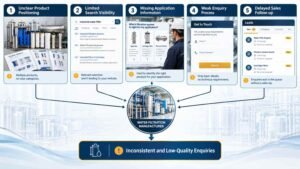
There are several commercial consequences:
- Product visibility is too broad: Buyers searching for a particular filter type may not find a dedicated page that answers their query.
- Applications are not explained: Visitors cannot easily understand whether the equipment is suitable for their industry or operating conditions.
- Technical information is difficult to access: Buyers may need to contact the company just to obtain basic specifications, dimensions or operating details.
- Enquiry forms collect too little information: Sales teams receive messages such as “Need water filter” without capacity, application, location or project details.
- Follow-up is inconsistent: An enquiry may arrive outside office hours or remain unanswered while the prospect contacts another supplier.
A useful digital marketing programme addresses these problems together. It does not treat website traffic as the final objective. The objective is to help a potential buyer move from identifying a filtration requirement to discussing a suitable product with the manufacturer.
Growth starts with how the company is positioned in the market
Before investing in campaigns, water filtration companies should examine how their business is described online.
A manufacturer that sells several filtration technologies should not rely on one generic message. The website and marketing campaigns should communicate the actual product range, the applications served and the company’s ability to supply the required equipment.
Consider three companies:
| Company positioning | What a buyer understands | Commercial limitation |
| Water filtration products supplier | The company sells filtration products | The buyer cannot identify its specialisation |
| Industrial filtration equipment manufacturer | The company serves industrial requirements | The specific equipment and applications remain unclear |
| Manufacturer of industrial sand, carbon and cartridge filtration systems | The product categories and market focus are clearer | Dedicated application information is still needed |
The third description gives a buyer a more useful starting point. It tells the visitor what the company supplies rather than relying on a broad industry label.
This does not mean every company should use the same positioning. A business focused on commercial buildings should not present itself as an industrial filtration specialist unless it genuinely serves that market. The website should reflect the company’s actual products, operating capabilities and target customers.
For businesses that need to improve organic visibility around their services and product categories, Adsthrive’s SEO services can support a more structured approach to search visibility.
Six commercial growth opportunities water filtration companies should develop
Rather than publishing generic posts about water purification, companies should build marketing around the situations that create a real requirement for filtration equipment.
1. New projects that require filtration from the beginning
A new manufacturing facility, commercial building, hospital, hotel, food processing unit or institutional project may require water filtration as part of its utility infrastructure.
These projects can create opportunities for equipment manufacturers before the installation stage. However, the company must be visible when consultants, contractors, engineers and project teams research suitable systems.
Create website pages that explain the filtration products available for new installations. Include relevant capacity ranges, product configurations, system photographs and the information a technical buyer needs before requesting a quotation.
Useful content may include:
- Filtration equipment for new industrial facilities.
- Commercial water filtration systems for large buildings.
- Industrial pressure sand and activated carbon filtration.
- Filtration equipment for process-water applications.
- Product selection considerations for new installations.
The purpose is not to claim that one system suits every project. It is to help visitors understand the company’s offering and identify whether they should contact the technical or sales team.
2. Existing plants that need replacement equipment
Not every filtration enquiry comes from a new project. Existing facilities may need replacement vessels, filter media, cartridges, complete filtration units, valves or related components.
Replacement requirements can be commercially valuable because the buyer may already understand the operating problem and have a defined requirement.
Build pages around the products and components that the company can genuinely supply for replacement or maintenance. Explain the information needed to identify a compatible product, such as equipment model, dimensions, connection type, operating pressure or existing system details.
A useful call to action could be:
Need a replacement filtration unit or component? Share your existing equipment details with our team for product assistance.
This gives the visitor a clear reason to enquire and helps the sales team collect information that can move the conversation forward.
3. Industries with specialised filtration requirements
A food processing plant, pharmaceutical facility, textile unit and commercial building do not necessarily have the same filtration objectives.
The water source, suspended solids, process requirements, operating conditions and downstream use can differ. A filtration manufacturer should therefore explain its products in the context of the industries it serves.
Create application pages only for industries where the company has relevant products or experience. For example:
| Application market | Potential filtration requirement | Useful website information |
| Food and beverage | Process-water filtration and pre-treatment | Product suitability, operating conditions and relevant applications |
| Pharmaceuticals | Filtration for specific process and utility requirements | Applicable product specifications and quality documentation |
| Textile manufacturing | Filtration for process and utility water | Equipment configurations and application details |
| Hotels and commercial buildings | Building water filtration | Capacity, installation context and maintenance considerations |
| Manufacturing facilities | Utility and process-water filtration | Filter type, flow requirements and equipment options |
These pages can attract searches that a generic product page may not address. They also help a buyer understand whether the manufacturer works with the type of application they have.
For companies expanding into AI-led discovery as well as conventional search, Adsthrive’s AI SEO services can complement the work of building useful, clearly structured website content.
4. Buyers comparing filtration technologies
Some prospects know that they need filtration but have not decided which technology or product configuration is appropriate.
They may compare sand filtration, activated carbon filtration, cartridge filtration, bag filtration or multimedia filtration. Their research can include questions about operating conditions, filtration stages, maintenance and the role of pre-treatment.
This is an opportunity to publish comparison content that helps buyers understand the differences without making unsupported claims.
A comparison page should explain:
- What each filtration method is designed to do.
- The type of application in which it may be considered.
- Important operating parameters.
- Maintenance and consumable requirements.
- When a technical assessment is necessary.
Do not state that one filter type is universally better than another. Suitability depends on the water characteristics, required output, system design and operating conditions.
For example, the NSF overview of water filtration testing and certification explains how filtration systems and components may be evaluated against relevant safety and performance requirements. Manufacturers can use this kind of authoritative technical reference when deciding how to present applicable product testing or certification information. Any certification claim on a company’s own website must match the actual product, scope and current certification status.
5. Distributors and channel partners looking for manufacturers
Water filtration companies that sell through distributors, dealers, system integrators or project contractors should not focus only on end-user enquiries.
A distributor may be searching for a manufacturer with a particular product range, supply capability, technical documentation or private-label arrangement. A system integrator may need a supplier who can support a project with the required equipment.
Create a dedicated business enquiry route for channel partners. It can explain:
- Product categories available for distribution.
- Markets or regions the company serves.
- Dealer or distributor enquiry process.
- Technical documentation available.
- How to discuss commercial terms and supply requirements.
A distributor enquiry should not be mixed with a residential product enquiry or a maintenance request. The sales team needs to identify the type of business opportunity before assigning it.
6. Service, maintenance and recurring product demand
Filtration equipment can create opportunities beyond the initial sale. Depending on the product and business model, customers may require replacement cartridges, filter media, consumables, maintenance support or additional equipment.
A website that focuses only on complete systems can miss these searches.
Build relevant pages for replacement products, consumables and service offerings if the company supplies them. Explain how customers can identify the correct replacement item and what details they should share.
For example, a replacement enquiry form can request:
- Existing equipment or filter model.
- Required product or component.
- Dimensions or technical specifications, where relevant.
- Quantity.
- Delivery location.
- Photograph or datasheet of the existing product.
This makes it easier for existing customers and new prospects to approach the company with a specific requirement.
Your website should help buyers identify the right product without calling first
For many manufacturers, the website is still organised around the company’s internal product catalogue. A visitor may see product names, but not enough information to determine which page is relevant to their requirement.
A more commercially useful structure connects product categories with applications and enquiry routes.
For example:
| Website page | Information to include | Desired visitor action |
| Industrial filtration systems | Product range, system types and industrial applications | Request a technical discussion |
| Pressure sand filters | Available configurations, specifications and applications | Enquire about a suitable model |
| Activated carbon filters | Product details, application context and operating considerations | Request product information |
| Cartridge filtration systems | Filter type, dimensions, compatibility and options | Submit a product enquiry |
| Bag filter housings | Housing details, configurations and relevant applications | Request a quotation |
| Replacement filter products | Compatibility information and identification requirements | Share existing equipment details |
Each page should have a clear purpose. Avoid creating several near-identical pages that change only the location or product name. Such pages provide little additional value to buyers and can make the website difficult to maintain.
What should a product page contain?
A useful product page should answer the questions a buyer is likely to ask before contacting the manufacturer.
Include:
- Product name and a clear explanation of its function.
- Available models or configurations.
- Technical specifications that the company can verify.
- Suitable applications and any relevant limitations.
- Product photographs, drawings or diagrams.
- Installation or operating information where available.
- Relevant testing, certification or compliance details, if applicable.
- A direct enquiry option.
The World Health Organization’s Guidelines for Drinking-water Quality provide an authoritative reference for understanding drinking-water quality and related health considerations. Manufacturers serving drinking-water applications should ensure that any quality or contaminant-reduction claims are technically accurate and supported by suitable evidence. A product page should never imply that a filtration system meets a particular requirement unless the company can substantiate that claim.
A clear product page can also reduce repetitive sales conversations. Buyers can review basic information before contacting the team, allowing the first discussion to focus on their actual requirement.
SEO for water filtration companies: capture searches with commercial intent
SEO for water filtration companies should focus on the products, applications and supplier requirements that can lead to business enquiries.
A manufacturer should not expect one homepage to rank for every product category. Search visibility is more effective when relevant product and application pages address distinct search needs.
For example, a company supplying industrial filtration equipment may want to appear for searches related to pressure sand filters, activated carbon filters, cartridge filter housings, industrial water filtration systems and filtration equipment manufacturers.
The exact keyword targets should depend on the company’s products, geography, competition and search data. Do not assume every phrase has the same search volume or commercial value.
Keyword opportunities that filtration companies may be missing
The following table illustrates the types of searches a manufacturer can target. These are keyword opportunities, not verified daily search-volume figures.
| Search category | Example search | Likely intent | Suitable landing page |
| Product-specific | Industrial cartridge filter manufacturer | Commercial | Cartridge filtration product page |
| Equipment-specific | Pressure sand filter supplier | High commercial | Pressure sand filter page |
| Application-based | Water filtration for food processing | Problem + commercial | Food processing application page |
| Supplier-focused | Industrial water filtration equipment manufacturers | Commercial | Manufacturer or product category page |
| Replacement-focused | Industrial filter cartridge replacement | High commercial | Replacement products page |
| Technology comparison | Activated carbon filter vs sand filter | Research + commercial | Technical comparison article |
| Channel partner | Water filter equipment distributor opportunity | Partnership | Distributor enquiry page |
A practical keyword plan should separate three types of search intent:
- Agency intent: Businesses looking for an SEO or digital marketing partner.
- Product intent: Buyers looking for a filtration product, manufacturer or supplier.
- Problem-led intent: Businesses researching a water-quality or filtration requirement before selecting equipment.
The primary keyword, SEO for water filtration companies, should be used naturally in the article and in relevant on-page elements. The secondary terms—SEO services for water filtration companies, Digital marketing for water filtration companies, Lead generation for water filtration companies and Digital marketing agency for water filtration companies—should appear where they genuinely fit the discussion.
Companies that need to attract both product buyers and businesses looking for marketing support should keep these two audiences separate in their website architecture. A page targeting manufacturers looking for an agency should not compete with a product page targeting a buyer looking for filtration equipment.
Paid advertising can capture buyers who are ready to contact a supplier
SEO helps build organic visibility over time. Google Ads can provide an additional route to buyers who are actively searching for a product or supplier.
For a water filtration manufacturer, paid campaigns should be organised around commercially meaningful product groups rather than one broad campaign targeting every water-related search.
A company could separate campaigns for:
- Industrial filtration equipment.
- Pressure sand filters.
- Activated carbon filtration systems.
- Cartridge and bag filtration products.
- Commercial water filtration equipment.
- Replacement filters and components.
Each campaign should lead to a relevant landing page. Sending every advertisement to the homepage creates unnecessary work for the visitor and makes it harder to measure which product category is attracting enquiries.
What should a filtration company’s Google Ads campaign avoid?
Broad searches can attract people looking for household water purifiers, DIY filter replacements, water filter servicing or general information. These may be irrelevant to a manufacturer selling industrial equipment.
Use negative keywords where appropriate, review actual search terms and separate residential traffic from industrial or commercial campaigns.
Ad copy should communicate what the company supplies and who it serves. For example:
Industrial Filtration Equipment Manufacturer
Explore industrial filtration systems, product specifications and application options. Contact our team for product details and commercial enquiries.
The landing page should support the promise made in the advertisement. It should show the relevant product, explain its application and provide a straightforward enquiry route.
Campaigns also need conversion tracking. Measure form submissions, calls and qualified enquiries rather than treating every click as a successful outcome. For further guidance on campaign structure and performance, manufacturers can refer to Google Ads optimisation techniques.
LinkedIn and social media should demonstrate product capability
A water filtration manufacturer does not need to publish generic motivational posts every week. Social media should help buyers, consultants, distributors and industry professionals understand the company’s products and expertise.
LinkedIn is particularly useful for reaching professional audiences involved in industrial projects, engineering, procurement, facility management and distribution.
What should water filtration companies publish?
A practical content plan can include:
| Content type | Example | Commercial purpose |
| Product demonstration | A close-up video of a filtration unit and its components | Help buyers understand the product |
| Application post | Filtration equipment used in a relevant industrial setting | Connect products with actual markets |
| Technical explainer | Differences between cartridge and bag filtration | Support product evaluation |
| Manufacturing update | Assembly, inspection or testing process | Demonstrate manufacturing capability |
| Product documentation | Specification sheet or configuration overview | Help technical buyers evaluate suitability |
| Project or installation example | A verified installation and its application | Provide evidence of experience |
| Distributor communication | Product range and channel partnership information | Attract potential business partners |
The company can also use LinkedIn outreach to connect with relevant professionals. Rather than sending the same sales message to hundreds of people, identify the roles and organisations that match the company’s actual market.
Potential audiences may include:
- Plant and facility managers.
- Water treatment consultants.
- Procurement managers.
- Project contractors.
- Industrial engineers.
- System integrators.
- Equipment distributors.
A useful outreach message should introduce the company’s relevant product category and ask whether the recipient handles projects where that equipment may be required. It should not assume that every person contacted has an immediate purchase requirement.
Social media can also support paid lead-generation campaigns. A product video, technical guide or application-focused post can be promoted to a relevant professional audience. The objective should be to attract people with a genuine business interest, not simply maximise impressions.
For manufacturers already investing in industrial visibility, Adsthrive’s industrial machinery digital marketing guide provides related context on reaching industrial buyers through digital channels.
Lead generation should collect the information sales teams actually need
A high number of enquiries does not automatically mean a high number of sales opportunities.
A filtration manufacturer may receive enquiries from residential customers, students, maintenance technicians, distributors, consultants and industrial buyers. These enquiries have different commercial value and should not all enter the same sales process.
Lead generation for water filtration companies should therefore focus on attracting relevant prospects and collecting enough information to understand their requirements.
Improve the enquiry form
A form that asks only for a name, phone number and message may generate submissions, but it often leaves the sales team with little context.
A more useful form can include:
| Field | Why it matters |
| Name and company | Identifies the person and organisation |
| Business email and phone | Provides contact information |
| Industry or application | Helps identify the market |
| Product required | Identifies the filtration category |
| Capacity or flow requirement | Provides an initial technical reference, where applicable |
| Project location | Helps determine service or delivery relevance |
| Requirement type | Separates new projects, replacement and general enquiries |
| Additional details or file upload | Allows the buyer to share specifications or photographs |
Do not make every field mandatory. A long form can discourage genuine prospects, especially when they are still evaluating suppliers. Ask for essential details first and collect further technical information during the follow-up.
Create different enquiry routes for different buyers
A distributor looking for a product catalogue should not have to complete the same form as an industrial customer requesting a quotation.
Consider separate calls to action:
- Request a product quotation.
- Discuss an industrial application.
- Enquire about replacement filters.
- Become a distributor.
- Request technical information.
This gives visitors a more relevant route and helps the company assign enquiries to the appropriate team.
Companies seeking a more structured acquisition approach can explore Adsthrive’s lead generation services, which can be aligned with the business’s target market and enquiry requirements.
AI lead qualification can help sales teams respond with better context
A website enquiry may arrive at any time. If the sales team has to manually review every message, identify its product category, find the right representative and initiate follow-up, some opportunities may remain unattended.
AI-assisted lead qualification can help organise this process.
For a water filtration business, an automated system can classify incoming enquiries based on information such as:
- Product category requested.
- Industrial or commercial application.
- New installation or replacement requirement.
- Project location.
- Capacity or technical details supplied.
- Whether a quotation or product discussion is requested.
The system can then route the enquiry to the relevant sales representative or request missing information.
For example, an enquiry for a pressure sand filter for a manufacturing facility can be categorised separately from a residential cartridge replacement request. The sales team can prioritise the industrial requirement and ask the buyer for the technical details needed to proceed.
How connected automation can support the enquiry process
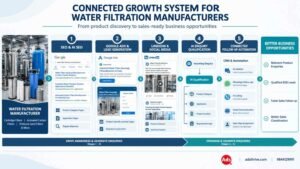
A customised automation workflow can connect several activities:
- A visitor submits an enquiry through the website.
- The system records the enquiry and identifies its product category.
- AI-assisted qualification checks the information provided.
- The prospect receives an acknowledgement or a request for missing details.
- The appropriate sales representative is notified.
- A follow-up task is created.
- Relevant communication and status updates are recorded in the CRM.
An AI chatbot agent can help answer initial product and service questions, collect basic requirement details and direct visitors to the appropriate enquiry route.
For prospects who request a callback or need further discussion, AI calling solutions can support automated calling and follow-up workflows. WhatsApp and email automation can also help maintain communication, while CRM updates keep the sales team informed.
The important point is that automation should follow the company’s actual sales process. A manufacturer with a small sales team may need a simple enquiry-routing workflow. A larger supplier handling several product categories may need separate qualification rules and follow-up sequences.
Adsthrive’s approach is to build customised, connected AI automation around business requirements rather than forcing companies to manage unrelated tools for chat, WhatsApp, calling, booking and CRM updates.
What should water filtration companies measure to understand commercial growth?
Website traffic is useful, but it does not tell a manufacturer whether marketing is attracting the right buyers.
A campaign may generate many visits and form submissions while producing very few relevant opportunities. Another campaign may attract fewer visitors but generate enquiries from distributors, contractors or industrial customers with a defined requirement.
Measurement should connect marketing activity with sales progress.
| Metric | What it tells the company | Why it matters |
| Organic product-page traffic | Whether relevant product pages are attracting search visitors | Shows which categories are gaining visibility |
| Product enquiry submissions | Whether visitors are taking action | Measures enquiry activity |
| Qualified enquiries | Whether enquiries match the target market | Shows lead relevance |
| Cost per qualified lead | How much is spent to acquire a relevant opportunity | Helps compare campaign efficiency |
| Quotation requests | Whether enquiries are progressing commercially | Connects marketing with sales activity |
| Lead-to-quotation rate | How many qualified enquiries reach the quotation stage | Identifies gaps in lead quality or sales handling |
| Sales conversion | How many opportunities become customers | Connects marketing with revenue outcomes |
| Response time | How quickly the team responds to new enquiries | Helps identify delays in follow-up |
Review performance by product category
Do not combine every product inquiry into one report. A campaign for industrial cartridge filters may perform differently from a campaign for pressure sand filters or activated carbon systems.
Review the performance of each category separately:
- Which product pages attract relevant visitors?
- Which campaigns generate enquiries from the intended market?
- Which products receive the most quotation requests?
- Which enquiry sources produce the strongest sales opportunities?
- Which enquiries repeatedly fail qualification?
- Where are prospects dropping out of the sales process?
This information can guide budget allocation, content improvements and sales follow-up.
For example, if a product page receives organic traffic but few enquiries, the company may need clearer specifications, stronger product photographs or a more visible call to action. If Google Ads generates many enquiries but few quotations, the targeting or landing-page message may be attracting the wrong audience.
Marketing reports should be reviewed alongside CRM data. Without that connection, the company may optimize for form submissions while overlooking whether those submissions become real opportunities.
How Adsthrive supports water filtration companies looking for business growth
Water filtration companies often need several marketing activities to work together. Search visibility can bring a potential buyer to the website, paid campaigns can capture active demand, LinkedIn can build industry reach, and lead-generation campaigns can encourage prospects to make contact. AI automation can then help organise enquiries and maintain follow-up.
Adsthrive supports businesses through a combination of digital marketing and customized automation services.
SEO and AI SEO for product and application visibility
Adsthrive can help structure a website around the company’s actual filtration products, applications and commercial search opportunities. This includes improving product-category pages, developing relevant application content, strengthening internal linking and targeting search terms that match the business’s market.
The objective is to help the company appear when potential buyers search for filtration products, manufacturers and application-specific solutions.
Google Ads for active product demand
Paid search campaigns can target buyers looking for specific filtration equipment or suppliers. Campaigns can be organised around product categories and connected to relevant landing pages, with conversion tracking to evaluate enquiry quality.
Lead generation across relevant business audiences
Adsthrive can help manufacturers reach potential customers through search, paid campaigns, LinkedIn and other suitable channels. Campaigns can be planned around the company’s target industries, product range and geographic markets.
AI chatbot, WhatsApp and calling automation
Incoming enquiries can be handled through connected workflows that collect basic information, respond to initial questions and support timely follow-up. AI calling and WhatsApp automation can help reduce manual communication work, while CRM updates give sales teams better visibility into enquiry status.
One connected setup based on the manufacturer’s workflow
A company should not have to manage separate disconnected tools for every stage of enquiry handling. Adsthrive can customize an integrated setup based on the business’s requirements, team size, products and existing systems.
For one manufacturer, the priority may be improving Google visibility and generating product enquiries. Another may already receive enquiries but need better qualification, faster callbacks and CRM coordination.
The right combination depends on the company’s actual bottleneck. Businesses can discuss their requirements directly through Adsthrive’s contact details.
Frequently asked questions
1. How can water filtration companies get more customers online?
Water filtration companies can attract more customers by improving product-specific SEO, creating application pages, running targeted Google Ads, publishing technical content and reaching relevant buyers through LinkedIn. Clear enquiry forms and timely follow-up help turn website interest into business discussions.
2. Why is SEO important for water filtration companies?
SEO helps manufacturers appear when buyers search for filtration equipment, filter types, suppliers and application-specific solutions. A well-organised website can attract relevant visitors to product pages and help potential customers understand the company’s offerings before making an inquiry.
3. What should a water filtration manufacturer’s website include?
A manufacturer’s website should include product categories, technical specifications, applications, product photographs, relevant documentation, company capabilities and clear enquiry options. Separate pages for major products and target industries make it easier for buyers to find relevant information.
4. Are Google Ads useful for industrial water filtration businesses?
Yes. Google Ads can help manufacturers reach people actively searching for industrial filtration products and suppliers. Campaigns should use relevant keywords, negative keywords, product-specific landing pages and conversion tracking to reduce irrelevant enquiries and evaluate performance.
5. How can water filtration companies generate B2B leads?
Companies can generate B2B leads through product-focused SEO, Google Ads, LinkedIn outreach, industry-specific content, distributor campaigns and targeted enquiry forms. The best approach depends on the products supplied and the industries the company serves.
6. Can AI automation help manage filtration equipment enquiries?
Yes. AI automation can categorise enquiries, collect missing information, send acknowledgements, notify sales representatives, support WhatsApp or calling follow-ups and update CRM records. The workflow should be customized to the company’s product categories and sales process.
7. How long does SEO take to generate enquiries for water filtration companies?
SEO does not have a fixed timeline. Results depend on the website’s current condition, competition, target keywords, content quality, technical performance and the company’s market. Manufacturers should monitor improvements in relevant rankings, product-page traffic and qualified enquiries rather than relying only on traffic growth.
8. What is the difference between SEO and lead generation for water filtration companies?
SEO improves a company’s visibility in organic search results and helps attract relevant visitors. Lead generation focuses on turning potential customers into identifiable business enquiries through landing pages, forms, paid campaigns, outreach and follow-up. SEO can contribute to lead generation, but both need to be measured.
Final takeaway
Water filtration companies do not need to promote every product through the same message or depend on one marketing channel. A manufacturer can create stronger commercial visibility by explaining its product range clearly, connecting equipment with relevant applications, publishing useful technical information and making it easy for buyers to enquire.
SEO for water filtration companies should attract the right searches, while Google Ads and LinkedIn can help reach active buyers and relevant business audiences. Lead-generation campaigns should collect useful project information, and AI automation can help sales teams organise and follow up on incoming opportunities.
When these activities are planned around the company’s actual products and customers, digital marketing becomes more than a way to increase website traffic. It becomes a practical route to better enquiries, stronger sales conversations and business growth.